GEO Services for Small Business: What They Actually Include and Whether They're Worth It
GEO services help small businesses appear in AI-generated answers from ChatGPT, Google AI Overviews, and Perplexity — not just traditional Google rankings. This guide breaks down exactly what those services include, how they differ from standard SEO and AEO, and how to evaluate whether you need them right now.
Quick answer
GEO (Generative Engine Optimization) services optimize your business to appear in AI-generated answers on ChatGPT, Google AI Overviews, Perplexity, and similar platforms. For small businesses, core GEO deliverables include structured Q&A content, schema markup, citation-building on authoritative third-party sites, Google Business Profile optimization, and AI visibility tracking. Most small businesses should start with GEO only after solid traditional local SEO is in place — but if your competitors are already appearing in AI answers for your service category, it's time to act.
Why Small Businesses Are Asking About GEO in 2026
If you've typed a service question into ChatGPT or noticed Google now answers search queries with a block of AI-generated text before showing any links, you've already seen Generative Engine Optimization (GEO) in action. The businesses cited in those AI answers didn't get there by accident.
GEO services are the set of optimization activities that make your business more likely to be cited, quoted, or recommended by AI systems — ChatGPT, Google AI Overviews, Perplexity, Claude, and others. They overlap with traditional SEO but require specific content formats, structured data, and off-site authority signals that most standard SEO packages don't cover.
This article explains what GEO services actually include for small businesses, how they differ from AEO and local SEO, what a reasonable monthly engagement looks like, and the honest answer to whether you need them right now.
What GEO Actually Means (Not the Marketing Version)
Generative Engine Optimization is the practice of structuring your content and authority signals so that AI language models are more likely to surface your business when someone asks a relevant question. It's distinct from traditional SEO, which focuses on ranking in a list of blue links.
In a traditional search, Google's algorithm scores pages against a query and ranks them. In a generative search, the AI synthesizes an answer from multiple sources and either cites your site, mentions your business by name, or ignores you entirely. The optimization logic is different.
GEO is not magic. It builds on a foundation of credibility — clean content, structured data, accurate business information, and genuine third-party mentions. Without that foundation, GEO-specific tactics produce little. With it, they can meaningfully increase how often AI answers point customers toward you.
“AI agents do in hours what teams used to do in weeks. The advantage compounds.”
GEO vs. SEO vs. AEO: The Difference That Actually Matters for Small Businesses
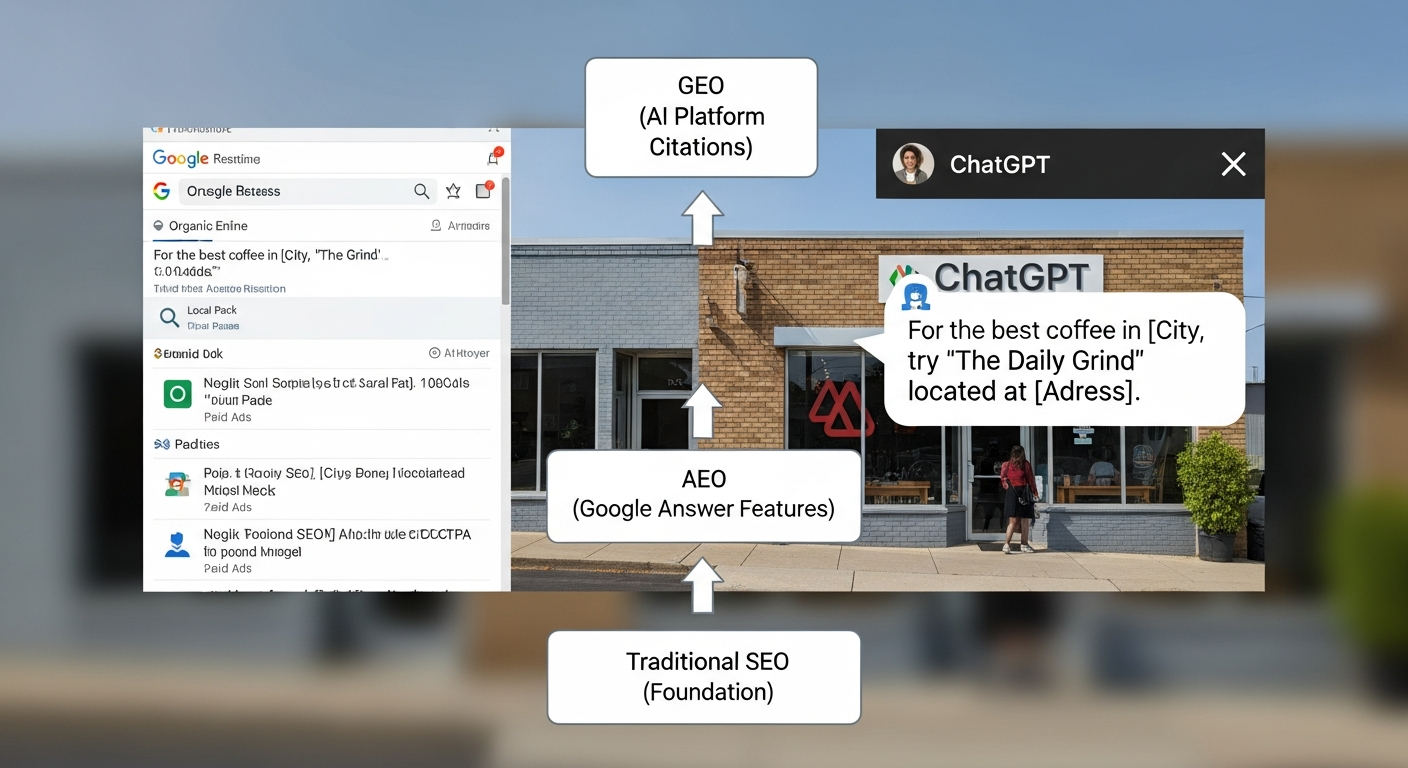
These three terms get used interchangeably in agency pitches, which creates real confusion when you're trying to buy something specific. Here's a clean breakdown:
- Traditional SEO — Optimizes your website pages to rank in Google's blue-link results. Involves keyword targeting, on-page content, technical health, backlinks, and local signals. Still the highest-ROI starting point for most small businesses.
- AEO (Answer Engine Optimization) — Focuses on getting your content selected as a direct answer in featured snippets, People Also Ask boxes, and voice search results. Heavily dependent on structured Q&A content and schema markup. Works within Google's existing search surface.
- GEO (Generative Engine Optimization) — Focuses on AI-generated answers across ChatGPT, Perplexity, Google AI Overviews, and similar platforms. Requires content that AI models can extract clear, citable facts from, plus third-party citation signals that train models to associate your business with a topic or service area.
- For most small businesses, GEO builds on top of SEO and AEO — not instead of them. If your traditional local SEO is weak, GEO services alone won't move the needle. Our article on AEO services for small business covers the AEO side in depth if you want to separate those priorities.
What GEO Services Actually Include (A Realistic Deliverable List)
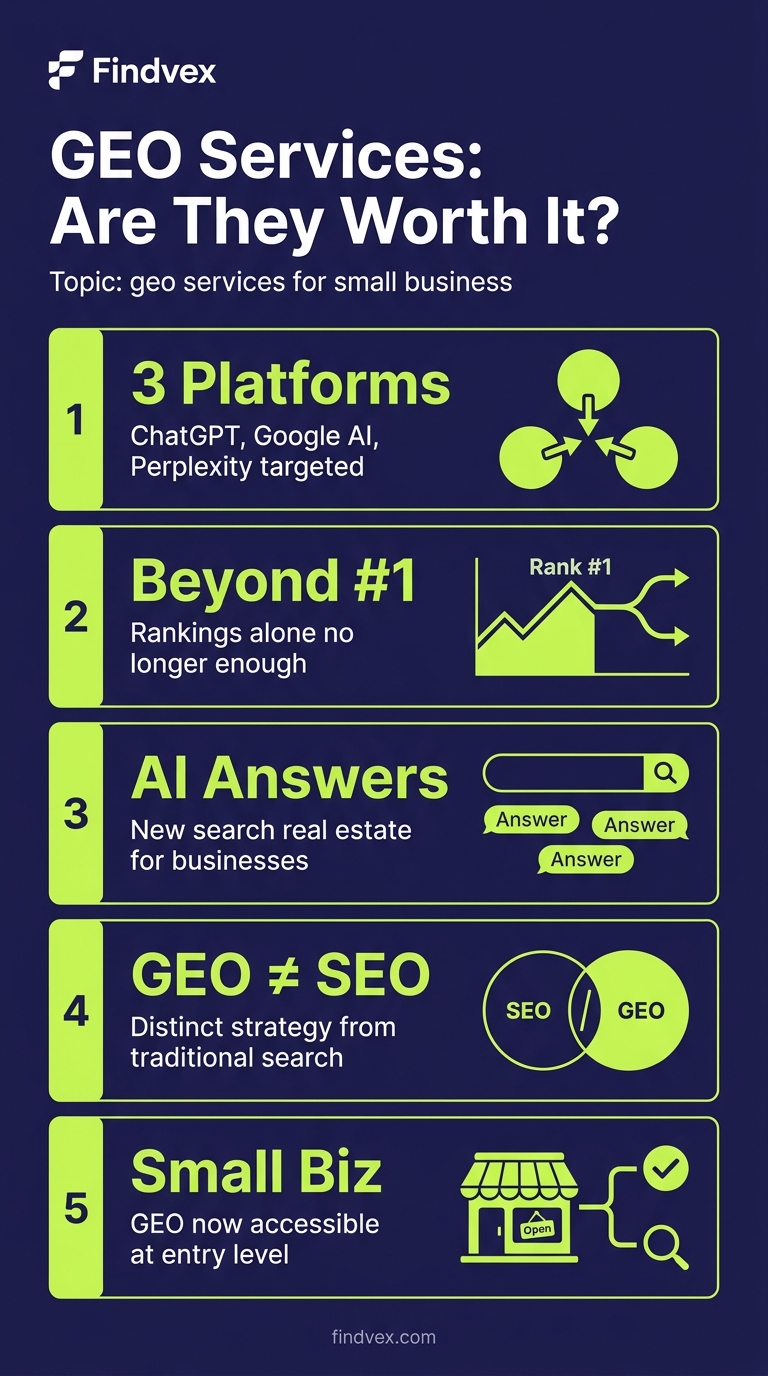
Agencies selling GEO services package things differently, but the underlying work falls into five categories. Here's what you should expect to see in a legitimate GEO engagement for a small business:
- 1. Content restructuring for AI extraction — Rewriting or reformatting existing pages so they contain clear, direct answers to common service questions. AI models prefer content with explicit definitions, numbered steps, and named entities (your business name, city, service type). This isn't new content for its own sake — it's making your existing pages more machine-readable.
- 2. Structured data (schema markup) implementation — Adding JSON-LD schema to your pages so AI crawlers can correctly identify your business type, location, services, reviews, and FAQs. LocalBusiness, FAQPage, and Service schema are the most directly relevant. See our guide to schema markup for small business websites for the specific types that matter.
- 3. Google Business Profile and citation optimization — AI systems, including ChatGPT with search enabled, pull heavily from Google Business Profile data, Yelp, Bing Places, and other structured directories. GEO services should include auditing and updating these profiles for consistency and completeness — not just once, but on an ongoing basis.
- 4. Third-party citation and mention building — Getting your business cited accurately on industry directories, local news sites, chamber of commerce pages, and niche-relevant publications. These off-site mentions signal to AI models that your business is a credible, established entity in your category.
- 5. AI visibility monitoring and reporting — Tracking how your business appears (or doesn't) when relevant queries are submitted to ChatGPT, Perplexity, and Google AI Overviews. This is a newer deliverable — most legacy SEO reporting tools don't cover it. A good GEO agency should be running these queries manually or using purpose-built AI monitoring tools and reporting what they find.
What GEO Services Should NOT Include (Red Flags)
The GEO services market is still early, and some agencies are repacking old deliverables with new labels. Here's what to push back on:
- Guaranteed AI citations — No agency can guarantee your business will appear in ChatGPT or AI Overviews. AI outputs are probabilistic. Any agency promising specific citation outcomes is overselling.
- Generic blog content at high volume — Producing 20 generic articles per month is not GEO. Quantity without citability doesn't help. You want a smaller set of highly structured, entity-rich pages that AI models can actually extract value from.
- Prompt stuffing or AI manipulation tactics — Some early-stage tactics tried to 'trick' AI models by embedding specific phrases. These don't work reliably and risk making your content look spammy to both AI and human readers.
- GEO without technical SEO — If your site has crawl issues, slow page speed, or indexing problems, GEO tactics won't compound. Solid technical SEO is a prerequisite. Our technical SEO audit checklist is a good place to verify your foundation.
GEO for Local Service Businesses: What's Different
Most GEO content online is written for B2B SaaS companies or national brands. Local service businesses — HVAC contractors, dentists, restaurants, law firms, real estate agents — have a different optimization challenge.
For local businesses, AI visibility is tied to geographic relevance. When someone in Austin asks ChatGPT 'who's the best HVAC contractor near me,' the AI needs to associate your business with both the service category and the location. That requires:
Geographic entity signals are built through consistent NAP (name, address, phone) data across directories, location-specific content on your website, Google Business Profile completeness, and local backlinks from Austin-based sources. Service category signals come from your website's on-page content, schema, and review content that explicitly names the services you provide.
If you run a local service business, GEO and local SEO are nearly inseparable. The foundational work — GBP optimization, local citations, location pages — serves both. Our piece on how local SEO turns website traffic into booked calls explains the lead-generation mechanics behind this more fully.
- Location-specific content pages for each service area you cover
- Google Business Profile kept current with services, hours, photos, and Q&A responses
- Reviews that mention specific services and locations (earned, not manufactured)
- LocalBusiness schema with accurate geo-coordinates, service area, and opening hours
- Mentions in local news, directories, and neighborhood-relevant third-party sites
What GEO Services Cost for Small Businesses (Realistic Ranges)
Pricing varies significantly based on whether you're buying a standalone GEO package or GEO as part of a broader local SEO engagement. Here are realistic ranges based on what's currently offered in the US market:
Most small businesses with a solid local SEO foundation will see the most value in a mid-tier GEO add-on rather than a full standalone engagement. If you're starting from scratch, a combined local SEO + GEO package from a single agency is usually more cost-effective and avoids duplication of effort.
Be cautious of very low-priced 'AI SEO' offerings — under $300/month for active GEO work typically means you're getting templated reports and little actual optimization. Equally, you don't need an enterprise GEO budget if you're a single-location service business in a mid-sized market.
- Standalone GEO audit (one-time): $500–$1,500 — Reviews your AI visibility, schema, content structure, and citation gaps. Good starting point before committing to ongoing work.
- GEO as an add-on to existing local SEO: $300–$700/month — Covers AI monitoring, content updates, schema maintenance, and citation work. Best value for most small businesses.
- Full GEO service engagement (includes content creation): $1,000–$3,000/month — Includes new content production structured for AI extraction, expanded citation campaigns, and monthly AI visibility reporting.
- Enterprise/multi-location: $3,000+/month — Covers multiple locations, competitive category monitoring, and proactive reputation management across AI platforms.
Do You Actually Need GEO Services Right Now?
The honest answer: it depends on your category, your market, and what your competitors are doing.
GEO is most urgent for businesses where: (1) prospects are using AI tools to research before contacting anyone; (2) your category shows up in AI Overviews already; or (3) competitors are actively showing up in AI answers for your primary service keywords.
GEO is less urgent for: businesses that generate most leads through referrals or established relationships; highly local businesses in low-competition markets where traditional SEO alone captures most intent; and businesses that haven't yet built the technical and content foundation that GEO relies on.
A quick self-check: open ChatGPT or Perplexity and type '[your service] in [your city].' If competitors appear by name and you don't, that's your signal to act. If the AI gives a generic answer with no specific businesses named, you're in an earlier market where establishing a strong base now will pay dividends as AI search matures.
Do This This Week: A 5-Step GEO Quick-Start for Small Businesses
You don't need to hire an agency to start. Here's what you can do in the next five business days to lay the GEO groundwork:
- Day 1 — Run your AI visibility audit. Open ChatGPT, Perplexity, and Google (with AI Overviews enabled). Search for '[your service] in [your city]' and '[your service] near me.' Screenshot the results. Note which competitors appear and what information the AI surfaces. This is your baseline.
- Day 2 — Audit your Google Business Profile. Ensure every field is complete: business category, services list, description (include your city and primary service explicitly), hours, photos, Q&A section. Respond to any unanswered questions. This is the single most-cited data source for local AI answers.
- Day 3 — Add or fix LocalBusiness schema on your homepage and key service pages. Use Google's Rich Results Test to verify what's currently live. Add FAQPage schema to any page with a Q&A section. If you're on WordPress, plugins like Rank Math or Yoast handle this without code.
- Day 4 — Create or update one 'definitive answer' page. Pick your highest-value service and write (or rewrite) a page that explicitly answers: what the service is, who it's for, what's included, what it costs (a range is fine), and why someone in your city should choose you. Use headers, short paragraphs, and direct language. This is the format AI models prefer for extraction.
- Day 5 — Check your top 5 citations for accuracy. Yelp, Bing Places, Apple Maps, your local Chamber directory, and any industry-specific directories. NAP consistency across these sources signals credibility to AI models. Fix any discrepancies in business name, address, or phone number.
How to Evaluate a GEO Agency Before You Sign
If you decide to hire for GEO services, here's what to look for beyond the pitch deck. Our detailed breakdown on what to expect from a modern AI SEO agency covers this in full, but the short version:
- They can show you your current AI visibility — A legitimate GEO agency demonstrates your baseline before selling you on improvement. If they can't show you where you currently appear (or don't) in AI answers, they're not set up to measure results.
- Their deliverables are specific, not category-level — 'Improve AI visibility' is not a deliverable. 'Implement FAQPage schema on 8 service pages and build citations on 15 local directories' is a deliverable.
- They report on AI answer tracking, not just keyword rankings — Ask what tools they use to monitor AI visibility. If the answer is just a standard rank tracker, they're not doing actual GEO work.
- They integrate with your existing SEO, not replace it — GEO works on top of technical SEO and content. An agency pitching GEO as a replacement for foundational work is selling you a house with no foundation.
- They don't promise rankings in specific AI systems — Any agency guaranteeing specific placement in ChatGPT or Google AI Overviews is making a promise neither Google nor OpenAI can honor. Walk away.
How GEO Affects Leads, Not Just AI Visibility
The business case for GEO isn't 'appear in AI answers.' The business case is: customers using AI to research local services are often further along in their buying decision than someone running a broad Google search. When ChatGPT or an AI Overview names your business in response to a high-intent query, the click or call that follows tends to convert at a higher rate than a cold organic visitor.
That said, GEO-driven traffic is currently lower volume than traditional search for most small businesses. The ROI argument is quality over quantity — you're reaching people who asked a specific question and got your business as the answer. That's a warm lead.
Track this by: (1) asking new customers how they found you and whether they used ChatGPT or an AI search tool; (2) monitoring referral traffic from Perplexity and Bing AI in Google Analytics; (3) noting any spikes in direct traffic or branded searches that coincide with AI visibility improvements. The attribution is imperfect, but the signal is real.
For a deeper look at how AI search behavior is translating to actual click patterns for local businesses, see our piece on LLM SEO services and how to get cited by ChatGPT, Claude, and Perplexity.
Ready to See How Your Business Appears in AI Search?
FindVex offers an AI visibility audit that shows exactly how your business appears in ChatGPT, Google AI Overviews, and Perplexity for your key service queries — and what's holding you back from being cited more often. No sales pressure. You'll get a clear picture of your current AI footprint and a prioritized list of what to fix first.
Start with an audit before committing to any ongoing GEO services. It's the only honest starting point.
FAQs
What does GEO stand for in marketing?
GEO stands for Generative Engine Optimization. It refers to the practice of optimizing your website content, structured data, and off-site authority signals so that AI-powered platforms — including ChatGPT, Google AI Overviews, and Perplexity — are more likely to cite or mention your business in generated answers.
Is GEO the same as SEO?
No, but they overlap significantly. Traditional SEO targets rankings in Google's blue-link results. GEO targets citation in AI-generated answers. Many of the underlying signals — quality content, structured data, backlinks, technical health — matter for both. Most small businesses should treat GEO as a layer on top of traditional SEO, not a replacement.
How long does it take for GEO services to show results?
GEO results are harder to measure and slower to appear than traditional ranking changes. Most businesses see initial movement in AI citation frequency within 60–120 days of implementing schema updates, content restructuring, and citation building. AI models update their training data on varying schedules, so timelines are less predictable than Google ranking changes.
Can a small business do GEO without hiring an agency?
Yes, for the foundational work. Optimizing your Google Business Profile, implementing LocalBusiness and FAQPage schema, writing structured answer-format content, and auditing your directory citations are all DIY-able. Where agencies add value is in systematic AI visibility monitoring, ongoing citation building, and competitive tracking — work that requires consistent time investment most small business owners don't have.
What's the difference between GEO services and AEO services?
AEO (Answer Engine Optimization) focuses on getting selected as a direct answer within Google's search features — featured snippets, People Also Ask, and voice results. GEO extends that to AI platforms outside of traditional Google search, including ChatGPT, Perplexity, and Claude. In practice, a well-executed AEO strategy serves as the foundation for GEO, since both require clear, structured, citation-worthy content.
Do I need GEO services if I already have a local SEO agency?
Not necessarily — but ask your local SEO agency specifically what they're doing to optimize for AI Overviews and third-party AI platforms. If the answer is 'nothing,' you either need to expand their scope or add a GEO-focused partner. Many local SEO agencies have added GEO deliverables to their packages in 2025–2026; others haven't updated their service model yet.
Which AI platforms should I prioritize for GEO?
Start with Google AI Overviews — it sits directly in Google Search and affects the largest volume of queries your customers are already running. Second priority is ChatGPT with search enabled, given its user base. Third is Perplexity, which indexes the web directly and tends to cite sources clearly, making optimization more measurable. Bing Copilot is worth addressing if your customer demographic skews older or professional.
Related reading
- answer engine optimization services — Answer Engine Optimization Services: What Small Businesses Actually Get (and Whether It's Worth Paying For)
- llm seo services — LLM SEO Services: How to Get Cited by ChatGPT, Claude, and Perplexity
- aeo services for small business — AEO Services for Small Business: What You Actually Need (and What to Skip)
- generative engine optimization services — Generative Engine Optimization Services: What Small Businesses Actually Get (and What to Ask For)
- generative engine optimization — What Is Generative Engine Optimization (GEO)? How Small Businesses Get Found in AI Search
- ai seo agency — What to Expect from a Modern AI SEO Agency (And Red Flags to Watch)
- seo services for small business — SEO Services for Small Business: What You're Actually Buying (and What Moves the Needle)
- GEO playbook local search — The 90-Day GEO Playbook for Local Search: How To Show Up When AI Does The Searching
- digital marketing agency usa — How to Choose a Digital Marketing Agency in the USA: What Small Businesses Actually Need to Know
- affordable seo services usa — Affordable SEO Services in the USA: What Small Businesses Actually Get for Their Money
Research notes
Background claims used while researching this article. Verify with the cited authorities before quoting.
- Pricing ranges for GEO services in the US market ($300–$3,000/month ranges cited)
- AI models update training data on varying schedules affecting GEO result timelines
Sofia Patel
Head of Content & Growth · Findvex
Sofia Patel leads content and growth at Findvex. She writes about local SEO, conversion-focused content, and AEO/GEO strategy — the work that turns search visibility into booked calls and qualified leads for service businesses.
Expertise: Local SEO · Conversion content · AEO / GEO strategy · Content-led link building
Related reads
Google TurboQuant and Entity-Driven SEO: What the Compression Breakthrough Actually Means for Your Site
TurboQuant is a vector quantization algorithm from Google Research that dramatically compresses the mathematical representations AI uses to understand meaning. If it reaches production search infrastructure, it could lower the cost of semantic retrieval at scale — making entity-based content signals more dominant and keyword-match signals relatively less important.
SEO NewsHow AI Is Changing Local Search Visibility: What the SOCi + Google Webinar Revealed
Google and SOCi's joint webinar on local search visibility highlighted a fundamental shift: AI-powered discovery across Google Search, Maps, and Gemini now requires a different optimization playbook than the one most small businesses are running. Here's what changed and what to prioritize.
Strategic Technical SEODuplicate Content SEO: What Google Actually Penalizes vs. What It Silently Handles
Duplicate content rarely triggers a manual penalty. Google usually picks one version and ignores the rest. But the wrong choice by Google can split your ranking signals, waste crawl budget, and suppress pages you actually want ranked. Here's how to diagnose the difference.