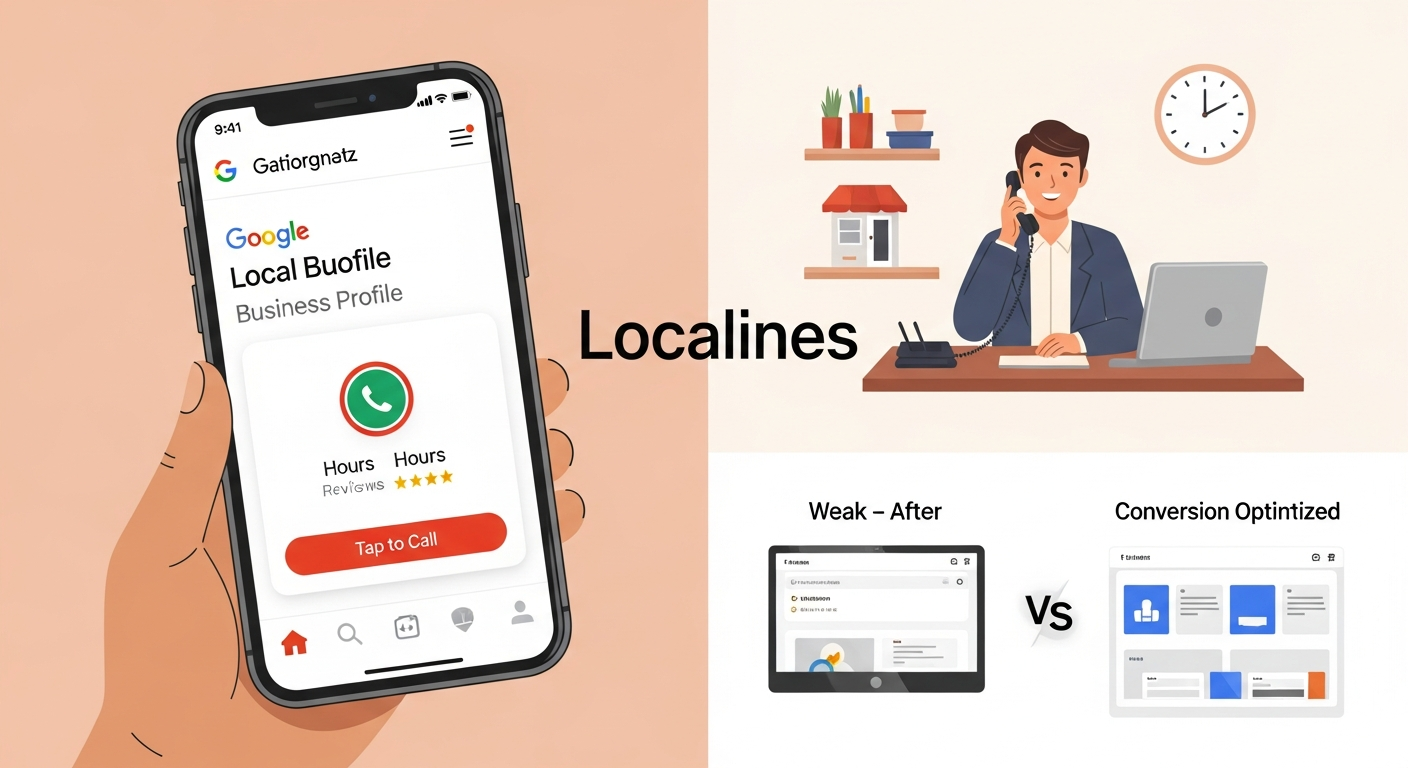
How Local SEO Turns Website Traffic Into Booked Calls
Getting traffic from local searches is only half the job. This guide walks through how local SEO services — done right — move visitors from Google to your phone line, appointment calendar, or contact form.
Quick answer
Local SEO turns traffic into booked calls by combining three things: high-intent keyword targeting (people searching 'near me' or '[service] in [city]'), a fully optimized Google Business Profile with a clear call-to-action, and local landing pages that remove friction between the search and the booking. Traffic without these conversion layers rarely produces calls.
The Gap Between 'We Rank' and 'We Get Calls'
Most small business owners who invest in local SEO services are chasing one outcome: the phone ringing. But ranking on page one for a local keyword and actually converting that visibility into booked calls are two very different problems — and plenty of businesses solve the first one without ever cracking the second.
The fix is not mysterious. Local SEO creates booked calls when it targets the right intent, presents the right information at the right moment, and removes every obstacle between a searcher and a 'schedule' button. This guide breaks down exactly how that works — and what to do this week to make it happen.
Quick Answer: How Local SEO Converts Traffic Into Calls
Local SEO converts traffic into booked calls through three compounding layers: (1) intent-matched keywords that attract visitors who are ready to act, (2) a Google Business Profile that lets searchers call or book without ever clicking your website, and (3) local landing pages that answer trust questions fast and make booking frictionless. Remove any one layer and conversion rates drop sharply.
“AI agents do in hours what teams used to do in weeks. The advantage compounds.”
Why Search Intent Is the Real Starting Point
Not all local traffic is equal. Someone searching 'what is HVAC maintenance' is researching. Someone searching 'HVAC repair Austin TX today' is ready to buy. Local SEO services that drive calls are built around the second type of query — transactional, location-specific, and often time-sensitive.
The highest-converting local keywords tend to share a pattern: they include a service, a location modifier, and sometimes an urgency signal. Think 'emergency plumber Denver', 'teeth whitening near me open Saturday', or 'personal injury lawyer Houston free consultation'. These searchers have already decided they need help — they are choosing between you and a competitor.
- Target '[service] + [city]' and '[service] near me' keyword patterns for bottom-of-funnel traffic.
- Add urgency modifiers ('same day', 'open now', 'emergency') for service businesses where timing matters.
- Use Google Search Console to find which queries already send you traffic — then build dedicated pages around the ones with the most clicks and the highest implied intent.
- Avoid over-optimizing for broad informational keywords if your goal is phone calls, not blog readers.
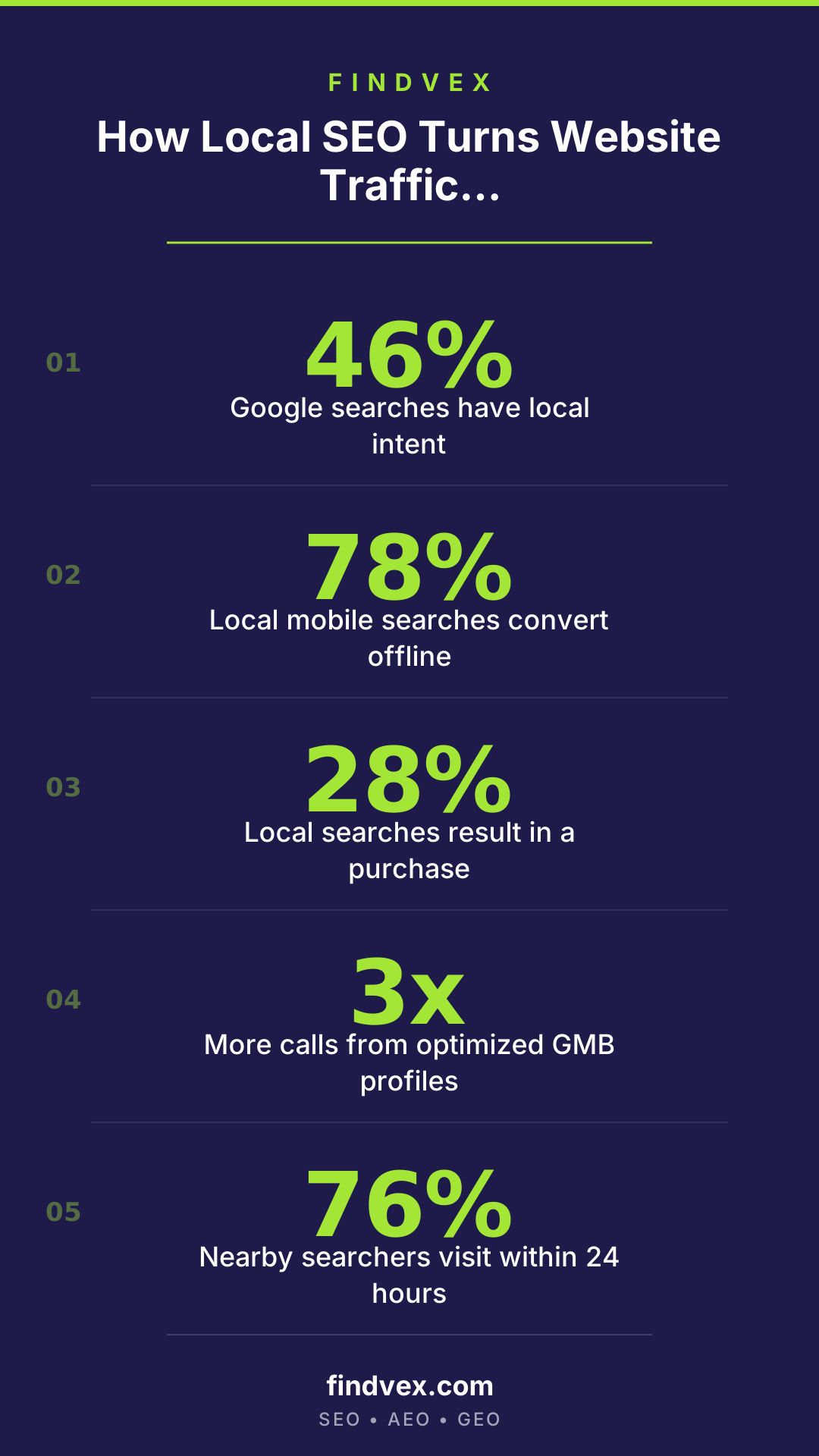
Your Google Business Profile Is a Lead Generation Tool, Not a Listing
For a significant share of local searches, your Google Business Profile (GBP) is the first — and sometimes only — thing a potential customer sees. The local pack that appears above organic results shows your name, rating, hours, and a call button. A searcher can call you, get directions, or book an appointment without ever touching your website.
That means your GBP is doing direct conversion work. An incomplete or poorly maintained profile loses calls that your rankings technically earned.
- Primary category: Choose the most specific category that matches your core service. This directly affects which searches trigger your listing.
- Business description: Use your 750 characters to describe what you do, who you serve, and what makes you the right choice — not a generic tagline.
- Services and products: List every individual service with its own description. This content feeds Google's understanding of your relevance.
- Phone number and booking link: Make sure the call button goes to a number that is answered during business hours. If you offer online booking, connect it directly in your profile.
- Photos: Profiles with photos receive substantially more direction requests and website clicks than those without. [Source needed: Google Business Profile performance data — verify current figures from Google's own documentation before publishing.]
- Q&A section: Pre-populate common questions ('Do you offer free estimates?', 'Are you accepting new patients?') so searchers get answers before hesitating.
- Posts: Use weekly GBP posts to promote offers, announce availability, or highlight a seasonal service — they display in your profile and reinforce relevance.
Local Landing Pages: Where SEO Traffic Becomes a Lead
When a searcher clicks through to your website, you have roughly a few seconds to prove you are the right choice for their specific situation in their specific location. A generic homepage does not do this job. A well-built local landing page does.
A local landing page answers three unspoken questions immediately: Are you near me? Do you do exactly what I need? Why should I trust you? When those three questions are answered above the fold, conversion rates climb.
For businesses serving multiple cities or neighborhoods, a dedicated page per service area — built with genuinely local content, not just a swapped city name — is one of the highest-ROI investments in local SEO. We cover how to do this without making every page sound the same in our guide to local landing pages that rank without sounding generic.
- Include the city or neighborhood name in the H1, title tag, and first paragraph — naturally, not stuffed.
- Show a local phone number prominently at the top of the page (and make it a tap-to-call link on mobile).
- Add a click-to-schedule button or embedded booking widget above the fold.
- Feature reviews from customers in that specific area when possible.
- Include a Google Map embed showing your location or service area.
- List specific services available in that location — especially if your offering varies by geography.
- Add LocalBusiness schema markup to every location page.
Removing the Friction Points That Kill Calls
Even a business with strong local rankings and a great GBP can lose calls to friction — anything that makes a motivated visitor pause, second-guess, or give up before contacting you. The most common friction points are slow pages, unclear pricing signals, and buried contact options.
Page speed is a real conversion killer, particularly on mobile where most local searches happen. A page that takes more than three seconds to load on a phone loses a measurable share of visitors before they ever see your offer. If you have not addressed your Core Web Vitals, our guide on what business owners need to fix first is a practical starting point.
Trust signals matter especially in service categories where a customer is inviting you into their home or making a health decision. Displaying your license number, showing real team photos, embedding a Google review widget, and listing your years in business all reduce hesitation.
- Mobile-first check: Open your website on your own phone and try to find the phone number and booking option in under 10 seconds. If you cannot, neither can your visitors.
- Single primary CTA: Every local page should have one dominant call-to-action — 'Call Now', 'Book a Free Estimate', or 'Schedule Today'. Multiple competing CTAs dilute action.
- Response time signal: If you offer same-day or next-day availability, say so. 'We answer calls Mon–Fri 8am–6pm and reply to web inquiries within 2 hours' removes a key objection.
- Review count and recency: Three stars and eight reviews from 2019 hurt more than they help. Actively requesting reviews from recent customers is part of a complete local SEO strategy.
- Form length: Every additional field in a contact form reduces submission rates. Ask for name, phone, and the service needed. Collect everything else when you call back.
You Cannot Improve What You Do Not Track
One of the clearest gaps between businesses that get ROI from local SEO services and those that do not is call tracking. If you do not know which pages, keywords, or GBP actions are driving calls, you are flying blind when it comes to optimizing your budget.
Basic call tracking can be set up through Google Ads (which feeds data back into Google Analytics and Search Console) or through a dedicated tool that assigns unique numbers to different traffic sources. At minimum, you should know: how many calls came from organic local search this month, which pages drove the most calls, and whether your GBP call button is being used.
- Set up call tracking: Use Google's call tracking within your GBP or a third-party tool to attribute calls to specific sources.
- Goal tracking in GA4: Set up a conversion event for phone number clicks, form submissions, and booking completions.
- Monthly review: Check your Search Console for which queries drove impressions and clicks to your local pages, then cross-reference with call volume.
- GBP Insights: Review the 'Calls', 'Direction requests', and 'Website clicks' data in your Business Profile monthly — this is free and shows exactly how your listing drives action.
Do This This Week: Your Local SEO-to-Calls Action Plan
You do not need to overhaul your entire website to start converting more local traffic into calls. Here is a focused five-task plan you can complete in a few hours this week.
- Day 1 — Audit your GBP: Log into your Google Business Profile. Confirm your primary category, update your hours, add at least three recent photos, and check that your booking link or phone number is active and correct.
- Day 2 — Check your top local page on mobile: Pull up your most important local service page on your phone. Can you find the phone number and a way to contact you within 10 seconds? If not, fix the CTA placement before anything else.
- Day 3 — Add or improve one location-specific page: If you serve more than one city and do not have dedicated pages per location, create one for your highest-value market. Include a local phone number, city name in the H1, a review from a local customer, and a map embed. See our guide on local landing pages for a complete framework.
- Day 4 — Set up basic call tracking: Even a free tool or Google's built-in GBP call history gives you a baseline. Know how many calls you are getting from local search before you spend more on SEO.
- Day 5 — Shorten your contact form: If your inquiry form asks for more than four fields, cut it down. Name, phone number, and 'What do you need help with?' is enough to start the conversation.
Want to Know Where Your Local SEO Is Losing Calls?
FindVex audits your local SEO stack — your Google Business Profile, local landing pages, conversion paths, and tracking setup — and shows you exactly where visitors are dropping off before they call. No generic reports. Just a clear picture of what to fix and why it matters for your specific business.
If your rankings have improved but your phone is not ringing more, that is a conversion problem, not a traffic problem — and it is very fixable. Get a free local SEO conversion audit from FindVex and find out where the gap is.
FAQs
What is local SEO and how does it help get more calls?
Local SEO is the process of optimizing your online presence so your business appears when people in your area search for the services you offer. It helps generate calls by targeting high-intent searches (like 'plumber near me' or 'dentist in [city]'), optimizing your Google Business Profile so searchers can call directly from search results, and building local landing pages that turn clicks into inquiries.
How long does it take for local SEO to start generating calls?
Google Business Profile optimizations can start showing results within a few weeks — especially if your profile was incomplete or had outdated information. Organic ranking improvements from local landing pages and on-site work typically take two to four months to show measurable gains in call volume, though this varies significantly by market competitiveness and your starting point.
Why am I getting local SEO traffic but no calls?
Traffic without calls usually signals a conversion problem rather than an SEO problem. The most common causes are: no clear call-to-action above the fold, a slow or hard-to-navigate mobile experience, a weak or incomplete Google Business Profile, a lack of trust signals (reviews, credentials, photos), and contact forms that ask for too much information. Fixing these conversion layers is often faster and cheaper than chasing more traffic.
Do I need a separate landing page for every city I serve?
If you serve multiple cities or neighborhoods, dedicated local landing pages for each area will outperform a single generic service page almost every time. Each page should have genuinely location-specific content — not just a swapped city name — including local reviews, a local phone number, and references to local context. This gives Google a clearer signal about your relevance to each area and gives visitors a more relevant experience.
How important is my Google Business Profile compared to my website for local calls?
Both matter, but your Google Business Profile often drives more direct calls because it displays a tap-to-call button right in the local pack — before a searcher ever visits your website. Many local customers call directly from the GBP without clicking through at all. For this reason, an optimized GBP is often the fastest single win for increasing local call volume.
What does local SEO cost for a small business?
Local SEO service pricing varies widely based on market competitiveness, the number of locations, and the scope of work. [Source needed: current industry pricing benchmarks — avoid fabricating specific dollar ranges without verified data. Consider linking to a FindVex pricing or services page when available.]
Sources & Citations
Sofia Patel
Writing about AI, search, and what actually moves the needle for US small businesses.
Related reads
The AI Crawler Protection Paradox: Why Brands Block Bots Then Pay to Be Seen
Businesses are simultaneously blocking AI crawlers from scraping their content and paying to appear in AI-generated answers. That contradiction has a name: the protection paradox. Here's what it means technically, and what small businesses should actually do about it.
industry-seo-playbooksReal Estate SEO: A Practical Guide for Small Businesses
Real estate SEO helps agents, brokerages, and property managers rank in local Google searches so buyers and sellers find them first. This guide covers everything from Google Business Profile to IDX optimization and neighborhood content—practical steps you can start this week.
local-seo-for-service-businessesNear Me SEO: A Practical Guide for Small Businesses
"Near me" searches connect high-intent buyers to local businesses — but ranking for them requires more than just adding the phrase to your website. This guide covers every lever you can pull, from your Google Business Profile to on-page signals and review strategy.