Near Me SEO: A Practical Guide for Small Businesses
"Near me" searches connect high-intent buyers to local businesses — but ranking for them requires more than just adding the phrase to your website. This guide covers every lever you can pull, from your Google Business Profile to on-page signals and review strategy.
Quick answer
To rank for "near me" searches, you need a fully optimized Google Business Profile, consistent NAP (name, address, phone) citations across the web, location-specific pages on your website, and a steady stream of genuine customer reviews. Google uses proximity, relevance, and prominence to decide who shows in the Local Pack — and you can influence all three.
Why "Near Me" Searches Matter More Than Your Homepage Traffic
When someone types "plumber near me" or "dentist near me" into Google, they're not browsing — they're ready to call. That intent gap between a general search and a near-me search is enormous. A person searching "plumbing tips" might read your blog and leave. A person searching "emergency plumber near me" wants a phone number within 30 seconds.
Near me SEO is the discipline of making your business visible for those high-intent, location-based queries. It sits at the intersection of Google Business Profile optimization, on-site local signals, citation building, and review management. Get it right and your phone rings. Miss even one piece and a competitor shows up in the Local Pack instead of you.
This guide walks through every practical lever in plain English — no jargon, no fluff, just the actions that move rankings.
How Google Decides Who Ranks for Near Me Queries
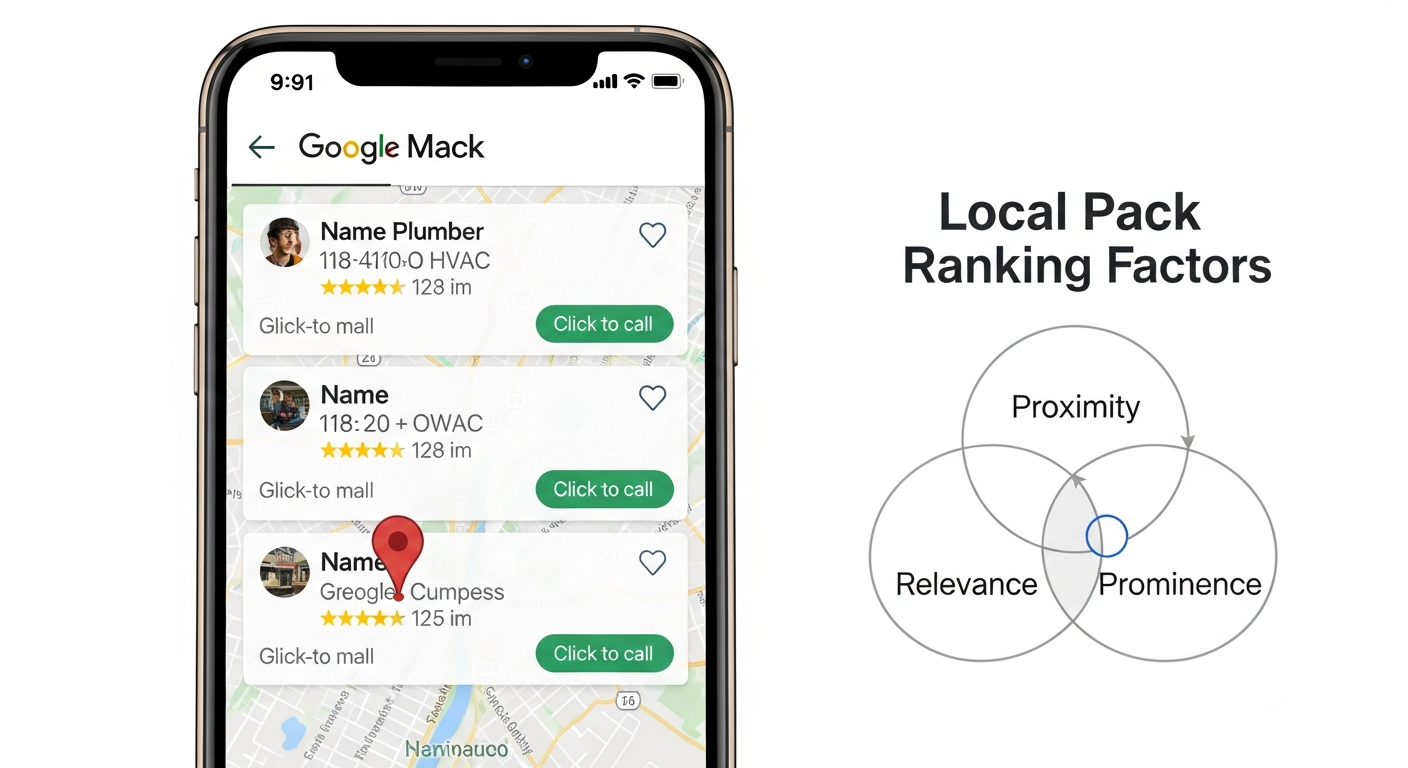
Google evaluates local results using three factors: proximity, relevance, and prominence. Understanding each one tells you exactly where to focus your effort.
Proximity is how physically close your business is to the person searching. You cannot change where your office is, but you can make sure Google knows your exact service area. Relevance is whether your business profile and website clearly match what the searcher wants. If your Google Business Profile category is vague or your website never mentions the service, Google hesitates. Prominence is your reputation online — reviews, backlinks, citations, and how well-known your business appears to be.
Most small businesses underperform on relevance and prominence, not proximity. That's good news: both are fully in your control.
“AI agents do in hours what teams used to do in weeks. The advantage compounds.”
Google Business Profile: Your Most Important Near Me SEO Asset
Your Google Business Profile (GBP) is the single highest-leverage asset for near me SEO. It powers the Local Pack — the three-business block that appears at the top of local search results. A thin or neglected profile is the most common reason a local business doesn't show up.
Here's what a fully optimized GBP looks like in practice.
- Choose the most specific primary category available. "General contractor" is weaker than "Kitchen Remodeler" if that's your core service.
- Add every applicable secondary category — each one expands the searches you can appear for.
- Write a business description that naturally includes your primary service and city. Aim for 250–300 words. Avoid keyword stuffing.
- Upload at least 10 high-quality photos: storefront, team, work samples, before-and-after if applicable. Profiles with photos receive significantly more direction requests and calls (source needed — avoid stating a specific unverified figure).
- Set your service area correctly. If you serve a radius around your location, define it. If you serve specific cities, list them individually.
- Add every service you offer under the Services tab, with a short description per service.
- Enable messaging and keep response time under a few hours.
- Post a Google Business Post at least once every two weeks — a promotion, a completed job, a seasonal offer.
- Keep your hours current, especially holidays. Incorrect hours are a fast way to lose trust with both Google and customers.
NAP Consistency and Citation Building
NAP stands for Name, Address, and Phone number. Every time your business is listed on a directory, review site, or local publication, that listing is a citation. Google cross-references these citations to verify your business is legitimate and to confirm your location details.
Inconsistent NAP — "Smith's Plumbing LLC" on one site and "Smith Plumbing" on another, or an old phone number on Yelp — creates mixed signals. It doesn't tank rankings immediately, but it does reduce Google's confidence in your listing, which can keep you out of the top three Local Pack spots.
Start with the core citation sources: Google Business Profile, Bing Places, Apple Maps, Yelp, Facebook Business, and your industry-specific directories (Houzz for home services, Healthgrades for medical, Avvo for legal, etc.). Then move to broader data aggregators like Data Axle and Neustar Localeze, which feed dozens of smaller directories automatically.
Run a free citation audit on BrightLocal or Whitespark before building new citations — fix the messy ones first, then expand.
On-Page SEO Signals That Support Near Me Rankings
Your website needs to confirm what your GBP claims. Google looks at your site to validate relevance. A business with a strong profile but a thin, location-free website will plateau in rankings.
The most impactful on-page changes for near me SEO:
- Include your city and service in your homepage H1 and title tag. "Residential Electrician in Austin, TX" beats "Welcome to Our Website."
- Embed a Google Map on your Contact page — it reinforces your location signal.
- Add your full NAP in the footer of every page, formatted consistently with your GBP.
- Create a dedicated location page for each city or neighborhood you serve. A single page that says "We serve Austin, Round Rock, Cedar Park, and Pflugerville" is far weaker than four separate pages, each with unique content about that location.
- Use LocalBusiness schema markup on your homepage and location pages. This structured data helps Google understand your business type, address, hours, and phone number without having to parse plain text.
- Mention local landmarks, neighborhoods, or known areas in your service pages where it makes genuine sense — not as a keyword dump, but as real geographic context.
- Include a page title that mirrors how customers actually search, e.g., "AC Repair Near Me in Phoenix, AZ — [Your Business Name]."
Reviews: The Prominence Signal You Can Actually Control
Review count and quality directly affect your prominence score. A business with 12 reviews and a 3.8-star average will almost always lose the Local Pack to a competitor with 80 reviews and a 4.7-star average, assuming other signals are comparable.
The practical approach to building reviews isn't complicated — it's just consistently executed. Ask every satisfied customer, every time. The most effective method is a direct link to your Google review page sent via text message immediately after a job is completed. The further from the service experience the request comes, the lower the conversion rate.
On the response side: reply to every review, positive and negative. A thoughtful response to a negative review does more for your credibility than ignoring it. It shows potential customers that you're accountable. Keep responses short, professional, and specific — don't copy-paste a generic reply to every five-star review.
Never offer incentives for reviews. Google's policies prohibit it and the risk of a profile suspension isn't worth it.
Local Landing Pages That Capture Near Me Traffic
If you serve multiple areas, individual location pages are one of the highest-ROI content investments you can make. Each page targets a city-level search — "HVAC repair in Dallas" or "family dentist in Naperville" — and gives Google a highly relevant, location-specific URL to rank.
The trap most businesses fall into is duplicating the same page content and just swapping the city name. Google recognizes this and it rarely ranks well. Each location page needs to earn its place with genuine, unique content: what makes that location relevant to your business, local customer stories (without fabricating them), specific neighborhoods you serve in that city, and a unique CTA tied to that location.
For more on building location pages that actually rank, see our guide to local landing pages that rank without sounding generic.
Technical SEO Foundations That Near Me Rankings Depend On
Near me SEO lives mostly in GBP and on-page signals, but weak technical foundations can prevent any of it from working. If Google can't crawl your site efficiently, your local pages may not get indexed at all.
The most common technical issues that hurt local rankings:
- Site not indexed: Run site:yourdomain.com in Google to confirm your pages are indexed. If important pages are missing, check Google Search Console's Pages report.
- Slow mobile load times: Near me searches happen overwhelmingly on mobile. A site that takes 5+ seconds to load on a phone loses conversions before they happen. Check your Core Web Vitals in Google Search Console.
- Missing or broken mobile experience: Use Google's Mobile-Friendly Test to verify your site renders correctly on small screens.
- HTTP instead of HTTPS: Any site without an SSL certificate raises trust concerns for both users and Google.
- Duplicate location pages without canonical tags: If you have multiple location pages that are nearly identical, use canonical tags to avoid diluting relevance signals.
- No XML sitemap submitted: Submit your sitemap via Google Search Console so Google finds your location pages faster.
Do This This Week: Your Near Me SEO Action Plan
You don't need to do everything at once. Here's a prioritized five-day action plan that covers the highest-impact moves first.
- Day 1 — GBP audit: Log into your Google Business Profile. Verify your primary category, add missing secondary categories, update your description, and confirm your service area is set correctly. Add at least five fresh photos if you haven't in the last 30 days.
- Day 2 — NAP check: Google your business name and scan the first page of results. Check Yelp, Facebook, and your top industry directory. Correct any inconsistencies in name, address, or phone number.
- Day 3 — On-page quick wins: Check your homepage title tag and H1. Make sure both include your city and primary service. Add your NAP to the footer if it's missing. Embed a Google Map on your Contact page.
- Day 4 — Schema markup: Add LocalBusiness JSON-LD schema to your homepage. Include your business name, address, phone, URL, opening hours, and business type. Validate it with Google's Rich Results Test.
- Day 5 — Review request system: Set up a simple SMS or email template that goes out to every customer after job completion. Include your direct Google review link. Make it the last step in your post-service workflow.
How Near Me Rankings Translate to Actual Leads
Rankings in the Local Pack don't just drive traffic — they drive calls, direction requests, and website clicks from people who are already in buying mode. A business that appears in the top three for "emergency plumber near me" at 9pm on a Sunday is capturing demand that a business ranking fifth on page two will never see.
The conversion funnel for near me traffic is much shorter than for organic blog traffic. Someone clicking your Local Pack listing has a specific need, is in your area, and is comparing a handful of options. Your job is to remove friction: your phone number should be clickable, your hours accurate, your reviews recent, and your website fast enough to load before they close the tab.
If you want to understand how this pipeline works end to end, our article on how local SEO turns website traffic into booked calls walks through the conversion mechanics in detail.
FAQs
Do I need to use the phrase "near me" on my website to rank for near me searches?
No. Google interprets "near me" based on the searcher's location and your business's geographic signals — your GBP location, service area, local landing pages, and citations. Adding "near me" to your page copy or title tags rarely helps and can look unnatural. Focus on clearly stating your city and service instead.
How long does it take to rank in the Local Pack?
It depends on your starting point and how competitive your market is. A business with a complete GBP, consistent citations, and 30+ recent reviews in a mid-sized city can see movement within 4–8 weeks of optimization. In highly competitive markets like major cities, it can take 3–6 months of consistent effort.
Does my website need to rank organically for near me searches, or is the Google Business Profile enough?
Both matter. The Local Pack (driven by your GBP) and the organic results below it are separate ranking systems. Appearing in both increases your visibility and your credibility. For competitive queries, businesses that own both a Local Pack spot and an organic result capture significantly more of the page.
What if I run a service-area business and don't have a physical storefront?
You can still rank in the Local Pack. Set up your Google Business Profile as a service-area business, hide your address if you work from home, and define your service areas by city or zip code. The same rules apply: optimize your categories, gather reviews, and build location-specific pages on your website.
How many reviews do I need to compete?
There's no universal threshold — it depends on your competitors. Search your primary service + city and look at the review counts of the top three Local Pack listings. That's your benchmark. If they have 50, 60, and 90 reviews, you need to be in that range with a 4.5+ average to compete seriously.
Can I rank for near me searches in cities where I don't have an office?
With your GBP, you can only rank in areas you designate as your service area — and proximity still plays a role. For organic rankings, you can create city-specific landing pages and rank for queries like "[service] in [city]" without a physical presence there. A local landing page strategy is the right approach for multi-city coverage.
Does social media activity affect near me rankings?
Not directly. Social signals are not a confirmed Google ranking factor for local search. However, an active Facebook Business Page or Instagram presence can show up in branded searches and helps build the broader online presence that contributes to your prominence score indirectly.
Sources & Citations
Sofia Patel
Writing about AI, search, and what actually moves the needle for US small businesses.
Related reads
OpenAI Crawl Activity Tripled Since GPT-5: What It Means for Your Website
OpenAI's crawl activity roughly tripled following the GPT-5 launch, with OAI-SearchBot overtaking GPTBot in log-file events. If you haven't audited your robots.txt or server logs for AI crawler behavior recently, now is the time.
seo-newsThe AI Crawler Protection Paradox: Why Brands Block Bots Then Pay to Be Seen
Businesses are simultaneously blocking AI crawlers from scraping their content and paying to appear in AI-generated answers. That contradiction has a name: the protection paradox. Here's what it means technically, and what small businesses should actually do about it.
industry-seo-playbooksReal Estate SEO: A Practical Guide for Small Businesses
Real estate SEO helps agents, brokerages, and property managers rank in local Google searches so buyers and sellers find them first. This guide covers everything from Google Business Profile to IDX optimization and neighborhood content—practical steps you can start this week.