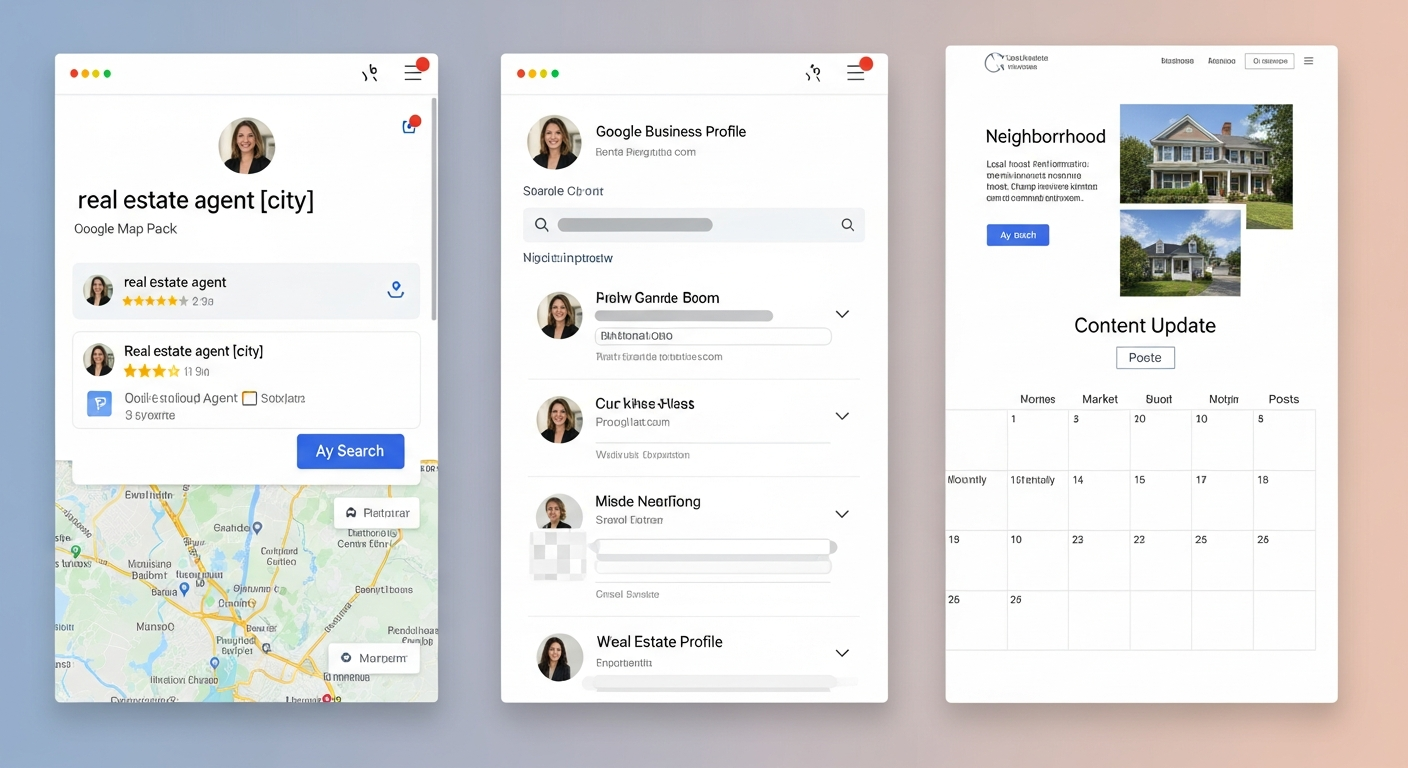
Real Estate SEO: A Practical Guide for Small Businesses
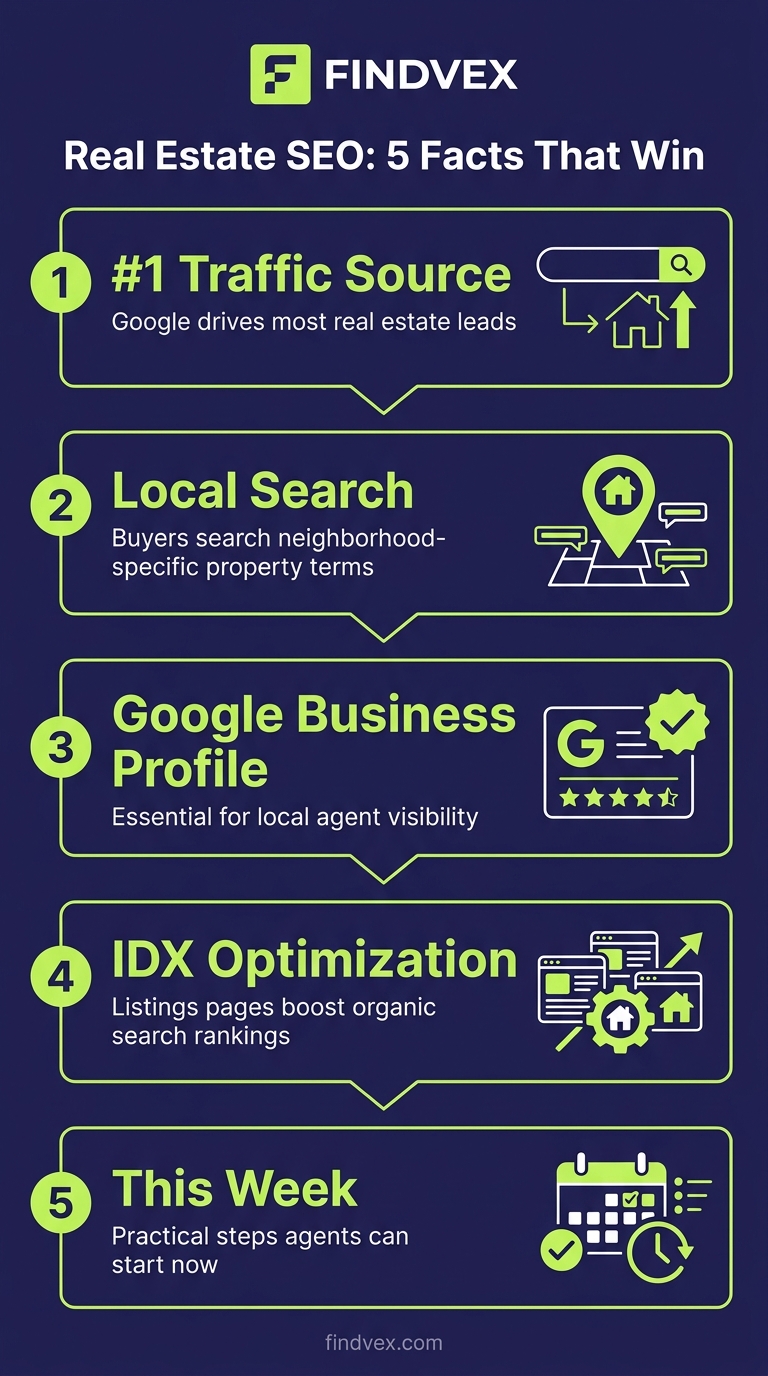
Real estate SEO helps agents, brokerages, and property managers rank in local Google searches so buyers and sellers find them first. This guide covers everything from Google Business Profile to IDX optimization and neighborhood content—practical steps you can start this week.
Quick answer
Real estate SEO means optimizing your website, Google Business Profile, and content so buyers and sellers find you in local search results before they find your competitors. The highest-impact moves are: (1) optimize your Google Business Profile for your city and service type, (2) create individual neighborhood or city landing pages, (3) ensure your IDX listings are crawlable, and (4) add LocalBusiness and RealEstateAgent schema markup. Most solo agents and small brokerages can see measurable improvement in 60–90 days by focusing on these four areas first.
Why Real Estate SEO Is Different From Other Industries
Real estate is one of the most hyperlocal search categories that exists. A buyer searching for help is not typing 'real estate agent'—they're typing 'real estate agent in Austin TX' or 'homes for sale in Naperville IL.' The geography is embedded in almost every query. That changes how you build your entire SEO strategy.
It also means you're competing on two fronts simultaneously: the Google Map Pack (driven by your Google Business Profile) and traditional organic rankings (driven by your website). Winning both is possible for a small brokerage or solo agent, but you have to play them differently.
A third complication is IDX (Internet Data Exchange)—the feed of MLS listings on your site. IDX is powerful for user experience, but many IDX implementations block search engines from indexing listing pages, or create duplicate content across hundreds of agent sites using the same feed. Fixing that is often the single biggest technical win for a real estate website.
Google Business Profile: Your Most Urgent Priority
Before you touch your website, your Google Business Profile (GBP) needs to be airtight. For local searches like 'real estate agent near me' or 'Realtor in [city],' the Map Pack typically appears above organic results. If your profile is incomplete or unoptimized, you're invisible to the majority of ready-to-act buyers and sellers.
The business category matters more than most agents realize. Select 'Real Estate Agency' or 'Real Estate Agent' as your primary category. If you also do property management or work with commercial properties, add those as secondary categories—do not try to stuff them into your description.
Your service area settings should list the specific cities and zip codes you actively work in. Avoid setting a radius that covers half the state. Google correlates service area with searcher location. Tighter, more accurate settings tend to outperform broad ones for agents who serve a defined market.
- Complete every GBP section: hours, phone, website, services, description (use your city + specialties naturally in the first two sentences).
- Upload at least 10–15 high-quality photos: office exterior, headshots, team, and neighborhood photos of areas you serve.
- Post to GBP at least twice a month—new listings, market updates, or buyer tips. Posts are indexed quickly and show recency signals.
- Enable messaging and respond within an hour when possible. Response speed influences local ranking.
- Ask every satisfied client for a Google review, and always respond to reviews—positive and negative.
“AI agents do in hours what teams used to do in weeks. The advantage compounds.”
Real Estate Keyword Strategy: Think Like Your Client, Not Like an Agent
Most real estate agents target keywords like 'buy a home in [city]' or 'sell my house fast.' Those are fine, but they're also the most competitive. The faster wins—and often the more valuable leads—come from intent-specific, longer-tail keywords that reveal where a prospect is in the buying or selling journey.
Map your keywords to three stages of intent: awareness (research phase), consideration (actively evaluating), and decision (ready to act). Each stage needs different content.
- Awareness: 'What is the average home price in [neighborhood]', 'best neighborhoods for families in [city]', '[city] real estate market update 2026'
- Consideration: 'How to choose a real estate agent in [city]', 'buyer's agent vs. listing agent', '[city] first-time homebuyer programs'
- Decision: 'Real estate agent in [city]', 'sell my home in [zip code]', 'top Realtor in [neighborhood]'
- Niche opportunities: 'luxury homes in [area]', 'investment properties [city]', 'condos for sale [neighborhood]', 'homes with acreage near [city]'
Neighborhood and City Landing Pages: The Core of Your Organic Strategy
Your homepage can't rank for every location you serve. You need individual landing pages—one per city or neighborhood that matters to your business. These are not thin pages with a map and a contact form. They are substantive, locally-specific pages that signal to Google (and to searchers) that you genuinely know that market.
A neighborhood page that actually ranks includes: a genuine overview of what it's like to live there, current market context (median price range, days on market, whether it's a buyer's or seller's market), nearby schools, commute notes, local landmarks and amenities, and a handful of relevant listings if your IDX setup allows it. This combination of local signals is what separates pages that rank from pages that just exist.
The internal link structure between your neighborhood pages also matters. Link your city hub page to each neighborhood page, and link between related neighborhoods. This creates topical depth that standalone pages can't achieve. For more detail on building location pages that actually convert, see our guide on local landing pages that rank without sounding generic.
- One page per meaningful city or neighborhood—avoid combining two areas into one page.
- Include a unique H1 like 'Homes for Sale in [Neighborhood], [City]—What Buyers Need to Know.'
- Add a 'Why Work With Us in [Neighborhood]' section featuring transactions, client stories (with permission), or local market knowledge.
- Keep URLs clean: /homes-for-sale-[neighborhood]-[city]/ or /[city]-real-estate-agent/.
- Update each page quarterly with fresh market data to preserve rankings.
IDX and Technical SEO: The Problem Most Agents Don't Know They Have
IDX (Internet Data Exchange) feeds MLS listing data directly to your website. For users, it's excellent. For SEO, it's frequently a problem. Here's why: most IDX platforms generate listing pages on a subdomain (like idx.yourdomain.com) or through JavaScript rendering. Google may not index these pages at all, or it may index them as separate from your main domain, meaning your site gets no SEO credit for the content.
The second issue is duplicate content. If 50 agents in your market all use the same IDX provider, their listing pages are nearly identical. Google will not rank duplicated listing pages, and having large amounts of thin, duplicate content on your site can drag down the performance of your other pages.
The practical fix depends on your platform. Some IDX providers now offer server-side rendering (SSR) or the ability to display listing pages on your main domain—check with your provider. At minimum, ensure that your IDX pages are not blocking crawlers unnecessarily, that your canonical tags are set correctly, and that you're building original content around key listings rather than relying solely on the feed data. If you need a structured way to audit these issues, our technical SEO audit checklist for small business websites walks through exactly this process.
- Check whether your IDX pages are indexed: type site:yourdomain.com in Google and review what shows up.
- Verify canonical tags on listing pages point to the correct URL—not the IDX subdomain.
- Add original introductory copy to listing detail pages where your platform allows it.
- Block low-value IDX pages (search result pages, saved search pages) from indexing via robots.txt or noindex tags.
- Request that your IDX provider detail their crawlability and indexation support—this is a reasonable ask before committing to a platform.
Schema Markup for Real Estate Websites
Schema markup is structured data that tells search engines—and increasingly AI Overviews—exactly what your page is about. For real estate businesses, two schema types are essential: LocalBusiness (specifically RealEstateAgent) and, where relevant, RealEstateListing.
RealEstateAgent schema on your homepage and agent profile pages tells Google your name, address, phone number, service area, and business type in a machine-readable format. This reinforces your GBP signals and increases the likelihood of appearing in rich results. Listing schema on property pages can surface price, square footage, status, and location in search results—a click-through advantage over competitors with plain blue links.
- Implement RealEstateAgent schema on: homepage, about page, and individual agent bios.
- Key properties to include: name, address, telephone, url, areaServed (use city names, not coordinates), priceRange (optional but useful).
- For listing pages: use RealEstateListing schema with address, numberOfRooms, floorSize, price, and offerType.
- Validate all schema with Google's Rich Results Test before publishing.
- Add BreadcrumbList schema to neighborhood and listing pages to improve click-through rates in SERPs.
Content That Builds Authority and Drives Leads—Not Just Traffic
The agents who rank sustainably don't just publish blog posts—they build content that serves real buyer and seller questions at every stage of the decision. The goal is not to get traffic to a blog; it's to get the right visitor to a contact form, a phone call, or a listing inquiry.
Market update content is one of the most underused assets in real estate SEO. A monthly or quarterly local market report—covering inventory levels, median prices, days on market, and your honest take on what it means for buyers or sellers—serves dual purposes: it ranks for market-related searches, and it demonstrates expertise to prospective clients who find it via Google or referral.
Process content converts well because it addresses the anxiety buyers and sellers feel. Articles like 'What to Expect When Selling Your Home in [City]' or 'How to Make a Competitive Offer in a [City] Seller's Market' answer the questions your prospects are asking at 10pm before they decide who to call. These are not lead magnets—they're genuinely useful content that earns trust before anyone has picked up the phone.
To understand how SEO-driven content turns into actual booked consultations, not just pageviews, read how local SEO turns website traffic into booked calls.
- Monthly market update: 400–600 words, published same week each month, specific neighborhood or zip code focus.
- Buyer and seller guides: long-form, 1,500+ words, city-specific where possible.
- FAQ content: 'How long does it take to sell a home in [city]?', 'What is the closing cost for buyers in [state]?'—these target featured snippet positions.
- Seasonal content: spring buying season, year-end tax implications of selling, new construction vs. resale in [city].
- Agent interview or Q&A posts: these work especially well for establishing personal brand and E-E-A-T (Experience, Expertise, Authoritativeness, Trustworthiness) signals.
Reviews and Reputation: The Ranking Signal Most Agents Underestimate
Google uses review signals—quantity, recency, sentiment, and response rate—as local ranking factors. For real estate agents, getting consistent reviews is harder than in high-volume industries like restaurants because transactions happen less frequently. That makes each review more valuable, and the ask more important.
The best time to request a review is at closing, or within 48 hours when the client's positive experience is freshest. Send a direct link to your Google review form—do not make clients hunt for it. A short, personal message explaining that reviews help your business and future buyers or sellers find trustworthy guidance tends to outperform generic 'please leave us a review' requests.
Reviews on Zillow, Realtor.com, and Yelp also matter, but Google reviews are the most direct ranking signal for local SEO. If you're building from zero, prioritize Google first, then expand to platform-specific sites once your GBP has at least 10–15 solid reviews.
- Create a direct Google review shortlink via your GBP dashboard and save it to your phone.
- Mention specific transactions in your review request: 'Your feedback on helping you find the Riverside home would mean a lot.'
- Respond to every review within 24–48 hours—positive responses signal active management to Google.
- Set a goal: one new Google review per closed transaction. Track it in a simple spreadsheet.
- Never incentivize reviews with gifts or discounts—this violates Google's policies and risks suspension of your GBP.
Do This This Week: Your Real Estate SEO Action Plan
You don't need to do all of this at once. Start here, and you'll have measurable progress within 30 days.
- Day 1–2: Log into your Google Business Profile and audit every field. Fix incomplete sections, add five new photos, and update your service area to reflect your actual market.
- Day 3–4: Run a site:yourdomain.com search and check whether your IDX listing pages are indexed. If they are and they're duplicates, flag this for your web developer.
- Day 5: Identify the top three neighborhoods or cities you want to rank for. Check whether you have dedicated landing pages for each. If not, add them to your content calendar with a 30-day deadline.
- Day 6–7: Add RealEstateAgent schema to your homepage and validate it with Google's Rich Results Test. This takes under an hour and delivers lasting benefit.
- Week 2 onwards: Draft your first local market update post. Publish it. Commit to doing one per month. Set a calendar reminder.
How Real Estate SEO Fits Into a Broader Local Strategy
Real estate SEO doesn't operate in isolation. The same principles that drive results for real estate agents—local landing pages, GBP optimization, schema, review management—apply across every service-based local business. If you want to see how these strategies play out in other industries for comparison and cross-learning, our playbooks for SEO for dentists and restaurant SEO cover the same framework in different contexts.
For agents who are serious about building long-term organic visibility, understanding the technical foundation matters too. Our near me SEO guide goes deep on how Google determines which businesses to surface for proximity-based searches—essential reading if you're trying to dominate your city's local pack.
The businesses that win in local search are not the ones with the biggest budgets—they're the ones who are consistently specific, consistently useful, and consistently present in the right places. Real estate is no different.
FAQs
How long does real estate SEO take to show results?
Most agents see measurable improvement in Google Business Profile visibility within 30–60 days of making targeted optimizations. Organic website rankings for neighborhood and city pages typically take 60–120 days to move meaningfully, depending on competition in your market and the quality of your content. SEO compounds over time—the agent who starts today is significantly ahead of one who starts six months from now.
Can a solo real estate agent compete with Zillow or Realtor.com in search?
Not on broad national terms—and that's not the goal. Zillow and Realtor.com dominate generic searches like 'homes for sale.' Solo agents and small brokerages win by being hyper-specific: ranking for '[neighborhood] real estate agent,' '[city] home buyer guide,' or 'sell my home in [zip code].' The searcher who finds you through a specific, local query is also more likely to be a motivated, high-quality lead.
Does IDX hurt my real estate website's SEO?
It can, if your IDX implementation creates duplicate content, loads listings on a separate subdomain, or uses JavaScript that search engines can't crawl. Some modern IDX platforms handle these issues well with proper server-side rendering and canonical configuration. Audit your current setup by checking whether your listing pages appear in a site: search and whether canonical tags are set correctly.
What is the most important ranking factor for real estate local SEO?
For the Google Map Pack, your Google Business Profile—specifically completeness, review quantity and recency, and category relevance—carries the most weight. For organic website rankings, it's a combination of content relevance (neighborhood pages with genuine local detail), technical health (fast load times, correct indexation), and authoritative backlinks from local sources like community organizations, local news, or partner businesses.
Should real estate agents use social media instead of SEO?
Both have a role, but they serve different buyer behaviors. Social media builds brand awareness and nurtures warm audiences. SEO captures people who are actively searching for a real estate agent right now—that search intent is much closer to a transaction. SEO also compounds: a neighborhood page you publish today can generate leads for years. A social post has a 24–48 hour window. Most agents should prioritize SEO for sustainable lead generation, and use social to amplify their content.
What schema markup should a real estate website use?
At minimum: RealEstateAgent schema on your homepage and agent bio pages, and LocalBusiness schema with accurate NAP (name, address, phone) information. If your IDX setup allows original listing pages, add RealEstateListing schema with property details. Also implement BreadcrumbList schema on interior pages to improve click-through rates from search results.
Sources & Citations
- — Specific platform names and capabilities would make the IDX section more actionable; could not verify without a current source
- — Google's local ranking documentation confirms review signals matter but does not publicly detail exact weighting; cite Google's Help documentation if available
Sofia Patel
Writing about AI, search, and what actually moves the needle for US small businesses.
Related reads
OpenAI Crawl Activity Tripled Since GPT-5: What It Means for Your Website
OpenAI's crawl activity roughly tripled following the GPT-5 launch, with OAI-SearchBot overtaking GPTBot in log-file events. If you haven't audited your robots.txt or server logs for AI crawler behavior recently, now is the time.
seo-newsThe AI Crawler Protection Paradox: Why Brands Block Bots Then Pay to Be Seen
Businesses are simultaneously blocking AI crawlers from scraping their content and paying to appear in AI-generated answers. That contradiction has a name: the protection paradox. Here's what it means technically, and what small businesses should actually do about it.
local-seo-for-service-businessesNear Me SEO: A Practical Guide for Small Businesses
"Near me" searches connect high-intent buyers to local businesses — but ranking for them requires more than just adding the phrase to your website. This guide covers every lever you can pull, from your Google Business Profile to on-page signals and review strategy.