Generative Engine Optimization Services: What Small Businesses Actually Get (and What to Ask For)
GEO services optimize your business to appear in AI-generated answers — not just traditional search results. Here's what's actually included, how it differs from SEO, and what small businesses should demand before signing a contract.
Quick answer
Generative engine optimization (GEO) services help your business appear in AI-generated answers from tools like ChatGPT, Perplexity, Google AI Overviews, and Claude. A real GEO service includes content restructuring for citation readiness, schema markup, entity building, and authority signal development — not just keyword optimization. For small businesses, it complements traditional SEO rather than replacing it.
Section 1
If you've searched for your business category on ChatGPT or Perplexity lately and didn't show up, you've already experienced the problem generative engine optimization services are built to solve.
GEO — generative engine optimization — is the practice of structuring your content, authority signals, and entity data so that AI systems choose to cite or recommend your business when users ask relevant questions. It's not about stuffing more keywords into your homepage. It's about becoming the kind of source that language models trust enough to reference.
This guide breaks down what GEO services actually include, how they differ from traditional SEO and AEO, what small businesses should budget, and the red flags that separate real practitioners from agencies that just renamed their SEO packages.
What Generative Engine Optimization Actually Means
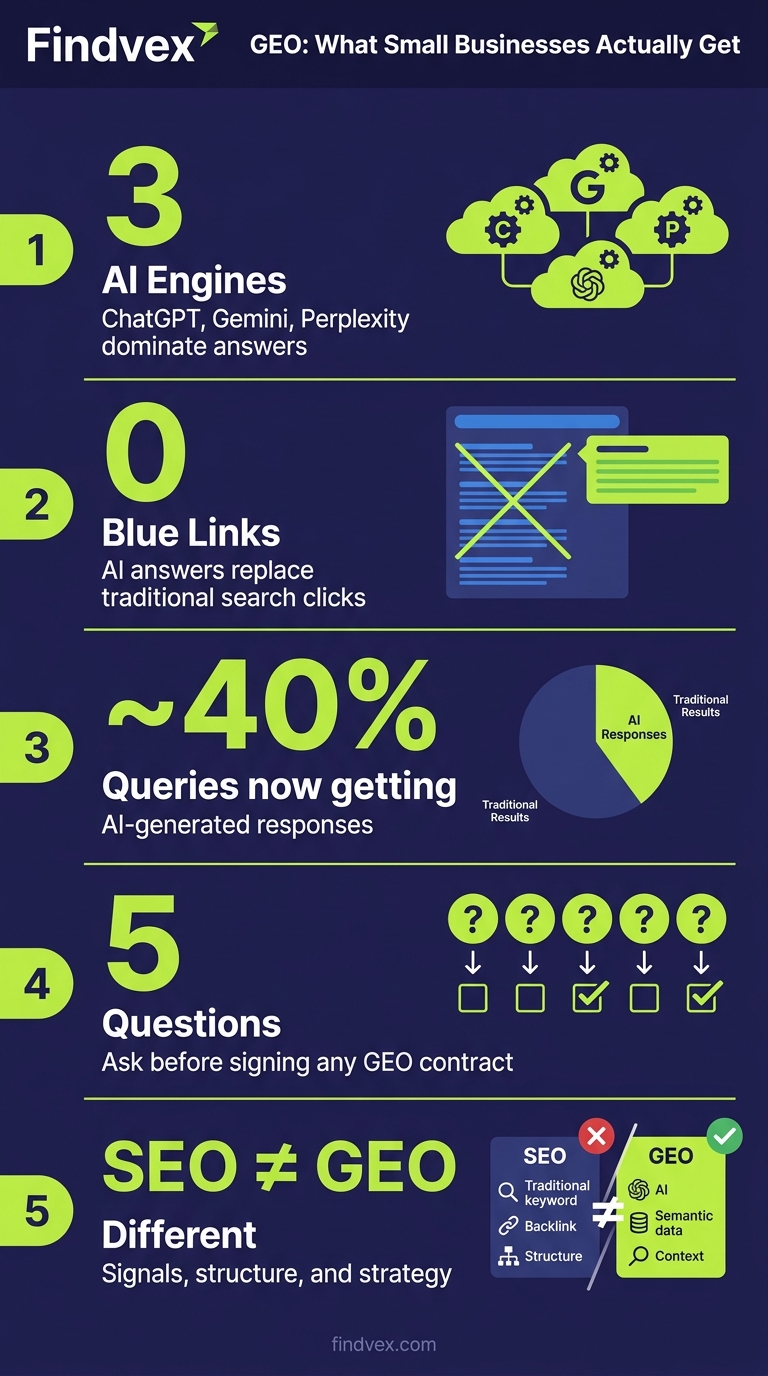
Traditional SEO optimizes for Google's ranking algorithm — crawlability, links, relevance signals. GEO optimizes for how large language models (LLMs) process and retrieve information when generating answers.
When a user asks ChatGPT "who are the best HVAC contractors in Denver?" or "what should I look for in a family dentist?" — the model doesn't run a keyword search. It draws on its training data and, in search-enabled modes, retrieves live web content. GEO shapes both: what the model already associates with your brand, and what it finds when it looks.
The term is sometimes used interchangeably with AEO (answer engine optimization) and LLM SEO. They overlap significantly. The meaningful distinction: GEO tends to emphasize AI generative systems (ChatGPT, Claude, Gemini, Perplexity), while AEO historically covered voice assistants and featured snippets too. For practical purposes — especially for small businesses — the deliverables are nearly identical.
“AI agents do in hours what teams used to do in weeks. The advantage compounds.”
GEO vs. SEO: What Changes and What Doesn't
The honest answer: most of what makes a site rank well on Google also makes it more likely to be cited by AI. Fast, crawlable pages, strong E-E-A-T signals, structured data, authoritative external mentions — these benefit both channels.
Where GEO diverges from standard SEO is in content format and intent targeting.
- Format: AI models prefer direct, declarative sentences over SEO prose that buries the answer. A paragraph that opens with "The three main types of water heater warranties are..." is more citation-ready than one that starts "When homeowners are considering..."
- Entity clarity: GEO requires that your business is clearly associated with specific topics, locations, and services — not just through keywords, but through consistent mentions across authoritative third-party sources (directories, press, review platforms).
- Question-answer alignment: Content structured around specific questions (FAQs, how-to sections, definitions) gives LLMs clean passages to extract and cite.
- Citation surface area: Traditional SEO focuses on ranking your own pages. GEO also targets mentions on other sites — because LLMs often cite third-party sources rather than your homepage.
What a Real GEO Service Package Includes
This is where most agency comparison articles fall short — they list agency names without explaining what work actually gets done. Here's what a legitimate GEO service for a small business should include:
Not every agency delivers all of these. Use this list as your checklist when evaluating proposals.
- AI visibility audit: A baseline check of how your business currently appears (or doesn't) in ChatGPT, Perplexity, Google AI Overviews, and Bing Copilot for relevant queries. This tells you where the gaps are before any work begins.
- Content restructuring for citation readiness: Rewriting existing service pages, about pages, and blog posts to lead with direct answers, use clear entity language, and include structured Q&A sections.
- Schema markup implementation: LocalBusiness, FAQ, HowTo, and Service schema help AI parsers understand exactly what your business does, where it operates, and what questions it answers. (See our guide on the schema types that actually affect rankings.)
- Entity and knowledge panel optimization: Ensuring your business name, address, category, and service descriptions are consistent and accurate across Google Business Profile, data aggregators, Wikipedia-adjacent sources, and industry directories.
- Third-party citation building: Getting your business mentioned in the kinds of sources LLMs are trained on — local news, industry publications, review platforms, and relevant listicles. This is the link building equivalent for AI visibility.
- FAQ and topical content development: New content designed specifically to answer the questions your customers ask AI tools. Not keyword-stuffed blog posts — structured, direct answers.
- Monitoring and reporting: Tracking how often your business appears in AI-generated results for target queries, with monthly reporting on visibility trends.
What GEO Services Won't Do (And Agencies That Overpromise)
AI citation isn't fully controllable. No agency can guarantee that ChatGPT mentions your business — any more than an SEO agency can guarantee position one for a competitive keyword. LLM outputs are probabilistic, and the ranking factors are not fully transparent.
Be skeptical of any GEO agency that promises:
The honest agencies in this space set realistic expectations: better-structured content and stronger entity signals increase the probability of citations, but there's no on/off switch.
- Guaranteed appearances in ChatGPT or Perplexity results
- "Proprietary AI ranking algorithms" with no explanation of what that means
- Results in 30 days or less for competitive queries
- Packages that are clearly just rebranded old-school SEO (keyword density reports, link farms, generic content)
How GEO Works Differently for Local Service Businesses
Most GEO content online focuses on B2B SaaS or enterprise brands. But local service businesses — HVAC contractors, dental practices, real estate agents, restaurants — have a meaningful GEO opportunity that's often overlooked.
When someone asks ChatGPT or Perplexity "what's a good family dentist in Austin?" or "who should I call for emergency plumbing in Chicago?" — those queries have local intent. And AI search tools increasingly surface local results, especially in search-enabled modes.
For local businesses, GEO priorities look like this:
- Google Business Profile completeness: GBP data feeds directly into Google AI Overviews and Maps-based AI answers. Every field filled out accurately is GEO work.
- Consistent NAP data across directories: Name, Address, Phone must be identical everywhere — Google, Yelp, Angi, HomeAdvisor, BBB, and industry-specific directories. Inconsistencies confuse entity resolution.
- Review volume and recency: AI models use review signals as authority indicators. A consistent flow of detailed, recent reviews improves your citation probability for service-quality queries.
- Location-specific content: Pages that directly answer "[service] in [city]" questions with specific, useful information — not templated content — are more likely to be cited for local queries.
- Local PR and mentions: Coverage in local news outlets, neighborhood blogs, and community platforms adds the kind of third-party authority signals that LLMs weight heavily.
What GEO Services Cost for Small Businesses
Pricing varies widely because the discipline is new and agencies are still standardizing their offerings. Based on what's publicly available in the market:
The most important pricing question isn't the monthly rate — it's what's deliverable-driven. Ask any agency: what specifically do I get each month, and how do you measure progress?
- Entry-level / one-time audits: $500–$2,000 for an AI visibility audit and content recommendations. Good starting point if you want to understand your current exposure before committing.
- Ongoing monthly GEO retainers: $1,000–$3,500/month for small businesses, covering content updates, schema implementation, citation building, and monthly reporting.
- Bundled SEO + GEO packages: Many agencies now combine traditional SEO and GEO services. These typically run $2,000–$5,000/month and make more sense for most small businesses than siloed GEO-only work.
- Enterprise / competitive verticals: $5,000–$15,000+/month, not relevant for most small businesses.
6 Red Flags When Evaluating a GEO Agency
The GEO space is still maturing, which means there are agencies charging a premium for work that doesn't exist yet. Here's what to watch for:
- No AI visibility audit before pitching. If an agency jumps straight to a proposal without first showing you your current AI citation gaps, they're guessing.
- Can't explain their methodology. "We optimize for AI" is not a methodology. Ask specifically: what content changes do you make, which schema types do you implement, what does citation building look like?
- Reporting is only vanity metrics. Rankings and impressions matter, but GEO reporting should include share-of-voice in AI results for target queries — not just organic traffic charts.
- No mention of traditional SEO foundation. GEO doesn't work on a site with broken indexing, thin content, or no domain authority. If an agency wants to skip the foundation, walk away.
- Guarantees of AI placements. No one controls LLM outputs. Confidence is fine; guarantees are a sign of overselling.
- Templated deliverables. A GEO strategy for a plumber in Nashville should look different from one for a dental practice in Miami. Cookie-cutter packages don't cut it.
Do This This Week: Your GEO Quick-Start Checklist
You don't need an agency to start. Here are five things you can do this week that move the needle on AI visibility — before you spend a dollar on GEO services.
- Run the manual audit yourself. Type 5–10 questions your customers might ask into ChatGPT, Perplexity, and Google (with AI Overviews enabled). Note which competitors appear and which questions you're absent from. That's your gap list.
- Audit your Google Business Profile. Check that your category, services, description, and hours are complete and accurate. Add any missing service areas. This feeds directly into AI local results.
- Add FAQ sections to your top 3 service pages. Write 4–6 direct questions and answers for each page. Format them as plain HTML Q&A pairs and add FAQ schema. Direct, specific answers — not marketing copy.
- Check NAP consistency. Google your business name and scan the top 10 directory listings. Any discrepancy in address format or phone number is a GEO liability. Fix them.
- Identify one third-party citation opportunity. Find one local publication, industry directory, or community platform where your competitors are mentioned and you're not. That's your first outreach target.
GEO Doesn't Replace SEO — Here's How They Work Together
The biggest mistake small businesses make when exploring GEO services is treating it as a replacement for traditional SEO. It isn't. The two strategies are complementary, and GEO built on a weak SEO foundation consistently underperforms.
Think of it this way: Google's crawlers and AI systems both need to find, access, and trust your content. Technical SEO handles the find-and-access part. GEO handles the trust and citation part. You need both.
If your site has indexing issues, slow load times, or thin content, fix those first. Then layer in GEO-specific optimizations. That sequencing produces compounding results — better traditional rankings increase your domain authority, which increases your probability of AI citations.
For a fuller picture of how these strategies connect, our overview of AI SEO agencies and what they actually do walks through the service landscape in more detail.
FAQs
What is generative engine optimization (GEO)?
Generative engine optimization (GEO) is the practice of optimizing your website, content, and authority signals so that AI systems — like ChatGPT, Google AI Overviews, Perplexity, and Claude — cite or recommend your business when users ask relevant questions. It focuses on content structure, entity clarity, schema markup, and third-party citations rather than traditional keyword ranking.
How is GEO different from SEO?
Traditional SEO optimizes for Google's ranking algorithm — targeting crawlability, backlinks, and keyword relevance. GEO optimizes for how large language models retrieve and cite information when generating answers. The two strategies overlap significantly, especially in content quality and authority signals, but GEO places additional emphasis on direct-answer formatting, entity consistency, and being mentioned across third-party sources that LLMs draw from.
Is GEO the same as AEO (answer engine optimization)?
They're closely related and often used interchangeably. AEO historically referred to optimizing for voice assistants and featured snippets. GEO specifically targets AI generative systems like ChatGPT, Gemini, and Perplexity. In practice, the deliverables for a small business are nearly identical: structured content, FAQ schema, entity building, and citation development.
How much do generative engine optimization services cost?
Entry-level audits typically run $500–$2,000. Ongoing monthly GEO retainers for small businesses range from $1,000–$3,500/month. Bundled SEO + GEO packages, which make more sense for most small businesses, typically cost $2,000–$5,000/month. Pricing varies significantly by agency, market competitiveness, and scope.
Can a small business do GEO without hiring an agency?
Yes, to a meaningful degree. Completing your Google Business Profile, adding FAQ schema to service pages, ensuring NAP consistency across directories, and writing direct-answer content are all DIY-friendly. Where agencies add value is in ongoing citation building, technical schema implementation, AI monitoring, and strategic content development at scale.
How long does GEO take to show results?
Technical changes like schema markup can influence AI retrieval within weeks. Content restructuring and citation building typically take 3–6 months to show measurable improvement in AI visibility, similar to traditional SEO timelines. Any agency promising significant results in under 30 days should be questioned.
Should I do GEO or SEO first?
SEO first — or both together as a bundled service. GEO built on a site with indexing issues, thin content, or low domain authority consistently underperforms. Fix the technical SEO foundation, then layer in GEO-specific optimizations. The two strategies compound each other when done in sequence.
Do local service businesses benefit from GEO?
Yes. AI tools increasingly surface local results for queries with local intent — "best plumber in [city]," "family dentist near me," etc. For local businesses, GEO priorities include Google Business Profile completeness, NAP consistency, review volume, location-specific content, and mentions in local publications and directories.
Related reading
- geo services for small business — GEO Services for Small Business: What They Actually Include and Whether They're Worth It
- answer engine optimization services — Answer Engine Optimization Services: What Small Businesses Actually Get (and Whether It's Worth Paying For)
- aeo services for small business — AEO Services for Small Business: What You Actually Need (and What to Skip)
- llm seo services — LLM SEO Services: How to Get Cited by ChatGPT, Claude, and Perplexity
- generative engine optimization — What Is Generative Engine Optimization (GEO)? How Small Businesses Get Found in AI Search
- digital marketing agency usa — How to Choose a Digital Marketing Agency in the USA: What Small Businesses Actually Need to Know
- ai seo agency — What to Expect from a Modern AI SEO Agency (And Red Flags to Watch)
- google business profile optimization services — Google Business Profile Optimization Services: What Local Businesses Actually Get (and What Moves the Needle)
- seo services for small business — SEO Services for Small Business: What You're Actually Buying (and What Moves the Needle)
- GEO playbook local search — The 90-Day GEO Playbook for Local Search: How To Show Up When AI Does The Searching
Research notes
Background claims used while researching this article. Verify with the cited authorities before quoting.
- GEO pricing ranges cited ($500–$2,000 for audits, $1,000–$3,500/month for retainers, $2,000–$5,000/month for bundled packages)
- AI search tools increasingly surface local results for local-intent queries
Sofia Patel
Head of Content & Growth · Findvex
Sofia Patel leads content and growth at Findvex. She writes about local SEO, conversion-focused content, and AEO/GEO strategy — the work that turns search visibility into booked calls and qualified leads for service businesses.
Expertise: Local SEO · Conversion content · AEO / GEO strategy · Content-led link building
Related reads
Google TurboQuant and Entity-Driven SEO: What the Compression Breakthrough Actually Means for Your Site
TurboQuant is a vector quantization algorithm from Google Research that dramatically compresses the mathematical representations AI uses to understand meaning. If it reaches production search infrastructure, it could lower the cost of semantic retrieval at scale — making entity-based content signals more dominant and keyword-match signals relatively less important.
SEO NewsHow AI Is Changing Local Search Visibility: What the SOCi + Google Webinar Revealed
Google and SOCi's joint webinar on local search visibility highlighted a fundamental shift: AI-powered discovery across Google Search, Maps, and Gemini now requires a different optimization playbook than the one most small businesses are running. Here's what changed and what to prioritize.
Strategic Technical SEODuplicate Content SEO: What Google Actually Penalizes vs. What It Silently Handles
Duplicate content rarely triggers a manual penalty. Google usually picks one version and ignores the rest. But the wrong choice by Google can split your ranking signals, waste crawl budget, and suppress pages you actually want ranked. Here's how to diagnose the difference.