Google Business Profile Optimization Services: What Local Businesses Actually Get (and What Moves the Needle)
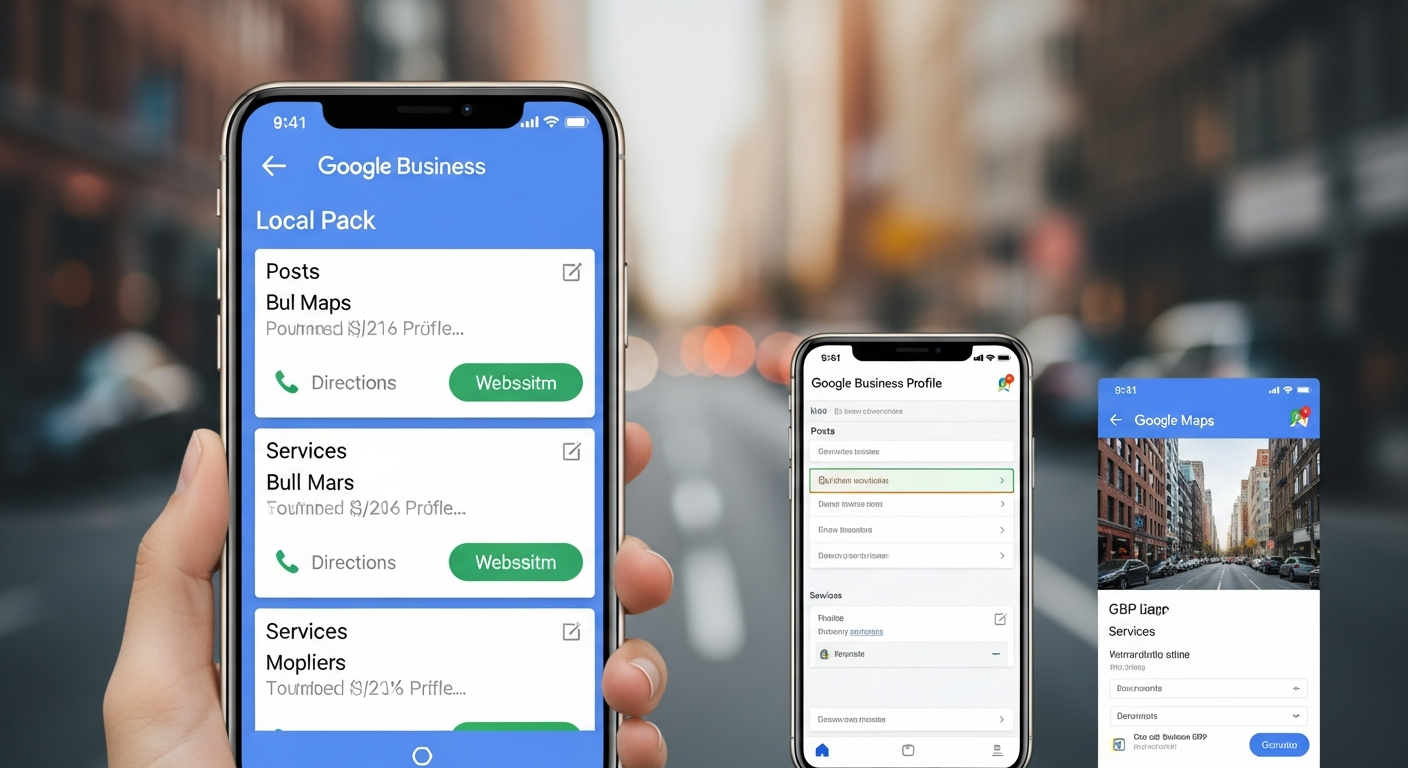
Google Business Profile optimization services help local businesses rank in the Map Pack, appear in AI Overviews, and convert searchers into booked calls. Here's what the service actually includes, what it costs, and how to tell if a provider is worth hiring.
Quick answer
Google Business Profile optimization services involve setting up and continuously managing your GBP listing so it ranks in Google's Local Pack and Map results. Core deliverables include category selection, photo management, review response strategy, Q&A population, post scheduling, service/product listing, and citation consistency audits. Done well, these services directly increase calls, direction requests, and website clicks from high-intent local searchers — not just impressions.
What Google Business Profile Optimization Services Actually Are
If someone searches 'plumber near me' or 'best Italian restaurant in Austin,' the three map listings that appear before the organic results are the Local Pack. Getting into that Pack — and staying there — is exactly what Google Business Profile (GBP) optimization services are designed to do.
Most local businesses have a GBP listing. Far fewer have one that's actively managed, accurately categorized, regularly updated, and structured to convert. That gap is where optimization services earn their fee.
This article breaks down what a reputable GBP optimization service actually delivers, what separates a real provider from a checkbox vendor, and what you can do yourself this week before spending a dollar.
What's Included in a Google Business Profile Optimization Service
The deliverables vary by provider and price point, but any service worth paying for covers the following core areas. If a provider skips more than one or two of these, ask why.
- Profile setup and verification: Claiming and verifying the listing, resolving duplicate listings, and ensuring the business is in the correct Google account with proper ownership.
- Primary and secondary category selection: Choosing the most specific primary category (e.g., 'Emergency Plumber' instead of just 'Plumber') and adding relevant secondary categories to expand your visibility surface.
- NAP consistency audit: Checking that your business name, address, and phone number match exactly across your website, GBP, and major citation sources like Yelp, Apple Maps, and data aggregators.
- Photo and video optimization: Uploading correctly sized, geotagged, high-quality photos of your interior, exterior, team, and services — and replacing outdated or low-quality images.
- Service and product listings: Populating the Services tab with keyword-rich descriptions for each service you offer, which feeds directly into how Google categorizes your relevance.
- Business description optimization: Writing a 750-character description that leads with your primary service and location, naturally includes target keywords, and reads like a real business — not a keyword list.
- Google Posts scheduling: Publishing weekly or bi-weekly posts (offers, events, updates) that signal an active, legitimate business to Google's ranking algorithm.
- Q&A management: Seeding the Q&A section with your most common customer questions and answering them — preventing misinformation and adding keyword-rich content Google can surface.
- Review response strategy: Responding to all reviews (positive and negative) within a defined SLA, which influences both ranking signals and conversion.
- Insights reporting: Monthly reporting on calls, direction requests, website clicks, and photo views — tied to actual lead outcomes, not just impressions.
“AI agents do in hours what teams used to do in weeks. The advantage compounds.”
The 4 GBP Factors That Actually Drive More Calls
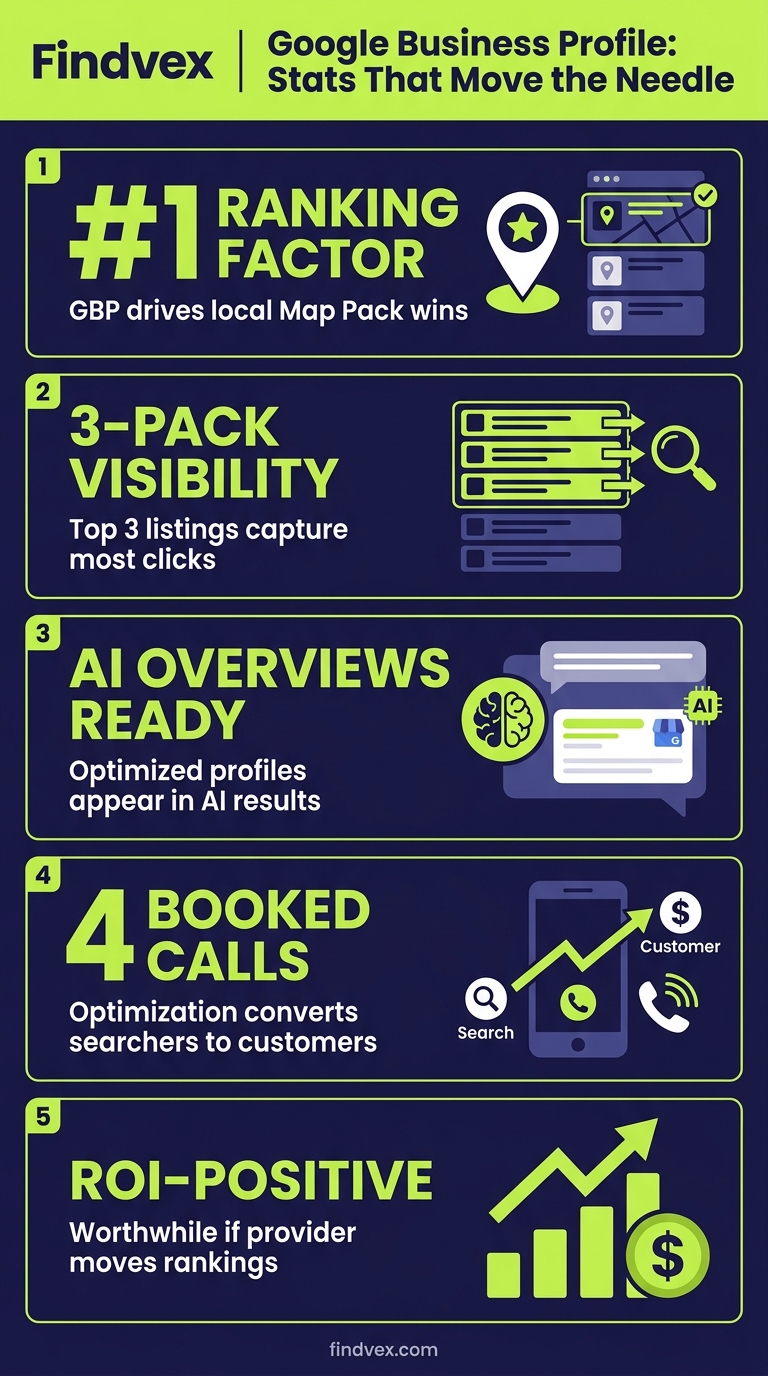
Google's local ranking algorithm weighs three broad signals: relevance, distance, and prominence. Optimization services affect all three, but not equally. Here's where the real impact lives.
- Review velocity and response rate: The number of recent reviews — and whether the business responds to them — is one of the strongest prominence signals. A business with 12 reviews from the last 60 days will typically outrank one with 200 reviews from 2021 if all else is equal. Optimization services that include a review acquisition workflow (email or SMS follow-up sequences) are worth significantly more than those that don't.
- Category precision: Broad categories like 'Contractor' or 'Health' cover hundreds of business types. The more specific your primary category, the tighter your relevance match for high-intent queries. Providers who research and test category options — rather than defaulting to the obvious choice — deliver measurably better Local Pack placement.
- Photo engagement: Google's own data shows that listings with more photos receive more direction requests and website clicks. Optimization that includes regular photo uploads (not just a one-time batch) sustains this engagement signal over time.
- Service area vs. storefront configuration: Incorrectly setting your listing as a service-area business when you have a physical location (or vice versa) suppresses your visibility. Getting this configuration right — and setting service areas at the correct granularity — directly affects which searches you appear for.
How GBP Optimization Differs by Industry
Generic GBP management works for no one. The tactics that move the needle for a dental practice differ from those for a plumbing company or a restaurant. Here's what good looks like by vertical.
- Restaurants and food service: Menu integration via the GBP menu editor or a supported third-party platform is critical. Google can surface specific dishes in AI Overviews and local searches. Consistent photos of actual dishes — not stock images — drive click-through. For more on ranking strategy for restaurants, see our guide to restaurant SEO services.
- Healthcare and dental practices: The Health category has HIPAA-adjacent considerations around reviews. GBP optimization for clinics and dental practices should include appointment booking integration, patient-safe review response templates, and careful use of service listings. Our guide to SEO for dentists covers the broader local strategy.
- Home services (plumbers, HVAC, electricians): Google Local Services Ads (LSA) work alongside GBP, not instead of it. Optimization should align GBP categories with LSA job types. Review volume is especially high-stakes here because service quality is hard to verify before hire. Our plumber SEO services article explains the full local call-generation stack.
- Real estate agents: Individual agent profiles vs. brokerage profiles need careful management. Many agents lose visibility because their brokerage's GBP dominates. Service area configuration, neighborhood-specific photo sets, and regular posts about listings all help individual agents compete.
What Google Business Profile Optimization Services Cost in 2026
Pricing structures vary widely, and the range is broad enough to be confusing. Here's a realistic breakdown of what different price points typically buy you.
$99–$299/month: Usually a templated setup service with minimal ongoing management. You'll get a one-time profile audit, some photo uploads, and a monthly report. Review management and posts are often add-ons or absent entirely. Suitable for very simple single-location businesses with low competition.
$300–$699/month: Ongoing management including posts, Q&A, review responses, and monthly reporting. Some providers at this tier include citation management. This is the most common range for small local businesses in moderate-competition markets.
$700–$1,500+/month: Multi-location management, review acquisition workflows, Local Services Ads coordination, and conversion-focused reporting (actual calls and leads, not just impressions). Providers in this tier should also be connecting GBP performance to your broader local SEO strategy — not treating it as an isolated channel.
One-time setup fees ranging from $300 to $1,000 are common and reasonable for new or unclaimed profiles. Be cautious of providers who charge setup fees but offer no ongoing management — a perfectly optimized profile that sits untouched will slowly lose ground to competitors who are actively posting and earning reviews.
What you should never pay for: guaranteed Local Pack rankings (no one can guarantee these), bulk review packages (a Google Terms of Service violation), or 'proprietary GBP algorithms' (there aren't any).
Red Flags to Watch for When Hiring a GBP Optimization Provider
The GBP optimization space has more questionable vendors than almost any other local SEO category. Here's how to filter them out quickly.
- They don't ask for your Google account access: Legitimate providers need access to your Google Business Profile via the Business Profile Manager. Anyone claiming they can 'optimize your profile' without account access is either doing surface-level work or using unauthorized methods.
- They promise Page 1 or Map Pack rankings: Local rankings depend on proximity, competition, category, and dozens of signals the provider doesn't fully control. Promises of guaranteed placement are a sales tactic, not a deliverable.
- Their reporting only shows impressions and views: Impressions are a vanity metric for local SEO. Good providers report on calls, direction requests, and website clicks — and ideally connect those to form fills or bookings through call tracking.
- They sell reviews: Incentivized or purchased reviews violate Google's policies and risk profile suspension. Any provider offering 'review generation' should mean a process for asking real customers — not buying fake ones.
- No mention of citation consistency: Your GBP doesn't exist in isolation. If your name, address, and phone number are inconsistent across the web, no amount of GBP work will fully compensate. Providers who ignore citations are solving half the problem.
Why GBP Optimization Now Affects AI Overview and AI Mode Visibility
Google's AI Overviews and AI Mode increasingly pull local business information directly from GBP data to answer queries like 'who's the best HVAC company in Charlotte' or 'find a family dentist open Saturday near me.' A fully optimized, actively managed profile gives Google's AI more structured, trustworthy data to work with — making citation in these answers more likely.
Specifically, the following GBP elements feed AI Overview generation: business categories, service listings, review content and sentiment, Q&A content, and business attributes (wheelchair accessible, free WiFi, women-led, etc.). Optimization services that treat these as static fields rather than active content opportunities are leaving AI visibility on the table.
If you're thinking about AI search visibility more broadly, our article on how local SEO turns website traffic into booked calls connects the GBP layer to the full conversion funnel. For the AI-specific angle, the 90-Day GEO Playbook for Local Search walks through how to build citation authority across AI answer engines.
DIY vs. Hiring Out: Where the Line Actually Is
You can absolutely manage your own GBP — and you should understand the basics even if you hire someone. Here's an honest breakdown of what's DIY-friendly and what genuinely benefits from professional management.
Do it yourself if: You're a single-location business with low local competition, you have 30–60 minutes per week to dedicate to the listing, you're comfortable in the Business Profile Manager dashboard, and you have a process for asking satisfied customers to leave reviews.
Hire out if: You have multiple locations, you're in a high-competition vertical (legal, medical, HVAC, dental), you don't have time for consistent upkeep, you want conversion tracking connected to actual revenue, or your competitors' profiles are clearly more active than yours.
The honest truth is that most small business owners under-invest in GBP because it feels like 'just a listing.' It's not. For service-area businesses especially, your GBP is often the first and only thing a high-intent searcher sees before deciding to call.
Do This This Week: 7 GBP Actions That Take Under 2 Hours Total
Whether you hire out or go DIY, these actions produce measurable results and cost nothing but time.
- 1. Audit your primary category (10 min): Search your top competitor in Google Maps and check their primary category. If theirs is more specific than yours, update yours in Profile Manager → Edit Profile → Business Category.
- 2. Add or update your Services tab (20 min): List every distinct service you offer with a 2–3 sentence description. Include the service name naturally in the description. This is how Google decides which searches you're relevant for.
- 3. Upload 5 new photos (10 min): Add fresh photos of your space, team, or recent work. Date them this week. Google surfaces recently uploaded photos more prominently in Maps.
- 4. Publish a Google Post (10 min): Write a short post about a current offer, seasonal service, or recent project. Include a call-to-action button linking to your booking page or contact form.
- 5. Seed 3 Q&A entries (15 min): Open your listing in Maps (logged out of your Google account), click 'Ask a question,' and post your three most common customer questions. Then log back in and answer them from the business account.
- 6. Respond to your most recent reviews (15 min): Reply to every unanswered review — positive and negative — with a personalized (not templated) response. Use the service and location naturally in positive responses.
- 7. Check NAP consistency (15 min): Google your business name and compare how it appears on Yelp, your website footer, Facebook, and Apple Maps. Any mismatch in name, address, or phone number is worth fixing immediately.
Ready to Get More Calls from Your GBP Without Guessing?
FindVex's local SEO services include full Google Business Profile management — from initial optimization to ongoing posting, review workflows, and conversion reporting. We connect your GBP performance to actual leads, not just profile views.
If you're not sure whether your current listing is working as hard as it should, start with a free local visibility audit. We'll tell you exactly what's holding your profile back and what fixing it would realistically deliver — before you spend anything.
FAQs
What does a Google Business Profile optimization service actually do?
It sets up, audits, and continuously manages your GBP listing to improve your ranking in Google's Local Pack and Maps results. Core work includes category selection, service listings, photo management, review response, Google Posts, Q&A population, and citation consistency. Ongoing management — not just one-time setup — is what drives sustained ranking and lead generation.
How much do Google Business Profile optimization services cost?
Monthly management typically ranges from $99–$1,500+ depending on the number of locations, competition level, and scope of services. Basic single-location management runs $300–$700/month from reputable providers. Multi-location or high-competition verticals (legal, medical, home services) often justify $700–$1,500+/month. One-time setup fees of $300–$1,000 are standard for unclaimed or under-optimized profiles.
Can I optimize my Google Business Profile myself?
Yes — and you should understand the basics regardless of whether you hire someone. Solo operators and single-location businesses with low competition can manage their own profiles effectively with 30–60 minutes per week. The DIY approach breaks down at scale (multiple locations), in high-competition markets, or when you need conversion tracking connected to actual revenue.
Does Google Business Profile optimization affect AI Overviews?
Increasingly, yes. Google's AI Overviews pull business information — including categories, services, reviews, and Q&A content — directly from GBP when answering local queries. A fully populated, actively managed profile gives Google's AI more reliable data to cite, which improves your chances of appearing in AI-generated local recommendations.
How long does it take to see results from GBP optimization?
Basic improvements like category fixes and service listings can improve visibility within 2–4 weeks. Sustained Local Pack ranking improvements from review growth and ongoing posting typically take 60–90 days to become measurable. High-competition markets may take longer. Be skeptical of any provider promising rapid ranking results in under 30 days.
What's the difference between GBP optimization and local SEO?
GBP optimization is a component of local SEO — arguably the most impactful single component for businesses that rely on walk-in traffic or local service calls. Full local SEO also includes on-site optimization, local landing pages, citation building, and link acquisition. GBP optimization alone will produce strong results in low- to moderate-competition markets; highly competitive verticals need the full stack.
Are Google review packages worth buying?
No — and they're a Google Terms of Service violation. Purchasing fake or incentivized reviews risks profile suspension, which eliminates your entire GBP presence. Legitimate review acquisition means building a process to ask real customers for honest feedback via email or SMS follow-up. That's what reputable GBP optimization services include.
How do I know if my current GBP optimization service is working?
Your provider should report on calls, direction requests, and website clicks from your GBP — not just views and impressions. If the only metrics in your monthly report are 'profile views' and 'search impressions,' push for call tracking data. Ideally, you should be able to trace a percentage of booked appointments or inbound calls back to Google Maps/GBP directly.
Related reading
- answer engine optimization services — Answer Engine Optimization Services: What Small Businesses Actually Get (and Whether It's Worth Paying For)
- near me seo strategy — Near Me SEO Strategy: A Local Discovery Playbook for Service Businesses
- plumber seo services — Plumber SEO Services: How to Get More Local Calls Without Paying Per Lead
- local seo services usa — Local SEO Services in the USA: Which Businesses Get the Best ROI (and Why)
- generative engine optimization services — Generative Engine Optimization Services: What Small Businesses Actually Get (and What to Ask For)
- aeo services for small business — AEO Services for Small Business: What You Actually Need (and What to Skip)
- geo services for small business — GEO Services for Small Business: What They Actually Include and Whether They're Worth It
- restaurant seo services — Restaurant SEO Services: What Actually Drives More Covers, Reservations, and Takeout Orders
- llm seo services — LLM SEO Services: How to Get Cited by ChatGPT, Claude, and Perplexity
- ai seo agency — What to Expect from a Modern AI SEO Agency (And Red Flags to Watch)
Research notes
Background claims used while researching this article. Verify with the cited authorities before quoting.
- Google's own data shows that listings with more photos receive more direction requests and website clicks
- Review velocity and recency as a Local Pack ranking factor
Sofia Patel
Head of Content & Growth · Findvex
Sofia Patel leads content and growth at Findvex. She writes about local SEO, conversion-focused content, and AEO/GEO strategy — the work that turns search visibility into booked calls and qualified leads for service businesses.
Expertise: Local SEO · Conversion content · AEO / GEO strategy · Content-led link building
Related reads
Google TurboQuant and Entity-Driven SEO: What the Compression Breakthrough Actually Means for Your Site
TurboQuant is a vector quantization algorithm from Google Research that dramatically compresses the mathematical representations AI uses to understand meaning. If it reaches production search infrastructure, it could lower the cost of semantic retrieval at scale — making entity-based content signals more dominant and keyword-match signals relatively less important.
SEO NewsHow AI Is Changing Local Search Visibility: What the SOCi + Google Webinar Revealed
Google and SOCi's joint webinar on local search visibility highlighted a fundamental shift: AI-powered discovery across Google Search, Maps, and Gemini now requires a different optimization playbook than the one most small businesses are running. Here's what changed and what to prioritize.
Strategic Technical SEODuplicate Content SEO: What Google Actually Penalizes vs. What It Silently Handles
Duplicate content rarely triggers a manual penalty. Google usually picks one version and ignores the rest. But the wrong choice by Google can split your ranking signals, waste crawl budget, and suppress pages you actually want ranked. Here's how to diagnose the difference.