Restaurant SEO Services: What Actually Drives More Covers, Reservations, and Takeout Orders
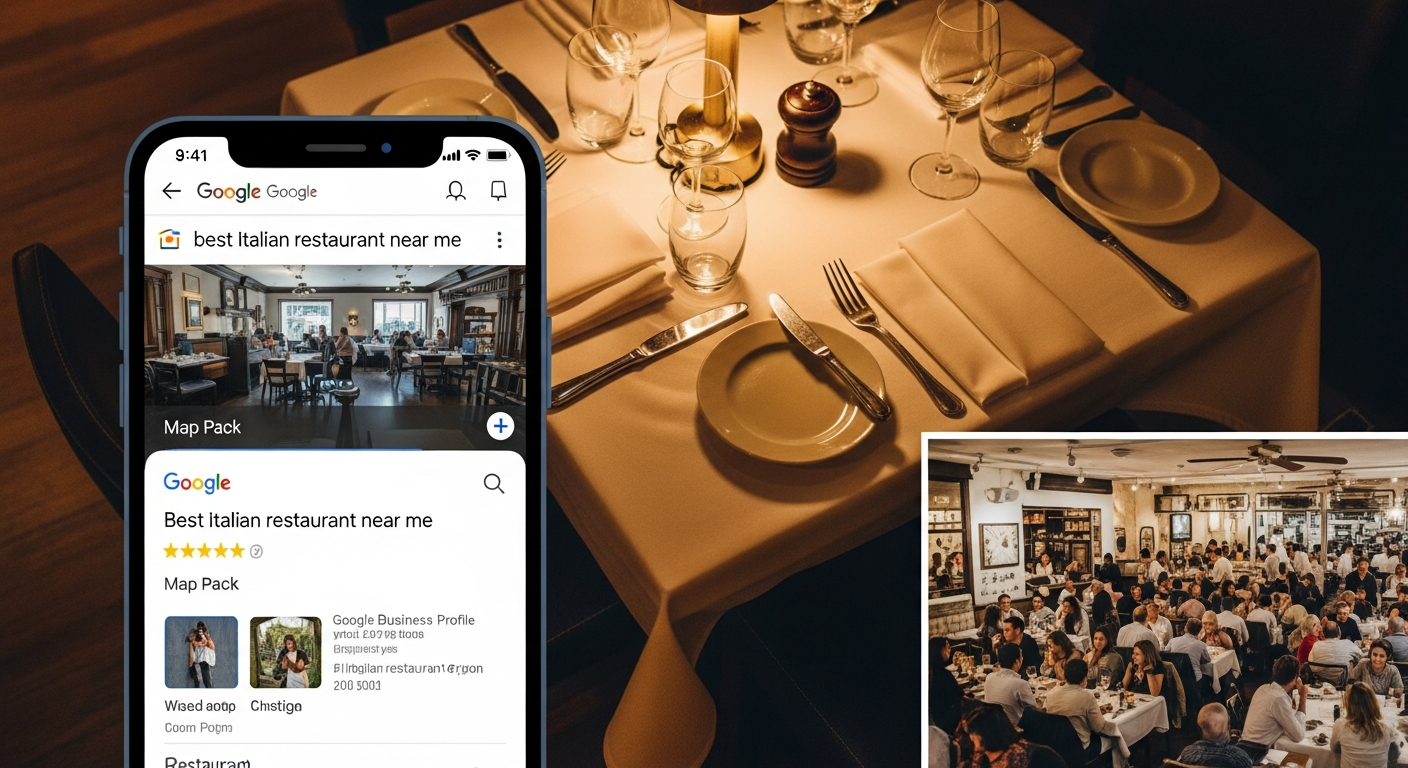
Restaurant SEO services cover Google Business Profile optimization, local keyword targeting, menu schema, and review management. Together, these push your restaurant into the Map Pack and onto the shortlists diners make before they ever pick up the phone.
Quick answer
Restaurant SEO services are a bundle of local search tactics — Google Business Profile optimization, location-based keyword targeting, menu and restaurant schema markup, citation building, and review management — that help your restaurant appear in Google's Map Pack and organic results when diners search for places to eat nearby. Most restaurants see the biggest early gains from a fully completed GBP, consistent NAP citations, and menu schema that enables rich results.
Why Restaurant SEO Is Different From Every Other Local Business
Most restaurant customers decide where to eat before they leave the house — and the shortlist is almost always built on Google. They search 'best tacos near me,' scroll the Map Pack, check photos and reviews, and tap a reservation link. Your food quality doesn't matter at that moment. Your search presence does.
That's the core problem restaurant SEO services are built to solve. Unlike SEO for law firms or clinics, restaurant SEO has to win on two separate surfaces at once: Google Maps (where the Map Pack lives) and organic blue-link results (where your menu page, neighborhood landing page, and 'best of' content can rank). Miss either surface and you're handing covers to the competitor down the street.
This guide breaks down exactly what restaurant SEO services should include, which tactics move the needle fastest, and how to hold any agency or freelancer accountable for results.
What Restaurant SEO Services Actually Include
A genuine restaurant SEO engagement is not 'posting on social' or 'writing a few blogs.' It's a set of technical and local optimization tasks that compound over time. Here's what a credible service should deliver:
- Google Business Profile (GBP) full build-out and ongoing management — categories, attributes (outdoor seating, LGBTQ+ friendly, reservations), hours, menu upload, Q&A responses, and weekly photo updates
- Local keyword research targeting both intent clusters ('Italian restaurant downtown Austin') and high-conversion modifiers ('open late,' 'private dining room,' 'gluten free menu')
- On-page SEO for your website — title tags, meta descriptions, H1s, and page copy optimized for location + cuisine type
- Restaurant schema markup — specifically Restaurant schema, Menu schema, and LocalBusiness schema to enable rich results in Google Search
- Citation building and NAP (Name, Address, Phone) consistency across Yelp, TripAdvisor, OpenTable, Yelp, Google, Apple Maps, and major data aggregators
- Review management strategy — response templates, review acquisition workflows, and handling of negative reviews
- Local link building — coverage from food bloggers, city guides, local news, and event listings
- Menu page SEO — individual dish pages or a well-structured menu page that ranks for specific queries like 'wood-fired pizza [city name]'
“AI agents do in hours what teams used to do in weeks. The advantage compounds.”
Google Business Profile: The Highest-ROI Starting Point
If you only do one thing this month, make it your Google Business Profile. For restaurants, GBP is disproportionately powerful compared to other local business types because Google surfaces a richer card — with photos, menus, reservation buttons, popular times, and diner reviews — before a user ever clicks through to your website.
An incomplete or stale GBP is one of the most common reasons restaurants get passed over in the Map Pack even when they're the obvious best option in the area.
- Choose the most specific primary category available (e.g., 'Sushi Restaurant' over 'Restaurant')
- Add every applicable secondary category — this widens the keyword footprint without any extra content work
- Upload at minimum 20 high-quality photos: interior, exterior, food dishes, staff, menu board
- Enable the Reserve button through OpenTable, Resy, or Yelp if you take reservations
- Add your full menu — either via GBP's built-in menu tool or by linking to a crawlable menu page on your website
- Set holiday hours proactively — Google penalizes profiles that show incorrect hours during holidays
- Post to GBP at least twice per week using the Updates feature: specials, events, new menu items
- Use the Products section to highlight signature dishes with photos and descriptions
Restaurant Schema Markup: The Technical Edge Most Competitors Skip
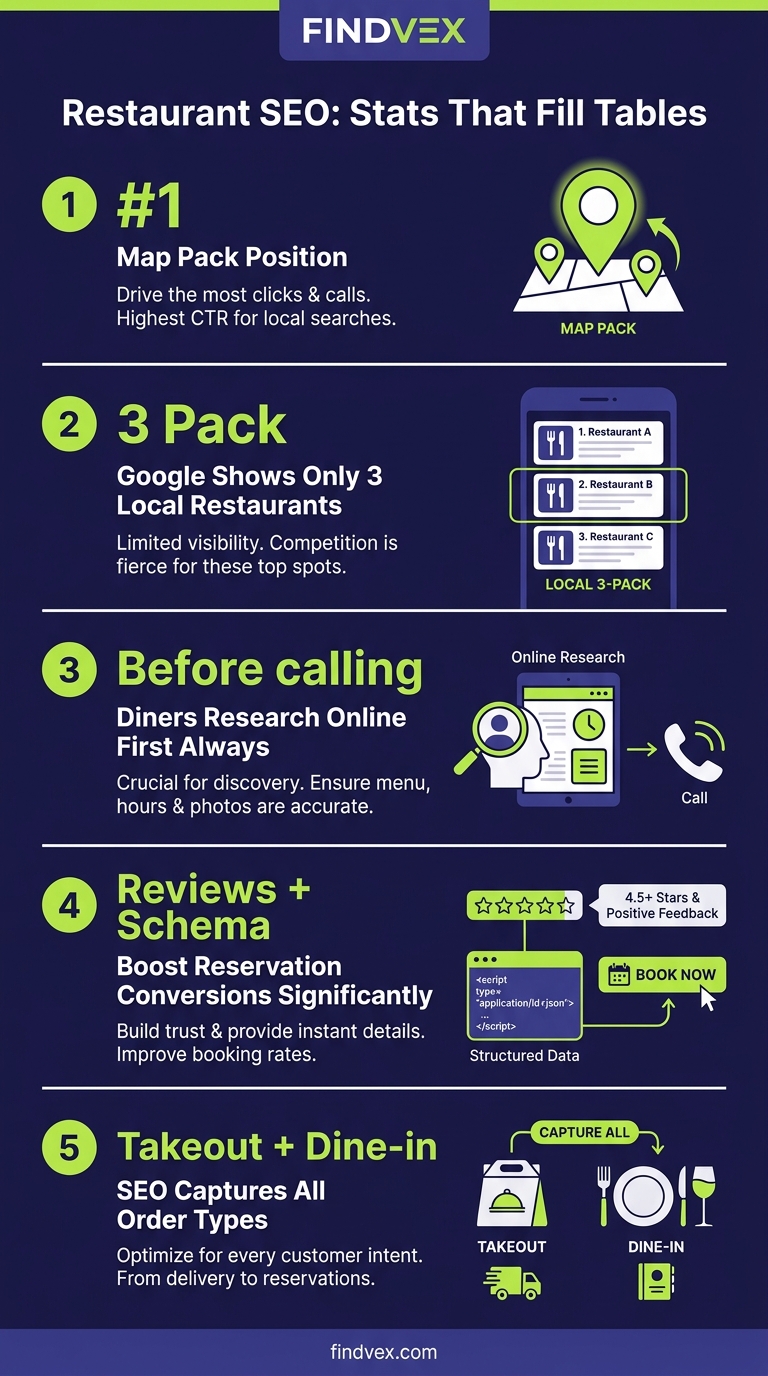
Schema markup tells Google exactly what type of business you are, what you serve, and where you're located — in a machine-readable format. For restaurants, the right schema implementation can unlock rich results (star ratings, price range, cuisine type) directly in the search snippet, which meaningfully improves click-through rate.
Three schema types matter most for restaurants:
- Restaurant (LocalBusiness subtype): Includes name, address, phone, URL, cuisine type, price range, opening hours, and accepted payment methods
- Menu schema: Lets you mark up individual menu sections and items — useful for ranking on dish-specific queries and for AI Overviews that pull restaurant details
- Review/AggregateRating schema: Pulls your star rating into organic search snippets — note this must reflect genuine reviews and comply with Google's guidelines
Keyword Strategy for Restaurants: Go Specific to Win Fast
Generic terms like 'restaurant Chicago' are won by Yelp, TripAdvisor, and Eater. You will not outrank them with a small-business website. The winning play is specificity — targeting the long-tail and cuisine-plus-location queries that aggregators don't own.
Think about how your best customers actually searched for you. They probably typed something like 'outdoor brunch spots Portland' or 'BYOB Italian restaurant Brooklyn' — not just 'Italian restaurant.' Those are the keywords with real conversion intent and manageable competition.
- Cuisine + neighborhood: 'Vietnamese food East Nashville,' 'farm-to-table downtown Denver'
- Occasion-based: 'anniversary dinner spots Seattle,' 'large group restaurant Houston'
- Attribute-based: 'dog-friendly restaurant Austin patio,' 'late night food [city]'
- Dish-specific: 'best smash burger [city],' 'truffle pasta [neighborhood]'
- Event-based: 'Valentine's Day dinner [city] 2026,' 'private dining room [city]'
Review Management: The Ranking Signal Restaurants Underestimate
Review quantity, recency, and response rate are significant local ranking factors — and for restaurants specifically, they also drive direct conversion. A restaurant with 400 reviews averaging 4.3 stars will almost always outrank a competitor with 60 reviews at 4.7 stars, because Google favors review volume and freshness alongside rating.
The most effective review acquisition tactic is the simplest: train your front-of-house staff to mention Google reviews at checkout, and add a QR code on the receipt or table card that goes directly to your GBP review link. Don't ask only happy customers — just ask consistently.
Responding to every review — positive and negative — signals to Google that the business is active. It also shows prospective diners how you handle problems, which builds trust before they ever visit.
Your Restaurant Website: The 5 On-Page Fixes That Actually Rank
A lot of restaurant websites look beautiful and rank terribly. Heavy JavaScript, no title tags, PDF menus that Google can't read, and a homepage that says nothing about where the restaurant is located. Here's what to fix first:
- Title tag formula: [Cuisine Type] Restaurant in [City, Neighborhood] | [Restaurant Name] — do this for your homepage and every location page
- Replace PDF menus with HTML menus — Google can't read PDFs reliably, and an HTML menu page can rank independently for dish queries
- Add your city and neighborhood name in your homepage H1 and first paragraph — don't make Google guess your location
- Create a dedicated 'About' or 'Our Story' page that mentions the neighborhood, nearby landmarks, and how long you've been open — this builds local topical relevance
- Add an embedded Google Map on your Contact/Location page — this reinforces geographic signals and helps with GBP association
Citation Building and NAP Consistency: The Unglamorous Work That Compounds
Citations are mentions of your business name, address, and phone number (NAP) on third-party directories. For restaurants, the priority list is: Google Business Profile, Yelp, TripAdvisor, OpenTable (if applicable), Yelp Reservations, Apple Maps, Bing Places, Facebook, and the major data aggregators (Foursquare/Factual, Neustar Localeze, Data Axle).
Inconsistent NAP — mismatched phone numbers, old addresses, name variations — sends conflicting signals to Google and can suppress your Map Pack ranking. Run a citation audit before building new ones. If you moved locations or changed your phone number in the last two years, cleaning up old listings is likely the highest-priority task.
For restaurant groups or multi-location concepts, each location needs its own separate GBP listing and citation profile. Combining them is one of the most common and damaging mistakes multi-location operators make.
AI Overviews and 'Near Me' Queries: What's Changing for Restaurants in 2026
Google's AI Overviews are increasingly appearing for restaurant queries — especially for occasion-based and attribute-based searches. When a user asks Google 'best date night restaurants in Austin with a rooftop,' an AI Overview may appear above the Map Pack pulling from GBP data, review content, and well-structured website copy.
The good news: the optimization required to appear in AI Overviews largely overlaps with traditional local SEO. A complete GBP, consistent citations, strong review volume, and structured menu content are the foundation. The difference is that your website copy needs to directly answer the questions diners are asking — not just list what you serve.
If you want to go deeper on showing up in AI-powered local search, our guide on the 90-day GEO playbook for local search covers exactly how to structure content for AI discovery.
Restaurant SEO Services: Hiring an Agency vs. Doing It In-House
Here's the honest breakdown. Most restaurant operators don't have bandwidth to run a full SEO program alongside managing staff, inventory, and covers. But not every restaurant needs a full-service agency either.
The threshold question is this: are you trying to rank in one location in a mid-size market, or are you competing in a high-density urban market or running multiple locations? The former is manageable with a part-time internal effort plus tools. The latter almost always benefits from professional help.
When evaluating restaurant SEO services, ask any agency these four questions before signing a contract:
- Can you show me current Map Pack rankings for a comparable restaurant client in a competitive market?
- What's your process for GBP management — who handles it, how often, and what does a monthly deliverable look like?
- How do you approach review acquisition without violating Google's guidelines?
- What does the first 90 days look like, and what metrics will you report on?
Do This This Week: A 5-Step Restaurant SEO Quick Start
You don't need an agency to get started. Here's what to do in the next five business days to move the needle on your restaurant's local visibility:
- Day 1 — GBP audit: Log into your Google Business Profile. Confirm your primary and secondary categories, check that your hours are correct, and count your photos. If you have fewer than 20, upload more today.
- Day 2 — Menu fix: If your menu is a PDF, email your web developer or use a page builder to create an HTML version. At minimum, list your main sections and dishes as text on a /menu page.
- Day 3 — Title tag check: Visit your homepage. Use a browser extension like MozBar or just right-click > View Page Source and search for '<title>'. Does it include your cuisine type, city, and restaurant name? If not, fix it.
- Day 4 — Citation scan: Use a free tool (BrightLocal's Citation Tracker has a free tier, or search your business name + phone number manually) to find listings with inconsistent NAP. Flag the top five for correction.
- Day 5 — Review workflow: Create a short review request message for your staff to use at checkout ('If you enjoyed tonight, a Google review would mean a lot to us — scan this code!') and print a QR card for tables. Deploy it this weekend.
How Restaurant SEO Converts Search Traffic Into Actual Revenue
Traffic without conversion is vanity. The reason restaurant SEO services are worth the investment isn't organic sessions in Google Analytics — it's reservation clicks, phone calls, direction requests, and online orders. These are the conversion actions Google tracks in GBP Insights and that you should be tracking in Google Search Console.
A well-optimized restaurant GBP typically drives direction requests (people navigating to you), website clicks, and phone calls directly from the search results page — often without the diner ever visiting your website. That means your GBP is functioning as a conversion page, not just a listing.
Set up conversion tracking for reservation clicks and phone call clicks on your website. If you're using OpenTable or Resy, check whether they provide referral source data — you want to know how many covers per month are attributable to Google search. That number is the ROI signal that justifies continued SEO investment.
For a broader look at how local SEO turns search visits into booked business, see our guide on how local SEO turns website traffic into booked calls.
FAQs
How long does restaurant SEO take to show results?
GBP improvements and citation fixes can produce visible Map Pack movement within 30 to 60 days. Organic keyword rankings for competitive terms typically take 3 to 6 months of consistent effort. Review-driven ranking improvements are faster — restaurants that run an active review acquisition campaign often see measurable GBP ranking improvements within 6 to 8 weeks.
What's the difference between restaurant SEO and regular local SEO?
Restaurant SEO emphasizes GBP more heavily than most local business types, because Google surfaces a richer restaurant card with menus, photos, popular times, and reservation links. It also relies more on cuisine-specific and occasion-based keyword targeting, and restaurant-specific schema types (Menu, hasMenu) that don't apply to other business categories.
How much do restaurant SEO services cost?
Credible restaurant SEO services in the US typically range from $500 to $2,500 per month depending on market competitiveness, number of locations, and scope of work. Single-location restaurants in smaller markets often get strong results at the lower end of that range. Multi-location groups in major cities should expect to invest more. Be cautious of packages under $300/month — at that price point, meaningful work is rarely being done.
Do I need a separate website page for my menu, or is a PDF menu fine?
An HTML menu page will almost always outperform a PDF menu for SEO purposes. Google cannot reliably index PDF content, which means dish-level search queries — 'wood-fired pizza Nashville,' 'gluten free pasta [city]' — won't find your menu. An HTML /menu page also earns internal links, loads faster on mobile, and can be marked up with Menu schema for rich results.
Can restaurant SEO help with Google Maps specifically, or just organic search?
Restaurant SEO directly targets Google Maps / Map Pack visibility. The Map Pack ranking factors — GBP completeness, proximity, review signals, citation consistency, and website relevance signals — are all addressed by a proper restaurant SEO program. Most of the highest-ROI tactics (GBP optimization, review management, citation building) are specifically designed to improve Map Pack position.
Should a restaurant try to rank for 'restaurants near me'?
You can't literally optimize for 'near me' as a keyword — Google resolves that based on the searcher's location. What you can do is ensure your GBP and website are strongly associated with your specific neighborhood, zip code, and city so that Google surfaces you when someone searches that query in your vicinity. Strong GBP signals, local reviews mentioning your neighborhood, and consistent citations are the levers that determine whether you appear in those results.
Is Yelp optimization part of restaurant SEO services?
It depends on the agency, but a comprehensive restaurant SEO service should include at least a Yelp profile audit and NAP consistency check. Active Yelp optimization — photo uploads, category verification, responding to reviews — is a separate function that some agencies include and others don't. For restaurants in markets where Yelp has strong consumer usage (especially West Coast cities), it's worth prioritizing.
Related reading
- restaurant seo — Restaurant SEO: How to Rank for Local Dining Searches
- real estate seo — Real Estate SEO: How Local Agents Win Search in 2026
- near me seo strategy — Near Me SEO Strategy: A Local Discovery Playbook for Service Businesses
- plumber seo services — Plumber SEO Services: How to Get More Local Calls Without Paying Per Lead
- local seo services — How Local SEO Turns Website Traffic Into Booked Calls
- google business profile audit — Google Business Profile Audit Checklist: 23 Things That Actually Affect Your Local Ranking
- seo for dentists — SEO for Dentists: A Practical Playbook for More Local Patients
- clinic seo services — Clinic SEO: How to Rank for "Doctor Near Me" Searches
- generative engine optimization — What Is Generative Engine Optimization (GEO)? How Small Businesses Get Found in AI Search
- google business profile optimization services — Google Business Profile Optimization Services: What Local Businesses Actually Get (and What Moves the Needle)
Research notes
Background claims used while researching this article. Verify with the cited authorities before quoting.
- Review quantity, recency, and response rate are significant local ranking factors
- Restaurant SEO services in the US typically range from $500 to $2,500 per month
Sofia Patel
Head of Content & Growth · Findvex
Sofia Patel leads content and growth at Findvex. She writes about local SEO, conversion-focused content, and AEO/GEO strategy — the work that turns search visibility into booked calls and qualified leads for service businesses.
Expertise: Local SEO · Conversion content · AEO / GEO strategy · Content-led link building
Related reads
Google TurboQuant and Entity-Driven SEO: What the Compression Breakthrough Actually Means for Your Site
TurboQuant is a vector quantization algorithm from Google Research that dramatically compresses the mathematical representations AI uses to understand meaning. If it reaches production search infrastructure, it could lower the cost of semantic retrieval at scale — making entity-based content signals more dominant and keyword-match signals relatively less important.
SEO NewsHow AI Is Changing Local Search Visibility: What the SOCi + Google Webinar Revealed
Google and SOCi's joint webinar on local search visibility highlighted a fundamental shift: AI-powered discovery across Google Search, Maps, and Gemini now requires a different optimization playbook than the one most small businesses are running. Here's what changed and what to prioritize.
Strategic Technical SEODuplicate Content SEO: What Google Actually Penalizes vs. What It Silently Handles
Duplicate content rarely triggers a manual penalty. Google usually picks one version and ignores the rest. But the wrong choice by Google can split your ranking signals, waste crawl budget, and suppress pages you actually want ranked. Here's how to diagnose the difference.