SEO for Dentists: A Practical Playbook for More Local Patients
Most dental practices lose new patients to competitors who rank higher on Google — not because they're better dentists, but because their SEO is. This playbook covers everything a dental practice needs: Google Business Profile optimization, service pages, reviews, local citations, and a 90-day action plan.
Quick answer
SEO for dentists means optimizing your Google Business Profile, building service-specific pages (implants, Invisalign, emergency dental), collecting consistent 5-star reviews, and earning local citations — so your practice appears when nearby patients search 'dentist near me' or 'teeth whitening [city].' Most practices see meaningful ranking movement within 60–90 days of fixing these fundamentals.
The Dental Practice SEO Problem Nobody Talks About
You went to dental school to treat patients — not to figure out why your competitor three blocks away keeps showing up first on Google Maps while your schedule has gaps on Tuesday afternoons. That's frustrating, and it's more common than you'd think.
Here's the reality: the dentist ranking above you probably isn't better at crowns or cleanings. They just have a more complete digital presence. Their Google Business Profile is fully filled out. They have a page dedicated to dental implants. They've accumulated 80 reviews this year while you have 12 from three years ago.
The good news? These are all fixable problems with a clear process. This playbook walks through exactly what to do — in the order that matters most for a dental practice.
Quick Answer: What Does SEO for Dentists Actually Cover?
Dental SEO is not one thing — it's a set of overlapping signals Google uses to decide which practice to show a patient who just searched 'emergency dentist near me' or 'pediatric dentist [your city].' The main pillars are: your Google Business Profile (the map listing), your website's service pages, your online reviews, your local citations, and the technical health of your website.
Each pillar feeds the others. A practice with 200 Google reviews but a slow, poorly structured website will still lose map pack rankings to a competitor who has both. You need to work all of them.
- Google Business Profile optimization (the #1 lever for map pack rankings)
- Service-specific pages on your website (implants, Invisalign, whitening, pediatric, emergency)
- Review generation — quantity, recency, and owner responses
- Local citations: consistent NAP (Name, Address, Phone) across directories
- Technical website health: speed, mobile usability, indexability
- Local landing pages if you serve multiple neighborhoods or suburbs
“AI agents do in hours what teams used to do in weeks. The advantage compounds.”
Google Business Profile: Your Most Valuable Dental SEO Asset
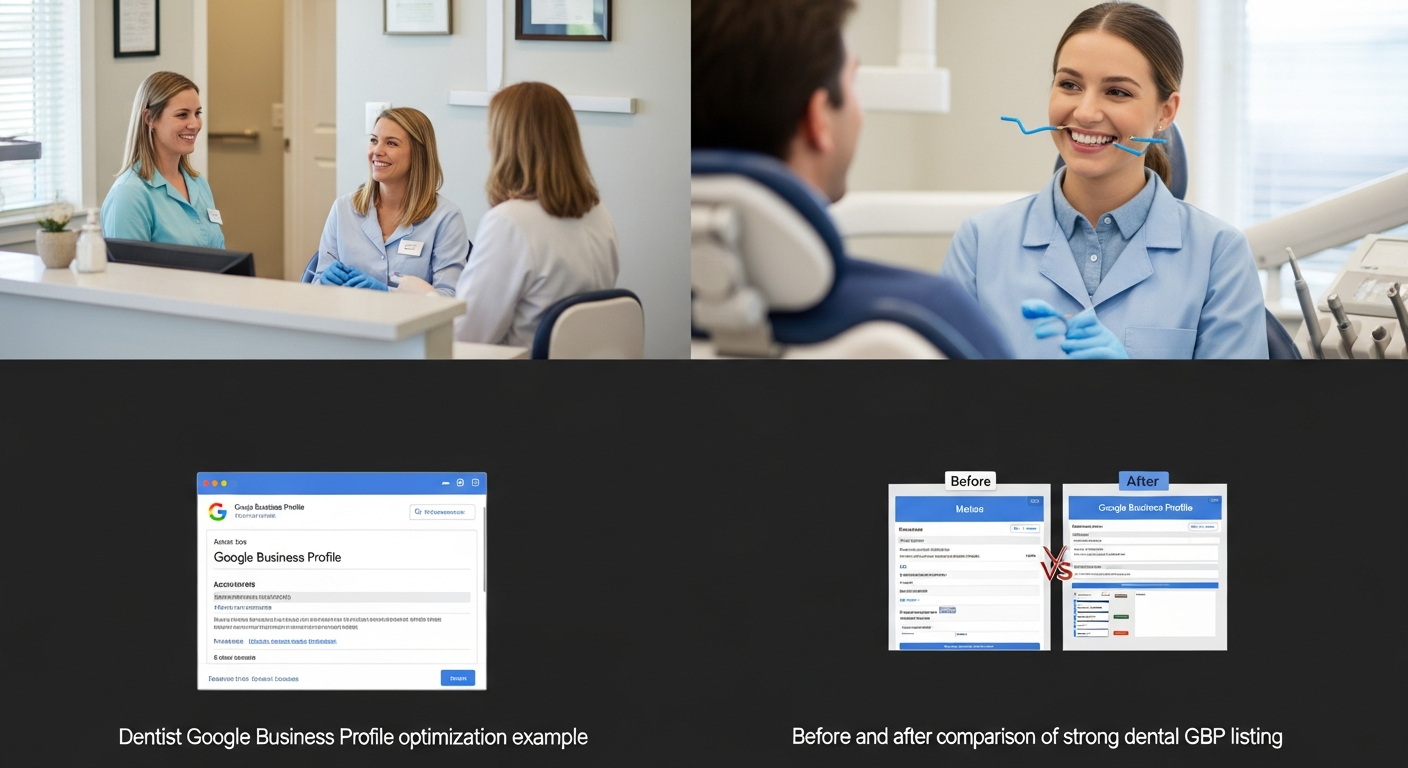
For most dental searches, the Local Pack — the map with three listings — is what patients click first. Your Google Business Profile (GBP) is what determines whether you appear there. Think of it as a second website that Google controls the layout of. Your job is to fill it in completely and keep it active.
Start with the basics: verify your practice, set your primary category to 'Dentist,' and add every relevant secondary category that applies (Cosmetic Dentist, Pediatric Dentist, Oral Surgeon, Orthodontist — whatever fits your actual services). Incomplete category selection is one of the most common GBP mistakes dental practices make.
Beyond categories, your GBP needs to work hard every week. Practices that post regular updates, answer Q&A questions, and upload fresh photos of their office and team consistently outperform inactive profiles — even when the inactive practice has more reviews.
- Set primary category: Dentist. Add secondary categories matching your actual services.
- Write a keyword-rich business description (750 characters max — use them).
- Add every service with its own name, description, and price range if applicable.
- Upload 15–20 photos: exterior, reception, operatory, team headshots, before/afters (with patient consent).
- Enable messaging and respond within a few hours.
- Post at least once a week — promotions, new services, staff spotlights, or patient education.
- Answer every question in the Q&A section before a stranger does.
- Respond to every review, positive and negative, within 48 hours.
Service Pages: The Website Foundation Every Dental Practice Needs
One of the biggest SEO mistakes dental practices make is having a single 'Services' page that lists everything in bullet points. That page cannot realistically rank for 'dental implants [city]' and 'Invisalign [city]' and 'teeth whitening [city]' all at once — the topics are too different, and Google needs a dedicated, thorough page for each.
Each high-value service should have its own page, written for the patient who is actively researching that treatment. Someone searching 'how much do dental implants cost in Austin' is in a very different mindset than someone searching 'dentist near me.' Your implants page needs to answer the cost question directly, explain candidacy, describe your process, and include patient FAQs.
Prioritize pages for your highest-revenue and most-searched services first. In most practices, that means implants, clear aligners (Invisalign or similar), cosmetic dentistry, emergency dental, and pediatric dentistry if you offer it.
- Dental Implants — include cost ranges, candidacy info, process steps, recovery
- Invisalign / Clear Aligners — compare to braces, duration, cost, candidacy
- Teeth Whitening — in-office vs. take-home, realistic results, sensitivity
- Emergency Dental Care — what qualifies, what to do first, same-day availability
- Pediatric Dentistry — first visit age, what to expect, parent FAQs
- Dental Veneers — porcelain vs. composite, process, longevity
- Root Canal Treatment — address the fear directly, modern comfort techniques
- General / Preventive Dentistry — cleanings, X-rays, sealants, fluoride
Local Landing Pages for Multi-Location or Multi-Suburb Practices
If your practice draws patients from multiple neighborhoods, suburbs, or nearby cities, you need location-specific landing pages — not just a single homepage referencing your city. A page titled 'Dentist in Riverside' will not rank for patients searching in adjacent Moreno Valley or Corona without its own dedicated page.
The key is making these pages genuinely useful rather than thin duplicates with the city name swapped out. Each page should reference local landmarks, mention nearby schools or employers, include directions from that area, and ideally feature a review or testimonial from a patient in that community. For a deep dive on building these pages correctly, see our guide on local landing pages that rank without sounding generic.
If you're a single-location practice in a city with distinct neighborhoods, a lighter approach works: reference specific neighborhoods naturally in your content and GBP posts, and build one well-optimized page for your primary service area.
Review Strategy: How Dental Practices Build Review Volume That Sticks
Reviews are the most direct trust signal for patients choosing a dentist — and they're a significant ranking factor in Google's local algorithm. Recency matters as much as total count. A practice with 40 reviews from the past six months will often outrank a practice with 200 reviews, most of which are three years old.
The most effective review generation system for dental practices is the post-appointment ask. Train your front desk and hygienists to mention the review request naturally at checkout: 'We'd really appreciate it if you left us a Google review — it takes about 30 seconds and it helps us a lot.' Follow up with an automated text or email containing a direct link to your Google review page. Most practice management software (Dentrix, Eaglesoft, Curve, Open Dental) can trigger these automatically.
Never offer incentives for reviews — this violates Google's policies and can result in review removal or profile suspension. Focus instead on making the ask easy and consistent.
- Ask at checkout verbally — train every staff member who has patient contact.
- Send a follow-up text within 2 hours of the appointment with a direct review link.
- Target 8–12 new Google reviews per month as a baseline goal.
- Respond to every review — thank positive reviewers specifically, address negative reviews calmly and offline.
- Don't neglect Healthgrades, Zocdoc, and Yelp — patients check multiple platforms.
- Never buy reviews or offer discounts in exchange for reviews.
Local Citations and NAP Consistency for Dental Practices
A citation is any mention of your practice's name, address, and phone number (NAP) on another website. Google uses citation consistency to verify that your business is legitimate and located where you say it is. Inconsistencies — your suite number listed differently across directories, an old phone number still on Yelp — create confusion and suppress rankings.
For dental practices, the most important citation sources are Google Business Profile, Bing Places, Apple Maps, Yelp, Healthgrades, Zocdoc, WebMD, Vitals, and your local Chamber of Commerce. Run your current listings through a tool like BrightLocal or Whitespark to find inconsistencies and missing listings. Clean up the NAP discrepancies before adding new citations.
- Audit existing citations for NAP consistency before building new ones.
- Priority directories: Google, Bing Places, Apple Maps, Yelp, Healthgrades, Zocdoc, WebMD, Vitals.
- Ensure your website footer NAP exactly matches your Google Business Profile.
- List your practice with your State Dental Association and local dental society — high-authority, industry-specific citations.
- Add your practice to local health directories maintained by your city or county health department.
Technical SEO Basics Every Dental Website Needs
You don't need to become a web developer, but your dental website has to meet basic technical standards or all the GBP work and content creation in the world won't get you to page one. The most common issues on dental practice websites are slow load times (often caused by uncompressed images from photo shoots), poor mobile experience, and missing or duplicate title tags.
Run your site through Google Search Console — it's free and will flag indexing issues, mobile usability problems, and Core Web Vitals failures directly. If you're seeing red or orange on the Core Web Vitals report, prioritize that before anything else. Patients searching 'emergency dentist' on a phone will bounce from a slow site immediately. For a complete checklist of what to check and fix, our technical SEO audit checklist for small business websites walks through each issue step by step.
- Verify your site in Google Search Console and review the Coverage report weekly.
- Compress all images — dental before/after photos are often 3–5MB; they should be under 200KB.
- Ensure every service page and location page has a unique, keyword-specific title tag.
- Add DentalClinic and MedicalOrganization schema markup to your homepage.
- Make sure your website is mobile-first — over 60% of local dental searches happen on phones.
- Use HTTPS. If your site still shows HTTP, fix this immediately.
- Create a clear URL structure: /services/dental-implants/, not /page?id=42.
Schema Markup Dental Practices Should Use
Structured data helps Google understand exactly what your pages are about — and it's especially useful for healthcare providers. Adding the right schema markup can get your practice's hours, address, and services displayed directly in search results without the patient needing to click through.
At minimum, implement LocalBusiness schema (with the Dentist subtype) on your homepage, including your practice name, address, phone number, opening hours, and geo coordinates. Add FAQPage schema to any service page that includes a Q&A section — this is one of the most reliable ways to win featured snippets for high-intent dental queries like 'how long do dental implants last' or 'does Invisalign hurt.'
- LocalBusiness / Dentist schema on the homepage with NAP, hours, and geo coordinates.
- MedicalOrganization schema if you operate multiple locations.
- FAQPage schema on every service page with a patient FAQ section.
- BreadcrumbList schema for site navigation.
- Review / AggregateRating schema if you display on-site reviews (do not use for Google reviews per policy).
Mistakes Dental Practices Make with SEO (and How to Avoid Them)
Most of these mistakes come from well-meaning dental marketing vendors who apply generic tactics without understanding how patients choose a dentist.
- Treating SEO as a one-time project. Google's algorithm updates regularly, competitors improve their profiles, and reviews go stale. SEO requires ongoing maintenance — at least a few hours per month minimum.
- Using the same homepage title tag for every page. Every page needs a unique title tag targeting its specific service and location.
- Ignoring negative reviews. Unanswered negative reviews damage trust more than the negative review itself. Respond calmly, take the conversation offline, and show potential patients how you handle problems.
- Building a website for the dentist, not the patient. Patients searching 'tooth pain' don't care about your dental school pedigree on the first read — they want to know if you're available today and whether you accept their insurance.
- Buying a generic dental website template from a company that uses the same content on 500 other dental practice sites. Duplicate content across practices in the same market will suppress rankings for all of them.
- Ignoring Healthgrades and Zocdoc. Many patients use these platforms specifically to find and compare dentists. An incomplete or unmanaged profile costs you referrals.
- Not tracking where new patients come from. If you don't know whether new patients found you through Google Maps, organic search, or a referral, you can't allocate your marketing budget intelligently. Ask every new patient at intake.
90-Day Dental SEO Roadmap
This is a sequenced plan based on what moves the needle fastest for a dental practice starting from scratch or cleaning up a neglected online presence. Adjust based on your current situation — if your GBP is already strong, skip ahead.
- Days 1–10: Audit your GBP completely. Fix category, hours, services, description, photos. Claim any unclaimed duplicate listings and mark them as closed or merge them.
- Days 11–20: Run a NAP audit across your top 10 citation sources. Fix every inconsistency. Update your website footer to match exactly.
- Days 21–30: Set up Google Search Console if not already active. Fix any crawl errors, indexing issues, or mobile usability warnings.
- Days 31–45: Create or rewrite your three highest-revenue service pages (typically implants, clear aligners, and emergency dental). Each page should be 600–900 words with a FAQ section and a clear call to action.
- Days 46–60: Launch a review generation process. Train staff, set up automated follow-up texts, and target 8+ new Google reviews per month going forward.
- Days 61–75: Add LocalBusiness and FAQPage schema markup to your homepage and service pages. Compress all images. Check title tags on every page.
- Days 76–90: Create or improve location pages for your top two or three surrounding neighborhoods/suburbs. Post weekly on GBP. Review your Google Search Console data and identify which queries are gaining impressions — double down on those topics.
Ready to Put This Into Practice?
The practices winning on Google Maps aren't doing anything mysterious — they're doing the fundamentals consistently and completely. Most dental practices have significant gaps in at least two or three of the areas covered in this playbook.
If you'd rather have an expert identify exactly where your practice is losing ground and build a prioritized fix list, FindVex offers dental SEO audits and local search strategy for practices that want a clear action plan without the guesswork. No long-term contracts. No generic templates. Just a specific plan for your market.
Use the contact form below to tell us your practice name and city — we'll take a look at your current rankings and send back an honest assessment within 24 hours.
FAQs
How long does dental SEO take to show results?
Most dental practices see measurable improvement in Google Maps rankings within 60–90 days of fully optimizing their Google Business Profile and building consistent review velocity. Organic website rankings for competitive terms like 'dental implants [city]' typically take 3–6 months of consistent effort. Emergency dental and 'dentist near me' searches respond faster because they're heavily influenced by GBP signals.
What's the most important SEO factor for dentists?
For local search — which is where most new patient searches happen — your Google Business Profile is the single most important factor. A complete, active, well-reviewed GBP will outperform a beautifully designed website that has been ignored. That said, the two work together: a strong GBP drives patients to your website, and a well-built website converts them into appointments.
Should a dental practice do SEO in-house or hire an agency?
It depends on your team's capacity and technical comfort. GBP management, review responses, and posting can realistically be handled in-house by a front desk coordinator with the right training. Technical website work, schema implementation, and competitive keyword strategy are usually better handled by a specialist. A hybrid approach — handling reviews and GBP internally, outsourcing technical and content work — is often the most cost-effective model for small and mid-sized practices.
How many Google reviews does a dental practice need to rank?
There's no magic number, and review count is just one of many local ranking factors. What matters more than total count is recency and response rate. A practice with 50 reviews from the past year will often outrank a practice with 150 reviews that are 3–4 years old. Aim for a steady, sustainable pace — 8 to 12 new reviews per month is an achievable and meaningful target for most practices.
Do dentists need separate pages for each service?
Yes, for services that patients actively search for. High-value, frequently searched services — dental implants, Invisalign, teeth whitening, emergency dental, pediatric dentistry — each need their own dedicated page. A single 'Services' page listing everything cannot realistically rank for multiple competitive keywords. Each page targets a specific patient intent and a specific keyword.
What is NAP consistency and why does it matter for dental SEO?
NAP stands for Name, Address, and Phone number. Google cross-references your practice information across dozens of directories, review sites, and healthcare platforms. If your address is listed differently (Suite 200 vs. Ste. 200 vs. no suite number), or an old phone number is still listed on Yelp, Google may treat these as different businesses or reduce confidence in your listing's accuracy — which suppresses your map rankings. Audit and standardize your NAP across all platforms.
Is Healthgrades important for dental SEO?
Healthgrades is important for two reasons: patients use it directly to compare and choose dentists, and it's a high-authority citation source that signals legitimacy to Google. An incomplete or unmanaged Healthgrades profile costs you both direct referrals and citation value. Claim your profile, fill it out completely, and monitor it for new reviews.
Sources & Citations
David Kim
Writing about AI, search, and what actually moves the needle for US small businesses.
Related reads
Real Estate SEO: A Practical Guide for Small Businesses
Real estate SEO helps agents, brokerages, and property managers rank in local Google searches so buyers and sellers find them first. This guide covers everything from Google Business Profile to IDX optimization and neighborhood content—practical steps you can start this week.
local-seo-for-service-businessesNear Me SEO: A Practical Guide for Small Businesses
"Near me" searches connect high-intent buyers to local businesses — but ranking for them requires more than just adding the phrase to your website. This guide covers every lever you can pull, from your Google Business Profile to on-page signals and review strategy.
seo-newsTracking Parameters in Internal Links Are Hurting Your SEO — Here's How to Fix Them
Tracking parameters like UTM codes belong in your analytics tool, not in your internal links. When they end up in internal hrefs, they create duplicate page versions, confuse Googlebot, and dilute the link equity passing through your site. Here's the technical breakdown and a practical fix.