Clinic SEO: How to Rank for "Doctor Near Me" Searches
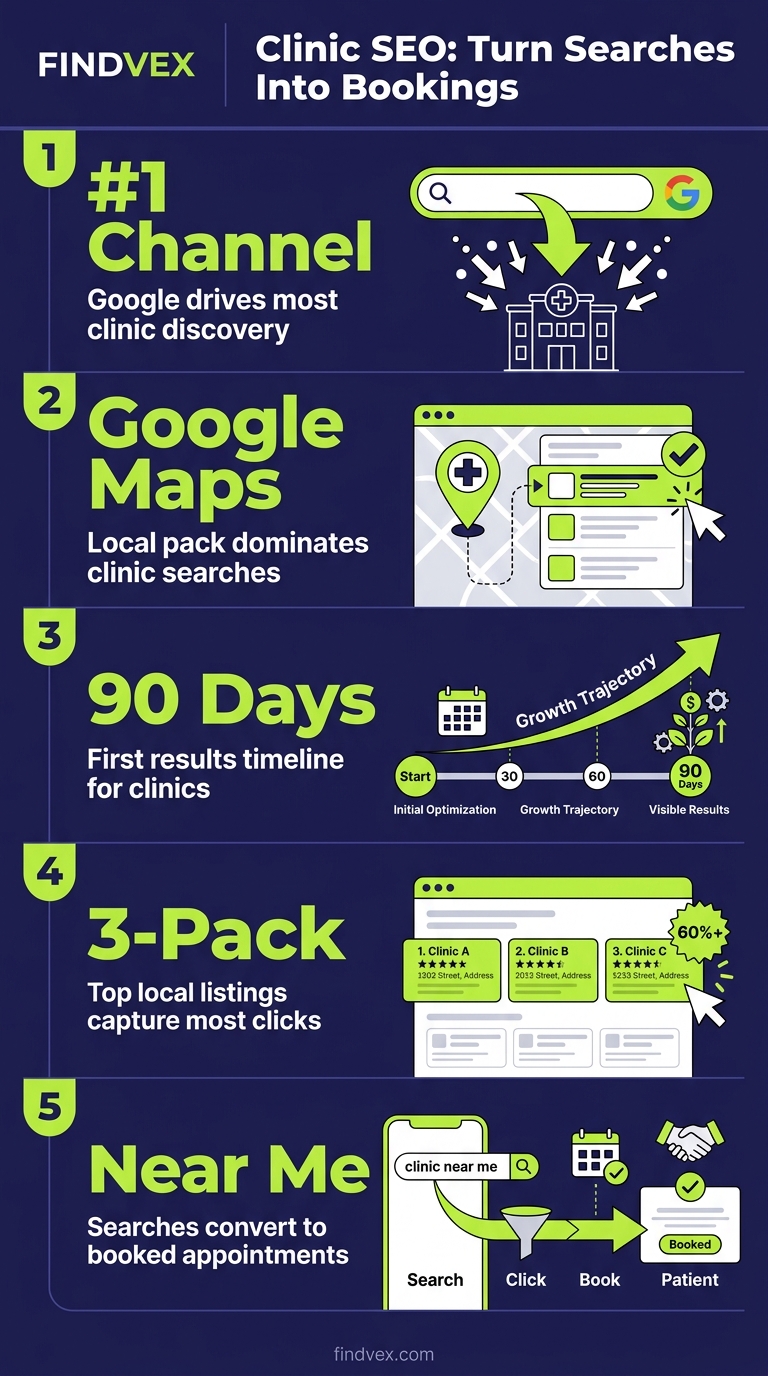
Clinic SEO services help medical, dental, and specialty practices rank higher in local Google searches and Google Maps — turning search visibility into booked appointments. This guide covers what good clinic SEO looks like, what to expect from a provider, and how to prioritize your first 90 days.
Quick answer
Clinic SEO services are local search optimization strategies specifically designed for medical and specialty practices. They typically include Google Business Profile optimization, local keyword targeting (e.g., 'urgent care near me'), on-page SEO for service pages, citation building, and review management. A well-run clinic SEO campaign should increase organic search visibility and drive a measurable uptick in appointment bookings within 90–180 days.
Why Clinic SEO Is Different From General Local SEO
If you run a dental practice, urgent care center, physical therapy clinic, or any health-related small business, you already know the competition for local patients is fierce. Someone searches 'pediatric dentist near me' or 'physical therapy [city name]' — and whichever practice shows up first gets the call.
Clinic SEO services are not the same as generic local SEO. They need to account for healthcare-specific trust signals (reviews, credentials, provider bios), HIPAA-adjacent content considerations, and the fact that patients searching for care are often in a high-intent, time-sensitive mindset. That means your site architecture, content, and Google Business Profile need to be dialed in differently than a plumber or restaurant would be.
The good news: most clinic websites are technically under-optimized, which means there's real ranking upside available without a massive budget.
What Clinic SEO Services Should Actually Include
Not all SEO agencies understand the healthcare space. Here's what a legitimate clinic SEO service should cover — and what you should ask about before signing anything.
- Google Business Profile (GBP) optimization — Your GBP listing is often the first thing a prospective patient sees. A clinic SEO provider should optimize your categories, service descriptions, appointment link, photo library, and posting cadence. They should also monitor and respond to reviews.
- Local keyword targeting — This means identifying the actual phrases patients type: 'family doctor accepting new patients [city],' 'walk-in clinic open Sunday,' 'sports medicine near me.' Generic 'doctor SEO' keywords are too broad to convert.
- Service page SEO — Each core service your clinic offers (e.g., teeth whitening, sports physicals, prenatal care) deserves its own optimized page with a clear headline, local signals, and a booking CTA. One long homepage is not enough.
- Citation building and NAP consistency — Your clinic's Name, Address, and Phone number must be consistent across directories like Healthgrades, Zocdoc, Yelp, WebMD, and the major data aggregators. Inconsistencies confuse Google and erode local ranking authority.
- Review acquisition strategy — Reviews directly influence both Google Maps ranking and patient trust. A good SEO provider will set up a system (text or email follow-up) to consistently collect new reviews — not just ask you to 'encourage patients to leave reviews.'
- On-page technical SEO — Title tags, meta descriptions, header structure, page speed, and mobile usability all matter. Healthcare sites are often built on dated CMS platforms with unresolved technical issues that silently suppress rankings.
- Schema markup — LocalBusiness, MedicalOrganization, Physician, and FAQ schema help Google understand your clinic's identity and surface rich results in search.
- Content strategy for patient questions — Blog posts and FAQ pages answering real patient questions (e.g., 'how long does a dental cleaning take?') build topical authority and capture informational search traffic that feeds your appointment funnel.
“AI agents do in hours what teams used to do in weeks. The advantage compounds.”
Red Flags to Watch for When Evaluating Clinic SEO Providers
The SEO industry has no shortage of providers who promise Google page-one rankings in 30 days and deliver nothing but a monthly report full of vanity metrics. In the healthcare space, where patient trust is everything, a bad SEO agency can actually damage your reputation.
Here are the warning signs that should make you walk away:
- Guaranteed #1 rankings — No ethical SEO agency can guarantee specific rankings. Google's algorithm isn't controllable. Anyone who says otherwise is either lying or planning to use tactics that will eventually get your site penalized.
- No mention of your Google Business Profile — If an agency pitches you on 'SEO' but doesn't discuss GBP as a core part of the plan, they don't understand how local clinic search actually works.
- Link schemes or PBNs — Buying links from low-quality networks is a fast way to tank your domain authority. Ask how they build links. Good answers involve digital PR, local citations, and supplier/partner directories.
- Keyword reports that don't connect to appointments — If the only metrics they report are rankings and impressions, ask them to connect those numbers to calls and bookings. If they can't, you're paying for traffic that isn't converting.
- Cookie-cutter content — Clinics with identical blog posts swapped only by city name will get flagged for thin content. Demand evidence of clinic-specific content strategies.
- No healthcare industry experience — SEO for a medical or dental practice carries nuances around E-E-A-T (Experience, Expertise, Authoritativeness, Trustworthiness) that generic agencies often miss. Google holds health-related pages to a higher standard under its Quality Rater Guidelines.
SEO Priorities by Clinic Type
Different clinic types have different patient search patterns and competitive landscapes. Here's how priorities shift depending on your practice.
- Dental practices — Reviews and GBP dominate. 'Dentist near me,' 'emergency dentist [city],' and 'teeth whitening [city]' are high-intent keywords worth building dedicated landing pages for. Our guide on SEO for dentists covers the full playbook.
- Medical/primary care clinics — Focus on 'accepting new patients' keywords and insurance-related searches. Healthgrades and Zocdoc citations are critical authority signals in this vertical.
- Physical therapy and chiropractic — Condition-specific pages perform well: 'lower back pain treatment [city],' 'rotator cuff physical therapy near me.' Schema for MedicalCondition and MedicalTherapy helps with rich results.
- Mental health practices — High-sensitivity content requires careful SEO. E-E-A-T signals (licensed provider bios, credentials, evidence-based treatment descriptions) are especially important. Avoid aggressive calls-to-action on pages addressing crisis-related topics.
- Urgent care and walk-in clinics — Speed and availability are the core patient questions. GBP hours must be accurate and updated in real time. 'Open now' and 'urgent care open Sunday' keyword targeting should be a priority.
- Specialty clinics (dermatology, orthopedics, fertility, etc.) — Procedure-specific pages rank well and convert at a high rate because they match surgical-level search intent. Build a page for every major procedure your clinic performs.
The Technical SEO Foundation Every Clinic Website Needs
Before any content or link-building work pays off, your clinic's website has to be technically sound. This is the unsexy work that most clinic owners overlook — and it's often what's suppressing rankings.
Run through this foundation checklist before investing in broader SEO services:
- Mobile-first design — The majority of local health searches happen on smartphones. Your site must load fast, display cleanly, and have a visible 'Book Appointment' or 'Call Now' button above the fold on mobile.
- Page speed and Core Web Vitals — Slow pages lose patients before they ever read your content. Use Google Search Console's Core Web Vitals report to identify LCP (Largest Contentful Paint) and CLS (Cumulative Layout Shift) issues. Our guide on Core Web Vitals for SEO breaks down exactly what to fix first.
- HTTPS — Every clinic website must run on HTTPS. HTTP sites signal untrustworthiness to both Google and patients, and browsers will actively warn users away.
- Crawlability and indexing — Use Google Search Console's Pages report to verify your key service pages are indexed. Surprisingly common: clinic sites that accidentally block pages via robots.txt or noindex tags. See our indexing issues guide if this applies to you.
- Structured data (schema) — Implement LocalBusiness or MedicalOrganization schema on your homepage, Physician schema for provider pages, and FAQ schema on any page with patient questions. This gives Google the signal structure it needs to generate rich results.
- Canonical tags — Many clinic websites on platforms like WordPress or Wix accidentally create duplicate URLs. Canonical tags tell Google which version to index and rank.
Google Business Profile and Reviews: The Fastest Wins for Clinics
For most clinics, the Google Business Profile is the single highest-leverage asset in local SEO — and it's free. Yet most practice owners set it up once and never touch it again.
Here's what an actively managed GBP looks like for a clinic:
- Primary category accuracy — Use the most specific category available (e.g., 'Dental Clinic' rather than just 'Health'). Add all relevant secondary categories.
- Services listed with descriptions — Every service your clinic offers should be listed in the Services section with a written description. Google uses this to match your profile to searches.
- Photos updated monthly — Real photos of your waiting room, staff, and exterior build trust and improve GBP engagement signals. Clinics with more photos tend to get more profile views.
- Posts published weekly — Use Google Posts for promotions, new provider announcements, hours updates, or seasonal health tips. Consistent posting signals an active, trustworthy practice.
- Review response rate — Respond to every review, positive and negative. A professional, empathetic response to a negative review can neutralize reputational damage. Non-responses signal indifference.
- Appointment link configured — Your GBP should link directly to your booking page, not just your homepage. Reduce the friction between 'found you on Google' and 'appointment booked.'
Content Strategy That Drives Clinic Appointments, Not Just Traffic
Content for clinic SEO has to do more than rank — it has to convert a health-anxious person into a patient who books an appointment. That means every piece of content needs a job.
Here's a content framework that connects traffic to appointments:
- Service pages — One page per service, with a local keyword in the title (e.g., 'Root Canal Treatment in Austin, TX'), a description of the procedure, what to expect, provider credentials, and a booking CTA.
- Location pages — If you serve multiple areas or have multiple locations, build dedicated pages for each. Generic pages that only change the city name won't rank. Each page needs unique content that references local landmarks, neighborhoods, and community context. Our guide on local landing pages covers this in depth.
- Provider bio pages — Patients search for doctors by name. Optimized provider pages with credentials, specialties, languages spoken, and a headshot improve both rankings and conversion.
- Patient FAQ content — Answer the questions your front desk gets every day: 'Do you accept [insurance]?' 'How long is a new patient appointment?' 'What should I bring to my first visit?' This content ranks for informational queries and builds trust before the appointment.
- Condition and symptom pages — For specialty clinics, pages targeting specific conditions ('symptoms of carpal tunnel,' 'when to see a dermatologist') capture patients early in their search journey and funnel them toward booking.
How to Measure Whether Your Clinic SEO Is Actually Working
Rankings and impressions are not the metrics that matter to a clinic owner. What matters is new patient appointments. Here's how to track clinic SEO results in a way that connects to revenue:
- Google Business Profile Insights — Track calls, direction requests, and website clicks from your GBP listing. These are direct indicators of patient intent, not just awareness.
- Google Search Console — Monitor clicks and impressions for your most important service and location keywords. Look for upward trends over 90-day windows, not week-to-week noise.
- Call tracking — Use a call tracking number on your website (distinct from your GBP number) to attribute phone calls to organic search. Most SEO platforms and even Google Ads offer this capability.
- Conversion rate on service pages — In Google Analytics 4, set up conversion events for appointment form submissions and click-to-call actions. A service page that gets 200 visits/month but zero conversions needs CRO work, not more traffic.
- New patient source data — Add 'How did you hear about us?' to your intake form and track it. Organic search attribution is always imperfect, but this gives you a directional signal.
Do This This Week: Your 5-Day Clinic SEO Action Plan
You don't need to tackle everything at once. Here's a focused five-day sprint to build momentum before you engage a full SEO service:
- Day 1 — Audit your Google Business Profile. Log into your GBP dashboard. Check that every field is complete: categories, services, hours (including holiday hours), appointment link, and photos. Update anything that's outdated.
- Day 2 — Run a site:yourdomainname.com search in Google. Look at how many pages are indexed. If key service pages are missing, check Google Search Console's Pages report for exclusions. Flag any indexing issues for your web team or SEO provider.
- Day 3 — Test your site on mobile. Use Google's Mobile-Friendly Test tool. If your booking button isn't visible without scrolling, that's a priority fix. Check page load speed with PageSpeed Insights.
- Day 4 — Audit your reviews. Count how many Google reviews you have and your average rating. Set a goal: most competitive clinic markets require 50+ reviews to rank consistently in the Local Pack. Set up a review request workflow this week (a simple text message to patients post-visit works).
- Day 5 — Map your service pages. List every service your clinic offers. Check whether each service has a dedicated page on your site. If not, prioritize building those pages — starting with your highest-revenue or highest-demand services.
Choosing the Right Clinic SEO Provider: Questions to Ask
If you're ready to hire a clinic SEO service, here are the questions that will separate credible providers from those who will take your money and underdeliver:
- 'Can you show me case studies from other medical or healthcare practices?' — Look for specifics: what keywords they moved, how calls or bookings changed, how long it took.
- 'What does your first 90 days look like?' — A structured onboarding that starts with technical audit, GBP optimization, and keyword mapping signals an experienced team.
- 'How do you report results, and what metrics do you track?' — If the answer is only rankings and traffic, push them on calls, form submissions, and GBP actions.
- 'What is your content process?' — Will you review and approve content before it's published? For healthcare, this matters. Factual errors or unsubstantiated medical claims carry real risk.
- 'Do you build links, and how?' — Demand transparency. Citation building and local PR are legitimate. Link farms and PBNs are not.
- 'Who will actually work on my account?' — Many agencies sell with senior staff and service with juniors. Know who your day-to-day contact is and what their experience level is.
FAQs
How much do clinic SEO services cost?
Clinic SEO services typically range from $750 to $3,500 per month depending on market competitiveness, number of locations, and the scope of services included. Single-location practices in smaller markets can often see meaningful results at the lower end of that range. Larger practices in competitive metro areas should expect to invest more. Be cautious of packages priced under $500/month — at that price point, execution is often automated and minimal.
How long does it take for clinic SEO to show results?
Most clinics start seeing measurable improvements in Google Business Profile visibility and local pack rankings within 60–90 days of consistent optimization. Organic rankings for service and location pages typically take 3–6 months to meaningfully move, especially in competitive markets. Expect a 6-month commitment before evaluating whether an SEO provider is delivering.
Can I do clinic SEO myself, or do I need an agency?
You can handle some foundational work yourself — optimizing your Google Business Profile, adding schema markup, improving your service pages, and asking patients for reviews. For competitive markets or multi-location practices, a specialized agency will likely move faster and with fewer mistakes. A hybrid approach works well: do the GBP and review work in-house, and outsource the technical SEO, link building, and content production.
What is the most important ranking factor for clinic local SEO?
Google's local ranking algorithm weighs three main factors: relevance (does your profile and website match the search query?), distance (how close is your clinic to the searcher?), and prominence (how well-known and trusted is your practice based on reviews, citations, and links?). For most clinics, prominence — especially review volume and GBP completeness — is the factor with the most room to improve quickly.
Does HIPAA affect what I can say in my SEO content?
HIPAA primarily governs patient health information, not marketing content. You can write freely about services, conditions, procedures, and staff credentials without HIPAA concerns. Where you need to be careful is with patient testimonials or case studies — you cannot use a patient's identifiable information (including a photo or specific story) for marketing without a signed HIPAA-compliant authorization.
Should my clinic target 'near me' keywords in its content?
You don't need to literally write 'near me' on your pages — Google automatically maps proximity-based searches to businesses in the area. Instead, use your city and neighborhood names throughout your service pages, titles, and meta descriptions. Consistent local signals across your website and GBP profile are what help you rank when someone searches 'dentist near me' from down the street.
How important are online reviews for clinic SEO?
Reviews are one of the highest-impact ranking factors for clinic local SEO, and they also directly influence whether a patient chooses your practice over a competitor. Clinics with a consistent stream of recent, positive reviews outperform those with older, static review profiles — even if the older total is higher. Building a systematic post-visit review request process is one of the best ROI moves a clinic can make.
Related reading
- near me seo strategy — Near Me SEO Strategy: A Local Discovery Playbook for Service Businesses
- llm seo services — LLM SEO Services: How to Get Cited by ChatGPT, Claude, and Perplexity
- real estate seo — Real Estate SEO: How Local Agents Win Search in 2026
- seo for dentists — SEO for Dentists: A Practical Playbook for More Local Patients
- local seo services — How Local SEO Turns Website Traffic Into Booked Calls
- restaurant seo — Restaurant SEO: How to Rank for Local Dining Searches
- ai seo agency — What to Expect from a Modern AI SEO Agency (And Red Flags to Watch)
- GEO playbook local search — The 90-Day GEO Playbook for Local Search: How To Show Up When AI Does The Searching
- small business seo strategy — The 2026 SEO Strategy Small Businesses Should Actually Follow
- google search update — What Changed in Google Search This Week and What Small Businesses Should Do
Research notes
Background claims used while researching this article. Verify with the cited authorities before quoting.
- Price range for clinic SEO services ($750–$3,500/month)
- 60–90 day GBP improvement timeline and 3–6 month organic ranking timeline
- Google's local ranking algorithm factors: relevance, distance, prominence
- Google Quality Rater Guidelines holding health-related pages to higher E-E-A-T standard
Sofia Patel
Head of Content & Growth · Findvex
Sofia Patel leads content and growth at Findvex. She writes about local SEO, conversion-focused content, and AEO/GEO strategy — the work that turns search visibility into booked calls and qualified leads for service businesses.
Expertise: Local SEO · Conversion content · AEO / GEO strategy · Content-led link building
Related reads
How AI Models Actually 'Understand' Your Brand — and What to Do When They Get It Wrong
AI models construct a representation of your brand from training data, retrieval signals, and cited sources — a process that's invisible, imperfect, and increasingly consequential. If ChatGPT, Perplexity, or Google's AI Overviews are describing your business inaccurately, the fix isn't a phone call to OpenAI. It's a deliberate content and citation strategy.
Keyword ResearchHow to Find Competitor Keyword Gaps Without Wasting Budget
Competitor keyword gap analysis tells you exactly which search terms your rivals rank for that you don't. Done right, it's one of the highest-ROI moves in SEO. Done wrong, it produces a bloated list of irrelevant keywords you'll never recover from. Here's how to do it right.
SEO NewsThe 90-Day GEO Playbook for Local Search: How To Show Up When AI Does The Searching
When someone asks ChatGPT 'best HVAC company near me,' your Google ranking doesn't matter if you're not in the AI's answer. This 90-day GEO playbook shows small businesses exactly how to build the signals that get you cited in AI-powered local search.