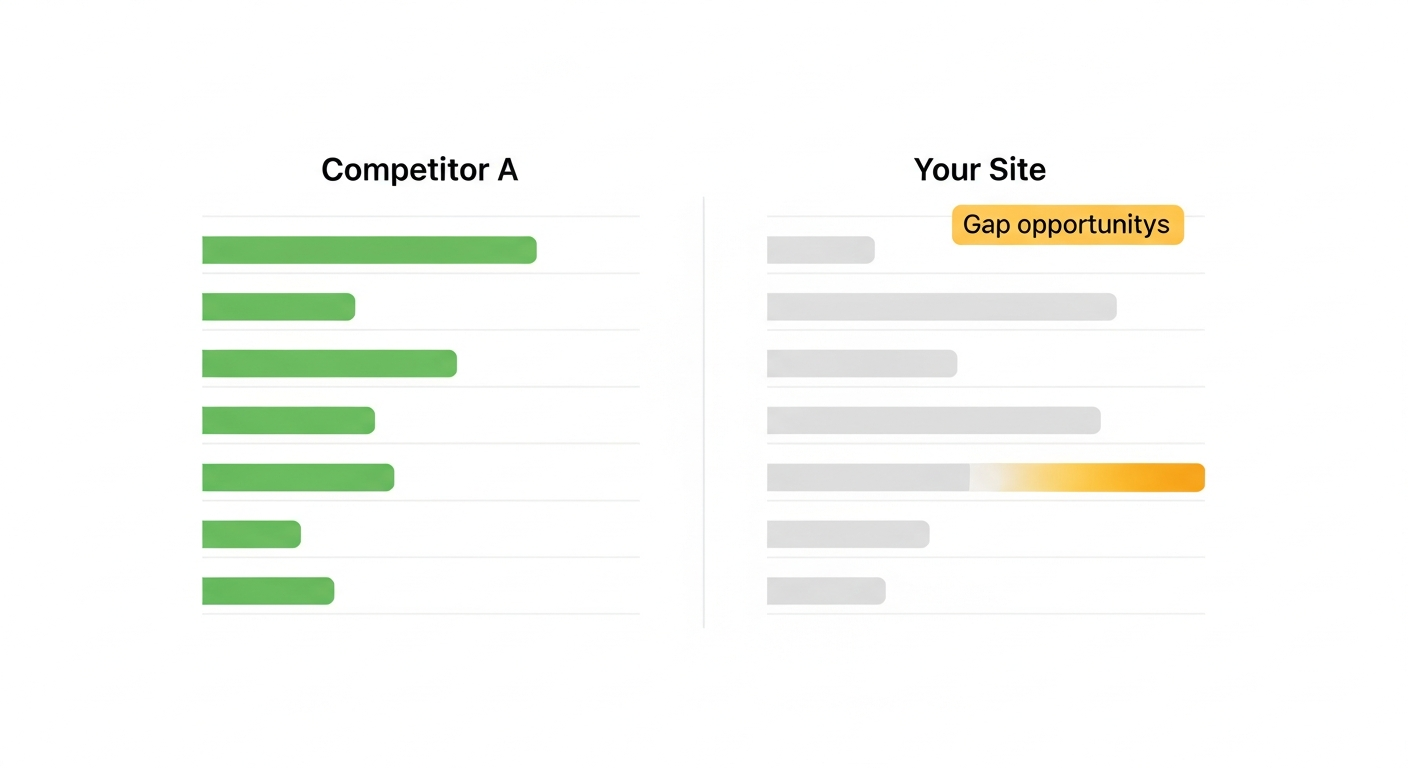
How to Find Competitor Keyword Gaps Without Wasting Budget
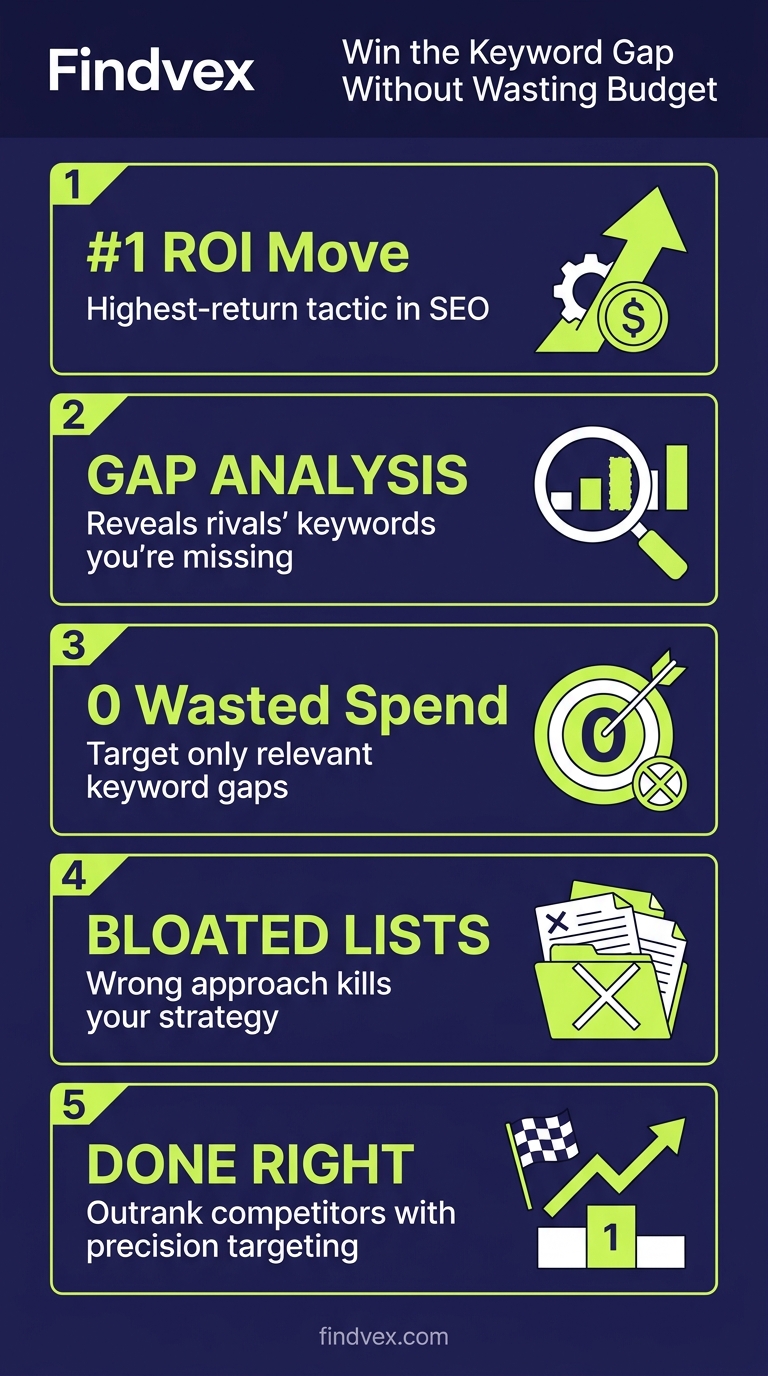
Competitor keyword gap analysis tells you exactly which search terms your rivals rank for that you don't. Done right, it's one of the highest-ROI moves in SEO. Done wrong, it produces a bloated list of irrelevant keywords you'll never recover from. Here's how to do it right.
Quick answer
A competitor keyword gap is any search term your competitors rank for in Google that your website does not. To find them: (1) identify 3–5 real search competitors, (2) pull their organic keyword sets using a tool like Ahrefs, Semrush, or Moz, (3) filter for terms where they rank in positions 1–20 but you have no ranking at all, (4) score each gap by search volume, keyword difficulty, and business relevance, then (5) build or update pages only for gaps that match your actual services and buyer intent.
Why Most Keyword Gap Analyses Waste Money
A competitor keyword gap analysis sounds like free money. Your rivals are already ranking for terms you're not—just publish a page and grab their traffic, right? In practice, most gap analyses produce a spreadsheet with hundreds of keywords, no clear priority, and zero connection to whether those searches ever turn into revenue.
The problem isn't the concept. It's the execution. Businesses either skip the filtering step entirely and try to target every gap at once, or they chase high-volume terms that have nothing to do with what they actually sell. Both paths drain budget without moving the needle.
This guide walks through a focused, repeatable process to find gaps that are genuinely worth closing—ranked by effort, relevance, and business impact.
What a Competitor Keyword Gap Actually Is
A keyword gap exists when a competitor has a page ranking in Google's top 20 results for a term and your website has no ranking position for that same term—not even on page three.
Keyword gap analysis is distinct from general keyword research. You're not brainstorming topics from scratch. You're reverse-engineering what's already working for established players in your space and identifying where you're absent from conversations your potential customers are already having.
There are three types of gaps worth separating from the start:
- Missing gaps – Terms where competitors rank and you have zero presence. Highest priority if the intent matches your offer.
- Weak gaps – Terms where you rank but outside the top 20, while competitors rank in the top 10. Improvement is often faster than starting from zero.
- Untapped gaps – Terms where no single competitor dominates but the topic is clearly relevant to your market. Lower competition, often undervalued.
“AI agents do in hours what teams used to do in weeks. The advantage compounds.”
Step 1: Identify Your Search Competitors (Not Just Your Business Competitors)
Your search competitors are the sites that appear when your customers search for the services you offer. They're often not the same companies you think of as direct business competitors.
A law firm in Chicago might view another boutique firm as its main competitor. But in Google, it's competing against Avvo, FindLaw, Martindale, and national legal directories for half its target keywords. Running a gap analysis against the wrong set of sites produces irrelevant data.
How to build the right competitor set: Take your five most important service or product keywords and search for them in an incognito window while located (or VPN'd) in your target geography. Record the top five organic results for each. Pull out the domains that appear most frequently across those searches—those are your real search competitors. Aim for three to five domains. More than that dilutes focus.
Step 2: Pull Keyword Data With a Gap Tool
Every major SEO platform has a keyword gap or content gap feature. The mechanics are similar: you enter your domain and up to four competitor domains, and the tool returns a combined keyword universe filtered by who ranks where.
Common options include Ahrefs' Content Gap, Semrush's Keyword Gap, and Moz's True Competitor reports. If budget is tight, free tiers of Semrush and Ubersuggest provide limited gap data that's still useful for prioritization.
When running the analysis, set the filter to show keywords where at least two of your chosen competitors rank in positions 1–20 and your site ranks outside position 20 or not at all. This surfaces terms with demonstrated demand and proven rankability in your space—not theoretical opportunities.
- Ahrefs Content Gap – Strong for comparing multiple domains at once; good intent filtering.
- Semrush Keyword Gap – Clear visual overlap diagram; SERP feature data included.
- Moz Keyword Explorer – Useful for smaller sites; priority score simplifies decisions.
- Google Search Console – Free, but only shows keywords your site already has some data on. Not useful for finding true gaps.
Step 3: Filter Ruthlessly Before You Build Anything
Raw gap data is noise. A typical analysis for a mid-sized local business will surface anywhere from 200 to 2,000+ keywords your competitors rank for that you don't. The vast majority will be irrelevant, too competitive, or impossible to monetize.
Apply these filters in sequence before touching a single piece of content:
- Business relevance first – If the keyword doesn't describe a service you offer, a problem your customer has, or a question your buyer asks during the purchase journey, remove it. Don't let volume tempt you into off-topic content.
- Search intent match – Match the keyword's SERP intent (informational, navigational, commercial, transactional) to the type of page you can realistically build. A transactional keyword needs a service page. An informational keyword needs an article or guide.
- Keyword difficulty vs. your domain authority – If your site has a domain rating of 25 and the keyword requires a DR 60+ to compete, it's a long-term play, not a quick win. Segment these separately.
- Minimum volume threshold – For local businesses, 50–100 monthly searches can be meaningful. For national businesses, set the floor higher. Low-volume terms are fine if they're high-intent.
- SERP stability – Check whether the top results for a term have been stable for 6+ months. Volatile SERPs often indicate Google is still testing page formats and are harder to lock in.
Step 4: Score Gaps by Business Impact, Not Just Traffic Potential
Traffic is a vanity metric if it doesn't connect to revenue. Once you've filtered for relevant, winnable keywords, score each remaining gap on a simple three-factor model:
This isn't a complex formula. You're making judgment calls, not running regression models. The goal is to separate the top 10–15 gaps worth acting on now from the 50 that can wait six months.
- Commercial value (high/medium/low) – Does this keyword describe a service you sell, a comparison a buyer makes before purchasing, or a question that appears late in the decision process? High-value gaps sit close to the transaction.
- Competitive gap size – Is this a term where competitors rank in positions 1–3 and you're absent, or where they're ranking 15–20 with weak content? The latter is faster to close.
- Content asset you already have – If you have an existing page that's relevant but poorly optimized, closing the gap is faster than building from scratch. Prioritize update opportunities over net-new content.
Step 5: Map Each Gap to a Specific Content Action
Every prioritized gap should map to exactly one of three actions: create a new page, update an existing page, or add a section to a page that partially covers the topic. Avoid building separate pages for keywords that should logically live together—that creates cannibalization risk and splits your ranking potential.
A practical workflow looks like this: export your scored gap list to a spreadsheet, add a column for 'existing page URL or none,' then a column for 'action: create / update / expand.' Assign each gap to a content brief. Don't write content without a brief—it's what prevents you from producing a page that technically exists but doesn't match the searcher's actual intent.
For small businesses with limited publishing bandwidth, targeting two to three gaps per month with thorough, well-structured content consistently outperforms publishing ten thin pages in a sprint. Quality and topical depth are what move rankings in competitive SERPs.
Three Keyword Gap Mistakes That Burn Budget Fast
Even with a solid process, certain patterns reliably derail gap analysis work. Recognizing them early saves significant time and spend.
- Targeting brand keywords – Your competitor ranks for '[CompetitorName] reviews.' That's not a gap you can or should close. Filter out branded terms immediately.
- Chasing volume over intent – A 5,000-monthly-search keyword in your gap report sounds exciting until you look at the SERP and see it's dominated by national brands, Wikipedia, and YouTube. Intent and competition context matter more than raw volume.
- Ignoring cannibaliation risk – If you already have two pages that loosely cover a topic, adding a third doesn't close the gap—it splits your authority three ways. Consolidate before you create. Our guide on the technical SEO audit checklist covers how to identify and resolve this kind of structural issue before it compounds.
Strategic Takeaway: Treat Gap Analysis as a Quarterly Process, Not a One-Time Audit
Competitor keyword landscapes shift. New pages get published, competitors gain or lose rankings, and your own site's authority changes as you build content and earn links. A keyword gap report pulled once and never revisited is useful for 90 days at most.
Build a lightweight quarterly rhythm: re-run your gap report, check the status of gaps you targeted last quarter, and identify the next batch of priority opportunities. This keeps your content investment pointed at live market conditions rather than data that's six months stale.
The business case is straightforward: closing high-intent keyword gaps increases the number of qualified searches where your site appears. More relevant visibility means more traffic that converts. The ROI compounds as each new page or update accumulates ranking history over time—without the ongoing cost of paid search for the same terms.
If you want to see how this gap process connects to your broader organic growth plan, the 2026 SEO strategy guide for small businesses covers how to allocate SEO effort across content, technical, and authority work in proportion to your specific growth goals.
Keyword Gap Tool Quick Reference
Here's a condensed comparison to help you choose the right tool for your situation and budget:
- Ahrefs Content Gap – Best for: multi-domain comparisons, strong backlink data context. Cost: paid plans starting ~$99/month.
- Semrush Keyword Gap – Best for: visual overlap analysis, SERP feature data, local keyword filtering. Cost: paid plans starting ~$139/month; limited free tier available.
- Moz Keyword Explorer – Best for: smaller budgets, straightforward priority scoring. Cost: paid plans starting ~$99/month.
- Ubersuggest – Best for: solo operators or very small budgets needing directional data. Cost: freemium with paid tiers from ~$29/month.
- Google Search Console – Best for: identifying weak gaps on terms you already partially rank for. Cost: free. Limitation: no competitor data.
Ready to Turn Keyword Gaps Into Real Organic Traffic?
FindVex runs competitor keyword gap analysis as part of every SEO engagement—mapping gaps to business value, filtering out the noise, and building content plans that connect to your actual revenue goals. If you'd rather have a clear, prioritized list of winnable keyword opportunities than a 2,000-row spreadsheet, we can help.
See how our keyword research and SEO strategy work connects to lead generation and pipeline growth.
FAQs
What is a competitor keyword gap?
A competitor keyword gap is a search term your competitors rank for in Google's top 20 results that your website does not currently rank for at all, or ranks very weakly for (outside position 20). It represents a potential opportunity to capture traffic your competitors are already receiving.
What tools can I use to find competitor keyword gaps?
The most common tools are Ahrefs Content Gap, Semrush Keyword Gap, and Moz Keyword Explorer. For smaller budgets, Ubersuggest provides directional gap data. Google Search Console is free but only surfaces keywords you already have some ranking data for—it can't identify true gaps where you have zero presence.
How do I know which keyword gaps are worth targeting?
Filter first by business relevance (does this describe your service or your buyer's decision process?), then by search intent match (can you build the right type of page for this query?), then by keyword difficulty relative to your domain authority. Volume matters, but a high-intent, low-volume keyword that describes exactly what you sell is usually more valuable than a high-volume keyword that's only tangentially related.
How often should I run a keyword gap analysis?
Quarterly is a practical cadence for most small and mid-sized businesses. Competitor rankings change, new content gets published, and your own domain authority shifts over time. Running the analysis annually means you're often acting on outdated data.
Can I do a keyword gap analysis without a paid tool?
You can get directional data using the free tiers of Semrush or Ubersuggest, combined with manual Google searches in incognito mode. It's more time-intensive and less comprehensive than a paid tool, but it's sufficient to identify your top 10–15 priority gaps if budget is constrained.
What's the difference between a keyword gap and a content gap?
These terms are often used interchangeably, but there's a useful distinction: a keyword gap is specifically about ranking absence for a search term, while a content gap is broader and can include topics your audience cares about that nobody in your space covers well yet. Keyword gap analysis is more data-driven; content gap analysis includes more qualitative judgment about audience needs.
Will closing keyword gaps hurt my existing rankings?
It can if you create new pages for keywords that are too similar to pages you already have—this is called keyword cannibalization. Before creating new content, always check whether an existing page already partially targets the gap. Updating and expanding that page is safer and faster than building a competing page from scratch.
Related reading
- how AI models understand your brand — How AI Models Actually 'Understand' Your Brand — and What to Do When They Get It Wrong
- google search update — What Changed in Google Search This Week and What Small Businesses Should Do
- real estate seo — Real Estate SEO: How Local Agents Win Search in 2026
- indexing issues seo — Indexing Issues: How to Diagnose and Fix Them in 30 Minutes
- local landing pages seo — Local Landing Pages That Rank Without Sounding Generic
- small business seo strategy — The 2026 SEO Strategy Small Businesses Should Actually Follow
- GEO playbook local search — The 90-Day GEO Playbook for Local Search: How To Show Up When AI Does The Searching
- local seo services — How Local SEO Turns Website Traffic Into Booked Calls
- llm seo services — LLM SEO Services: How to Get Cited by ChatGPT, Claude, and Perplexity
- restaurant seo — Restaurant SEO: How to Rank for Local Dining Searches
Research notes
Background claims used while researching this article. Verify with the cited authorities before quoting.
- Current pricing for Ahrefs, Semrush, Moz, and Ubersuggest plans
Emma Walsh
Keyword & Competitor Analyst · Findvex
Emma Walsh runs keyword research and competitor analysis at Findvex. She clusters search demand, maps SERP intent, and flags cannibalisation risk so the editorial team picks topics with a real shot at ranking.
Expertise: Keyword clustering · SERP intent analysis · Cannibalisation detection · Competitor gap mapping
Related reads
How AI Models Actually 'Understand' Your Brand — and What to Do When They Get It Wrong
AI models construct a representation of your brand from training data, retrieval signals, and cited sources — a process that's invisible, imperfect, and increasingly consequential. If ChatGPT, Perplexity, or Google's AI Overviews are describing your business inaccurately, the fix isn't a phone call to OpenAI. It's a deliberate content and citation strategy.
SEO NewsThe 90-Day GEO Playbook for Local Search: How To Show Up When AI Does The Searching
When someone asks ChatGPT 'best HVAC company near me,' your Google ranking doesn't matter if you're not in the AI's answer. This 90-day GEO playbook shows small businesses exactly how to build the signals that get you cited in AI-powered local search.
Strategic Local Industry UsaClinic SEO: How to Rank for "Doctor Near Me" Searches
Clinic SEO services help medical, dental, and specialty practices rank higher in local Google searches and Google Maps — turning search visibility into booked appointments. This guide covers what good clinic SEO looks like, what to expect from a provider, and how to prioritize your first 90 days.