How AI Models Actually 'Understand' Your Brand — and What to Do When They Get It Wrong
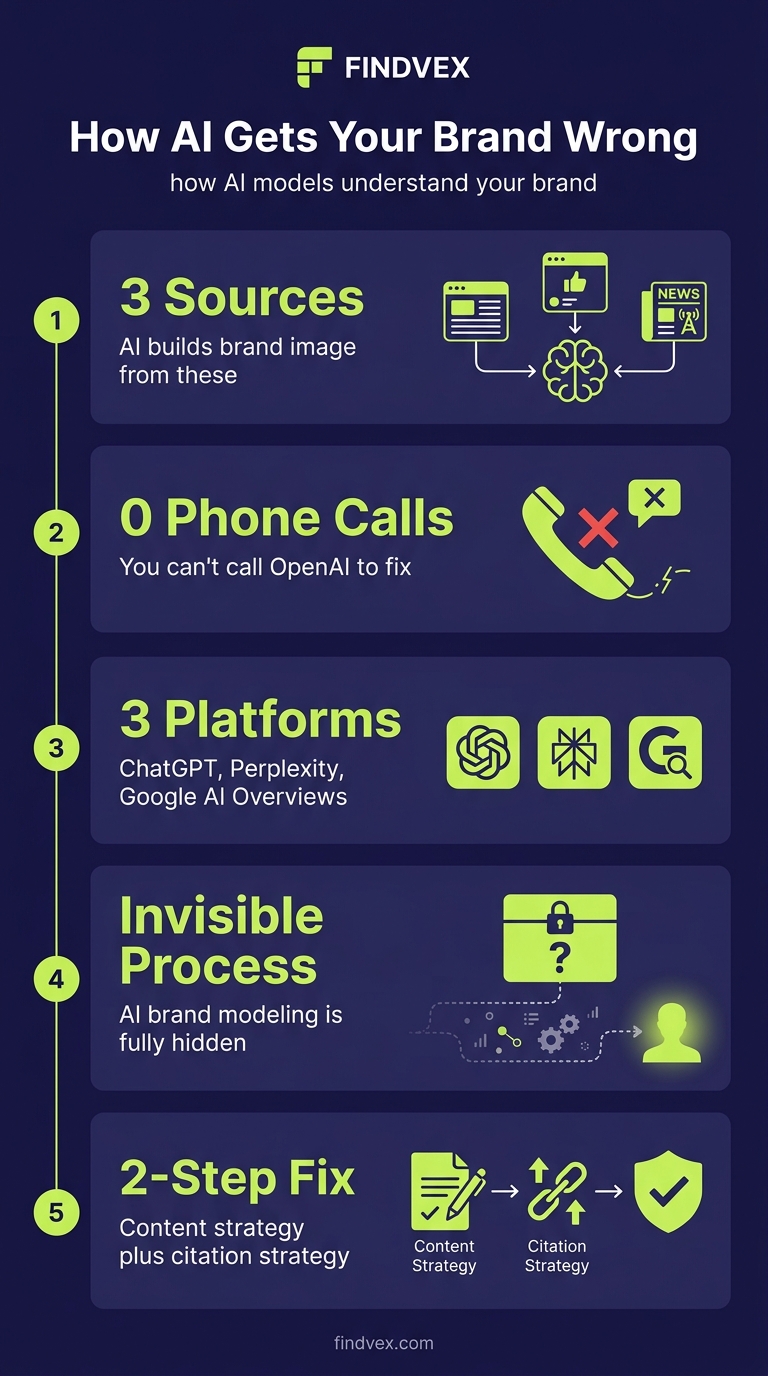
AI models construct a representation of your brand from training data, retrieval signals, and cited sources — a process that's invisible, imperfect, and increasingly consequential. If ChatGPT, Perplexity, or Google's AI Overviews are describing your business inaccurately, the fix isn't a phone call to OpenAI. It's a deliberate content and citation strategy.
Quick answer
AI models 'understand' your brand through three layers: (1) training data — what was written about you before the model's knowledge cutoff; (2) retrieval — what gets pulled in real-time from indexed sources like your site, reviews, and third-party mentions; and (3) generation — how the model synthesizes that into a response. If any layer contains thin, missing, or inaccurate information, the model's representation of your brand will be wrong. The fix is structured, authoritative content that directly states who you are, what you do, and where you operate — consistently, across sources AI crawlers can reach.
The Invisible Reputation Problem Most Businesses Don't Know They Have
When a prospective customer types your business name into ChatGPT or asks Google's AI Overview to recommend a service provider in your category, a version of your brand gets constructed on the fly — assembled from whatever signals the model has access to. That version may be accurate. Or it may be confidently, plausibly wrong.
This isn't a fringe edge case anymore. As AI-powered search handles an increasing share of discovery queries, the question of how a model represents your brand has direct implications for whether you get surfaced, recommended, or skipped entirely. According to a Search Engine Land analysis of how AI models process brand identity, the gap between what a business actually does and what a model 'knows' about it is often significant — and most business owners have no idea it exists.
The strategic shift here is fundamental: you can no longer optimize only for what Google's crawlers index. You also have to shape what AI models encode, retrieve, and generate about you.
The 3 Layers Where AI Models Form a Brand Impression
To fix the problem, you need to understand where it originates. AI models construct brand representations across three distinct layers, and each requires a different intervention.
“AI agents do in hours what teams used to do in weeks. The advantage compounds.”
Layer 1: Training Data (What the Model Learned Before You Knew It Existed)
Large language models are trained on a snapshot of the web — text scraped from websites, review platforms, directories, news articles, forums, and social content up to a specific cutoff date. Whatever was written about your brand before that cutoff gets baked into the model's base weights. If you had a negative press cycle, outdated service descriptions, or simply very little coverage, that's what the model learned.
You cannot retroactively change training data. What you can do is ensure that future model updates and retrieval layers have better signals to work with — which means acting now, not after the next training cycle.
Layer 2: Retrieval-Augmented Generation (What the Model Finds in Real Time)
Many AI systems — including Google's AI Overviews, Perplexity, and ChatGPT with Browse enabled — augment their base knowledge with real-time retrieval. They pull content from indexed web pages, knowledge panels, structured data, review aggregators, and trusted third-party sources at query time.
This is the layer you have the most control over right now. If your website clearly articulates your services, service areas, differentiators, and authority signals — and if that content is indexed, structured, and cited by other credible sources — retrieval-augmented models will surface a more accurate picture of your brand.
This is also where technical issues become brand issues. If pages are blocked by robots.txt, if structured data is malformed, or if your most authoritative content is buried behind JavaScript that crawlers can't render, retrieval fails. What the model finds instead is whatever fragment of your brand happens to be accessible — which may be a Yelp summary from three years ago.
Layer 3: Generation (How the Model Synthesizes and Presents Your Brand)
Even with good training data and clean retrieval, generation introduces another variable: how the model weighs, combines, and phrases its response. Models are probabilistic — they produce the most statistically likely output given the context. If your brand name is associated with ambiguous, inconsistent, or sparse signals, the model defaults to generalities or conflates you with competitors in the same category.
Reducing that ambiguity requires consistent entity signals across all sources: your site, Google Business Profile, schema markup, third-party directories, and earned media. The more sources say the same clear thing about your brand, the more confidently a model can represent you accurately.
What 'Getting It Wrong' Actually Looks Like for a Business
Misrepresentation by AI models tends to fall into a few recognizable patterns. Knowing which one applies to your business determines where to intervene.
- Wrong service description: The model describes a service you discontinued, lists a price range from a press mention years ago, or omits your core offer entirely because it wasn't prominently described on your site at crawl time.
- Geographic confusion: You serve a specific metro or region, but the model either omits location context or associates you with a different city where a competitor with a similar name operates.
- Category blending: You're a specialized provider (e.g., a pediatric physical therapist), but the model describes you generically as a 'physical therapy clinic' and doesn't surface you for specialty queries.
- Authority gap: Competitors with more third-party citations, reviews, and structured data get recommended; you don't appear at all, even if your service quality is comparable.
- Stale identity: Your brand pivoted — new ownership, rebranded, changed focus — but the model still reflects the old identity because retrieval sources haven't been updated.
How to Audit What AI Models Currently 'Know' About Your Brand
Before building a correction strategy, run a structured audit. This takes under an hour and surfaces gaps that most businesses have never examined.
- Step 1 — Query the major AI platforms directly. In ChatGPT, Claude, Perplexity, and Google's AI Overview, ask: 'What does [your business name] do?' and 'Who would you recommend for [your service] in [your city]?' Document the responses. Note what's accurate, what's missing, and what's wrong.
- Step 2 — Check your entity consistency. Search your business name in Google. Does your Knowledge Panel appear? Does it show the correct category, address, phone, hours, and description? Inconsistencies here propagate into AI retrieval.
- Step 3 — Audit your robots.txt and indexing. If AI crawlers are blocked — even partially — retrieval fails. Check whether GPTBot, ClaudeBot, and PerplexityBot are allowed in your robots.txt. Review Google Search Console for indexing gaps on your most important pages.
- Step 4 — Evaluate third-party citation quality. Search '[your business name] site:yelp.com', 'site:g2.com', and 'site:bbb.org'. What do those profiles say? Are they current? Incomplete profiles on high-authority domains become the version of your brand that models retrieve.
- Step 5 — Review your structured data. Use Google's Rich Results Test on your homepage and key service pages. Missing or broken schema means models can't reliably extract entity attributes from your content.
The Brand Encoding Fix: What to Build and Where
Once you know what the model has wrong — or what it's missing — the correction strategy operates on three levels: on-site content, structured data, and off-site citation building.
On-Site: Write for the Entity, Not Just the Keyword
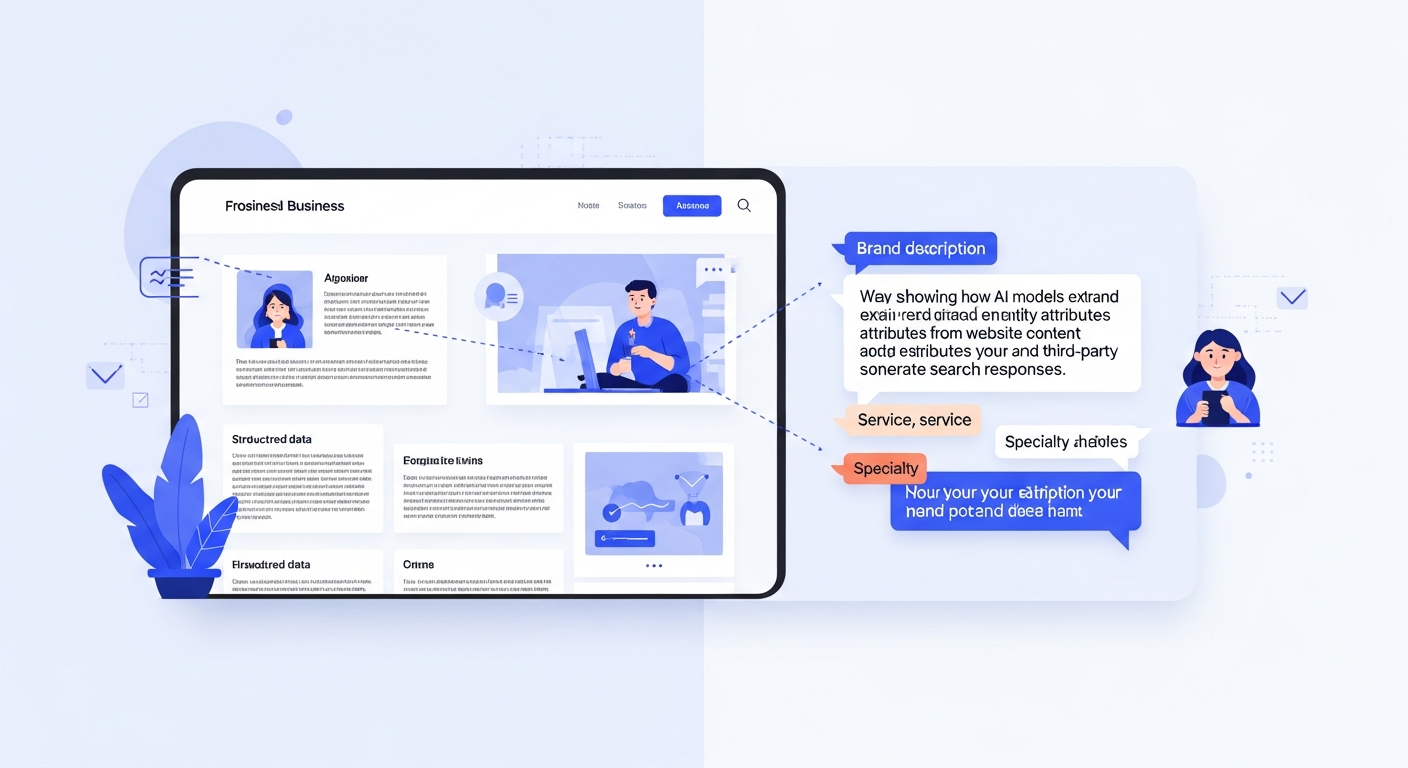
AI models extract entity attributes — who you are, what you do, where you serve, what makes you different — from page content. Generic service pages that say 'We offer high-quality plumbing services' give a model almost nothing to work with. Specific pages that name your service area, describe your specialties, list credentials, and explain your process give models the attributes they need to represent you accurately.
Every key service page should answer, in clear prose: What exactly is this service? Who is it for? What geography does it cover? What makes this provider qualified to deliver it? These aren't just SEO best practices — they're the raw material models use to construct your brand identity.
Structured Data: Give Models the Machine-Readable Version
Schema markup is how you communicate entity attributes in a format that doesn't require a model to interpret prose. For most small businesses, the highest-leverage schema types are LocalBusiness (or a more specific subtype like MedicalClinic, Restaurant, or LegalService), Organization, and BreadcrumbList. If you publish expert content, add Person schema to establish named authorship.
The goal isn't to trick the algorithm — it's to reduce ambiguity. When structured data explicitly states your business category, service area, founding date, and associated entities, models have a cleaner signal to pull from during retrieval.
Off-Site Citations: The Signals That Make Your Brand Feel Real to a Model
No amount of on-site optimization fully compensates for thin third-party mention volume. AI models weight citations from authoritative, independent sources — industry associations, local news outlets, review platforms, directories, and partner sites — as stronger evidence than self-reported claims on your own domain.
Priority citation targets for most small businesses: Google Business Profile (fully completed, with recent reviews responded to), Better Business Bureau, industry-specific directories, local chamber of commerce listings, and any earned media coverage you can generate through PR, guest publishing, or data-driven press releases.
The key insight: citation building for AI visibility follows the same logic as traditional link building for SEO — but the mechanism differs. You're not chasing PageRank; you're building the web of independent mentions that makes your brand entity credible and consistent enough for a model to confidently describe you.
Strategic Takeaway: Brand Encoding Is Now a Search Asset
The businesses that will win in AI-mediated search aren't necessarily those with the most content — they're the ones with the clearest, most consistent, most corroborated brand signal across every layer models can reach. That's a shift in how you think about SEO investment.
Traditional SEO optimized for crawlers indexing pages. AI search optimization requires thinking about how a model assembles a coherent picture of your business from dozens of disconnected signals — and systematically making that picture accurate and compelling.
The tradeoff is real: this work is slower and less directly measurable than keyword ranking. You won't see a 'brand encoding score' in Search Console. But the downstream impact — being correctly surfaced and recommended in AI-generated responses — is increasingly where discovery happens for high-intent queries.
Prioritize in this order: (1) Fix crawlability and indexing gaps so retrieval can actually reach your content. (2) Update on-site entity content to be specific and attributable. (3) Add or correct structured data. (4) Build and refresh off-site citations. This sequence addresses the layers in order of leverage and speed-to-impact.
If your competitors have already done this work and you haven't, you're not just behind on rankings — you're absent from the responses AI gives to buyers in your market. That's a pipeline problem, not a content problem.
FAQs
How do I know if an AI model is describing my business incorrectly?
Query ChatGPT, Perplexity, Claude, and Google's AI Overview directly. Ask 'What does [your business name] do?' and 'Who would you recommend for [your service] in [your city]?' Compare the responses to your actual services, location, and differentiators. Gaps and inaccuracies tell you exactly where your brand signal is weak.
Can I contact AI companies to correct wrong information about my brand?
There's no direct submission process for correcting brand information inside most AI models' base training data. Your leverage comes from improving the quality and consistency of retrievable web signals — your website content, structured data, Google Business Profile, and third-party citations — so that when models retrieve in real time, they find accurate information.
Does blocking AI crawlers hurt how models represent my brand?
Yes. If you block GPTBot, ClaudeBot, PerplexityBot, or similar crawlers in your robots.txt, retrieval-augmented AI systems can't access your authoritative on-site content. Models then rely on whatever third-party sources they can reach — which may be outdated or incomplete. For most service businesses, allowing AI crawlers is the right call. The exception is content publishers whose content itself is the product.
Is AI brand visibility the same as traditional SEO?
They overlap significantly but aren't identical. Traditional SEO optimizes for crawlers indexing pages and ranking them for keyword queries. AI search optimization focuses on how models extract, synthesize, and represent entity attributes — your identity, services, location, and authority — across multiple sources. Many of the same tactics apply (quality content, structured data, backlinks), but the success metric shifts from rankings to accurate brand representation in AI-generated responses.
How often do AI models update what they 'know' about my business?
It depends on the system. Models with retrieval-augmented generation (like Perplexity or ChatGPT with browsing enabled) can access near-real-time web content and update their responses as your site and citations change. Base training data updates on longer cycles — typically months to over a year — depending on the model's retraining schedule. Focusing on retrieval-layer signals (indexed content, GBP, structured data) gives you faster feedback loops.
What schema markup types matter most for AI brand representation?
For most small businesses: LocalBusiness schema (or a specific subtype matching your category), Organization schema, and Person schema for named experts or founders. These provide machine-readable entity attributes — category, service area, credentials, contact information — that models can extract cleanly during retrieval without having to interpret prose.
Related reading
- competitor keyword gaps — How to Find Competitor Keyword Gaps Without Wasting Budget
- ai seo agency — What to Expect from a Modern AI SEO Agency (And Red Flags to Watch)
- GEO playbook local search — The 90-Day GEO Playbook for Local Search: How To Show Up When AI Does The Searching
- real estate seo — Real Estate SEO: How Local Agents Win Search in 2026
- restaurant seo — Restaurant SEO: How to Rank for Local Dining Searches
- llm seo services — LLM SEO Services: How to Get Cited by ChatGPT, Claude, and Perplexity
- openai crawl activity tripled since gpt-5 — OpenAI Crawl Activity Tripled Since GPT-5: What It Means for Your Website
- google search update — What Changed in Google Search This Week and What Small Businesses Should Do
- seo for dentists — SEO for Dentists: A Practical Playbook for More Local Patients
- small business seo strategy — The 2026 SEO Strategy Small Businesses Should Actually Follow
Research notes
Background claims used while researching this article. Verify with the cited authorities before quoting.
- Search Engine Land analysis of how AI models process brand identity and the gap between actual business identity and model representation
Alex Rivera
CEO & Editorial Strategist · Findvex
Alex Rivera leads editorial strategy at Findvex. He sets the weekly content plan, picks topical pillars, and decides what to publish — and what to skip — based on search intent, competitive data, and what genuinely helps US small businesses rank.
Expertise: Editorial strategy · Topical authority · Content prioritisation · Pillar planning
Related reads
Local SEO Services in the USA: Which Businesses Get the Best ROI (and Why)
Local SEO services aren't one-size-fits-all. The tactics that fill a dentist's appointment book won't rank a plumber in the local pack. This guide breaks down what local SEO actually delivers by industry, what to prioritize first, and how to measure whether it's working.
Keyword ResearchHow to Find Competitor Keyword Gaps Without Wasting Budget
Competitor keyword gap analysis tells you exactly which search terms your rivals rank for that you don't. Done right, it's one of the highest-ROI moves in SEO. Done wrong, it produces a bloated list of irrelevant keywords you'll never recover from. Here's how to do it right.
SEO NewsThe 90-Day GEO Playbook for Local Search: How To Show Up When AI Does The Searching
When someone asks ChatGPT 'best HVAC company near me,' your Google ranking doesn't matter if you're not in the AI's answer. This 90-day GEO playbook shows small businesses exactly how to build the signals that get you cited in AI-powered local search.