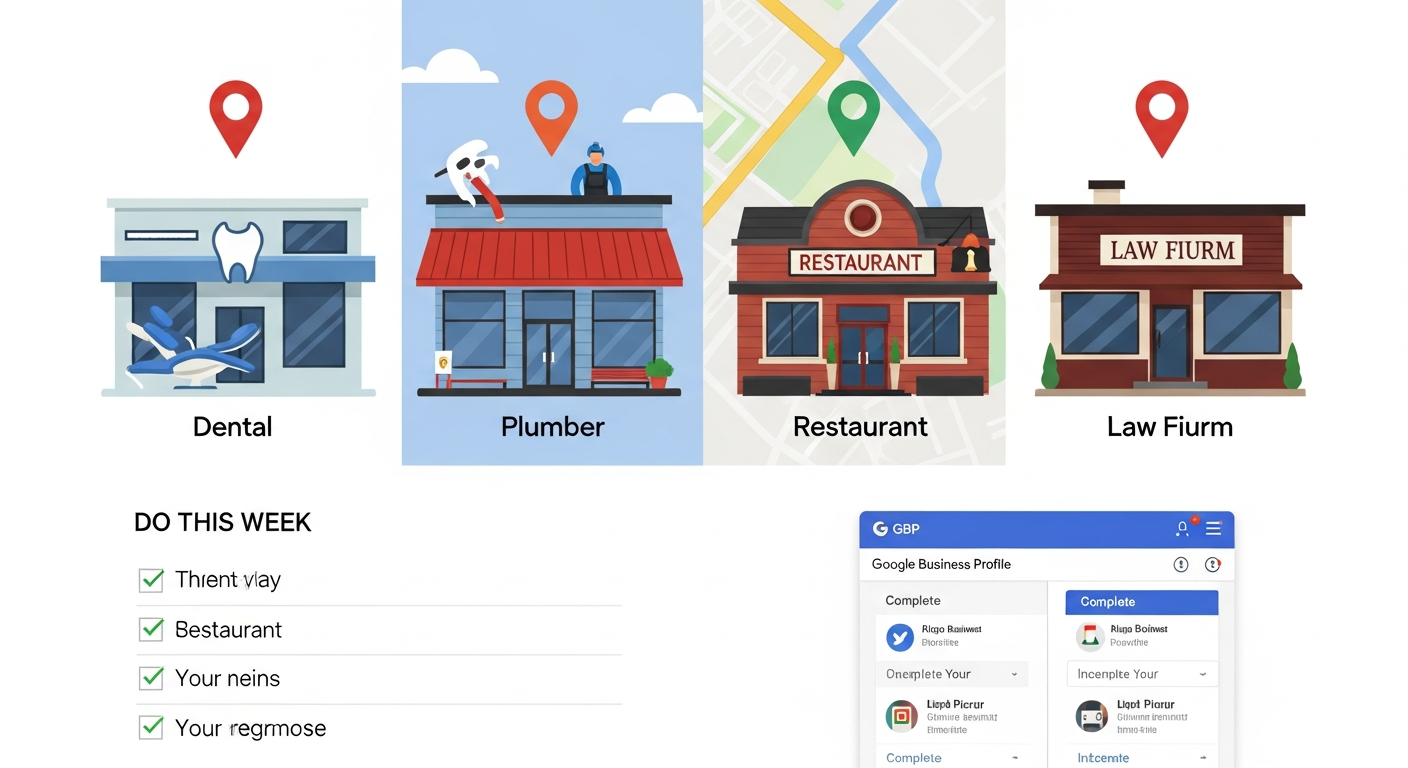
Local SEO Services in the USA: Which Businesses Get the Best ROI (and Why)
Local SEO services aren't one-size-fits-all. The tactics that fill a dentist's appointment book won't rank a plumber in the local pack. This guide breaks down what local SEO actually delivers by industry, what to prioritize first, and how to measure whether it's working.
Quick answer
Local SEO services help US small businesses appear in Google's local pack, Google Maps, and AI-powered search results when nearby customers are actively looking to buy. The most impactful tactics — Google Business Profile optimization, consistent NAP citations, location-specific landing pages, and review generation — vary in priority depending on your industry. Dentists and clinics need trust signals and appointment intent. Restaurants need map visibility and photo engagement. Lawyers need authority content. Plumbers and home-service businesses need fast mobile pages and "near me" targeting. Expect meaningful ranking movement in 60–90 days when the fundamentals are in place.
Why Local SEO Looks Different Depending on Your Industry
If you've searched for 'local SEO services USA' and received a generic pitch — optimize your Google Business Profile, build citations, get reviews — you've been handed table stakes, not a strategy. Those tactics matter, but their priority, execution, and measurable impact vary significantly depending on whether you run a dental practice, a law firm, a restaurant, or a plumbing company.
A dentist converting organic traffic into booked appointments needs trust signals front and center. A plumber competing in a saturated local pack needs map proximity signals and fast mobile load times. A restaurant lives and dies on photo freshness and review recency. A real estate agent needs neighborhood-level content authority.
This guide cuts through the generic advice. Below, you'll find what local SEO actually requires by business type, how to prioritize your investment, and how to know it's working before the 90-day mark.
What Local SEO Services Actually Deliver in 2026
Local SEO is not just about ranking on page one anymore. In 2026, it spans three distinct discovery surfaces: the Google local pack (the map and three listings above organic results), traditional organic results, and AI-powered answers in Google's AI Overviews, ChatGPT, and Perplexity.
Each surface has different ranking logic. The local pack prioritizes proximity, Google Business Profile (GBP) completeness, and review signals. Organic results favor topical authority and on-page relevance. AI answer engines favor structured, citable content with clear entity signals — your business name, address, service area, and category need to appear consistently across the web so models can confidently reference you.
A professional local SEO service addresses all three surfaces, not just one. If your provider is only reporting on local pack rankings, you're missing the full picture.
- Google Local Pack: proximity + GBP completeness + review volume and recency
- Organic search: topical content, location pages, on-page optimization
- AI Overviews and answer engines: structured data, entity consistency, authoritative citations
- Google Maps (Ask Maps): photo freshness, Q&A, GBP post frequency
“AI agents do in hours what teams used to do in weeks. The advantage compounds.”
Local SEO by Industry: What Actually Moves the Needle
Here's where most agencies get it wrong: they apply the same playbook to every client. The foundational checklist is the same, but the priority order and content strategy must reflect how customers search and decide in your specific vertical.
Dentists and Medical Clinics
Patients searching for a dentist or doctor are in a high-trust decision. They'll check your reviews, look at your website's credibility, and often check your Google Business Profile before ever clicking your website. That means review volume and recency, accurate service listings on GBP, and a website that passes basic E-E-A-T signals are non-negotiable.
For clinics specifically, structured data using MedicalBusiness schema helps Google and AI models correctly classify your practice. Location-specific landing pages — one per service area — compound over time and convert better than a single homepage.
Appointment intent keywords like 'teeth cleaning near me' or 'urgent care [city]' carry high commercial intent but face strong competition. An optimized GBP with consistent posting and a review request workflow is often what separates the first-place listing from the third.
- Priority 1: GBP reviews — recency and quantity
- Priority 2: MedicalBusiness / LocalBusiness schema markup
- Priority 3: Location landing pages for each service area
- Priority 4: E-E-A-T signals — provider bios, credentials, licensing
Law Firms and Solo Attorneys
Legal SEO is one of the most competitive local verticals in the US. Cost-per-click for terms like 'personal injury lawyer near me' is among the highest in search advertising, which is exactly why organic local SEO has outsized ROI for attorneys willing to invest.
The differentiator for law firms is topical authority. A personal injury firm that publishes detailed, accurate content about state-specific laws, case types, and the legal process builds the kind of content depth that earns rankings — and AI citations. Thin service pages don't cut it here.
Avvo, Justia, FindLaw, and state bar directories are high-authority citation sources that carry significant weight for legal local SEO. These aren't optional — they're core to establishing prominence in Google's local algorithm.
- Priority 1: Practice area content — specific, state-aware, substantive
- Priority 2: Legal directory citations (Avvo, Justia, FindLaw)
- Priority 3: GBP optimization with service categories and Q&A
- Priority 4: Reviews — critical for trust in high-stakes decisions
Restaurants and Food Service
Restaurant searches have some of the highest local intent of any category. 'Best tacos near me' or 'brunch spots in [neighborhood]' are searches with immediate action intent — the customer is deciding where to eat right now.
For restaurants, GBP photo freshness and post frequency are disproportionately important. Menus need to be uploaded directly in GBP and kept current. Review recency matters more than total volume — a restaurant with 200 reviews from two years ago will lose ground to one with 80 recent reviews.
Schema markup using Restaurant type with menu, hours, cuisine, and priceRange attributes helps Google surface your listing in rich results and AI-powered dining recommendations.
- Priority 1: GBP — menu, photos updated monthly, posts weekly
- Priority 2: Review recency and response rate
- Priority 3: Restaurant schema with menu, hours, price range
- Priority 4: Yelp, TripAdvisor, and OpenTable citation consistency
Plumbers and Home Service Businesses
Home service businesses — plumbers, HVAC, electricians, roofers — operate in urgent-need categories. When someone's pipe bursts at 9pm, they're not reading blog posts. They're calling the first result they see on the local pack.
Speed is everything here. Mobile page load time directly affects both user behavior and local pack ranking. A plumber whose website loads in 4 seconds is losing calls to competitors who load in 1.5 seconds — it's that straightforward.
Service-area pages are the content backbone of home service SEO. A plumbing company serving 12 zip codes should have a distinct, genuinely useful page for each service area — not thin duplicates. Each page should reference local landmarks, describe the service context, and include a clear call to action.
- Priority 1: Mobile page speed — target under 2 seconds LCP
- Priority 2: Service area landing pages per zip code or city
- Priority 3: GBP service listings with accurate categories
- Priority 4: Review request automation after each completed job
Real Estate Agents and Brokerages
Real estate local SEO is a long game. Buyers and sellers research extensively before contacting an agent — often over weeks or months. The businesses that win in real estate search are those that have built genuine neighborhood content authority: guides to local schools, market trend summaries, and community-specific buying advice.
IDX integration creates crawlability challenges that need to be solved at the technical level. Many real estate websites inadvertently block listing content from being indexed. Fixing this is often the highest-ROI technical intervention available.
Local schema with RealEstateAgent type, combined with Google Business Profile optimization for each office location, rounds out a strong real estate local SEO foundation.
- Priority 1: Neighborhood content — schools, market trends, community guides
- Priority 2: IDX technical SEO — ensure listings are crawlable and indexed
- Priority 3: RealEstateAgent schema markup
- Priority 4: GBP for each office location with reviews and posts
The Local SEO Foundation Every US Business Needs First
Regardless of industry, there's a foundational layer of local SEO that must be in place before any advanced tactics will compound. Think of this as the infrastructure your rankings are built on — if it's broken or inconsistent, everything above it underperforms.
Name, Address, and Phone (NAP) consistency is still foundational. Your business details need to match exactly across your website, GBP, and all directory listings — down to the abbreviations. '123 Main St.' and '123 Main Street' are inconsistencies that erode trust signals.
Your Google Business Profile is your most important local SEO asset. It's the first thing most users see, it powers your local pack listing, and it's increasingly the source AI models pull from when answering local queries. Incomplete profiles — missing hours, no photos, uncategorized services — are leaving rankings on the table.
- ✅ Google Business Profile: complete all fields, add photos, post weekly
- ✅ NAP consistency: match exactly across website, GBP, and all directories
- ✅ XML sitemap submitted to Google Search Console
- ✅ Location pages: one per primary service area, with unique content
- ✅ LocalBusiness schema on every location page
- ✅ Review generation: have a repeatable process for asking after service
- ✅ Mobile page speed: test with PageSpeed Insights, fix LCP issues first
- ✅ HTTPS: non-negotiable baseline trust signal
Local SEO in the Age of AI Search: What's New in 2026
AI-powered search surfaces — Google's AI Overviews, ChatGPT with search, Perplexity — are now meaningfully influencing how local businesses get discovered. When someone asks ChatGPT 'best plumber in Denver', the model synthesizes sources across the web and makes a recommendation. If your business isn't represented in those sources, you won't be recommended.
The local businesses most visible in AI search results share three characteristics: consistent entity signals (same business name, address, and category everywhere on the web), structured data that helps models extract facts cleanly, and third-party citations — reviews, directory listings, and editorial mentions — that corroborate the entity.
This isn't a separate strategy from traditional local SEO. It's an extension of it. The businesses that have done the foundational work — clean GBP, consistent citations, authoritative content — are the ones AI models cite. The new layer is making sure your content is structured for extraction, not just for human readers.
Do This Week: A 5-Step Local SEO Sprint
You don't need a six-month engagement to start seeing local SEO movement. Here's where to spend your first week's effort to build momentum fast.
- Day 1 — Audit your GBP: Complete every field. Upload 10+ photos. Add your services list. Check that your primary category is the most specific match available.
- Day 2 — Check NAP consistency: Search your business name in Google and compare how your name, address, and phone appear across your top 10 directory listings. Fix mismatches starting with Yelp, Apple Maps, Bing Places, and Facebook.
- Day 3 — Run a quick technical check: Use Google Search Console to identify any coverage errors. Check PageSpeed Insights on your homepage and your most important service page. Flag anything below 75 on mobile.
- Day 4 — Create or upgrade one location landing page: Pick your highest-value service area. Write a page that mentions the local context, your services in that area, and includes LocalBusiness schema. Add a clear CTA.
- Day 5 — Set up a review request workflow: Whether it's a follow-up text, email, or an in-person ask, build a repeatable process. One new review per week compounds faster than any other local SEO tactic over 6 months.
How to Know Your Local SEO Is Working (Before 90 Days)
One of the most common frustrations with local SEO is that business owners don't know what to measure. Rankings fluctuate. Traffic takes time. But there are early signals that tell you whether the foundation is taking hold.
Google Business Profile Insights is your first dashboard. Track direction requests, calls from GBP, and website clicks from the profile. These metrics should start moving within 30–45 days of a proper optimization. If they're flat after 60 days, something is wrong with your GBP setup or your review velocity.
Google Search Console shows you which queries are surfacing your pages. Watch for new impressions on location-specific keywords — even if click-through rates are low initially, impression growth signals that Google is starting to associate your pages with those queries.
Track review growth separately. It's one of the most direct inputs to local pack ranking and one of the few local SEO metrics you can influence week by week.
- GBP Insights: direction requests, calls, website clicks — check weekly
- Google Search Console: impressions for location + service keyword combos
- Local pack position: track your primary keyword + city combination monthly
- Review count and recency: aim for at least 2–4 new reviews per month
- AI mention tracking: search your business in ChatGPT and Perplexity monthly
What to Look for in a Local SEO Service Provider
Not all local SEO agencies are built the same. Here's what separates providers that move the needle from those that generate reports with no results.
Red flags: providers who can't explain what they're doing in plain English, who guarantee first-page rankings within 30 days, or whose deliverables consist primarily of auto-generated citation submissions and keyword-stuffed blog posts.
Green flags: providers who ask about your conversion goals before your keyword goals, who share a clear 90-day roadmap broken into specific deliverables, who track GBP performance and not just rankings, and who can demonstrate industry-specific experience — because local SEO for a dentist genuinely is different from local SEO for a restaurant.
Ask any prospective provider: 'How do you handle AI search visibility?' If they look blank, they're working from a 2022 playbook.
- ✅ Industry-specific experience and portfolio
- ✅ Clear deliverables: GBP optimization, citation audit, location pages, schema
- ✅ Reporting on GBP performance, not just keyword rankings
- ✅ AI visibility strategy — structured data, entity consistency, answer engine optimization
- ✅ Transparent monthly reporting with plain-language explanations
- 🚫 Guaranteed rankings within 30 days
- 🚫 Link schemes or mass citation spamming
- 🚫 No mention of Google Business Profile in their pitch
FAQs
How much do local SEO services cost in the USA?
Local SEO services in the US typically range from $500 to $2,500 per month for small businesses, depending on the market competitiveness, number of locations, and scope of work. Single-location businesses in smaller markets can see strong results at the lower end. Multi-location businesses or those in highly competitive categories like legal or medical SEO generally require more investment. One-time audits or setup packages typically run $750 to $2,000.
How long does it take for local SEO to show results?
Most businesses see early movement in GBP performance metrics — calls, direction requests, profile views — within 30 to 45 days of proper optimization. Meaningful local pack ranking movement typically takes 60 to 90 days. Organic search rankings for competitive keywords can take 3 to 6 months, depending on domain authority and content investment. Review velocity improvement can be measured week over week once a request workflow is in place.
Do I need separate local SEO strategies for each service area?
Yes, if you serve multiple cities or zip codes. A single homepage cannot rank for 'plumber in Austin' and 'plumber in Round Rock' simultaneously. You need distinct location landing pages for each primary service area — each with unique content, a local reference point, and proper LocalBusiness schema. These pages compound over time and consistently outperform generic service pages in local search.
Does local SEO still work when customers are searching on ChatGPT or Perplexity?
Yes — and the same fundamentals that strengthen traditional local SEO also improve AI search visibility. Consistent entity signals (your business name, address, category, and service area appearing uniformly across the web), structured data markup, and third-party citations on authoritative directories all contribute to how AI models represent your business. The new addition is ensuring your content is structured for extraction — clear headings, specific facts, and citable answers — so models can accurately recommend you.
Is Google Business Profile the most important local SEO factor?
For local pack rankings specifically, yes — GBP completeness, review signals, and category accuracy are among the strongest inputs to the local map algorithm. For organic rankings, on-page content and backlinks carry more weight. For AI search visibility, entity consistency across the entire web matters most. An effective local SEO strategy treats GBP as the foundation but builds the full structure around it.
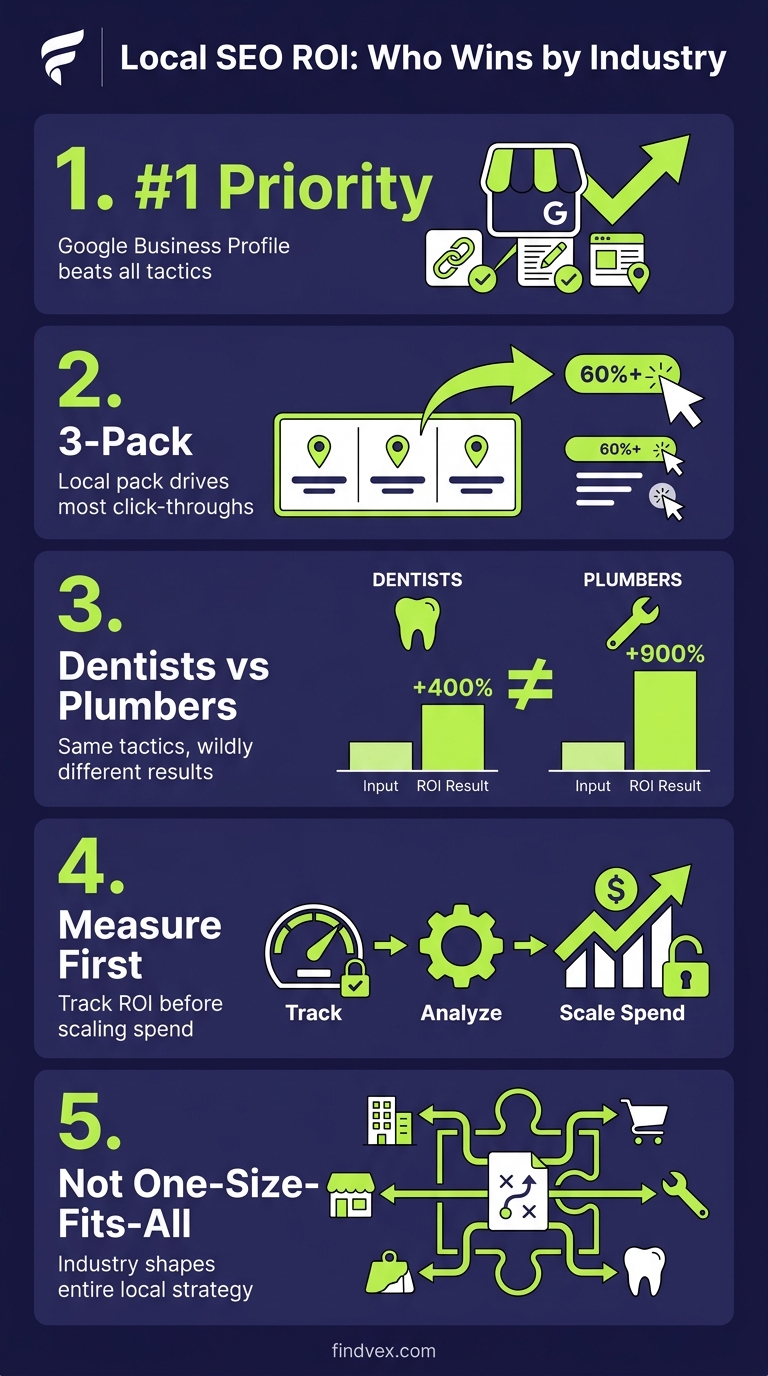
What's the difference between local SEO for a dentist vs. a plumber?
The tactics overlap at the foundational level but diverge in priority. Dental local SEO leans heavily on trust signals — E-E-A-T content, provider credentials, review quality, and appointment intent optimization. Plumber SEO prioritizes mobile page speed (urgent searches happen on phones), service area page coverage, and GBP categories. Dentists benefit from appointment-specific CTAs; plumbers benefit from click-to-call prominence and 24-hour availability signals.
Related reading
- clinic seo services — Clinic SEO: How to Rank for "Doctor Near Me" Searches
- near me seo strategy — Near Me SEO Strategy: A Local Discovery Playbook for Service Businesses
- llm seo services — LLM SEO Services: How to Get Cited by ChatGPT, Claude, and Perplexity
- real estate seo — Real Estate SEO: How Local Agents Win Search in 2026
- affordable seo services usa — Affordable SEO Services in the USA: What Small Businesses Actually Get for Their Money
- ai seo agency — What to Expect from a Modern AI SEO Agency (And Red Flags to Watch)
- restaurant seo — Restaurant SEO: How to Rank for Local Dining Searches
- GEO playbook local search — The 90-Day GEO Playbook for Local Search: How To Show Up When AI Does The Searching
- seo for dentists — SEO for Dentists: A Practical Playbook for More Local Patients
- local landing pages seo — Local Landing Pages That Rank Without Sounding Generic
Research notes
Background claims used while researching this article. Verify with the cited authorities before quoting.
- Cost range for local SEO services in the USA ($500–$2,500/month)
- Google Maps and local search drive over 1.5 billion destination visits monthly
Sofia Patel
Head of Content & Growth · Findvex
Sofia Patel leads content and growth at Findvex. She writes about local SEO, conversion-focused content, and AEO/GEO strategy — the work that turns search visibility into booked calls and qualified leads for service businesses.
Expertise: Local SEO · Conversion content · AEO / GEO strategy · Content-led link building
Related reads
Affordable SEO Services in the USA: What Small Businesses Actually Get for Their Money
Affordable SEO for small businesses in the USA typically costs $500–$2,000/month for a reputable agency or consultant. Here's what that budget gets you, what to avoid, and how to make sure every dollar drives leads — not just rankings.
SEO NewsHow AI Models Actually 'Understand' Your Brand — and What to Do When They Get It Wrong
AI models construct a representation of your brand from training data, retrieval signals, and cited sources — a process that's invisible, imperfect, and increasingly consequential. If ChatGPT, Perplexity, or Google's AI Overviews are describing your business inaccurately, the fix isn't a phone call to OpenAI. It's a deliberate content and citation strategy.
Keyword ResearchHow to Find Competitor Keyword Gaps Without Wasting Budget
Competitor keyword gap analysis tells you exactly which search terms your rivals rank for that you don't. Done right, it's one of the highest-ROI moves in SEO. Done wrong, it produces a bloated list of irrelevant keywords you'll never recover from. Here's how to do it right.