Near Me SEO Strategy: A Local Discovery Playbook for Service Businesses
A near me SEO strategy combines Google Business Profile optimization, location-specific landing pages, consistent citations, and review generation to rank when nearby customers are ready to buy. This guide shows you exactly what to do, business type by business type.
Quick answer
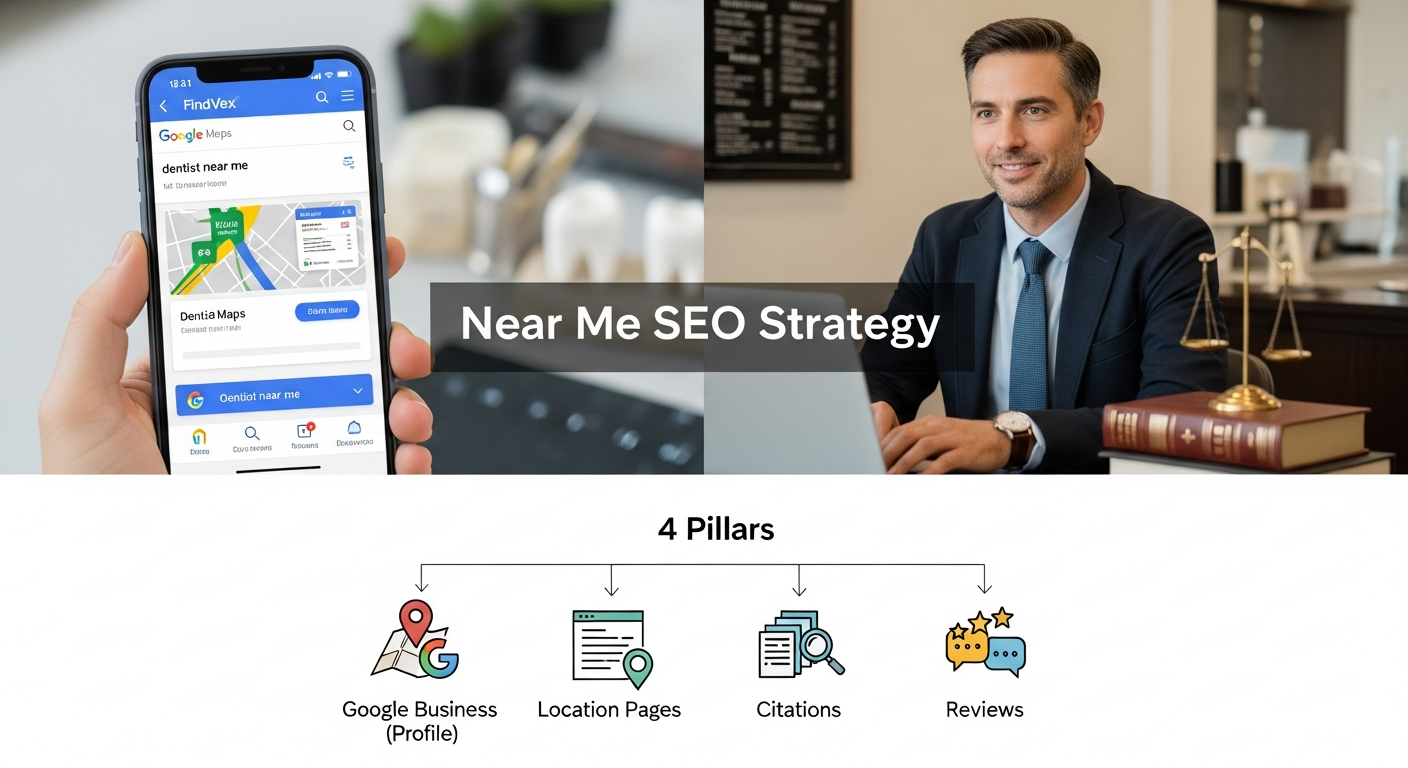
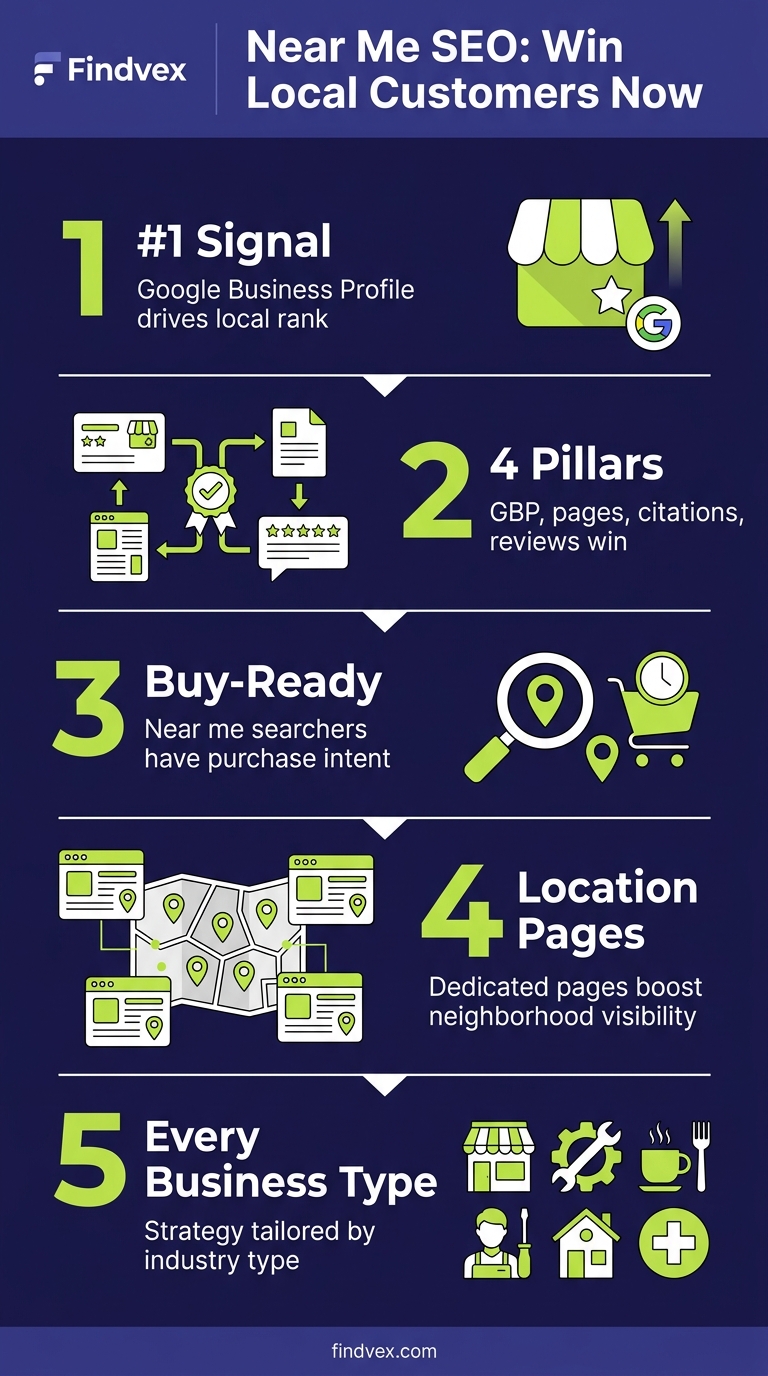
A near me SEO strategy has four core pillars: (1) a fully optimized and actively managed Google Business Profile, (2) location-specific landing pages on your website, (3) consistent NAP (name, address, phone) citations across directories, and (4) a steady stream of genuine customer reviews. Get all four working together and your business becomes the obvious choice when someone nearby searches for what you offer.
What 'Near Me' SEO Actually Means (and Why It's Different from Regular SEO)
When someone types 'dentist near me' or 'best pizza near me,' Google doesn't just look at your website content. It looks at signals that prove you're a real, trusted, active business in a specific location. That's the fundamental difference between local SEO and broad SEO: proximity, prominence, and relevance all have to fire at once.
The 'Local Pack' — those three business listings that appear above the organic results with a map — is the primary real estate you're competing for. Winning it consistently requires more than just a Google Business Profile. It requires a coordinated strategy across your profile, your website, your citations, and your reputation.
What competitors like Moz and Semrush cover thoroughly is the technical side: robots.txt, canonical tags, crawlability. What they largely skip for small businesses is the industry-specific execution — what a dentist's near me strategy looks like versus a restaurant's versus a law firm's. That's where this guide goes deeper.
The Four Pillars of a Near Me SEO Strategy
Think of your near me strategy as a four-legged stool. Pull one leg off and the whole thing wobbles. Here's what each pillar does and what 'done well' actually looks like.
“AI agents do in hours what teams used to do in weeks. The advantage compounds.”
Pillar 1: Google Business Profile Optimization
Your Google Business Profile (GBP) is the single highest-leverage asset in your near me strategy. It appears in Google Search, Google Maps, and increasingly inside AI-generated local answers. A neglected profile — outdated hours, no photos, unanswered reviews — actively costs you rankings and clicks.
A fully optimized GBP isn't a one-time setup. It's an ongoing content channel. Businesses that post weekly updates, respond to every review within 48 hours, and keep their service list current consistently outperform those that set it and forget it.
- Choose the most specific primary category that describes your main service (e.g., 'Cosmetic Dentist' rather than just 'Dentist').
- Add every applicable secondary category — each one expands the searches you're eligible for.
- Upload at least 10 high-quality photos: exterior, interior, team, products or services in action.
- Fill out every attribute relevant to your business (wheelchair accessible, free WiFi, accepts credit cards, etc.).
- Write a 750-character business description that naturally includes your primary service and city.
- Add your full service menu or service list with individual descriptions.
- Post at least one update per week — an offer, a tip, an event, or a new photo.
- Respond to every review, positive and negative, within 48 hours.
- Enable messaging and respond promptly — GBP tracks your response rate.
- Keep hours updated, especially around holidays.
Pillar 2: Location-Specific Landing Pages on Your Website
Your GBP drives map pack visibility. Your website drives organic results — and it reinforces your GBP authority. For small businesses serving multiple neighborhoods or offering multiple services, location-specific landing pages are non-negotiable.
The trap most businesses fall into is creating thin pages that are basically identical except for the city name swapped out. Google recognizes this pattern and treats those pages as low quality. Genuine local landing pages include neighborhood-specific information, locally relevant imagery, area-specific testimonials, and service details that vary by location.
For a deeper breakdown of how to build pages that actually rank without sounding like they were generated by a bot, see our guide on local landing pages that rank without sounding generic.
- Create one page per primary service per location if you serve multiple areas.
- Include the neighborhood or city name in the H1, the URL, the meta title, and at least one H2.
- Embed a Google Map of your specific location on each page.
- Add a local phone number (not a tracking number that changes) in the page header.
- Include 2–3 genuine customer quotes that reference the specific location.
- Link to local resources, events, or landmarks where natural — this signals genuine local relevance.
- Add LocalBusiness schema markup with accurate address, phone, and opening hours.
Pillar 3: Citation Consistency (NAP Across the Web)
Citations are mentions of your business name, address, and phone number (NAP) across directories, review sites, and data aggregators. Google cross-references these signals to confirm your business is real and located where you say it is. Inconsistent NAP — a suite number missing here, an old phone number there — introduces doubt and suppresses rankings.
Priority directories vary by industry. Every business needs the core generalist directories. Industry-specific directories add both citation value and referral traffic.
- Core citations every business needs: Google Business Profile, Bing Places, Apple Maps, Yelp, Facebook, Better Business Bureau.
- Healthcare and dental: Healthgrades, Zocdoc, WebMD directory, Vitals.
- Legal: Avvo, FindLaw, Justia, Martindale-Hubbell.
- Restaurants: Yelp, TripAdvisor, OpenTable, Zomato, the local chamber of commerce site.
- Real estate: Zillow, Realtor.com, Trulia, Homes.com.
- Run a NAP audit at least once per quarter — your address or phone can appear differently across sources without you realizing it.
- Use a consistent format: if your address is '123 Main St, Suite 4,' use that exact format everywhere.
Pillar 4: Review Generation and Reputation Management
Review quantity, recency, and response rate are confirmed local ranking factors. A business with 12 reviews from three years ago loses to a competitor with 60 reviews from the last six months, all else being equal. The goal isn't to game the system — it's to build a systematic process that gets happy customers to share their experience.
The most effective review generation approach is timing: ask immediately after the positive moment, before the customer has moved on. A text message sent within an hour of a completed appointment or delivery converts dramatically better than an email sent three days later.
- Create a short Google review link (available inside your GBP dashboard) and save it as a text template.
- Train your front-desk or service staff to verbally ask for a review at the end of a positive interaction.
- Send a follow-up text or email within one hour of service completion with a direct link.
- Never offer incentives for reviews — this violates Google's policies and can get reviews removed.
- Respond to every review. For negative reviews, acknowledge the issue, apologize without being defensive, and offer to resolve it offline.
- Aim for at least 2–4 new reviews per month to maintain recency signals.
- Ask customers to mention the specific service and location in their review where natural.
Industry-Specific Near Me SEO Tactics
The four pillars apply to every business. But the execution details — the categories, the keywords, the content formats, the directories — are industry-specific. Here's what near me SEO looks like in practice for four of the most competitive local verticals.
Dentists: Ranking for 'Dentist Near Me' and Procedure-Specific Searches
Dental practices compete in one of the most aggressive local SEO verticals. The businesses that win don't just rank for 'dentist near me' — they rank for procedure-specific queries like 'teeth whitening near me,' 'emergency dentist [city],' and 'invisalign provider [neighborhood].' Each procedure deserves its own service page.
For a full dental SEO playbook including GBP category strategy and patient review frameworks, see our guide on SEO for dentists.
- Primary GBP category: 'Dentist' — add 'Cosmetic Dentist,' 'Emergency Dental Service,' 'Pediatric Dentist' as secondary categories where accurate.
- Create individual service pages for high-value procedures: implants, veneers, Invisalign, teeth whitening, emergency care.
- Use patient intake forms to identify which search term brought them in — this tells you what's converting, not just ranking.
- Partner with local schools, gyms, or employers for community links that signal local authority.
Lawyers: Winning 'Attorney Near Me' in a High-Competition Market
Legal SEO is expensive to compete in through paid ads, which makes organic and local SEO critical for small and mid-size law firms. The key differentiator is practice-area specificity. A general 'lawyer near me' search is competitive. 'Car accident attorney [city]' or 'divorce lawyer [neighborhood]' is where you can actually win without a massive budget.
Trust signals matter enormously in legal searches. Bar association memberships, peer ratings on Avvo and Martindale-Hubbell, and case-result pages (framed carefully within ethical guidelines) all reinforce authority.
- Build individual pages for each practice area with a location modifier in the URL and title.
- List on all major legal directories: Avvo, FindLaw, Justia, Super Lawyers where eligible.
- Add Attorney and LegalService schema markup to your website.
- Create FAQ content that answers the specific questions your clients search for: 'how long does a personal injury case take in [state],' 'do I need a lawyer for a DUI in [city].'
- Publish locally relevant content: court location guides, state-specific legal explainers.
Restaurants: Dominating 'Restaurants Near Me' and Cuisine-Specific Searches
Restaurant searchers are often ready to act within the hour. That makes conversion-focused signals — photos, hours, menu accessibility, and review recency — especially important. Google's restaurant results pull from your GBP menu, your website, and review platforms simultaneously.
For a complete restaurant local SEO breakdown, see our guide on restaurant SEO and how to rank for local dining searches.
- Upload your full menu to GBP and keep it updated — pricing and item changes should be reflected within 24 hours.
- Add high-quality food photography to GBP: dishes, interior, exterior, and the dining experience.
- Use the 'Restaurant' primary category; add 'Italian Restaurant,' 'Seafood Restaurant,' or your specific cuisine type as secondary categories.
- Respond to Yelp and TripAdvisor reviews in addition to Google — restaurant customers use all three.
- Publish seasonal specials and events as GBP posts to keep your profile active.
- Ensure your website loads fast on mobile — restaurant searches spike on phones, often while someone is already out.
Real Estate: Ranking When Buyers and Sellers Search Locally
Real estate local SEO is unique because the 'near me' intent spans buyer searches ('homes for sale near me'), seller searches ('realtor near me'), and neighborhood research ('best neighborhoods in [city]'). Agents and brokerages that build content across all three intent types capture more of the funnel.
For a deeper dive into real estate SEO tactics, see our guide on real estate SEO for small businesses.
- Create neighborhood guide pages for every area you serve — these rank for 'living in [neighborhood]' and 'homes for sale in [neighborhood]' queries.
- Use Real Estate Agent and RealEstateAgent schema markup on agent profile pages.
- Build GBP profiles for your office location and keep the service-area settings accurate.
- Generate reviews from past clients that mention the specific neighborhood or city where you helped them.
- Publish market update content monthly — local search volume for '[city] real estate market' is consistent and commercial.
The Technical Foundation Your Near Me Strategy Depends On
Local SEO doesn't happen in isolation from your website's technical health. A slow-loading site, crawl errors, or missing schema markup can undermine everything you're doing on GBP and citations. You don't need an enterprise-level audit, but you do need the basics solid.
For a complete technical checklist tailored to small business sites, see our technical SEO audit checklist for small business websites. And if Core Web Vitals scores are dragging down your pages, our guide on Core Web Vitals for SEO covers what to fix first without getting lost in developer documentation.
- Implement LocalBusiness (or the appropriate sub-type: MedicalBusiness, LegalService, FoodEstablishment) schema on every location page.
- Ensure your website is mobile-first — Google indexes the mobile version of your site.
- Page load time under 3 seconds on mobile is a meaningful threshold for local search UX and ranking.
- Fix any crawl errors in Google Search Console, especially 404s on pages that have inbound links.
- Use HTTPS — any non-secure page signals untrustworthiness to both users and search engines.
- Make sure your NAP in your website footer exactly matches your GBP and directory listings.
How Near Me SEO Turns Visibility Into Actual Leads
Ranking in the local pack is step one. Converting that visibility into phone calls, bookings, and walk-ins is the actual goal. Local SEO traffic is inherently high-intent — someone searching 'plumber near me' right now is likely ready to hire. That means your conversion rate from local traffic should be significantly higher than from broad organic traffic.
The gap between ranking and converting usually comes down to three things: a click-to-call button that's prominent on mobile, a fast and simple contact or booking form, and social proof (reviews, trust badges, credentials) visible above the fold. For a deeper look at how local SEO turns website traffic into booked calls, we've covered the full conversion funnel in detail.
Track your GBP insights weekly: how many people called from your profile, requested directions, or clicked to your website. These metrics tell you whether your local visibility is generating business activity, not just impressions.
Do This This Week: Your Near Me SEO Action Plan
You don't need to execute everything at once. This is the highest-return sequence for a small business starting or resetting their near me SEO strategy.
- Day 1 — Audit your Google Business Profile: Verify it's claimed, hours are current, all categories are set, and there are at least 10 photos. Fix anything that's wrong before you do anything else.
- Day 2 — Run a NAP audit: Search your business name in Google and check the top 5 directory listings that appear. Make sure name, address, and phone are identical across all of them.
- Day 3 — Check your website's location page: Does it have your full address, a local phone number, an embedded Google Map, and LocalBusiness schema? If not, add them.
- Day 4 — Set up a review request workflow: Create your GBP review link, write a text template, and send it to your last 10 customers. This alone can meaningfully boost your review count inside two weeks.
- Day 5 — Post your first GBP update: Share a photo, an offer, or a helpful tip. Commit to doing this every week. Consistency beats perfection here.
- Week 2 — Identify one industry-specific directory you're not listed in and submit your business with accurate NAP.
- Week 3 — Create or improve one location landing page on your website using the checklist in Pillar 2 above.
- Ongoing — Track GBP calls and direction requests weekly. Review Google Search Console for any crawl errors or indexing issues monthly.
FAQs
How long does it take for near me SEO to show results?
Most small businesses start seeing measurable movement in Google Maps rankings within 60 to 90 days of consistently implementing the four pillars: GBP optimization, location pages, citation building, and review generation. The timeline varies based on how competitive your market is and how much work the baseline requires. Review generation tends to show the fastest impact.
Do I need a physical address to rank for near me searches?
Yes. Google requires a verifiable physical address to appear in the local pack. Service-area businesses that operate without a public storefront can hide their address in GBP while still setting a service area, but you still need a real address for verification purposes. PO boxes and virtual offices do not qualify under Google's guidelines.
What's the difference between near me SEO and regular local SEO?
Near me SEO is a subset of local SEO focused specifically on searches that include a proximity intent signal — either the literal phrase 'near me' or an implicit local intent like 'dentist [city name].' Regular local SEO is broader and includes strategies for ranking in city-level organic results and building local brand authority. The tactics overlap significantly, but near me searches skew heavily toward mobile and tend to convert faster.
How many Google reviews do I need to rank in the local pack?
There is no published minimum from Google. What matters more than a specific number is recency, volume relative to your direct competitors, and your response rate. In a small market, 20 reviews with consistent responses may be enough to rank. In a competitive urban market, you may need 100+. Audit what your top local competitors have and use that as your benchmark.
Can I rank for near me searches in cities where I don't have an office?
Ranking in the Google Maps local pack for a city where you have no physical presence is very difficult. You can rank in organic results for city-name keywords through optimized landing pages, but map pack rankings are tied to verified physical locations. If you serve multiple cities, create location-specific landing pages for each area and build citations that reference your service area.
Does my website matter for near me SEO or is Google Business Profile enough?
Both matter. Your Google Business Profile drives map pack visibility and direct GBP actions (calls, directions, messages). Your website reinforces your GBP authority through location pages, LocalBusiness schema, and content signals. Businesses with strong GBPs but weak websites often plateau in rankings. Businesses with great websites but neglected GBPs rarely break into the local pack. You need both working together.
What is the most common near me SEO mistake small businesses make?
The single most common mistake is setting up a Google Business Profile and then never touching it again. Google's local ranking algorithm factors in profile completeness, posting activity, review recency, and engagement signals. A neglected profile loses ground to active competitors over time, even if it was well-optimized initially.
Related reading
- local seo services — How Local SEO Turns Website Traffic Into Booked Calls
- restaurant seo — Restaurant SEO: How to Rank for Local Dining Searches
- clinic seo services — Clinic SEO: How to Rank for "Doctor Near Me" Searches
- real estate seo — Real Estate SEO: How Local Agents Win Search in 2026
- seo for dentists — SEO for Dentists: A Practical Playbook for More Local Patients
- GEO playbook local search — The 90-Day GEO Playbook for Local Search: How To Show Up When AI Does The Searching
- llm seo services — LLM SEO Services: How to Get Cited by ChatGPT, Claude, and Perplexity
- local landing pages seo — Local Landing Pages That Rank Without Sounding Generic
- small business seo strategy — The 2026 SEO Strategy Small Businesses Should Actually Follow
- AI crawler blocking strategy — The AI Crawler Protection Paradox: Why Brands Block Bots Then Pay to Be Seen
Research notes
Background claims used while researching this article. Verify with the cited authorities before quoting.
- Review recency, quantity, and response rate are confirmed local ranking factors
- Text messages sent within one hour of service completion convert better for review requests than emails sent days later
Sofia Patel
Head of Content & Growth · Findvex
Sofia Patel leads content and growth at Findvex. She writes about local SEO, conversion-focused content, and AEO/GEO strategy — the work that turns search visibility into booked calls and qualified leads for service businesses.
Expertise: Local SEO · Conversion content · AEO / GEO strategy · Content-led link building
Related reads
How AI Models Actually 'Understand' Your Brand — and What to Do When They Get It Wrong
AI models construct a representation of your brand from training data, retrieval signals, and cited sources — a process that's invisible, imperfect, and increasingly consequential. If ChatGPT, Perplexity, or Google's AI Overviews are describing your business inaccurately, the fix isn't a phone call to OpenAI. It's a deliberate content and citation strategy.
Keyword ResearchHow to Find Competitor Keyword Gaps Without Wasting Budget
Competitor keyword gap analysis tells you exactly which search terms your rivals rank for that you don't. Done right, it's one of the highest-ROI moves in SEO. Done wrong, it produces a bloated list of irrelevant keywords you'll never recover from. Here's how to do it right.
SEO NewsThe 90-Day GEO Playbook for Local Search: How To Show Up When AI Does The Searching
When someone asks ChatGPT 'best HVAC company near me,' your Google ranking doesn't matter if you're not in the AI's answer. This 90-day GEO playbook shows small businesses exactly how to build the signals that get you cited in AI-powered local search.