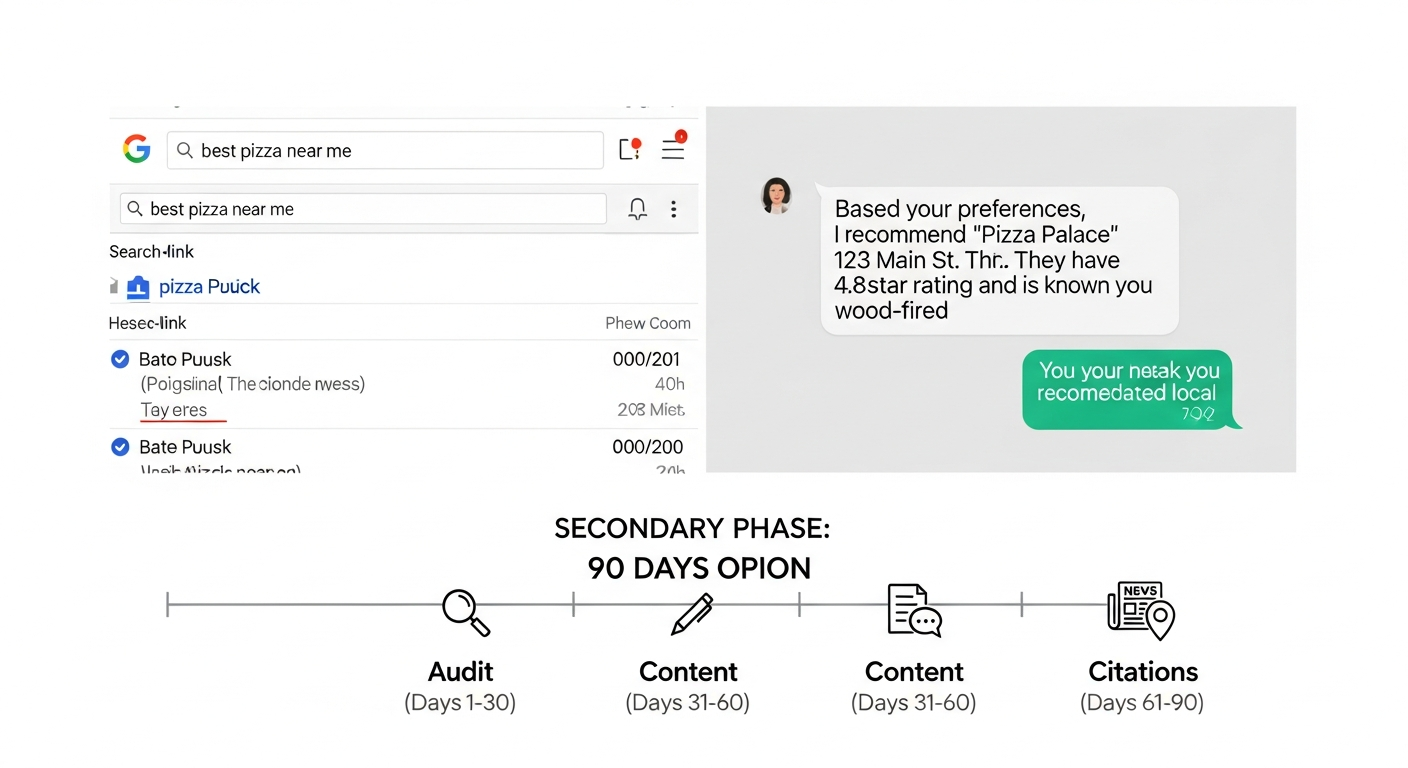
The 90-Day GEO Playbook for Local Search: How To Show Up When AI Does The Searching
When someone asks ChatGPT 'best HVAC company near me,' your Google ranking doesn't matter if you're not in the AI's answer. This 90-day GEO playbook shows small businesses exactly how to build the signals that get you cited in AI-powered local search.
Quick answer
GEO (Generative Engine Optimization) is the practice of structuring your business's content, citations, and reviews so that AI tools like ChatGPT, Perplexity, and Google's AI Overviews recommend you when someone asks a local question. The fastest wins: complete and consistent business data everywhere, a stream of recent reviews with specific language, and content written in plain-language question-and-answer format. A focused 90-day effort can meaningfully improve your AI citation frequency.
AI Is Now the Referral Source You Can't Afford to Ignore
When a potential customer opens ChatGPT and types 'best family dentist in Austin who takes new patients,' they don't get a list of blue links. They get a direct answer — usually three to five businesses, explained in a sentence or two. If you're not one of them, you've lost that lead before your website was ever seen.
This is the shift that Generative Engine Optimization (GEO) addresses. It's not a replacement for traditional local SEO — your Google Business Profile and local pack rankings still matter. GEO is the layer on top: the signals that tell AI models you're credible, specific, and worth recommending.
Search Engine Journal's coverage of the emerging GEO playbook for local search confirms that AI-powered search is actively reshaping how consumers discover local businesses — and that businesses optimizing for it now have a meaningful early advantage. Here's what you need to do about it over the next 90 days.
What GEO Actually Means for a Local Business
Traditional SEO is about ranking in an index. GEO is about being cited by a model. The distinction matters because AI tools don't just pull from Google's index — they synthesize information from across the web: review platforms, directories, news mentions, your own website content, and third-party sources that talk about you.
For a local business, GEO optimization comes down to three things: being findable (your data exists and is consistent), being credible (reviews, citations, and third-party mentions confirm your quality), and being extractable (your content is written so that an AI can lift the most useful parts and present them as an answer).
If your business information is incomplete, inconsistent across directories, or buried inside PDFs and image-heavy pages, AI tools can't confidently recommend you — even if you rank well on Google Maps.
“AI agents do in hours what teams used to do in weeks. The advantage compounds.”
Why This Is Urgent in 2026
The shift isn't theoretical. Consumers are increasingly asking AI assistants for local recommendations — for restaurants, contractors, healthcare providers, and professional services. Each of those queries is a moment where your business either gets cited or doesn't.
Critically, the businesses building AI citation frequency now are compounding an advantage. AI models develop patterns in what they recommend. Getting cited early — while the competitive field is still thin — is significantly easier than trying to displace established recommendations later.
The good news for small businesses: GEO isn't dominated by big brands the way that some national SEO terms are. A well-reviewed, well-described local plumber in Denver can absolutely outperform a national franchise in AI recommendations for 'best plumber in Denver' if their local signals are stronger.
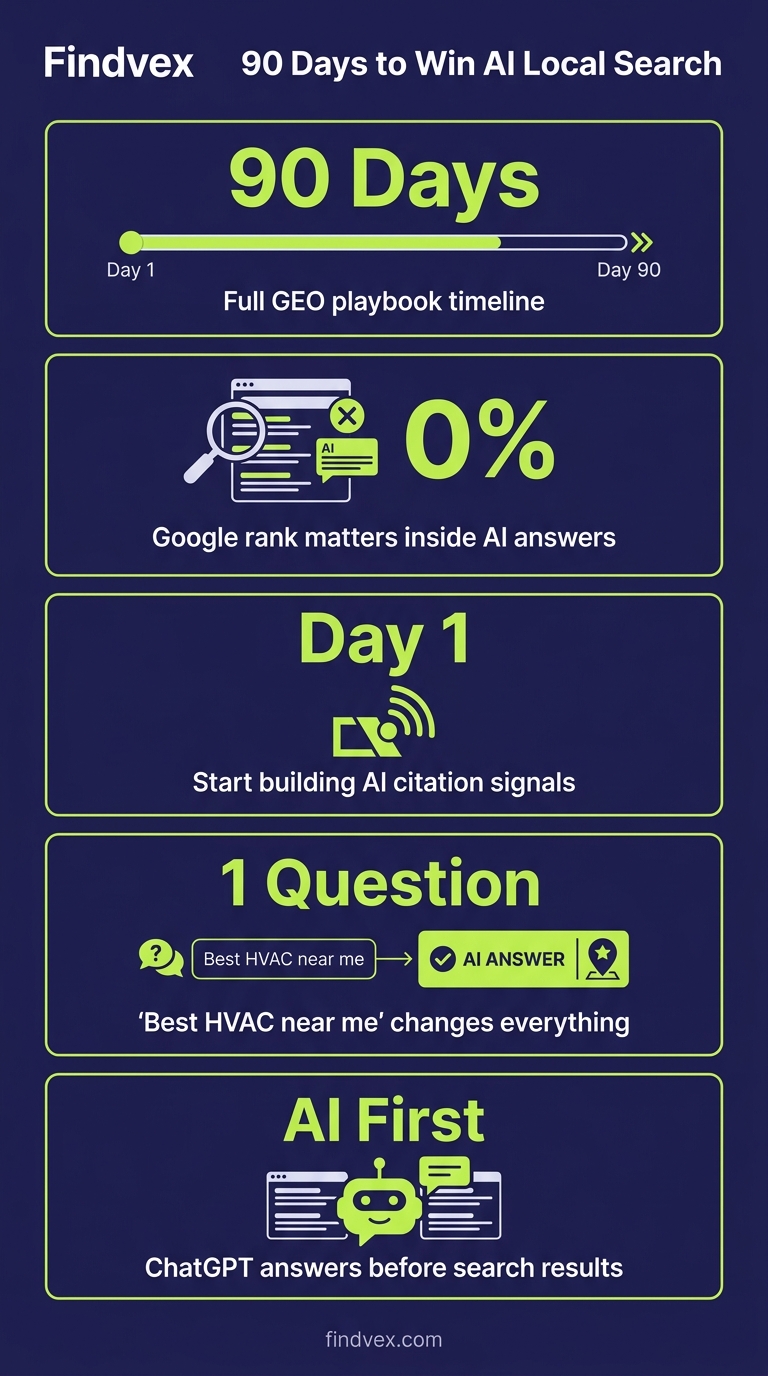
The 90-Day GEO Playbook: Week-by-Week Actions
This plan is built for small business owners and their marketing teams. Each phase has a clear focus and deliverable. You don't need specialist tools to start — most of this is actionable with what you already have access to.
Phase 1 (Days 1–30): Audit Your AI Presence and Fix Your Foundation
Before you build, find out where you stand. Open ChatGPT, Perplexity, and Google's AI Overviews. Type in the queries your ideal customers would ask — things like 'best [your service] in [your city]' or '[your service] near [your neighborhood] open weekends.' Note whether your business appears. If it doesn't, that gap is your baseline.
Then audit your data foundation. AI models pull from structured sources — Google Business Profile, Yelp, Bing Places, Apple Maps, industry directories, and your own website. Inconsistencies in your name, address, phone number, and business category across these sources create doubt in the model's confidence to recommend you.
Fix these in Phase 1:
- Verify your Google Business Profile is fully complete — categories, services, hours, description with specific service language, and at least 10 recent photos
- Claim and update your Bing Places listing (this directly feeds ChatGPT's local data)
- Check NAP consistency across your top 10 directory listings — fix any mismatches
- Add a clear, jargon-free business description to every platform that accepts one
- Ensure your website has a dedicated Contact/About page with your full address, service area, and business hours in crawlable text (not just an image or map embed)
Phase 2 (Days 31–60): Build Review Velocity and Content That AI Can Extract
Reviews are one of the most powerful GEO signals for local businesses. AI models don't just count reviews — they read the sentiment and the specificity. A review that says 'Great service, highly recommend!' tells an AI almost nothing. A review that says 'Dr. Chen did my root canal with zero pain and explained every step — best dental experience I've had in Chicago' gives the AI useful, citable detail.
Your goal in Phase 2 is twofold: generate a consistent flow of new reviews (recency matters) and gently guide customers toward specific language. A post-service follow-up message like 'If you have a moment, it helps future patients to mention what you came in for and what stood out' costs nothing and significantly improves review quality.
Simultaneously, start creating content in question-and-answer format. AI models love this structure because it makes extraction easy. Think of the top five questions your customers ask before hiring you — and write a clear, direct answer to each one on your website. These can live in a FAQ section, a dedicated FAQ page, or as individual short blog posts. Pair every answer with your location and service area explicitly stated.
- Set up a review request sequence (text or email) triggered 24–48 hours after service
- Respond to every existing review — AI models treat owner responses as a trust signal
- Write five 300-word FAQ pages targeting your most common pre-purchase questions
- Add LocalBusiness schema markup to your homepage and service pages (or ask your web developer to — it takes under an hour)
- Create a 'Services' page that lists every service by name, with a one-paragraph description for each — written as a human would describe it to a friend
Phase 3 (Days 61–90): Build Third-Party Citations and Measure AI Visibility
By week nine, your foundation is solid and your content is building. Now you focus on third-party mentions — the signals that tell AI models other credible sources are talking about you.
This doesn't require a PR budget. The most effective sources for local businesses are local: your city's Chamber of Commerce website, local news sites, neighborhood blogs, and industry association directories. A press release to your local news outlet about a business milestone, a guest post on a local business blog, or a sponsorship mention on a community organization's website all create the kind of third-party citations that AI models use to validate recommendations.
In parallel, start tracking your AI visibility properly. Once a week, run the same set of five to ten test queries across ChatGPT, Perplexity, and Google AI Overviews. Note whether you appear, what language is used about you, and whether competitors are consistently appearing where you aren't. This tracking gives you the feedback loop to know what's working.
- Submit your business to your local Chamber of Commerce and any industry-specific directories you haven't yet claimed
- Reach out to one or two local bloggers or news sites about a genuinely newsworthy business story
- Get listed on Nextdoor as a local business (a growing source of AI-readable local data)
- Set a weekly 15-minute calendar block to run your AI visibility test queries and log results
- Check if any existing blog posts, guides, or FAQ content on your site can be refreshed with more specific, extractable language
What Hasn't Changed: Traditional Local SEO Still Matters
GEO doesn't replace your Google Maps strategy — it extends it. The businesses that win in AI-powered local search are overwhelmingly the same ones that have strong Google Business Profiles, consistent NAP citations, and quality local backlinks. Think of GEO as a multiplier on top of a solid local SEO foundation, not a replacement for it.
If your local SEO fundamentals aren't in place yet, that's the right place to start before attempting GEO-specific tactics. Our guide on how local SEO turns website traffic into booked calls covers the core conversion mechanics. And if you're running local landing pages, the principles in our piece on local landing pages that rank without sounding generic apply directly to GEO content quality as well.
Do This This Week: Your 5-Action GEO Quick Start
You don't need 90 days to start building momentum. These five actions take less than two hours and move the needle immediately:
- Run your AI visibility test: search your top 3 customer queries in ChatGPT and Perplexity. Write down what you find — that's your baseline.
- Open your Google Business Profile and complete any empty fields: services list, business description, and Q&A section (you can seed your own Q&As).
- Claim your Bing Places listing and make sure it matches your Google Business Profile exactly.
- Send a review request to your last 10 customers today — even a simple text message works.
- Add one FAQ page to your website this week. Pick the question you get asked most before a sale and write a 200-word plain-language answer that includes your city and service type.
How GEO Affects Your Leads, Not Just Your Visibility
The practical lead-generation argument for GEO is straightforward. A customer who gets your business recommended by ChatGPT already has a degree of trust built in — the AI endorsed you. That's a warmer lead than someone who clicked you from a list of ten results and is comparison shopping.
As AI-powered search becomes a larger share of how local customers find service providers, the businesses with strong GEO signals will capture more of those high-intent leads. The businesses that wait will face the same dynamic that those who delayed Google Maps optimization faced five years ago — playing catch-up against competitors who built their presence first.
If you want hands-on help auditing your current local AI visibility and building a GEO-ready content structure, FindVex's local SEO team can run that assessment and give you a clear priority list.
FAQs
What is GEO in local search?
GEO stands for Generative Engine Optimization. It's the practice of building the content, citation, and review signals that help AI tools like ChatGPT, Perplexity, and Google AI Overviews recommend your business when someone asks a local question. Unlike traditional SEO, which focuses on ranking in a search index, GEO focuses on being cited by AI models that synthesize information from multiple sources.
Does GEO replace local SEO?
No — GEO is built on top of a strong local SEO foundation. Businesses with well-optimized Google Business Profiles, consistent NAP citations, and quality local content tend to perform well in AI recommendations too. GEO adds specific tactics — like AI-extractable content formats, review language, and third-party citations — that extend your local SEO investment into AI-powered search channels.
How do I know if AI platforms are recommending my business?
Run a simple manual test. Open ChatGPT, Perplexity, and Google AI Overviews and type in the queries your customers would use — 'best [your service] in [your city]' or '[your service] near [your neighborhood].' Note whether your business appears. Do this weekly with a consistent set of test queries to track your progress over time.
How long does it take to see results from GEO optimization?
Most businesses see some measurable improvement in AI citation frequency within 60–90 days of consistently implementing GEO tactics — particularly after improving data consistency, generating new reviews, and adding question-and-answer content to their website. Like traditional SEO, GEO is a compounding effort rather than an overnight change.
Why does Bing Places matter for GEO?
ChatGPT's local search data pulls from Bing's index, which means your Bing Places listing directly affects whether ChatGPT recommends you for local queries. Many small businesses have never claimed or completed their Bing Places listing, which creates a gap in their AI visibility. Claiming and fully completing it is one of the fastest GEO wins available.
What kind of content helps with GEO for local businesses?
Content written in a direct question-and-answer format works best for GEO. AI models are designed to extract clear, specific answers from content. FAQ pages, service description pages with specific plain-language details, and blog posts that directly answer common pre-purchase questions all give AI models clean, citable material. Include your service area, city, and specific service names explicitly in this content.
Are reviews really that important for AI local search?
Yes — and the quality and specificity of reviews matter as much as the volume. AI models analyze review sentiment and content to understand what a business is actually good at. Reviews that mention specific services, locations, staff, or outcomes give AI models much more useful data to work with than generic positive reviews. Recency also matters: a steady flow of new reviews signals that a business is active and currently operating.
Related reading
- generative engine optimization — What Is Generative Engine Optimization (GEO)? How Small Businesses Get Found in AI Search
- AI local search visibility — How AI Is Changing Local Search Visibility: What the SOCi + Google Webinar Revealed
- geo services for small business — GEO Services for Small Business: What They Actually Include and Whether They're Worth It
- llm seo services — LLM SEO Services: How to Get Cited by ChatGPT, Claude, and Perplexity
- aeo services for small business — AEO Services for Small Business: What You Actually Need (and What to Skip)
- generative engine optimization services — Generative Engine Optimization Services: What Small Businesses Actually Get (and What to Ask For)
- answer engine optimization services — Answer Engine Optimization Services: What Small Businesses Actually Get (and Whether It's Worth Paying For)
- ai search expert seo transition — From SEO Expert to AI Search Expert: How to Control What AI Says About Your Brand
- near me seo strategy — Near Me SEO Strategy: A Local Discovery Playbook for Service Businesses
- schema markup for small business — Schema Markup for Small Business Websites: The 5 Types That Actually Affect Your Rankings
Sources & Citations
Sofia Patel
Head of Content & Growth · Findvex
Sofia Patel leads content and growth at Findvex. She writes about local SEO, conversion-focused content, and AEO/GEO strategy — the work that turns search visibility into booked calls and qualified leads for service businesses.
Expertise: Local SEO · Conversion content · AEO / GEO strategy · Content-led link building
Related reads
Answer Engine Optimization (AEO): The 2026 Guide for Small Businesses
Learn answer engine optimization (AEO) in 2026. This practical guide helps small businesses get found in AI search, voice assistants, and answer engines.
SEOGenerative Engine Optimization (GEO): The 2026 Guide for Small Businesses
Learn how generative engine optimization helps small businesses get found in AI search. Our 2026 GEO guide covers strategies, tactics, and tips to boost visibility.
SEOSEO Agency in USA: AI-Powered SEO for Small Businesses | Findvex
Findvex is a leading SEO agency in USA delivering AI-powered SEO strategies that help small businesses rank higher, drive traffic, and grow revenue. Get started today.