LLM SEO Services: How to Get Cited by ChatGPT, Claude, and Perplexity
LLM SEO services optimize your website and content so that large language models — ChatGPT, Perplexity, Google Gemini — cite and recommend your business. Here's exactly what those services include, what outcomes to expect, and how to evaluate agencies offering them.
Quick answer
LLM SEO services (also called GEO or AEO services) optimize your content, schema, authority signals, and site structure so that large language models like ChatGPT, Perplexity, and Google Gemini surface your business in AI-generated answers. For small businesses, the practical goal is to become a cited, recommended source when a potential customer asks an AI about your service or location.
What LLM SEO Services Actually Are
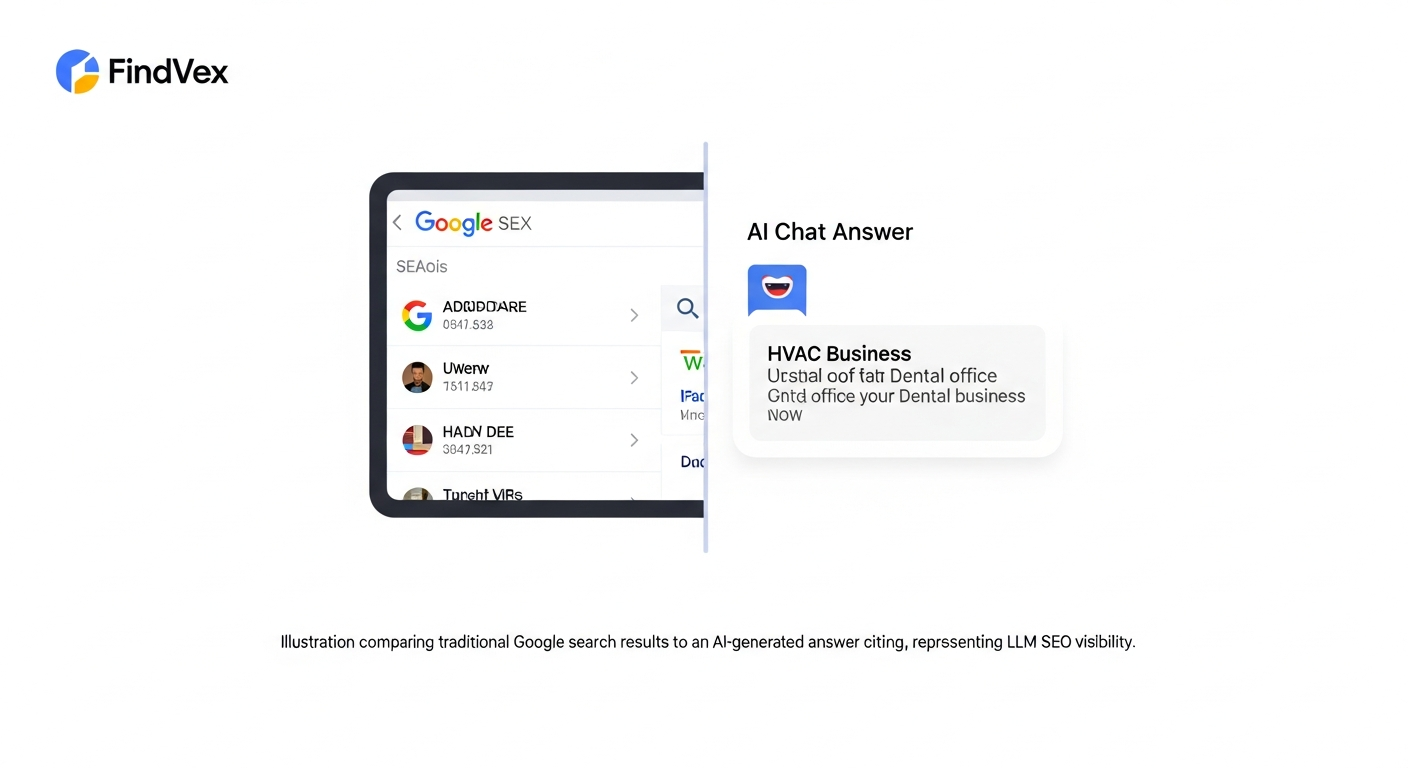
Traditional SEO gets you a blue link on a search results page. LLM SEO — sometimes called Generative Engine Optimization (GEO) or Answer Engine Optimization (AEO) — gets you mentioned inside the answer itself. When someone asks ChatGPT 'Who's the best HVAC company in Denver?' or asks Google's AI Overview 'What should I look for in a pediatric dentist?', LLM SEO is what determines whether your business gets cited or completely ignored.
The underlying mechanics are different from classic SEO. Language models don't crawl live pages the way Googlebot does. They synthesize information from training data, real-time web retrieval (in the case of ChatGPT Search, Perplexity, and Google's AI Mode), and authoritative third-party sources. That means your content needs to be structured, credible, and citation-worthy — not just keyword-dense.
For small businesses, this is not a niche concern anymore. As of mid-2025, a meaningful and growing share of informational and local queries are answered directly by AI engines before a user clicks a single link. If your site isn't set up to be understood and cited by these systems, you're invisible to an entire generation of search behavior.
What a Reputable LLM SEO Service Should Include
Not every agency calling itself an 'AI SEO agency' is actually doing LLM optimization. Here's what a legitimate service should cover — and what to push back on if it's missing.
- Entity optimization: Ensuring your business is clearly defined as a named entity — with consistent NAP (name, address, phone), category tags, and topical associations — across your site, Google Business Profile, and third-party directories. LLMs use entity recognition to decide who to recommend.
- Structured data and schema markup: Implementing LocalBusiness, FAQ, HowTo, Review, and Service schema so AI crawlers can extract structured facts about your business without guessing. Schema isn't just for Google anymore — it signals credibility to any retrieval-augmented system.
- Content restructuring for extractability: Rewriting or reformatting key pages so answers are easy to lift verbatim. This means clear definitions, direct question-and-answer formatting, numbered steps, and summary paragraphs that frontload the point.
- Authority and citation building: Getting your business mentioned in credible third-party sources — local news, industry directories, review platforms, and niche publications — that LLMs are likely to have in their training data or retrieve in real time.
- AI crawler access management: Making sure GPTBot, OAI-SearchBot, PerplexityBot, and other AI crawlers are not blocked in your robots.txt. This is a surprisingly common error. Blocking these bots means no visibility in those platforms, period.
- Google AI Overview targeting: Identifying which of your existing pages are close to earning an AI Overview placement and restructuring them to meet the format and authority bar Google's system appears to favor.
- Monitoring and reporting: Tracking whether your business is cited in AI answers — a fundamentally different metric from rank position. This requires manual sampling, brand mention tracking tools, and eventually purpose-built AI visibility dashboards.
“AI agents do in hours what teams used to do in weeks. The advantage compounds.”
LLM SEO vs. Traditional SEO: What's Different, What Overlaps
Here's the good news: strong traditional SEO is still the foundation. A technically sound site, quality content, and solid backlinks all feed directly into LLM visibility. But there are meaningful differences in emphasis.
Traditional SEO optimizes for keyword relevance and link authority. LLM SEO optimizes for factual clarity, structural extractability, and trust signals that AI systems recognize. A page that ranks #1 in Google might still get ignored by ChatGPT if the answer to a user's question is buried in paragraph six of a 3,000-word article.
The biggest practical difference: LLMs tend to cite sources that answer a specific question directly, not sources that rank for a broad keyword. That shifts content strategy toward specific, answerable prompts rather than traffic-volume-first keyword targeting. If you want to show up when someone asks 'What does a home inspection cover in Texas?', you need a page (or a clearly formatted section) that answers that exact question in plain language.
- Same as before: Technical health, Core Web Vitals, indexing, canonical tags, mobile-friendliness, backlinks.
- New emphasis: Direct answer formatting, entity clarity, schema depth, AI crawler access, third-party citation building.
- Reduced importance: Exact-match keyword density, meta keyword stuffing, manipulative link schemes.
How to Evaluate an Agency Offering LLM SEO Services
The space is new and the terminology is loose. Some agencies have genuinely adapted their practice for AI search; others have rebranded old tactics with new words. Here's how to tell the difference.
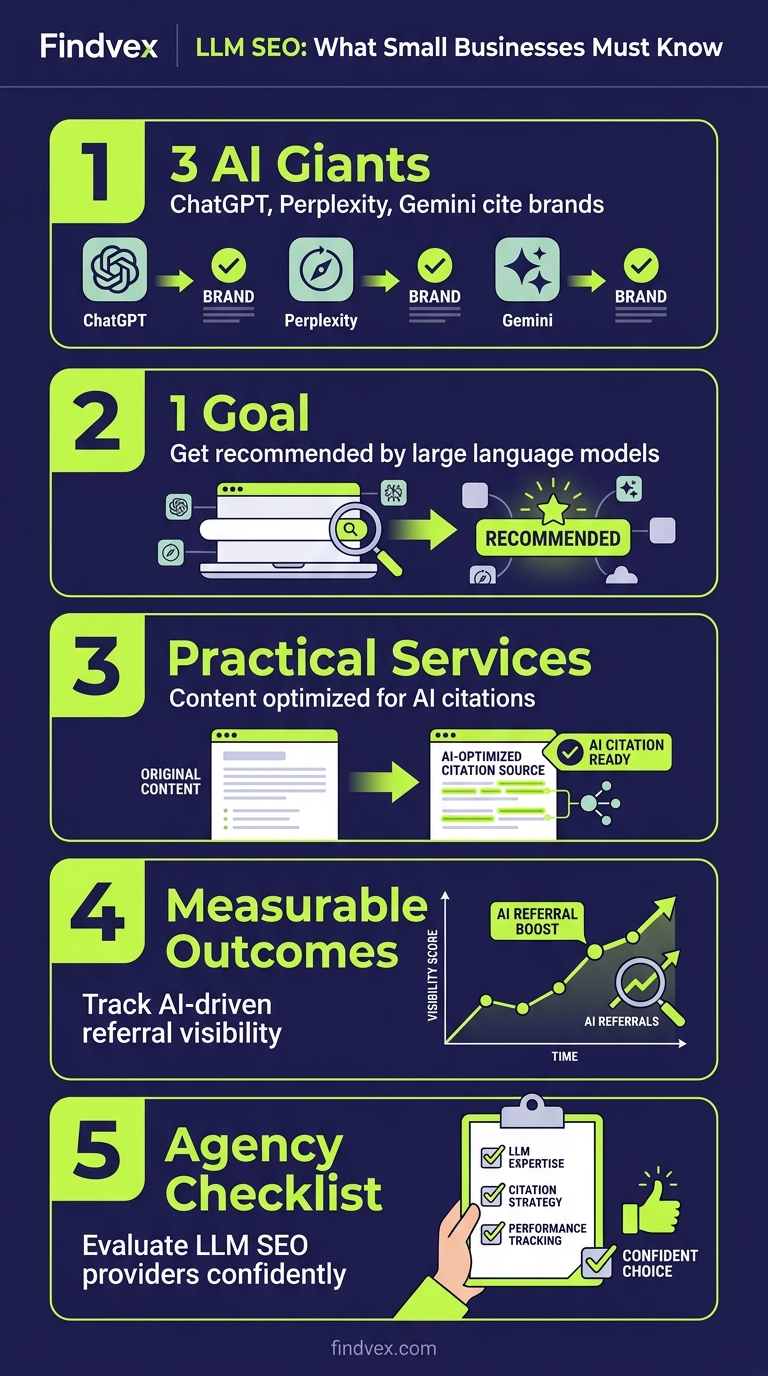
- Ask what they measure: If the answer is only 'keyword rankings,' they haven't adapted. A legitimate LLM SEO service also tracks AI citation frequency, entity mentions in AI answers, and AI Overview appearance rates.
- Ask about schema strategy: Can they walk you through which schema types they'll implement and why? Generic 'we add schema' is not enough — you want to hear specifics like LocalBusiness with serviceArea, Review aggregateRating, and FAQ structured data.
- Ask how they handle AI crawler access: They should immediately ask you whether GPTBot, OAI-SearchBot, and PerplexityBot are allowed in your robots.txt. If they don't know what OAI-SearchBot is, that's a red flag.
- Ask for a content audit approach: Real LLM SEO work involves identifying your highest-value pages, restructuring answers for direct extraction, and sometimes creating net-new content targeting specific AI query patterns.
- Ask about link and citation building: Legitimate authority building targets credible, relevant sources. If they mention bulk directory submissions or link farms, walk away.
LLM SEO for Local Small Businesses: Where to Focus First
If you're a local service business — a law firm, dental practice, HVAC company, real estate agent, or restaurant — LLM SEO has a specific, high-value application: making sure AI engines recommend you when someone asks a local intent question.
Local LLM visibility runs through three core channels: your Google Business Profile (which feeds Google's AI systems directly), your website's local schema and content, and your citation footprint across credible local sources. All three need to be consistent and maintained.
The highest-leverage starting point for most local businesses is their Google Business Profile combined with their service pages. If your GBP is complete and optimized — correct categories, thorough service descriptions, recent reviews with responses — and your service pages answer specific local questions directly, you're already ahead of the majority of competitors in most local markets.
- Ensure your Google Business Profile primary category is precise, not broad.
- Add service items with descriptions to your GBP — these can be extracted by AI systems.
- Build or update local landing pages that answer specific questions about your service in your city. (See our guide on local landing pages that rank without sounding generic.)
- Get reviews that mention your specific services and location — LLMs weight review content as a trust signal.
- Check that your NAP is identical across your site, GBP, Yelp, BBB, and relevant industry directories.
What LLM SEO Services Typically Cost
Pricing varies widely depending on the scope of work, the agency, and your site's current technical state. Because this space is new, there's less market standardization than in traditional SEO — which means you need to be especially clear on what's included.
Expect foundational LLM SEO work (technical audit, schema implementation, content restructuring for key pages, AI crawler review) to be priced as a one-time project or included in an ongoing retainer. Ongoing retainers that include monitoring, citation building, and content creation will typically run higher.
What you should not pay for: vague 'AI optimization' packages with no defined deliverables, guaranteed rankings in AI systems (no one can guarantee placement in LLM outputs), or services that are clearly just traditional SEO rebadged with AI terminology.
Do This This Week: A 5-Step LLM SEO Starter Plan
You don't need to hire an agency on day one. Here's what any small business owner can do right now to move in the right direction.
- Step 1 — Check your robots.txt: Go to yourdomain.com/robots.txt. Search for 'GPTBot' or 'PerplexityBot'. If you see a Disallow line for these bots, you are blocking AI crawlers from seeing your site. Fix this immediately or have your developer fix it.
- Step 2 — Run a site:yoursite.com search in Google: Confirm your core pages are indexed. If key pages are missing, read our guide on indexing issues SEO to diagnose why.
- Step 3 — Pick your three most valuable service pages and reformat them: Add a clear one-paragraph direct answer at the top of each page, convert relevant content into Q&A format, and make sure your business name, location, and service type appear in the first 100 words.
- Step 4 — Add or update your LocalBusiness schema: Use Google's Rich Results Test (search.google.com/test/rich-results) to check whether your schema is valid. If you have none, add it via your CMS plugin (Yoast, RankMath, or Schema Pro for WordPress) or ask your developer.
- Step 5 — Ask ChatGPT and Perplexity about your business or niche: Search '[your service] in [your city]' in both tools. See who gets cited. This gives you a real-world benchmark of your current AI visibility and shows you who you're competing with in these channels.
How LLM SEO Affects Leads, Not Just Traffic
The commercial case for LLM SEO is not about vanity metrics — it's about capturing demand at the moment of highest intent. When someone asks an AI assistant 'Who should I hire for estate planning in Nashville?', they're not browsing. They're close to picking up the phone.
Being cited in an AI answer at that stage is the equivalent of a warm referral from a trusted friend. The user already trusts the AI's recommendation framework. If your business is named, they will click, call, or search you directly. If your competitor is named instead, that lead is gone before your website ever had a chance.
This is why LLM SEO is increasingly a conversion-layer investment, not just a visibility play. The goal isn't to get more anonymous traffic — it's to intercept high-intent queries where purchase decisions are being made. For service businesses, that directly translates to booked calls and consultations, not just impressions. If you want to understand how that pipeline works, our piece on how local SEO turns website traffic into booked calls is worth reading alongside this one.
FAQs
What is LLM SEO and why does it matter for small businesses?
LLM SEO (Large Language Model SEO) is the practice of optimizing your website and content so that AI systems like ChatGPT, Perplexity, and Google's AI Overviews cite and recommend your business. It matters for small businesses because an increasing share of consumer queries — especially local and informational ones — are now answered directly by AI before any link is clicked.
Is LLM SEO the same as GEO or AEO?
They're closely related terms for the same emerging discipline. GEO (Generative Engine Optimization) and AEO (Answer Engine Optimization) refer to the same core goal: being cited in AI-generated answers. LLM SEO is a slightly broader term that emphasizes the large language model layer specifically. In practice, the services overlap significantly.
Do I need to choose between traditional SEO and LLM SEO?
No. Traditional SEO — technical health, quality content, strong backlinks — is the foundation of LLM SEO. AI systems heavily favor sites that are already authoritative and well-structured. LLM SEO adds a layer of content formatting, schema implementation, and AI crawler management on top of that foundation. The two reinforce each other.
How do I know if an AI system is recommending my business?
The simplest method is manual testing: search for your service and location in ChatGPT, Perplexity, and Google's AI Mode, and see who gets cited. You can also set up brand mention alerts, and some enterprise SEO tools are beginning to offer AI visibility tracking dashboards. Consistent manual sampling at least monthly gives you a useful baseline.
Can I block AI crawlers and still show up in AI search results?
Generally, no. If you block GPTBot, OAI-SearchBot, or PerplexityBot in your robots.txt, those platforms cannot retrieve fresh content from your site. For retrieval-augmented AI search (where the AI searches the web in real time), being blocked means being invisible. There are limited cases where historical training data creates exceptions, but this is unreliable and shrinking as models retrain.
What's the single most impactful LLM SEO change a small business can make today?
Check your robots.txt for blocked AI crawlers and fix any blocks immediately. Then pick your top service page and rewrite the opening section to directly answer the most common question a customer asks about that service. Those two steps cost nothing and move the needle faster than most technical work.
How long does it take to see results from LLM SEO services?
It depends on your starting point and which AI platforms you're targeting. Google AI Overviews can respond to technical and content changes within weeks, since they crawl your site regularly. ChatGPT's real-time web search (ChatGPT Search) can pick up new content quickly too. Full model training cycles — which affect how deeply LLMs 'know' your brand — operate on longer timelines of months. Expect meaningful progress on AI citation frequency within 60–90 days of consistent work.
Related reading
- ai seo agency — What to Expect from a Modern AI SEO Agency (And Red Flags to Watch)
- GEO playbook local search — The 90-Day GEO Playbook for Local Search: How To Show Up When AI Does The Searching
- clinic seo services — Clinic SEO: How to Rank for "Doctor Near Me" Searches
- near me seo strategy — Near Me SEO Strategy: A Local Discovery Playbook for Service Businesses
- local seo services — How Local SEO Turns Website Traffic Into Booked Calls
- real estate seo — Real Estate SEO: How Local Agents Win Search in 2026
- local landing pages seo — Local Landing Pages That Rank Without Sounding Generic
- how AI models understand your brand — How AI Models Actually 'Understand' Your Brand — and What to Do When They Get It Wrong
- AI crawler blocking strategy — The AI Crawler Protection Paradox: Why Brands Block Bots Then Pay to Be Seen
- openai crawl activity tripled since gpt-5 — OpenAI Crawl Activity Tripled Since GPT-5: What It Means for Your Website
Research notes
Background claims used while researching this article. Verify with the cited authorities before quoting.
- A meaningful and growing share of informational and local queries are answered directly by AI engines as of mid-2025.
- LLMs weight review content as a trust signal.
Sofia Patel
Head of Content & Growth · Findvex
Sofia Patel leads content and growth at Findvex. She writes about local SEO, conversion-focused content, and AEO/GEO strategy — the work that turns search visibility into booked calls and qualified leads for service businesses.
Expertise: Local SEO · Conversion content · AEO / GEO strategy · Content-led link building
Related reads
How AI Models Actually 'Understand' Your Brand — and What to Do When They Get It Wrong
AI models construct a representation of your brand from training data, retrieval signals, and cited sources — a process that's invisible, imperfect, and increasingly consequential. If ChatGPT, Perplexity, or Google's AI Overviews are describing your business inaccurately, the fix isn't a phone call to OpenAI. It's a deliberate content and citation strategy.
Keyword ResearchHow to Find Competitor Keyword Gaps Without Wasting Budget
Competitor keyword gap analysis tells you exactly which search terms your rivals rank for that you don't. Done right, it's one of the highest-ROI moves in SEO. Done wrong, it produces a bloated list of irrelevant keywords you'll never recover from. Here's how to do it right.
SEO NewsThe 90-Day GEO Playbook for Local Search: How To Show Up When AI Does The Searching
When someone asks ChatGPT 'best HVAC company near me,' your Google ranking doesn't matter if you're not in the AI's answer. This 90-day GEO playbook shows small businesses exactly how to build the signals that get you cited in AI-powered local search.