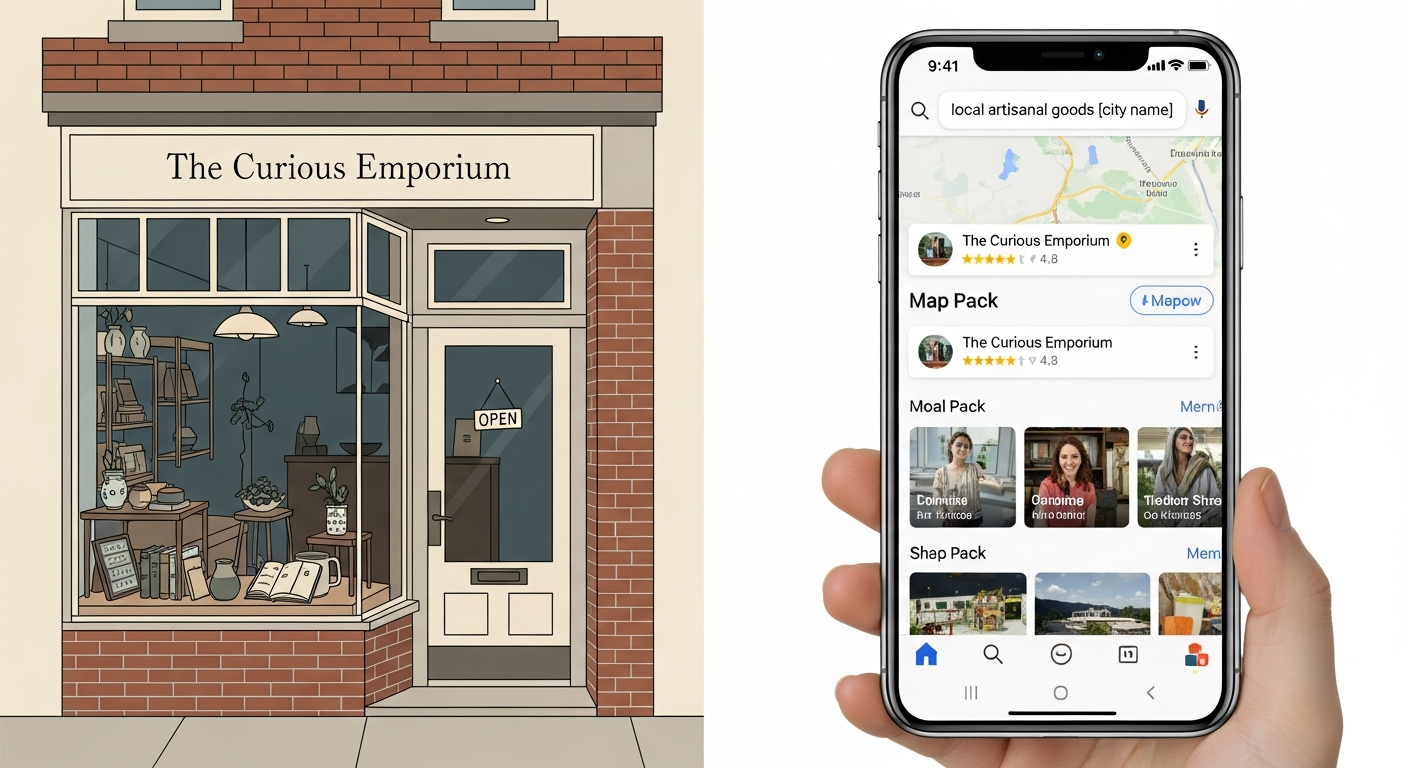
The 2026 SEO Strategy Small Businesses Should Actually Follow
The rules of search have shifted fast. This is the 2026 SEO framework small businesses should actually run — built around AI Overviews, local intent, content depth, and technical hygiene — with clear priorities so you know what to do first.
Quick answer
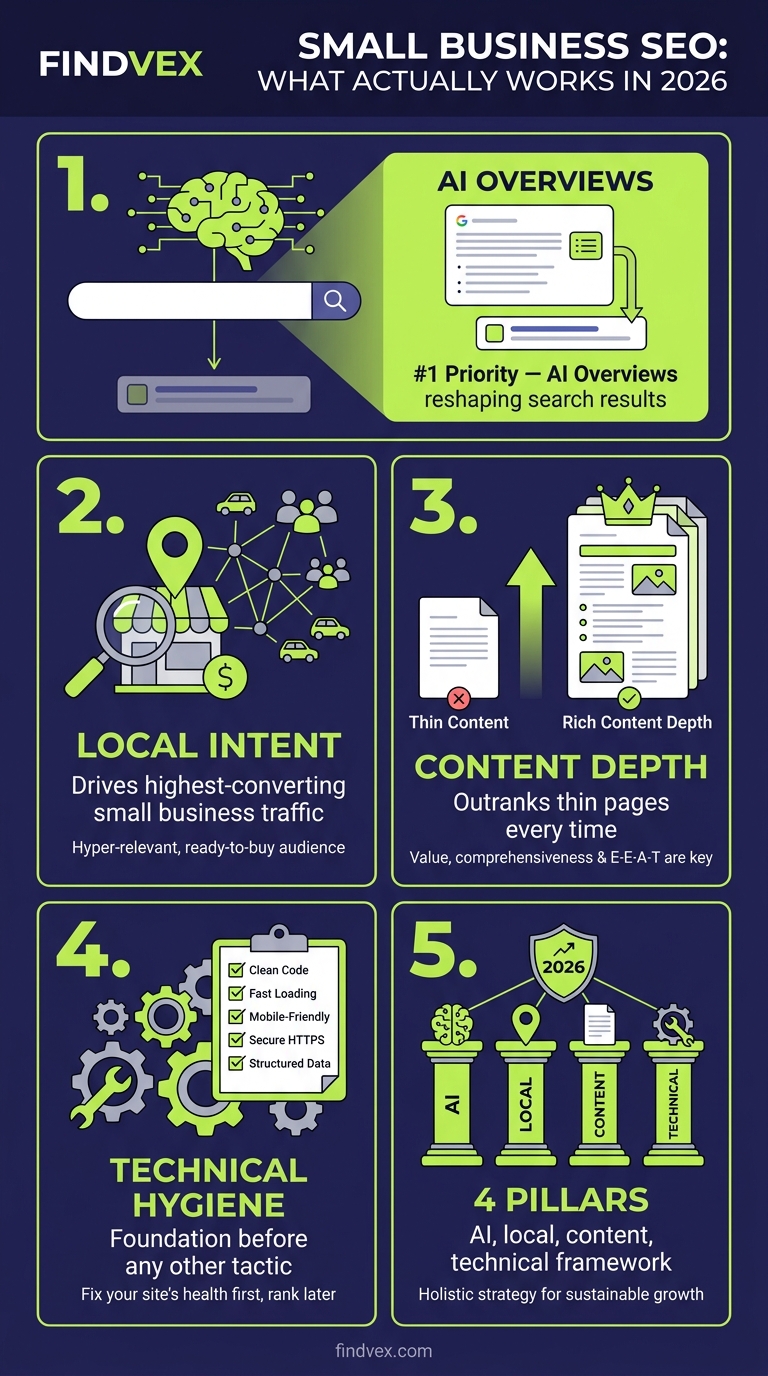
A winning 2026 small business SEO strategy has four pillars: (1) technical health so Google can crawl and render your site, (2) local SEO and Google Business Profile optimization to capture near-me and map-pack intent, (3) content that demonstrates genuine expertise and earns citations in AI Overviews, and (4) consistent measurement tied to leads and revenue — not just rankings. Prioritize local and technical first; content authority is the long-term compounding asset.
SEO in 2026: What Actually Changed for Small Businesses
If your SEO playbook still reads like a 2022 keyword-and-backlinks checklist, you are leaving pipeline on the table. Three structural shifts have reshaped how small business websites earn visibility in 2026: the expansion of AI Overviews into more query types, Google's continued elevation of local and 'near me' intent signals, and a measurable reduction in organic click-through on informational queries where AI answers appear above all blue links.
None of these changes make SEO less valuable for small businesses. They do change the order of operations. The businesses winning right now are not the ones doing the most SEO activity — they are doing the right SEO in the right sequence, with their budget allocated against the highest-return levers.
This guide lays out that sequence. Not as a theoretical framework, but as an operational strategy you can apply this quarter.
The Three Shifts That Redefine Small Business SEO in 2026
Understanding what changed is not an academic exercise — it tells you where to invest and what to deprioritize.
- AI Overviews on commercial-intent queries. Google's AI-generated summaries now appear on a broader range of queries, including many that small businesses historically captured with blog posts. Informational content that doesn't demonstrate genuine expertise or earn external citations is now competing for visibility in a format where only a handful of sources get surfaced.
- Local intent remains a direct-click channel. Map pack results, Google Business Profile calls, and local landing pages still drive direct conversions with high commercial intent. This channel has not been disrupted by AI Overviews in the same way — it is arguably more valuable now as the informational tier becomes more AI-dominated.
- E-E-A-T signals are table stakes, not differentiators. Experience, expertise, authoritativeness, and trustworthiness are now baseline requirements, not advantages. Sites that lack author bios, credentials, or verifiable business information face a structural headwind that content volume cannot overcome.
“AI agents do in hours what teams used to do in weeks. The advantage compounds.”
The Four-Pillar Framework for 2026 Small Business SEO
Every small business SEO strategy should be organized around four pillars — each with a distinct function, priority order, and business outcome. Running all four simultaneously without prioritization is how budgets get burned without measurable return.
Pillar 1: Technical Health — Your Crawl and Render Floor
Technical SEO is not glamorous, and it is not a differentiator — it is the floor. If Google cannot crawl, render, and index your pages reliably, every dollar spent on content and links is building on sand.
For most small business websites, the critical technical issues are a short list: pages blocked in robots.txt that shouldn't be, missing or broken canonical tags creating duplicate content problems, Core Web Vitals failures that hurt mobile experience, and HTTPS misconfigurations. These are not difficult to find — a structured technical audit surfaces them in hours.
The strategic point is this: fix technical issues before investing heavily in content or link building. A technically clean site amplifies every other SEO investment. A technically broken one dilutes it.
- Run Google Search Console's Coverage and Core Web Vitals reports monthly
- Confirm your sitemap is submitted, current, and lists only canonical, indexable URLs
- Verify page speed on mobile — not just desktop — since most local searches happen on mobile devices
- Check that internal links use consistent URL formats (no mixed HTTP/HTTPS, no trailing slash inconsistencies)
Pillar 2: Local SEO — Your Highest-ROI Channel in 2026
For any small business with a physical location or a defined service area, local SEO is the single highest-return SEO investment available in 2026. Map pack visibility and Google Business Profile impressions drive calls, direction requests, and booked appointments — outcomes that are directly attributable and tied to revenue.
Google Business Profile optimization is the starting point: complete NAP (name, address, phone) data, accurate service categories, a consistent posting cadence, and active review management. These signals are the primary inputs into local pack rankings alongside proximity and on-site relevance.
Beyond the profile, local landing pages that match service-area intent are the second lever. A page for 'HVAC repair in Austin, TX' needs genuine local signals — not a template with the city name swapped in. Coverage of local neighborhoods, service specifics, and customer-facing details that differentiate you from national competitors is what makes a local page rank and convert.
- Maintain consistent NAP across your GBP, website, and major citation sources
- Create individual landing pages for each core service in each geography you serve
- Respond to reviews consistently — both positive and negative — as engagement signals local activity
- Use local schema markup (LocalBusiness, Service) on location-specific pages
Pillar 3: Content Authority — The Compounding Long-Term Asset
Content authority is not about publishing volume. It is about building a credible, well-structured answer to every question your target customer has at each stage of their buying process — and doing it better than any competitor in your vertical and geography.
In 2026, content that earns AI Overview citations shares common characteristics: it answers questions directly and completely, it cites verifiable specifics rather than generalities, it is structured so that individual passages are extractable as answers, and it is attributed to identifiable people with relevant credentials.
For small businesses, this means a focused content calendar built around your core service topics — not a spray-and-pray approach to every trending keyword. A plumber in Denver does not need 200 blog posts. They need eight to twelve authoritative pages that cover their core services, common customer questions, and local market context — then a handful of supporting articles that link back to those pages.
The practical test: if you removed the author bio and business name from your page, could a reader tell it was written by someone with real on-the-job experience in that trade? If the answer is no, the content will not earn sustained visibility in 2026.
- Map content to your service categories first — one authoritative page per core service
- Add first-person experiential detail: how you diagnose problems, what your process is, what customers should watch out for
- Use FAQ sections and clear H2/H3 structure so AI systems can extract passage-level answers
- Interlink service pages to supporting blog content in a deliberate topical cluster structure
Pillar 4: Measurement — Tie SEO to Business Outcomes, Not Vanity Metrics
The most common way small businesses waste SEO budget is by optimizing for rank position and traffic volume without connecting those metrics to leads, calls, and revenue. Rankings are an input signal. Qualified leads are the business outcome.
Set up conversion tracking before you start any SEO campaign. At minimum: Google Search Console for organic query data, Google Analytics 4 for goal completions (form submissions, phone click-throughs, appointment bookings), and a call tracking number if phone leads are your primary channel. Without this instrumentation, you cannot make rational budget decisions.
Review performance monthly at a minimum. Look for pages that rank but don't convert — these need CTA or UX work. Look for pages that convert well but don't rank — these need SEO reinforcement. This feedback loop is what separates SEO programs that compound returns from those that plateau.
- Track form submissions, phone clicks, and appointment bookings as primary conversions in GA4
- Monitor GBP insights: calls, direction requests, and website clicks are high-intent conversion signals
- Set Search Console queries filtered by page to identify ranking-but-not-converting pages
- Review keyword position trends quarterly — but always contextualize against conversion data
Priority Order and Budget Allocation: Where to Start
Running all four pillars is the goal. Getting there in the right order is the strategy. Here is how to sequence investment based on your current baseline:
If your site has significant technical issues (crawl errors, index bloat, Core Web Vitals failures), address those first. The time horizon is two to six weeks and the cost is relatively low — this unlocks the full value of everything that follows.
If your technical foundation is solid, local SEO is next. A well-optimized Google Business Profile and a set of properly structured local landing pages will generate measurable leads faster than any content strategy. The time horizon for local gains is typically 60 to 120 days.
Content authority is the third investment and the longest compounding curve. Budget for quality over quantity. Two authoritative, deeply researched service pages per month outperform ten thin blog posts every time in the current environment.
Measurement infrastructure should be set up in week one, regardless of where you are in the sequence. You cannot optimize what you don't track.
The Real Trade-offs Small Business Owners Need to Understand
SEO is not a binary 'do it or don't' decision — it is a portfolio of bets with different time horizons and risk profiles. Here are the trade-offs that matter most for small business budgets:
Speed vs. durability. Paid search delivers leads immediately. SEO builds a channel that compounds over time but requires 90 to 180 days to show meaningful returns. If you have a cash flow problem today, don't deprioritize paid search for SEO. If you are thinking 12 to 24 months out, SEO has significantly lower cost-per-lead at scale.
Volume vs. authority. Publishing more content faster does not improve rankings in 2026. Google's helpful content systems are calibrated to surface the most authoritative answer per topic — not the most voluminous site. One genuinely expert page beats three thin pages targeting the same intent.
DIY vs. managed. A business owner can execute solid local SEO and basic technical fixes without outside help. Content authority and sustained technical monitoring are harder to do well without dedicated time or expertise. The honest answer: invest in the areas where your time is cheapest, and get help where it is most expensive.
Strategic Takeaway: The SEO Program That Compounds in 2026
The small businesses that will own their search categories by the end of 2026 are not doing more SEO. They are doing better-sequenced SEO with clear accountability to revenue outcomes.
The formula is straightforward: a technically clean site, a fully optimized local presence, a focused topical content program built on genuine expertise, and a measurement layer that connects search activity to bookings and pipeline. None of these elements are exotic. All of them require consistent execution over 12 to 18 months.
The competitive advantage for a small business in search is specificity. You know your trade, your market, and your customers at a level a national chain cannot replicate at scale. The 2026 SEO strategy is about making that specificity visible to Google — and to the customers searching for exactly what you do, where you do it.
FAQs
How long does it take for SEO to work for a small business?
Local SEO improvements — particularly Google Business Profile optimization and citation consistency — can show measurable results in 60 to 90 days. Content authority and broader organic ranking gains typically require 4 to 6 months of consistent work before significant traffic changes are visible. Technical fixes often show faster crawl and indexation improvements, sometimes within weeks of implementation.
What is the most important SEO factor for small businesses in 2026?
For most small businesses, local SEO — specifically Google Business Profile optimization and well-structured local landing pages — delivers the highest ROI because it captures high-intent, near-purchase searches. Technical health is the prerequisite. Content authority is the long-term compounding asset. All three matter; local is typically the fastest path to attributable revenue.
Does AI Overviews hurt small business SEO?
AI Overviews reduce click-through rates on informational queries where Google generates a summarized answer above organic results. For small businesses, the impact is most felt on top-of-funnel blog content. However, transactional and local intent queries — where users want to contact or visit a specific business — are less affected. Businesses that shift their SEO focus toward local intent and conversion-oriented content are better positioned.
How much should a small business spend on SEO?
There is no universal figure, but a useful framework is to evaluate SEO spend against the lifetime value of a customer and your current cost per lead from other channels. Local SEO foundations — GBP optimization, citation cleanup, a few local landing pages — can often be built for a few thousand dollars. Ongoing content and link building programs for competitive markets typically require sustained monthly investment. The key is measuring cost per lead from SEO versus other acquisition channels and reallocating accordingly.
Should I do SEO or paid search first?
If you need leads within 30 days, start with paid search — it is the only search channel that delivers traffic immediately. SEO is the right first investment if you have a 6-to-12-month runway and want to reduce your long-term cost per lead. Many small businesses run both: paid search for near-term pipeline, SEO for compounding returns. The mistake is expecting SEO to function as a short-term lead source.
What SEO tasks can a small business owner do without a consultant?
Google Business Profile management, review response, local citation consistency checks, and basic Search Console monitoring are all executable without outside help. Publishing authoritative service-page content — if the owner has genuine expertise to write about — is also effective. Technical SEO audits, structured data implementation, and site architecture decisions are areas where most business owners benefit from professional input.
Sources & Citations
Alex Rivera
Writing about AI, search, and what actually moves the needle for US small businesses.
Related reads
OpenAI Crawl Activity Tripled Since GPT-5: What It Means for Your Website
OpenAI's crawl activity roughly tripled following the GPT-5 launch, with OAI-SearchBot overtaking GPTBot in log-file events. If you haven't audited your robots.txt or server logs for AI crawler behavior recently, now is the time.
seo-newsThe AI Crawler Protection Paradox: Why Brands Block Bots Then Pay to Be Seen
Businesses are simultaneously blocking AI crawlers from scraping their content and paying to appear in AI-generated answers. That contradiction has a name: the protection paradox. Here's what it means technically, and what small businesses should actually do about it.
industry-seo-playbooksReal Estate SEO: A Practical Guide for Small Businesses
Real estate SEO helps agents, brokerages, and property managers rank in local Google searches so buyers and sellers find them first. This guide covers everything from Google Business Profile to IDX optimization and neighborhood content—practical steps you can start this week.