What Changed in Google Search This Week and What Small Businesses Should Do
Google search is always moving. This guide breaks down how to read algorithm updates without panicking, what signals actually shifted, and the practical steps small business owners should take when rankings change.
Quick answer
Google regularly releases ranking updates — broad core updates, spam updates, and smaller daily tweaks. When you notice a ranking or traffic change, check Google Search Central and the Google Search Status Dashboard first to confirm whether an update is active. Most small business sites recover by strengthening content quality, fixing technical issues, and ensuring their Google Business Profile is accurate. Reactive panic changes rarely help; methodical diagnosis does.
How to Read a Google Search Update Without Overreacting
Every few weeks, chatter about a Google algorithm update spreads through SEO forums, LinkedIn posts, and client emails. Traffic dips appear in dashboards. Rankings shuffle. The temptation is to act immediately — rewrite pages, build links overnight, change site structure. That impulse is usually wrong.
The more useful first step is verification. Google confirms major updates on the Google Search Status Dashboard and through Google Search Central communications. If neither source shows an active update, the traffic change you're seeing may be seasonal, a crawl anomaly, a competitor move, or a local data refresh rather than a broad algorithm shift.
This guide explains how to reliably track Google search changes, interpret what they signal for small business sites, and decide which actions are worth prioritizing.
The Main Types of Google Updates Small Businesses Encounter
Not all Google updates carry the same weight or require the same response. Understanding the category of a change helps you allocate time and budget correctly.
- Broad Core Updates: Released several times per year. These reassess quality signals across large portions of the index. Sites that lose visibility during a core update typically need long-term content and authority improvements — not quick fixes.
- Spam Updates: Target sites violating Google's spam policies, including thin content, link schemes, and scaled content abuse. If your site follows white-hat practices, these updates rarely cause harm.
- Local Search Updates: Affect Google Maps, the local pack, and local organic results. Changes here hit service businesses, restaurants, and multi-location companies hardest.
- Product Reviews Updates (now folded into core): Rewarded in-depth, experience-based product and service reviews over thin affiliate-style content.
- Daily Algorithmic Tweaks: Google makes thousands of smaller ranking changes each year. Most are invisible. A one or two position shift on a single keyword is almost never worth investigating in isolation.
- AI Overview Changes: Google's AI Overviews (formerly Search Generative Experience) continue to evolve. Small businesses increasingly lose zero-click traffic on informational queries to these summaries, making structured, authoritative content more important than ever.
“AI agents do in hours what teams used to do in weeks. The advantage compounds.”
How to Verify Whether an Update Is Actually Happening
Before changing anything on your site, confirm the source of the disruption. Rushing to rewrite pages during a non-update period creates churn without benefit.
- Google Search Status Dashboard (status.search.google.com): The official source. If a broad core update, spam update, or indexing issue is listed here with active dates, that's confirmed signal.
- Google Search Central Blog (developers.google.com/search/blog): Google announces major updates with detail here. Bookmark it.
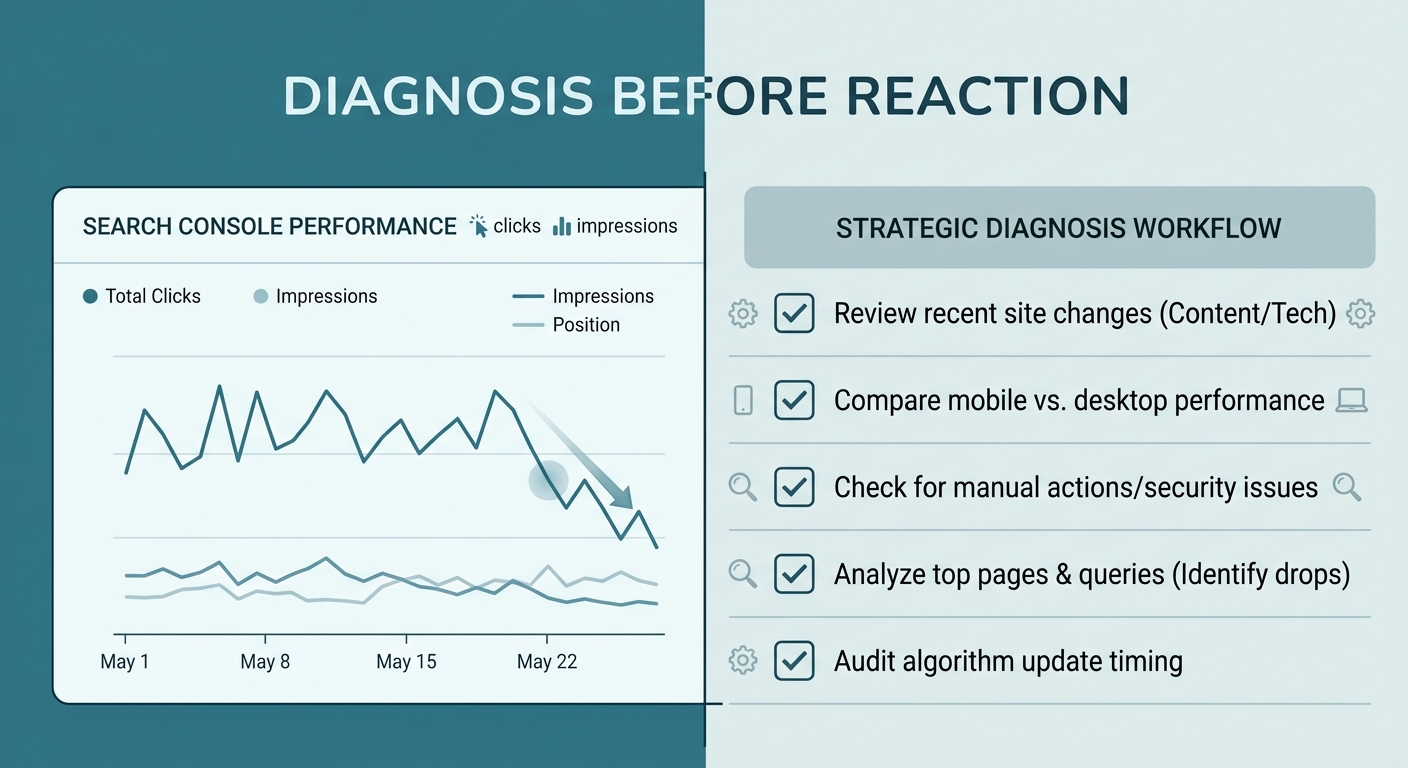
- Google Search Console: Check the Performance report. Filter by date around when you noticed the change. Look at clicks, impressions, and average position. A broad drop across many queries suggests an algorithm event. A drop on specific pages suggests a page-level issue.
- Trusted third-party monitors: Tools like Semrush Sensor, Mozcast, and SERPstat volatility trackers measure SERP fluctuation independently. High volatility scores that correlate with your traffic drop add weight to an update diagnosis.
- Cross-check with competitors: If competitors in your space also moved (up or down), that supports the update hypothesis. If only your site dropped while competitors held steady, the cause is likely site-specific.
What Small Businesses Should Actually Do After a Google Update
The right response depends on what you find in the diagnostic phase. Here is a prioritized workflow, not a panic checklist.
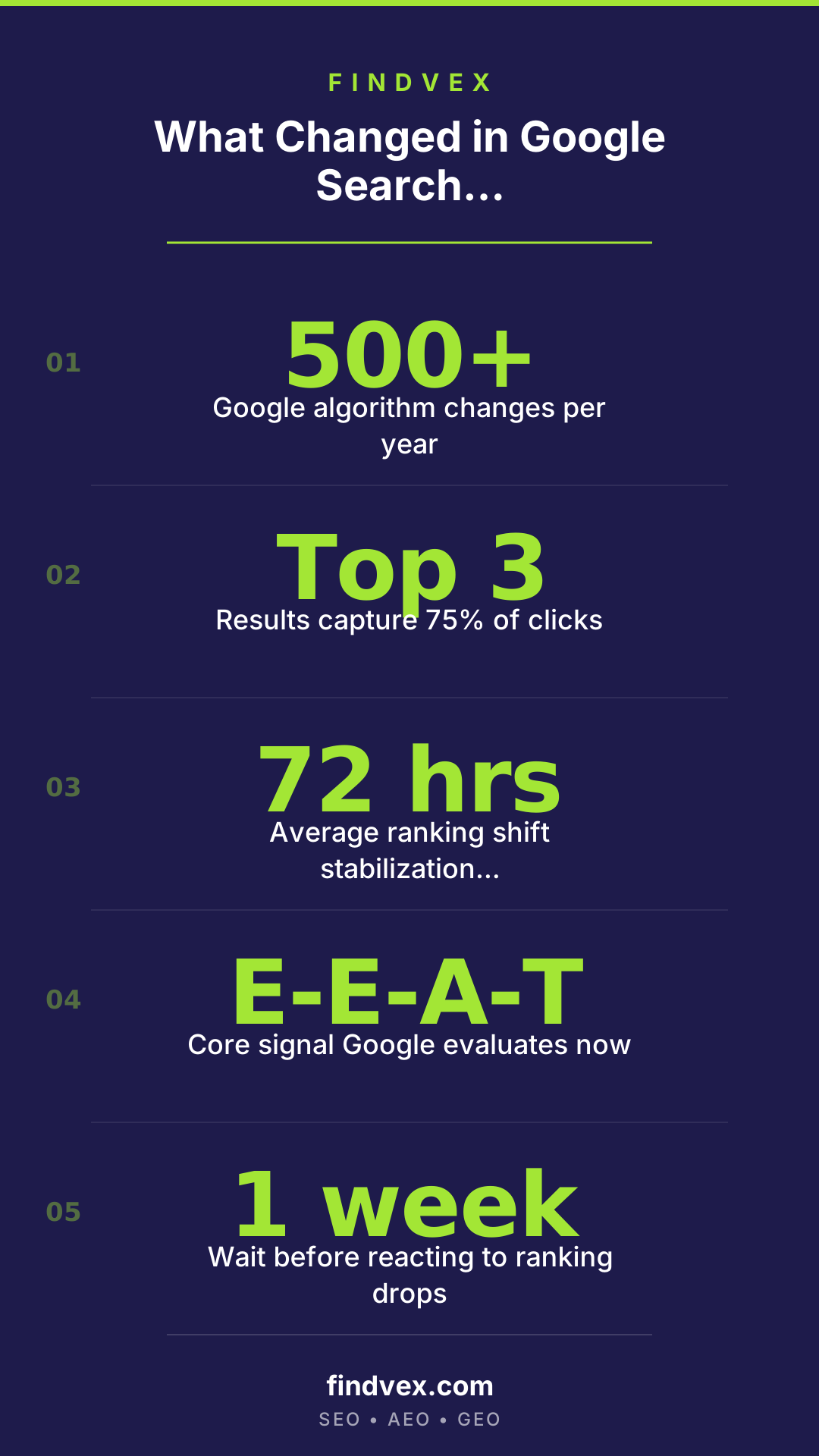
- Step 1 — Wait 48–72 hours: Updates often roll out over one to two weeks. Rankings fluctuate before settling. Decisions made in the first 24 hours of an update rollout are usually premature.
- Step 2 — Identify which pages lost visibility: In Google Search Console, compare the current period to the same period before the update. Sort pages by largest click decline. These are your investigation targets.
- Step 3 — Audit those pages for quality signals: Does the content answer the query completely? Is it written for a person or for a search engine? Does it demonstrate genuine expertise, experience, or local knowledge? Is the page slow or hard to use on mobile?
- Step 4 — Check technical fundamentals: Indexing issues, crawl errors, and Core Web Vitals problems can amplify the impact of a quality update. Run a quick technical check on your highest-traffic pages. Our technical SEO audit checklist for small business websites walks through this systematically.
- Step 5 — Review your Google Business Profile: For local businesses, keep your GBP hours, categories, and service areas accurate. Local pack fluctuations are common around updates and often stabilize without changes — but outdated profile data is a genuine liability.
- Step 6 — Do not make wholesale site changes based on a single update: Broad rewrites, domain moves, or link-building campaigns launched reactively during an update window are difficult to evaluate and can introduce new problems.
Content Quality: What Google Is Actually Measuring
Google's stated guidance around broad core updates consistently points to the same set of quality signals. These are not new concepts introduced by individual updates — they are the baseline Google has communicated for years and continues to weight more heavily as AI-generated content floods the web.
The practical question for a small business page is: does this content do something a competitor's page does not? That could mean genuine local knowledge, firsthand service experience, transparent pricing context, real customer scenarios, or more complete answers to follow-up questions the searcher is likely to have.
Thin service pages that list bullet points and end with a contact form are the most vulnerable pages in any core update. Pages built around a specific customer problem, written with real operational detail, consistently hold ranking better.
- Does the page answer the primary query in the first paragraph?
- Does it address follow-up questions naturally (FAQ sections help here)?
- Is there evidence of real expertise — specific numbers, named processes, actual local context?
- Is the author or business entity clearly identified?
- Are there helpful internal links to related, deeper content on the same site?
AI Overviews and the Changing Shape of Google Search Results
One structural change that has continued through 2025 and into 2026 is the expansion of Google's AI Overviews on informational queries. These summaries appear above traditional blue links and can reduce click-through rates on queries where your page previously ranked well.
For small businesses, the practical implication is this: traffic from purely informational queries (how-to articles, definition pages, general FAQ content) is structurally harder to capture than it was two years ago. The queries that still reliably drive visits and conversions are transactional and local — 'plumber near me,' 'best HVAC company in [city],' 'dentist accepting new patients [city].'
This does not mean informational content is worthless. It builds topical authority, supports AI Overview citations, and serves users who are in early research phases. But if you are a small business allocating limited content budget, transactional and local pages should be prioritized over broad informational articles.
Strategic Takeaway: Build for Stability, Not for Algorithms
The businesses that ride out Google updates with the least disruption are not the ones that respond fastest to each news cycle. They are the ones that built sites with clean technical foundations, genuine content, and consistent local presence before the update hit.
That is not a passive position. It requires regular content reviews, quarterly technical checks, and an honest audit of whether your pages actually serve the people searching for your services — or just approximate what a page about your services should look like.
For most small businesses, three priorities deliver the most update resilience: keeping your Google Business Profile accurate and active, having at least one well-developed service or location page per core offering, and resolving any technical issues flagged in Google Search Console before they compound. Everything beyond that is incremental.
If you want a structured starting point for the technical side, the FindVex technical SEO audit checklist for small business websites covers the fundamentals without requiring developer access.
FAQs
How do I know if a Google update affected my site?
Check Google Search Console's Performance report and compare the weeks before and after the suspected update. If clicks and impressions dropped across multiple pages simultaneously, an algorithm event is likely. Confirm by checking the Google Search Status Dashboard for an active update announcement.
How long does it take to recover from a Google core update?
Google has stated that recovery from a broad core update typically is not possible until the next core update, which may be several months away. That does not mean nothing can be done — improving content quality, fixing technical issues, and building authority all help — but significant ranking recovery usually takes three to six months at minimum.
Should I change my site immediately after noticing a ranking drop?
No. Wait 48–72 hours for the update to stabilize, then diagnose which specific pages dropped and why before making changes. Broad, reactive rewrites during an active rollout are difficult to evaluate and often cause more volatility.
Do Google updates affect local search results differently than organic results?
Yes. Local pack rankings (the map results) and Google Business Profile visibility are governed by different signals than organic web results. Local updates can shift local pack rankings independently of your site's organic performance. Keeping your GBP accurate and collecting genuine reviews are the most reliable local ranking actions.
What is the difference between a Google spam update and a core update?
A spam update targets sites that violate Google's explicit spam policies — thin content, manipulative link schemes, cloaking, AI-generated content at scale without editorial oversight. A broad core update reassesses quality and relevance signals more generally and can affect sites that are not spammy but are simply outclassed by better content. The remedies are different: spam issues require policy compliance; core update recovery requires genuine quality improvement.
How often does Google update its search algorithm?
Google makes thousands of changes to its ranking systems each year. Major confirmed updates — broad core updates, spam updates, and named system updates — typically number in the range of six to fifteen publicly announced events per year. Smaller, unannounced tweaks happen continuously.
Sources & Citations
Rhea Sharma
Writing about AI, search, and what actually moves the needle for US small businesses.
Related reads
The AI Crawler Protection Paradox: Why Brands Block Bots Then Pay to Be Seen
Businesses are simultaneously blocking AI crawlers from scraping their content and paying to appear in AI-generated answers. That contradiction has a name: the protection paradox. Here's what it means technically, and what small businesses should actually do about it.
industry-seo-playbooksReal Estate SEO: A Practical Guide for Small Businesses
Real estate SEO helps agents, brokerages, and property managers rank in local Google searches so buyers and sellers find them first. This guide covers everything from Google Business Profile to IDX optimization and neighborhood content—practical steps you can start this week.
local-seo-for-service-businessesNear Me SEO: A Practical Guide for Small Businesses
"Near me" searches connect high-intent buyers to local businesses — but ranking for them requires more than just adding the phrase to your website. This guide covers every lever you can pull, from your Google Business Profile to on-page signals and review strategy.