Affordable SEO Services in the USA: What Small Businesses Actually Get for Their Money
Affordable SEO for small businesses in the USA typically costs $500–$2,000/month for a reputable agency or consultant. Here's what that budget gets you, what to avoid, and how to make sure every dollar drives leads — not just rankings.
Quick answer
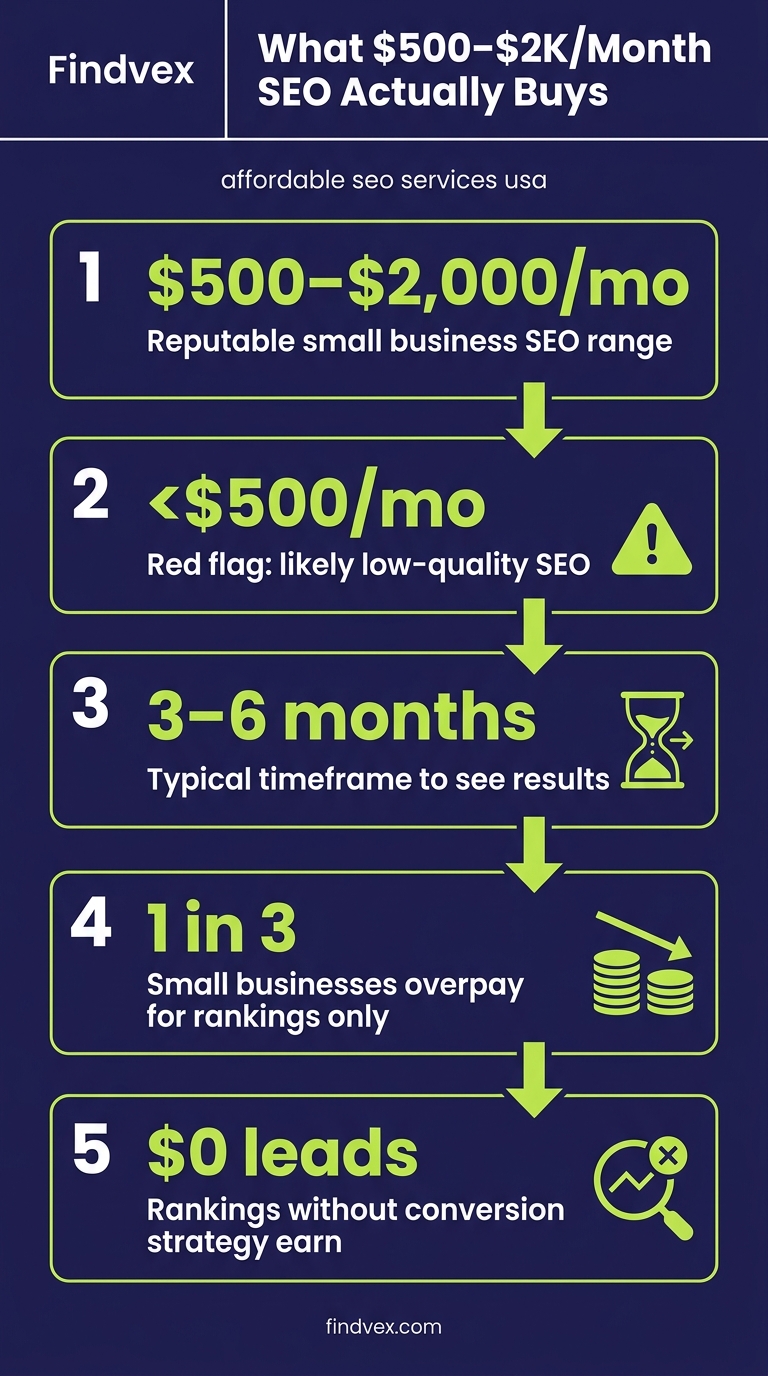
Affordable SEO services for small businesses in the USA typically range from $500 to $2,000 per month from a legitimate agency or $75–$150/hour from an independent consultant. That budget generally covers technical auditing, on-page optimization, local SEO, and monthly reporting. Be skeptical of any provider charging under $300/month with promises of guaranteed first-page rankings — those packages rarely deliver sustainable results.
What 'Affordable SEO' Actually Means for a Small Business
The word 'affordable' is doing a lot of work in this market. You'll see SEO packages advertised from $49/month to $5,000/month — all claiming to be 'affordable for small businesses.' The honest answer is that price alone tells you almost nothing. What matters is what's included, who's doing the work, and whether the output connects to leads and revenue.
For most US small businesses — a local service company, a single-location retailer, a solo professional — a realistic starting budget for meaningful SEO is around $500–$1,000/month from a specialist or small agency. That's not cheap relative to, say, a Facebook Ads boost, but it's a fraction of what enterprise brands spend, and the ROI compounds over time in a way paid ads don't.
Before you sign anything, you need to understand what's actually inside a package at each price point — and what's missing.
SEO Pricing Tiers: What Each Budget Level Actually Gets You
Here's an honest breakdown of what different monthly budgets tend to buy in the US market. These ranges reflect what independent consultants and small-to-midsize agencies typically charge for small business work.
- Under $300/month: Usually automated reporting tools resold with minimal human oversight. Expect generic link submissions, templated reports, and little to no strategic input. These packages rarely move rankings for competitive keywords and can sometimes cause harm through low-quality link building.
- $300–$600/month: Entry-level packages from smaller agencies or offshore teams. You may get a one-time technical audit, basic on-page optimization, and a monthly report. Execution quality varies significantly. Good for very new sites in low-competition niches; not enough for most businesses trying to compete locally.
- $600–$1,500/month: The sweet spot for most local small businesses. At this level, a reputable US-based agency or experienced consultant can cover monthly technical monitoring, on-page updates, Google Business Profile optimization, citation building, and 2–4 pieces of content per month. This is where real local SEO gains start to happen.
- $1,500–$3,000/month: Mid-tier packages that typically add link building outreach, conversion rate optimization input, deeper content strategy, and more frequent reporting. Right for businesses in competitive local markets (law, healthcare, home services in large metros).
- Above $3,000/month: Full-service SEO with dedicated account management, regular strategy calls, content production, PR-driven link building, and multi-location optimization. More than most small businesses need at the start — but worth it if you're scaling.
“AI agents do in hours what teams used to do in weeks. The advantage compounds.”
What Should Be Inside a Small Business SEO Package
Not every agency packages SEO the same way, but if you're paying for ongoing monthly SEO, here's what a legitimate package should include — and what you should push back on if it's missing.
- Technical SEO baseline: At minimum, a crawl of your site to identify indexing issues, broken links, duplicate content, and Core Web Vitals problems. This should happen in month one and be revisited quarterly. (If you want to understand what a thorough technical audit looks like before hiring anyone, our technical SEO audit checklist for small business websites covers every item worth checking.)
- On-page optimization: Title tags, meta descriptions, header structure, and internal linking reviewed and updated across your key service or product pages. Not a one-time task — it needs ongoing attention as your site grows.
- Google Business Profile management: For any local business, this is non-negotiable. Optimizing your GBP, posting regularly, managing reviews, and keeping NAP (name, address, phone) consistent across directories directly affects your local pack rankings.
- Content creation or optimization: At least 1–2 pieces per month — service pages, blog posts, FAQs — that target real search queries your customers use. Thin, AI-generated filler content doesn't count.
- Link building or citation building: Local citations (consistent business listings across directories) for local SEO; editorial links or digital PR for broader authority. Ask specifically what link building tactics the agency uses — and avoid anyone who can't explain their process clearly.
- Monthly reporting: A report that connects activity to outcomes — not just ranking changes, but traffic, clicks, conversions, and where possible, leads or calls attributed to organic search.
5 Red Flags That Mean an 'Affordable' SEO Package Is Actually a Waste of Money
The SEO industry has more noise than almost any other marketing channel. Here's how to filter it quickly.
- Guaranteed first-page rankings: No legitimate SEO professional guarantees specific rankings. Google's algorithm is not controllable by a third party. Anyone making this promise is either lying or planning to use tactics that will eventually get your site penalized.
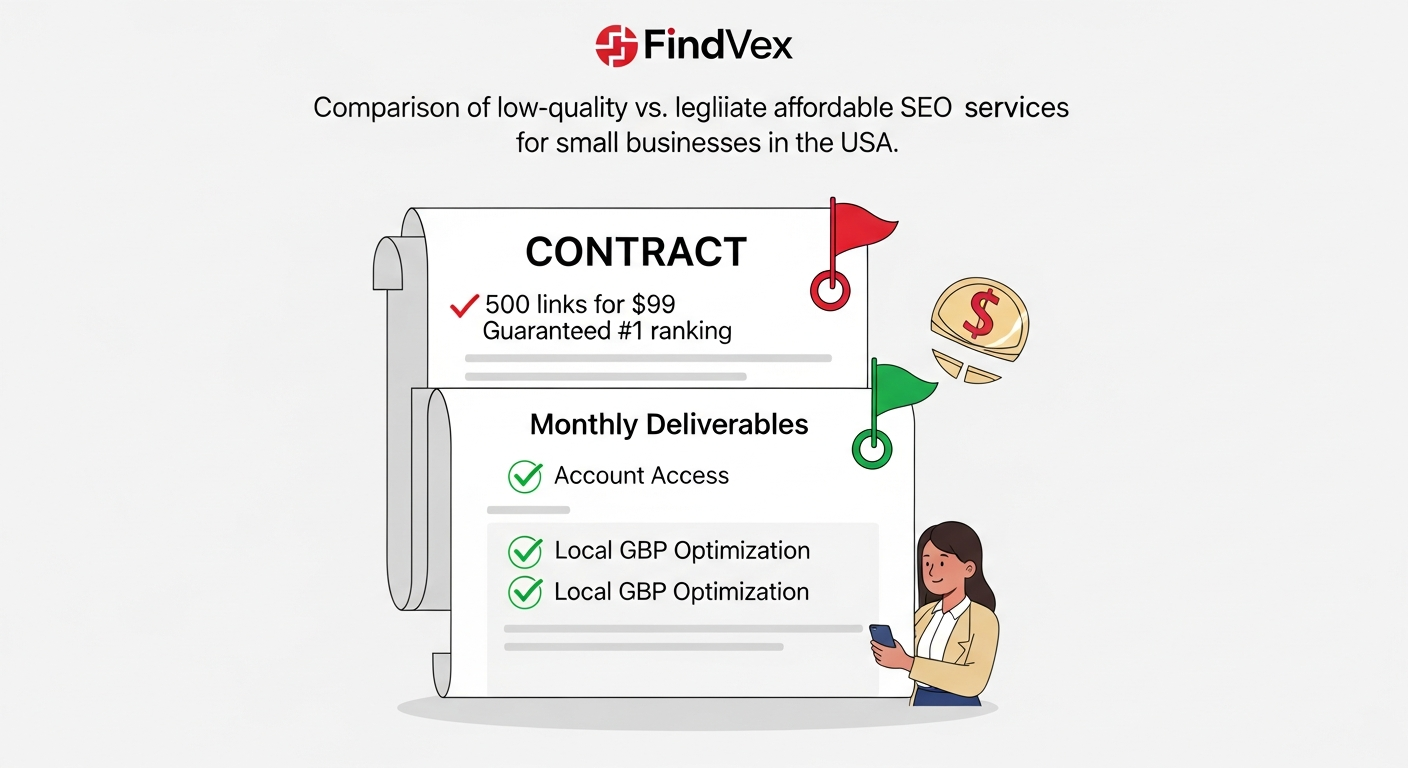
- No clear explanation of what they actually do: If a proposal says 'monthly SEO work' without specifying what tasks are performed, that's a red flag. Push for a line-item breakdown of deliverables.
- Link packages sold by volume: '500 backlinks for $99' is not SEO — it's a fast track to a Google penalty. Quality links come from real editorial placements, local business associations, or press coverage. They take time and can't be mass-produced.
- No access to your own accounts: You should always own your Google Search Console, Google Analytics, and Google Business Profile. Any agency that insists on creating or controlling these accounts on your behalf — and doesn't give you admin access — is a problem.
- No mention of local SEO for a local business: If you operate in a specific city or region and the proposal doesn't mention Google Business Profile, local citations, or location-based keyword targeting, you're looking at a generic template, not a strategy built for you.
Agency vs. Consultant vs. DIY: Which Is Right for Your Budget?
Most small businesses have three realistic options, each with different trade-offs.
A US-based SEO agency with small business experience is the right choice if you want consistent execution, a team covering multiple disciplines (technical, content, links), and you have at least $800–$1,000/month to commit. The risk is that smaller clients sometimes get handed to junior staff. Ask who will actually work on your account.
An independent SEO consultant is often the best value in the $500–$1,500/month range. You're paying for experience directly, without agency overhead. The risk is capacity — a solo consultant juggling 15 clients may not give you the bandwidth you need during a critical growth phase. Ask about their current client load.
DIY SEO makes sense if you have more time than budget and you're willing to invest in learning. Tools like Google Search Console (free), Screaming Frog (free up to 500 URLs), and Google's own Search Essentials documentation are genuinely useful starting points. The downside is the learning curve — most small business owners spend 6–12 months before seeing consistent results from a self-managed strategy.
If you're evaluating whether to hire help or go it alone, our guide on the 2026 SEO strategy small businesses should actually follow is worth reading first — it maps out exactly where to focus for maximum impact.
How to Measure Whether Your SEO Spend Is Actually Working
Rankings are a lagging indicator. They tell you where you are, not whether SEO is making you money. Here's what to actually track.
The metrics that matter most for a small business are: organic traffic to service or product pages (not just the homepage), clicks and calls attributed to organic search (trackable via Google Search Console and call tracking software), Google Business Profile views and direction requests, and — most importantly — lead volume from organic sources compared to the previous period.
A reasonable expectation for a new SEO engagement: meaningful ranking improvements in low-to-medium competition keywords by months 3–4, measurable traffic increases by month 4–6, lead attribution improvements by month 6–9. If you're six months in and seeing none of these, something is wrong with the strategy or execution.
For a deeper look at how traffic connects to actual phone calls and booked appointments, see how local SEO turns website traffic into booked calls — it walks through the specific conversion points where most small business SEO programs leak value.
One Thing Most Affordable SEO Packages Are Missing in 2026: AI Search Visibility
Here's something most SEO agencies aren't talking about in their packages yet: a significant and growing share of search queries are now being answered by AI-powered engines — Google's AI Overviews, ChatGPT Search, Perplexity, and others. These tools don't just rank pages; they synthesize answers and cite specific sources.
For small businesses, this creates a new layer of visibility that traditional SEO packages don't address. If your business isn't being cited in AI-generated answers for your core services, you're invisible to a growing segment of potential customers.
The good news is that the foundation for AI search visibility is largely the same as good traditional SEO: clear, well-structured content, consistent entity information (your business name, services, location), and authoritative sources linking to you. But there are specific structural and content choices that make your site more likely to be cited. Our guide to LLM SEO services covers this in detail if you want to understand what modern optimization looks like beyond Google's ten blue links.
Do This This Week: A 5-Step Pre-Hiring Checklist
Before you spend a dollar on SEO services, spend an hour on this. It will help you evaluate any proposal you receive — and might reveal quick wins you can implement yourself.
- 1. Check your indexing status: Go to Google Search Console > Pages report. If you don't have GSC set up, do that first — it's free and takes 10 minutes. Look for pages marked 'Not indexed' that should be ranking.
- 2. Run a site:yourdomain.com search in Google: See how many pages are indexed. A site with 50 pages but only 12 indexed has a crawlability problem that needs fixing before any other SEO work will compound.
- 3. Check your Google Business Profile: Search your business name on Google. Is the information correct? Do you have recent reviews? Is the category accurate? These are fast wins that don't require an agency.
- 4. Look at your top 3 competitors' websites: What pages do they have that you don't? What keywords do their title tags use? This 20-minute exercise often surfaces the most obvious gaps. Our guide on finding competitor keyword gaps walks through this systematically.
- 5. Ask any SEO agency for a sample report from an existing client (anonymized): The format and depth of their reporting tells you more about their process than any sales call. If they can't or won't share this, that's information too.
What FindVex Does Differently for Small Business SEO
FindVex is built specifically for small and local businesses in the USA who want SEO that connects directly to leads — not just traffic reports. Our approach combines technical auditing, local search optimization, content strategy, and AI search visibility into a single, transparent engagement.
We don't do volume link packages, we don't guarantee rankings, and we don't lock you out of your own accounts. What we do is give you a clear picture of what's holding your site back, fix it systematically, and report on what's actually moving your business forward.
If you want an honest assessment of where your site stands before committing to a monthly package, start with a site audit. You'll know exactly what you're working with — and what it would take to compete.
FAQs
What is a realistic cost for affordable SEO services in the USA?
For a small business, expect to pay $500–$2,000/month for reputable ongoing SEO from a US-based agency or consultant. Independent consultants often charge $75–$150/hour for project-based work. Packages under $300/month rarely deliver meaningful results and can sometimes cause harm through low-quality tactics.
How long does it take to see results from small business SEO?
For most small businesses, expect to see initial ranking improvements in 3–4 months for lower-competition keywords, measurable organic traffic increases by months 4–6, and lead attribution improvements by months 6–9. Results depend heavily on your market's competition level, your site's current technical health, and how consistently the SEO work is executed.
What's the difference between a local SEO package and a standard SEO package?
Local SEO packages focus on ranking in a specific geographic area — typically through Google Business Profile optimization, local citation building, location-specific landing pages, and local keyword targeting. Standard or national SEO packages focus on broader keyword rankings without geographic intent. Most small businesses operating in one area need local SEO as their foundation.
Can I do SEO myself instead of hiring an agency?
Yes, but with realistic expectations. DIY SEO is viable if you have more time than budget and you're willing to learn the basics of technical SEO, content creation, and link building. Free tools like Google Search Console and Google's Search Essentials documentation are solid starting points. Most business owners find that self-managed SEO takes 6–12 months before producing consistent results — and the opportunity cost of that time is worth factoring in.
What should I demand from an SEO agency before signing a contract?
Before signing, ask for: a line-item breakdown of monthly deliverables, clarity on who will actually execute the work (not just who sells it), access and ownership of all your accounts (Search Console, Analytics, GBP), a sample anonymized report from an existing client, and a clear explanation of their link building approach. Any hesitation on these is a red flag.
Are there SEO services specifically for local businesses like restaurants, dentists, or contractors?
Yes. Niche-specific SEO packages for local businesses (healthcare, home services, legal, food and beverage) typically include industry-specific keyword research, schema markup for that business type, and strategies suited to how customers search in that vertical. Generic packages applied without industry context tend to underperform.
Will SEO still matter if more people are using AI search tools?
Yes — and arguably more than before. AI search tools like ChatGPT Search, Google AI Overviews, and Perplexity pull from well-structured, authoritative web content to generate their answers. The businesses that invest in high-quality, clearly structured SEO today are the ones getting cited in AI-generated results tomorrow. The fundamentals of good SEO align closely with what AI engines look for when selecting sources to cite.
Related reading
- ai seo agency — What to Expect from a Modern AI SEO Agency (And Red Flags to Watch)
- openai crawl activity tripled since gpt-5 — OpenAI Crawl Activity Tripled Since GPT-5: What It Means for Your Website
- clinic seo services — Clinic SEO: How to Rank for "Doctor Near Me" Searches
- GEO playbook local search — The 90-Day GEO Playbook for Local Search: How To Show Up When AI Does The Searching
- AI crawler blocking strategy — The AI Crawler Protection Paradox: Why Brands Block Bots Then Pay to Be Seen
- competitor keyword gaps — How to Find Competitor Keyword Gaps Without Wasting Budget
- google search update — What Changed in Google Search This Week and What Small Businesses Should Do
- local seo services usa — Local SEO Services in the USA: Which Businesses Get the Best ROI (and Why)
- llm seo services — LLM SEO Services: How to Get Cited by ChatGPT, Claude, and Perplexity
- technical seo audit checklist — Technical SEO Audit Checklist for Small Business Websites
Research notes
Background claims used while researching this article. Verify with the cited authorities before quoting.
- Typical US SEO agency pricing ranges of $500–$2,000/month for small businesses
- Independent SEO consultant hourly rates of $75–$150/hour
Sofia Patel
Head of Content & Growth · Findvex
Sofia Patel leads content and growth at Findvex. She writes about local SEO, conversion-focused content, and AEO/GEO strategy — the work that turns search visibility into booked calls and qualified leads for service businesses.
Expertise: Local SEO · Conversion content · AEO / GEO strategy · Content-led link building
Related reads
Local SEO Services in the USA: Which Businesses Get the Best ROI (and Why)
Local SEO services aren't one-size-fits-all. The tactics that fill a dentist's appointment book won't rank a plumber in the local pack. This guide breaks down what local SEO actually delivers by industry, what to prioritize first, and how to measure whether it's working.
SEO NewsHow AI Models Actually 'Understand' Your Brand — and What to Do When They Get It Wrong
AI models construct a representation of your brand from training data, retrieval signals, and cited sources — a process that's invisible, imperfect, and increasingly consequential. If ChatGPT, Perplexity, or Google's AI Overviews are describing your business inaccurately, the fix isn't a phone call to OpenAI. It's a deliberate content and citation strategy.
Keyword ResearchHow to Find Competitor Keyword Gaps Without Wasting Budget
Competitor keyword gap analysis tells you exactly which search terms your rivals rank for that you don't. Done right, it's one of the highest-ROI moves in SEO. Done wrong, it produces a bloated list of irrelevant keywords you'll never recover from. Here's how to do it right.