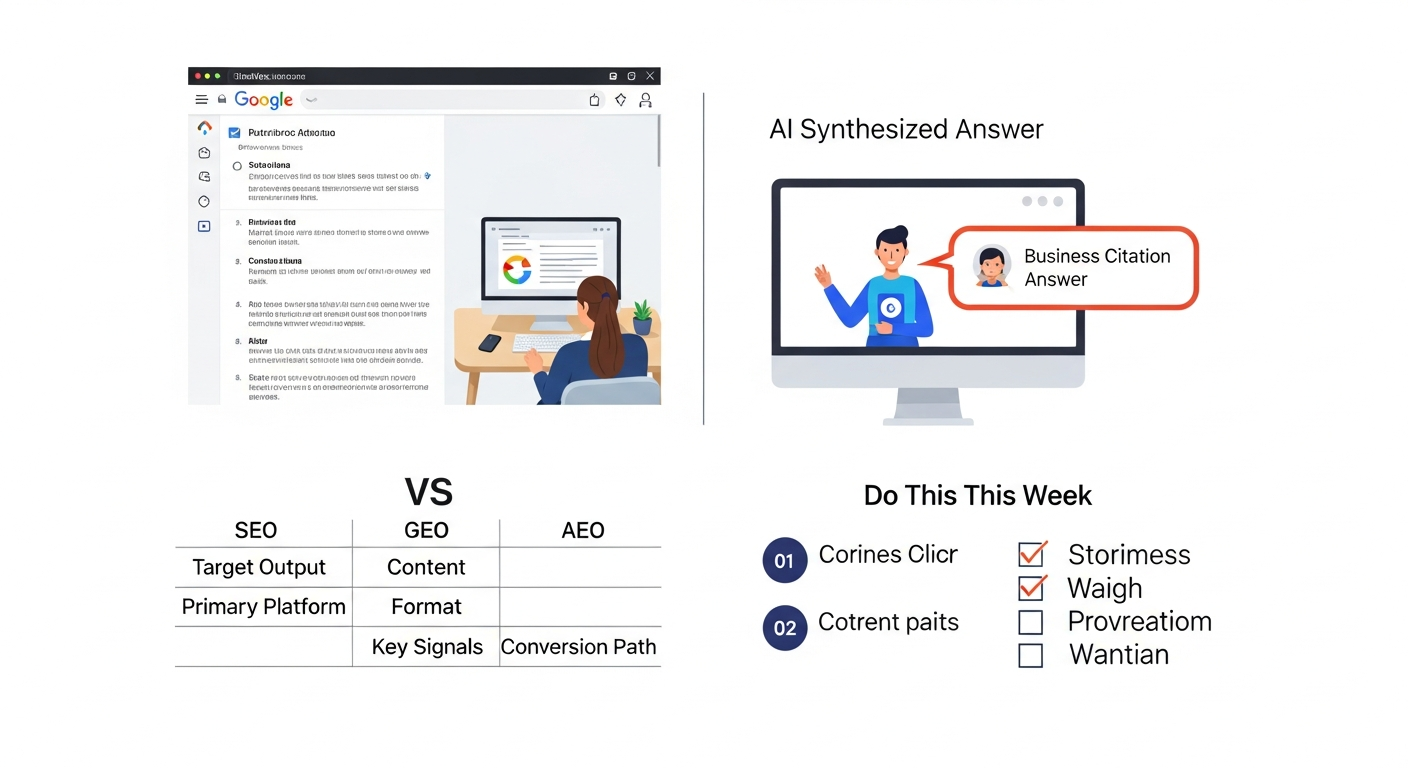
What Is Generative Engine Optimization (GEO)? How Small Businesses Get Found in AI Search
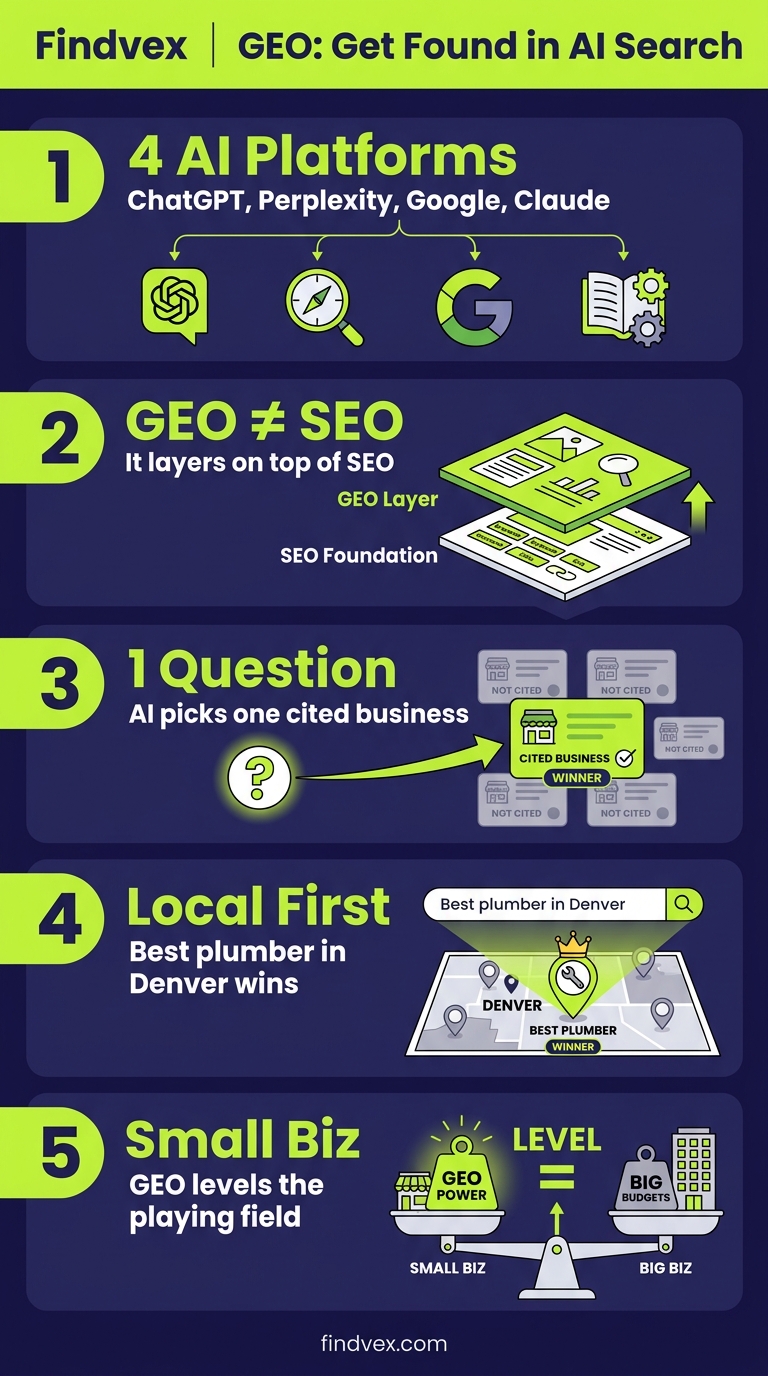
Generative Engine Optimization (GEO) is how you get your business cited by AI-powered search tools — ChatGPT, Perplexity, Google AI Overviews, and Claude. It's not a replacement for SEO. It's the layer you add on top so that when someone asks an AI 'who's the best plumber in Denver,' your name comes up.
Quick answer
Generative Engine Optimization (GEO) is the process of structuring your website content, authority signals, and brand presence so that AI-powered search engines — including ChatGPT, Google AI Overviews, Perplexity, and Claude — cite your business when answering user questions. Unlike traditional SEO, which targets blue-link rankings, GEO targets the AI-generated responses that now sit above those links — or replace them entirely.
Why GEO Matters Right Now for Small Business Owners
Search behavior is shifting. A growing share of users now type questions into ChatGPT, ask Perplexity for local recommendations, or rely on Google's AI Overviews instead of scrolling through traditional results. If your business isn't structured to be cited in those AI-generated answers, you're invisible to that audience — even if you rank on page one.
That's what Generative Engine Optimization addresses. GEO is not a replacement for SEO. It's a discipline that sits on top of your existing search strategy and answers a different question: not 'how do I get a blue link?' but 'how do I become the source an AI engine trusts and quotes?'
For small business owners, this matters because AI search tends to compress the results it surfaces. Instead of ten blue links, users see one synthesized answer. If your competitor is in that answer and you're not, they get the call.
What Generative Engine Optimization Actually Means
GEO refers to a set of content, technical, and authority-building practices designed to increase the likelihood that large language models (LLMs) and AI search engines reference your business, your content, or your expertise when generating answers.
The term was coined by researchers studying how AI systems select sources for their generated responses. The core finding: AI engines don't rank pages the same way Google does. They synthesize answers from sources they consider authoritative, structured, and contextually relevant. Your job is to be that source.
Three things drive GEO performance: content clarity (can an AI extract a clean answer from your page?), entity authority (does the broader web associate your business name with a topic or location?), and citation signals (are you referenced on sources AI engines already trust?).
“AI agents do in hours what teams used to do in weeks. The advantage compounds.”
GEO vs. SEO: What's the Same, What's Different
Most of what makes a site rank well in traditional search also helps with GEO — quality content, fast pages, strong technical foundations, and genuine authority. The difference is in the optimization layer on top.
Traditional SEO targets keyword placement, backlink counts, and click-through signals. GEO targets answer-readiness: is your content structured so an AI can extract, quote, and attribute it confidently? That means writing in clear declarative sentences, using structured data, having a consistent brand presence across the web, and being cited on trusted third-party sources.
The other major difference is intent coverage. Google SEO rewards pages that match specific keyword queries. AI search engines handle conversational, multi-step questions — 'What's the best family dentist in Austin that takes Delta Dental?' A GEO-optimized dental practice answers all the sub-questions that query contains: specialty, location, insurance, trust signals.
- SEO goal: rank in the blue-link results for target keywords
- GEO goal: be cited inside the AI-generated answer
- Both require: strong content, technical health, and real authority
- GEO adds: answer-ready structure, entity consistency, and third-party citation signals
- GEO also covers: ChatGPT, Perplexity, Claude, and Google AI Overviews — SEO alone does not
How AI Engines Decide Which Sources to Cite
This is the part most GEO guides skip over. Understanding the mechanics helps you make smarter decisions about where to invest your time.
AI language models are trained on large datasets scraped from the web. The sources they learned from most heavily — Wikipedia, industry publications, government sites, established directories — carry the most weight when the model forms an answer. If your business is mentioned or linked on those types of sources, the model is more likely to treat you as a credible entity.
Beyond training data, AI search engines like Perplexity and ChatGPT with web browsing also do real-time retrieval. They crawl pages to supplement their answers. For those systems, page structure matters enormously: clear headings, concise answers near the top of the page, schema markup, and fast load times all increase the chance a page gets pulled into a live response.
Google's AI Overviews add another layer: they tend to favor sources that already rank in the top results for the query. So GEO and traditional SEO are more interdependent than many people realize — ranking well is still a meaningful GEO signal.
6 GEO Tactics Small Businesses Can Action Right Now
Here's where theory becomes work. These six tactics are sequenced by impact — start at the top and work down.
- 1. Write answer-first content. For every service page and blog post, lead with a direct one- or two-sentence answer to the question the page addresses. AI engines extract these summaries directly. If your page buries the answer three paragraphs down, it gets skipped.
- 2. Build out your entity footprint. Make sure your business name, address, category, and service area are consistent across your Google Business Profile, your website, Yelp, industry directories, and any press mentions. AI models build a picture of your business from all these signals combined. Inconsistency creates uncertainty — and uncertain entities don't get cited.
- 3. Add structured data (schema markup). LocalBusiness, FAQPage, and Service schema help AI crawlers understand what your page is about without guessing. A plumber who marks up their service pages with structured data is unambiguously a plumber — not a hardware store, not a pipe manufacturer.
- 4. Earn mentions on trusted third-party sources. Guest posts on local news sites, features in trade publications, citations in roundup articles — these are the signals that carry authority into an AI model's training data and live retrieval. Focus on relevance over volume.
- 5. Write FAQ content that mirrors how people ask AI questions. People talk to AI engines like they talk to people. 'Do you accept same-day appointments?' 'Is this covered by insurance?' 'How long does the repair take?' Write those questions and answer them directly on your service pages.
- 6. Keep your content fresh and dateable. AI search engines, especially those doing live retrieval, favor recently updated content. Adding a 'Last updated' date and refreshing key pages quarterly signals that your information is current.
GEO for Local Service Businesses: The Specific Playbook
If you run a local business — a dental practice, HVAC company, law firm, restaurant, or real estate agency — GEO has a specific local flavor. The queries you need to win aren't just informational; they're transactional and geo-targeted.
When someone asks ChatGPT 'best HVAC company in Phoenix for heat pump installation,' the model pulls from its entity knowledge of local businesses and — if it has web access — from pages that explicitly answer that question. Your Google Business Profile is a key entity signal here: a fully optimized, review-rich GBP increases the chance a model knows who you are and what you do.
Local GEO also rewards specificity. A generic service page that says 'We offer HVAC services in Phoenix' is weak. A page that says 'We install and service Carrier and Lennox heat pumps in Phoenix, Scottsdale, and Tempe — same-day availability in most zip codes' gives an AI model enough specific, extractable information to confidently cite you.
Reviews are an underrated GEO signal for local businesses. AI engines pulling from third-party sources often encounter your Yelp page, your Google reviews, and local directory listings. A business with 200 reviews discussing specific services and locations has a richer entity profile than a competitor with 12 generic reviews.
What GEO Is Not (And Mistakes to Avoid)
GEO has attracted a lot of vendors selling questionable services. Before you spend a dollar, know what doesn't actually work.
Keyword stuffing your pages with AI-sounding phrases doesn't help. AI engines aren't looking for signal phrases — they're evaluating semantic clarity and topical depth. Shallow content with 'As an AI-search-ready business, we offer...' preambles is not a GEO tactic.
Paying for low-quality directory listings in bulk doesn't move the needle either. The citation signals that matter to AI engines come from sources with genuine authority — local newspapers, trade associations, established review platforms. Fifty listings on nobody-reads-this.com accomplish nothing.
And GEO doesn't replace the fundamentals. If your site has indexing issues, poor Core Web Vitals, or no real content — no GEO strategy will save you. Fix the foundation first.
Do This This Week: Your GEO Quick-Start Checklist
You don't need a six-month roadmap to get started. Here's what a business owner can do in the next five working days to build real GEO traction.
- Day 1 — Audit your entity consistency. Google your business name. Check that your name, address, phone number, and category match across Google Business Profile, Yelp, your website footer, and any directory listings. Fix any mismatches.
- Day 2 — Rewrite your homepage and top service page introductions. Lead each with a clear two-sentence answer to 'what do you do, where, and for whom?' Make it extractable.
- Day 3 — Add an FAQ section to your top two service pages. Write the questions exactly as a customer would ask them to an AI chatbot. Answer each in two to four sentences.
- Day 4 — Add or verify schema markup. If you're on WordPress, a plugin like Rank Math or Yoast handles LocalBusiness schema. If you're on a custom site, use Google's Rich Results Test to confirm your structured data is valid.
- Day 5 — Identify one trusted local source where you could earn a mention. A local business journal, a neighborhood association newsletter, a trade directory for your industry. Reach out with a genuine contribution — a quote, a tip, a case study.
How GEO Translates to More Leads (Not Just More Visibility)
This is where the rubber meets the road. Visibility in AI search is only valuable if it converts — and the conversion dynamics are different from traditional search.
In traditional search, a user clicks your link, lands on your page, and you control the experience from there. In AI search, the user often gets their answer in the AI response itself. Your business is cited, your name appears, and the user decides whether to click through to learn more or take action.
That means your citation has to do work before the click. Mentioning your phone number in content that AI tools can surface, having strong reviews visible on cited platforms, and being associated with a specific service niche (not just 'general contractor') all increase the chance that an AI citation turns into a direct inquiry.
Businesses that combine GEO with a conversion-optimized website — fast load times, clear calls to action, booking forms above the fold — tend to see the highest return. The AI drives intent; your site closes it.
FAQs
What is generative engine optimization (GEO) in simple terms?
GEO is the practice of optimizing your content and online presence so that AI-powered tools — like ChatGPT, Perplexity, Google AI Overviews, and Claude — cite your business when answering relevant questions. It focuses on making your content clear, structured, and authoritative enough for an AI to extract and reference.
Is GEO the same as SEO?
No, but they overlap significantly. Traditional SEO targets blue-link rankings on Google. GEO targets the AI-generated answers that now appear above those links — or replace them. Most SEO best practices (quality content, strong technical health, real authority) also help with GEO, but GEO adds specific tactics around answer-ready content structure, entity consistency, and third-party citation signals.
Does GEO work for local small businesses, or is it only for large brands?
GEO is especially impactful for local businesses. AI engines often surface specific local providers when users ask transactional questions like 'best electrician near me' or 'who does same-day HVAC repair in Atlanta.' A well-optimized Google Business Profile, location-specific service pages, and consistent directory listings all contribute to local GEO performance.
How long does GEO take to show results?
There's no fixed timeline because AI models update their knowledge at different intervals, and live-retrieval systems like Perplexity can surface your content within days of publication. Content and entity signals that influence model training data take longer — typically months. Most businesses see measurable improvement in AI citation frequency within 60 to 90 days of consistent GEO work.
Do I need to hire an agency for GEO, or can I do it myself?
The foundational GEO work — rewriting content to lead with direct answers, adding FAQ sections, fixing entity consistency, and implementing basic schema markup — is something most business owners or in-house marketers can handle. The more advanced work, like earning citations on high-authority sources and building a structured content program, often benefits from professional support.
Does GEO help with Google AI Overviews specifically?
Yes. Google AI Overviews tend to cite pages that already rank in the top organic results for a query, so traditional SEO and GEO are deeply connected for Google. Beyond rankings, AI Overviews also favor content with clear structure, direct answers near the top of the page, and relevant schema markup — all core GEO tactics.
What's the biggest GEO mistake small businesses make?
The most common mistake is treating GEO as a separate project from their existing content and SEO. GEO works best when it's integrated into every piece of content you publish — not bolted on afterward. The second biggest mistake is ignoring entity consistency: if your business name, address, and category aren't consistent across your website, GBP, and directories, AI engines can't confidently identify and cite you.
Related reading
- geo services for small business — GEO Services for Small Business: What They Actually Include and Whether They're Worth It
- GEO playbook local search — The 90-Day GEO Playbook for Local Search: How To Show Up When AI Does The Searching
- near me seo strategy — Near Me SEO Strategy: A Local Discovery Playbook for Service Businesses
- AI local search visibility — How AI Is Changing Local Search Visibility: What the SOCi + Google Webinar Revealed
- generative engine optimization services — Generative Engine Optimization Services: What Small Businesses Actually Get (and What to Ask For)
- answer engine optimization services — Answer Engine Optimization Services: What Small Businesses Actually Get (and Whether It's Worth Paying For)
- llm seo services — LLM SEO Services: How to Get Cited by ChatGPT, Claude, and Perplexity
- landscaping seo — Landscaping SEO: How to Fill Your Schedule Without Paying for Every Lead
- seo services for small business — SEO Services for Small Business: What You're Actually Buying (and What Moves the Needle)
- aeo services for small business — AEO Services for Small Business: What You Actually Need (and What to Skip)
Research notes
Background claims used while researching this article. Verify with the cited authorities before quoting.
- The term GEO was coined by researchers studying how AI systems select sources for their generated responses.
- Google AI Overviews tend to favor sources that already rank in the top organic results for the query.
Sofia Patel
Head of Content & Growth · Findvex
Sofia Patel leads content and growth at Findvex. She writes about local SEO, conversion-focused content, and AEO/GEO strategy — the work that turns search visibility into booked calls and qualified leads for service businesses.
Expertise: Local SEO · Conversion content · AEO / GEO strategy · Content-led link building
Related reads
Google TurboQuant and Entity-Driven SEO: What the Compression Breakthrough Actually Means for Your Site
TurboQuant is a vector quantization algorithm from Google Research that dramatically compresses the mathematical representations AI uses to understand meaning. If it reaches production search infrastructure, it could lower the cost of semantic retrieval at scale — making entity-based content signals more dominant and keyword-match signals relatively less important.
SEO NewsHow AI Is Changing Local Search Visibility: What the SOCi + Google Webinar Revealed
Google and SOCi's joint webinar on local search visibility highlighted a fundamental shift: AI-powered discovery across Google Search, Maps, and Gemini now requires a different optimization playbook than the one most small businesses are running. Here's what changed and what to prioritize.
Strategic Technical SEODuplicate Content SEO: What Google Actually Penalizes vs. What It Silently Handles
Duplicate content rarely triggers a manual penalty. Google usually picks one version and ignores the rest. But the wrong choice by Google can split your ranking signals, waste crawl budget, and suppress pages you actually want ranked. Here's how to diagnose the difference.