AEO Services for Small Business: What You Actually Need (and What to Skip)
AEO services help your business show up in AI-generated answers — not just Google blue links. This guide breaks down what answer engine optimization actually involves for small businesses, which services move the needle, and how to evaluate an agency before you spend a dollar.
Quick answer
AEO (answer engine optimization) services help small businesses appear in AI-generated answers on platforms like ChatGPT, Google AI Overviews, and Perplexity. Core deliverables include structured FAQ content, schema markup, entity consistency, citation building, and content designed to directly answer specific queries. Most small businesses need a focused starter scope — not a full enterprise retainer — before they see measurable AI visibility gains.
Section 1
If a potential customer asks ChatGPT 'who's the best HVAC company in Austin' or Google returns an AI Overview for 'affordable family dentist near me,' is your business in that answer — or is a competitor?
That's what AEO services are designed to fix. Answer engine optimization is still young enough that most small businesses haven't started, which means there's a real first-mover advantage right now. But the market is also full of agencies overselling it. This guide gives you an honest picture: what AEO services actually involve, which ones matter for a small business budget, what you should DIY, and what to hand off.
What AEO Services Actually Do (vs. What Agencies Say They Do)
Answer engine optimization is the practice of structuring your content, data, and online presence so that AI systems — ChatGPT, Google AI Overviews, Perplexity, Claude, Bing Copilot — pull from your business when generating answers.
Unlike traditional SEO, where you compete for a blue link position, AEO means becoming a cited source inside an AI-generated answer block. That changes what 'ranking' looks like: you're not chasing position 1; you're chasing inclusion in the answer itself.
Here's what legitimate AEO services actually involve:
What most agencies pitch vs. what actually moves the needle is worth clarifying. Agencies often lead with vague 'AI visibility reports' or 'prompt monitoring dashboards.' Those are useful reporting tools — not the core work. The core work is content structure, schema, entity authority, and citation building. If an agency can't explain those four things clearly, keep looking.
- Structured FAQ and Q&A content that directly answers the queries your customers type into AI tools
- Schema markup (FAQPage, LocalBusiness, Service, HowTo) that makes your data machine-readable
- Entity consistency across your website, Google Business Profile, citations, and third-party mentions
- Content written to be 'quotable' — clear sentences, definitive statements, no vague hedging
- Citation and mention building on trusted industry sources, directories, and local publications
- Monitoring whether your brand is being cited accurately (or at all) in AI responses
“AI agents do in hours what teams used to do in weeks. The advantage compounds.”
AEO vs. SEO vs. GEO: The Difference That Matters for Small Businesses
These three terms get mixed up constantly — including by agencies that should know better. Here's the practical distinction:
SEO (search engine optimization) is still your foundation. It covers technical health, keyword rankings, backlinks, and Google Business Profile. Nothing in AEO or GEO works well without solid SEO underneath it.
GEO (generative engine optimization) is about appearing in AI-generated summaries and recommendations in tools like ChatGPT and Perplexity when someone asks a broad or research-style question. It's content depth, topical authority, and being cited by other credible sources.
AEO (answer engine optimization) is the tighter subset of GEO focused on direct question-and-answer formats — the kind of short, definitive answers that get pulled into featured snippets, voice search results, AI Overviews, and conversational AI responses.
For most small businesses, the priority order is: fix SEO first, build AEO content second, layer in broader GEO strategy third. Skipping SEO to chase AI citations is like building a storefront before you've secured the lease.
For a broader view of the GEO side, see our 90-day GEO playbook for local search.
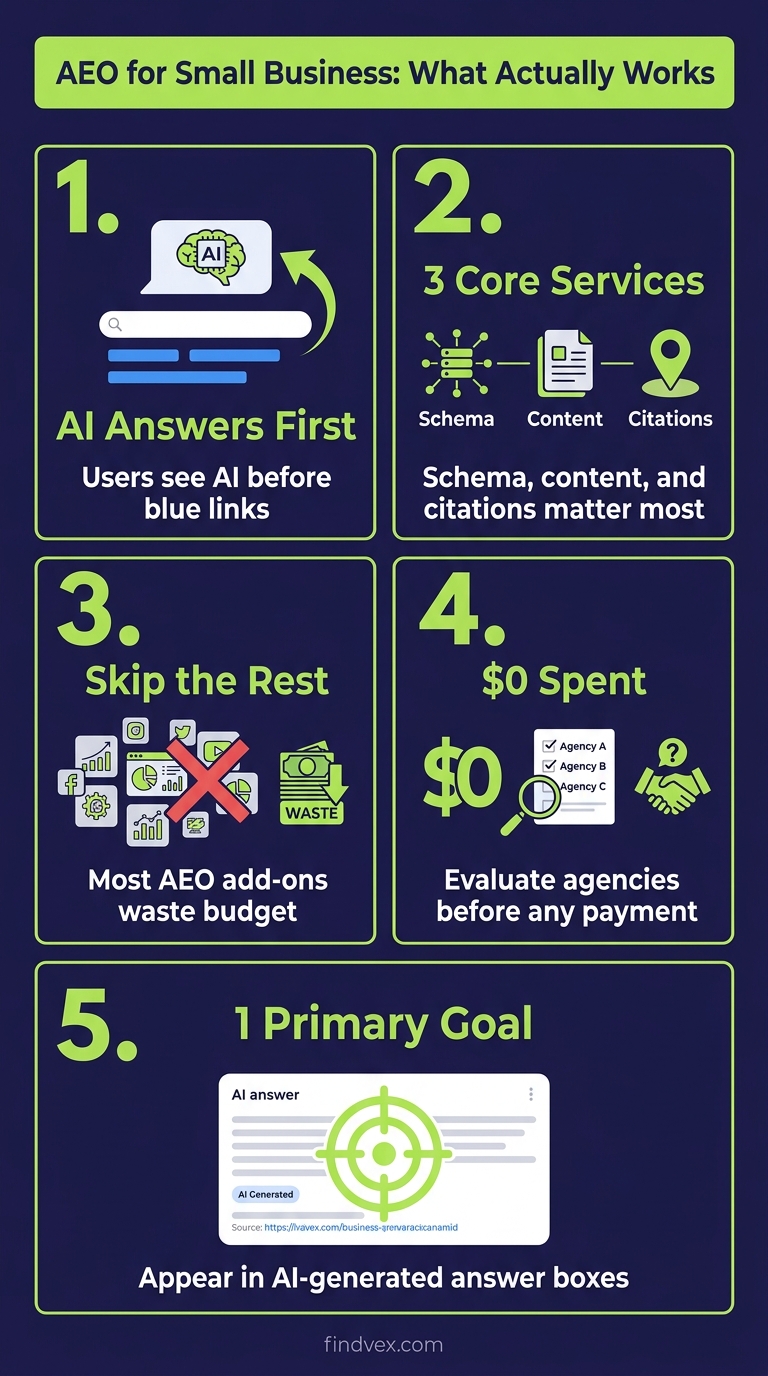
The 6 AEO Service Deliverables Worth Paying For
Not all AEO service packages are equal. These are the six deliverables that directly influence whether you get cited in AI answers — and what each one actually looks like in practice.
- FAQ content buildout: Writing 8–20 specific Q&A pairs per service or topic page, formatted as direct answers in 40–60 words. These feed Google's FAQPage rich results and train AI tools on what your business does and where.
- Schema markup implementation: Adding FAQPage, LocalBusiness, Service, and HowTo structured data to your pages. This is technical work — not just content — and requires someone who knows JSON-LD. Without it, AI systems have to infer your data rather than read it.
- Entity and NAP consistency audit: Making sure your business name, address, phone, categories, and service descriptions are identical across Google Business Profile, Yelp, Apple Maps, industry directories, and your website. AI models cross-reference these signals when deciding whether to trust and cite you.
- Citability content writing: Long-form pages written with clear, quotable sentences that give AI something concrete to pull. Think: 'We serve residential HVAC customers in Travis County with same-day service' rather than 'We're passionate about helping homeowners.'
- Third-party mention building: Getting your business named on local news sites, industry association pages, Chamber of Commerce listings, and review platforms. AI models weight third-party mentions heavily as trust signals.
- AI citation monitoring: Tracking whether ChatGPT, Perplexity, and Google AI Overviews are mentioning your business, and whether the information is accurate. This is ongoing work, not a one-time setup.
What You Can Do Yourself vs. What to Hand Off
Small business owners often assume AEO requires a full agency retainer from day one. It doesn't. Here's an honest split between what you can handle in-house and what genuinely benefits from professional help.
- DIY-able: Writing FAQ content for your service pages (use real customer questions from your inbox, reviews, or intake forms), updating your Google Business Profile with consistent service descriptions, collecting and responding to Google reviews, and basic NAP consistency cleanup across directories.
- Worth outsourcing: JSON-LD schema markup implementation (errors here hurt more than no schema at all), technical content audits to identify which pages have zero AI-citability potential, citation building on industry-specific directories you don't know about, and monitoring AI responses at scale.
- Grey zone: Content rewrites for citability. Some business owners write well enough to do this themselves with the right framework. Others burn time producing content that still won't get cited. If you can write a direct, jargon-free answer to 'what does [your service] cost and who is it for,' you can probably DIY this.
5 Questions to Ask Before Hiring an AEO Agency
The AEO agency market is full of SEO shops that rebranded their deck in late 2024. Here's how to tell the difference between a real specialist and a rebrand.
- Ask them to show you a before/after of AI citations for a past client. Not a dashboard screenshot — an actual example of a query where their client now appears in a ChatGPT or Perplexity answer. If they can't show one, ask why.
- Ask what they'll audit before recommending services. A legitimate agency diagnoses first: technical SEO health, existing schema, content citability, entity consistency. If they quote you a package before looking at your site, that's a red flag.
- Ask how they measure AEO success. AI Overviews appearance rate, Perplexity citation tracking, branded query growth, and direct traffic from AI-referred sessions are all legitimate metrics. 'Improved AI visibility' with no specifics is not.
- Ask whether they separate AEO from local SEO work. For most small businesses, these are interconnected. An agency that treats them as completely separate services may be padding scope.
- Ask what happens to the work if you cancel. Schema markup, FAQ content, and citation profiles should be assets you own — not locked in a proprietary system. Get this in writing.
AEO for Local Service Businesses: Where It Has the Fastest Impact
Not all small businesses see equal returns from AEO investment at the same stage. Based on the nature of how AI systems handle local queries, these are the business types where AEO services tend to produce faster, more measurable results:
Service businesses with high-intent queries — plumbers, HVAC, electricians, pest control — where customers ask AI tools 'who can fix X near me today.' These queries have clear local intent and AI systems actively try to surface specific providers.
Healthcare and wellness practices — dentists, chiropractors, physical therapists — where patients ask AI for recommendations before calling. Trust signals and consistent professional profiles matter a lot here.
Professional services — lawyers, CPAs, financial advisors — where AI tools are increasingly used for 'who should I hire for X' type research queries.
Restaurants and hospitality businesses see strong returns from Google AI Overviews but need a slightly different approach — menu schema, event schema, and review volume matter more than FAQ content.
If you're a local service business, your AEO and local SEO strategies overlap significantly. The entity consistency, Google Business Profile optimization, and citation building that drives local pack rankings also feed AI citation signals. You shouldn't need a completely separate budget for each.
What AEO Services Cost for Small Businesses
Pricing varies significantly based on scope and agency size, but here's a realistic picture of what small businesses are paying for AEO work in 2026.
One-time AEO audit and setup (schema implementation, FAQ content buildout, entity audit): typically $800–$2,500 depending on site size and complexity. This is a reasonable starting point for businesses that have solid SEO foundations already in place.
Monthly AEO retainer (ongoing content, monitoring, citation building): typically $500–$2,000/month for small business-focused agencies. Enterprise AEO retainers from larger agencies run $5,000–$15,000/month and are generally not appropriate for businesses under $2M annual revenue.
Bundled AEO + local SEO packages: the most cost-effective option for most small businesses, since the two disciplines overlap heavily. Expect $750–$3,000/month for a combined scope from a reputable agency.
A word on cheap AEO packages: anything under $400/month that claims full AEO services is almost certainly a rebranded link-building package with FAQ content bolted on. The schema work alone requires real technical skill.
Do This This Week: Your AEO Starting Point
You don't need an agency to start building AEO signals. Here's a practical five-step action plan you can execute this week — before you spend anything.
- Step 1 — Run a Google search for your top service + city (e.g., 'best plumber in Denver'). Look at whether an AI Overview appears, who it cites, and whether your business is included. This is your baseline.
- Step 2 — Open your top service page and count how many direct questions it answers. If it answers fewer than five specific customer questions with clear, direct sentences, add a FAQ section this week using questions from your Google reviews or intake forms.
- Step 3 — Check your NAP (name, address, phone) consistency. Search your business name on Google, Yelp, Apple Maps, and your industry's main directory. Any variation — including formatting differences like 'St.' vs 'Street' — should be corrected.
- Step 4 — Install FAQPage schema on your top two service pages. Use Google's free Structured Data Markup Helper or ask your web developer. Validate with Google's Rich Results Test before publishing.
- Step 5 — Ask ChatGPT and Perplexity: 'Who are the best [your service] providers in [your city]?' Screenshot the result. This is your benchmark. Repeat monthly to track whether your citations appear.
How AEO Affects Your Leads, Not Just Your Traffic
Here's the part most AEO content skips: AI citations don't always drive direct clicks. When someone gets an answer from ChatGPT or Perplexity, they may not click through to your site at all. So why invest?
Three reasons. First, when AI tools recommend your business by name, that name recognition builds trust before a customer ever visits your site. When they do search for you directly later, your conversion rate on branded searches is much higher than cold traffic.
Second, Google AI Overviews still drive click-through when the query has local or transactional intent — 'HVAC service near me,' 'book a dental cleaning in Seattle.' These are the queries where being cited leads directly to contact form submissions and calls.
Third, as more customers use AI for pre-purchase research, the businesses that get cited in AI answers increasingly control which brands make the shortlist. That's a pipeline filter that compounds over time.
The right way to frame AEO ROI for a small business: it's a trust and positioning investment with a 6–18 month payoff horizon, not a leads-this-month play. If you need leads in 30 days, paid search is your faster lever. AEO is what keeps your pipeline fed 18 months from now.
For more on connecting search visibility to actual booked calls, see how local SEO turns website traffic into booked calls.
FAQs
What are AEO services for small businesses?
AEO (answer engine optimization) services help small businesses appear in AI-generated answers on platforms like ChatGPT, Google AI Overviews, and Perplexity. Core services include FAQ content creation, schema markup implementation, entity consistency audits, citation building, and AI citation monitoring. Most small businesses start with a one-time audit and setup before moving to an ongoing retainer.
How is AEO different from SEO?
Traditional SEO focuses on ranking in Google's blue-link results through keywords, backlinks, and technical site health. AEO focuses on being cited inside AI-generated answer blocks on tools like ChatGPT, Perplexity, and Google AI Overviews. SEO is the foundation — AEO layers on top of it. You should not invest in AEO before your basic SEO is solid.
Do small businesses really need AEO services in 2026?
It depends on your business type and timeline. Local service businesses with high-intent queries (HVAC, dental, legal, etc.) are seeing real AI citation impact now. If a significant portion of your customers use AI tools for research before buying, AEO is worth starting. If your customer base is largely referral-driven or uses search minimally, it's a lower priority.
How much do AEO services cost for a small business?
A one-time AEO audit and setup (schema, FAQ content, entity audit) typically runs $800–$2,500. Monthly AEO retainers for small businesses range from $500–$2,000/month. Bundled AEO and local SEO packages are the most cost-effective option for most small businesses, usually $750–$3,000/month from a reputable agency.
Can I do AEO myself without hiring an agency?
Yes, partially. Writing FAQ content for your service pages, updating your Google Business Profile, and improving NAP consistency are all DIY-able. Schema markup implementation and technical content audits benefit from professional help, since errors in structured data can actively hurt your performance. Start with the DIY steps, then evaluate whether you need agency support.
How long does AEO take to show results?
Most small businesses see initial AI citation appearances within 3–6 months of implementing structured content and schema. Measurable lead impact typically takes 6–18 months as AI systems update their knowledge and trust signals accumulate. AEO is a medium-term investment, not a quick-win channel.
What's the difference between AEO, GEO, and LLM SEO?
AEO (answer engine optimization) focuses on direct Q&A format answers in AI responses and featured snippets. GEO (generative engine optimization) is the broader discipline of appearing in AI-generated summaries and recommendations. LLM SEO focuses specifically on getting cited within large language model outputs like ChatGPT and Claude. In practice, for small businesses, these overlap significantly and are usually delivered as a combined service.
Related reading
- geo services for small business — GEO Services for Small Business: What They Actually Include and Whether They're Worth It
- answer engine optimization services — Answer Engine Optimization Services: What Small Businesses Actually Get (and Whether It's Worth Paying For)
- llm seo services — LLM SEO Services: How to Get Cited by ChatGPT, Claude, and Perplexity
- generative engine optimization services — Generative Engine Optimization Services: What Small Businesses Actually Get (and What to Ask For)
- ai seo agency — What to Expect from a Modern AI SEO Agency (And Red Flags to Watch)
- seo services for small business — SEO Services for Small Business: What You're Actually Buying (and What Moves the Needle)
- digital marketing agency usa — How to Choose a Digital Marketing Agency in the USA: What Small Businesses Actually Need to Know
- GEO playbook local search — The 90-Day GEO Playbook for Local Search: How To Show Up When AI Does The Searching
- generative engine optimization — What Is Generative Engine Optimization (GEO)? How Small Businesses Get Found in AI Search
- google business profile optimization services — Google Business Profile Optimization Services: What Local Businesses Actually Get (and What Moves the Needle)
Research notes
Background claims used while researching this article. Verify with the cited authorities before quoting.
- Pricing ranges for AEO services ($800–$2,500 for one-time setup; $500–$2,000/month for retainers)
- AI search traffic growth and ChatGPT weekly active user figures referenced indirectly via competitor content
Sofia Patel
Head of Content & Growth · Findvex
Sofia Patel leads content and growth at Findvex. She writes about local SEO, conversion-focused content, and AEO/GEO strategy — the work that turns search visibility into booked calls and qualified leads for service businesses.
Expertise: Local SEO · Conversion content · AEO / GEO strategy · Content-led link building
Related reads
Google TurboQuant and Entity-Driven SEO: What the Compression Breakthrough Actually Means for Your Site
TurboQuant is a vector quantization algorithm from Google Research that dramatically compresses the mathematical representations AI uses to understand meaning. If it reaches production search infrastructure, it could lower the cost of semantic retrieval at scale — making entity-based content signals more dominant and keyword-match signals relatively less important.
SEO NewsHow AI Is Changing Local Search Visibility: What the SOCi + Google Webinar Revealed
Google and SOCi's joint webinar on local search visibility highlighted a fundamental shift: AI-powered discovery across Google Search, Maps, and Gemini now requires a different optimization playbook than the one most small businesses are running. Here's what changed and what to prioritize.
Strategic Technical SEODuplicate Content SEO: What Google Actually Penalizes vs. What It Silently Handles
Duplicate content rarely triggers a manual penalty. Google usually picks one version and ignores the rest. But the wrong choice by Google can split your ranking signals, waste crawl budget, and suppress pages you actually want ranked. Here's how to diagnose the difference.