How to Choose a Digital Marketing Agency in the USA: What Small Businesses Actually Need to Know
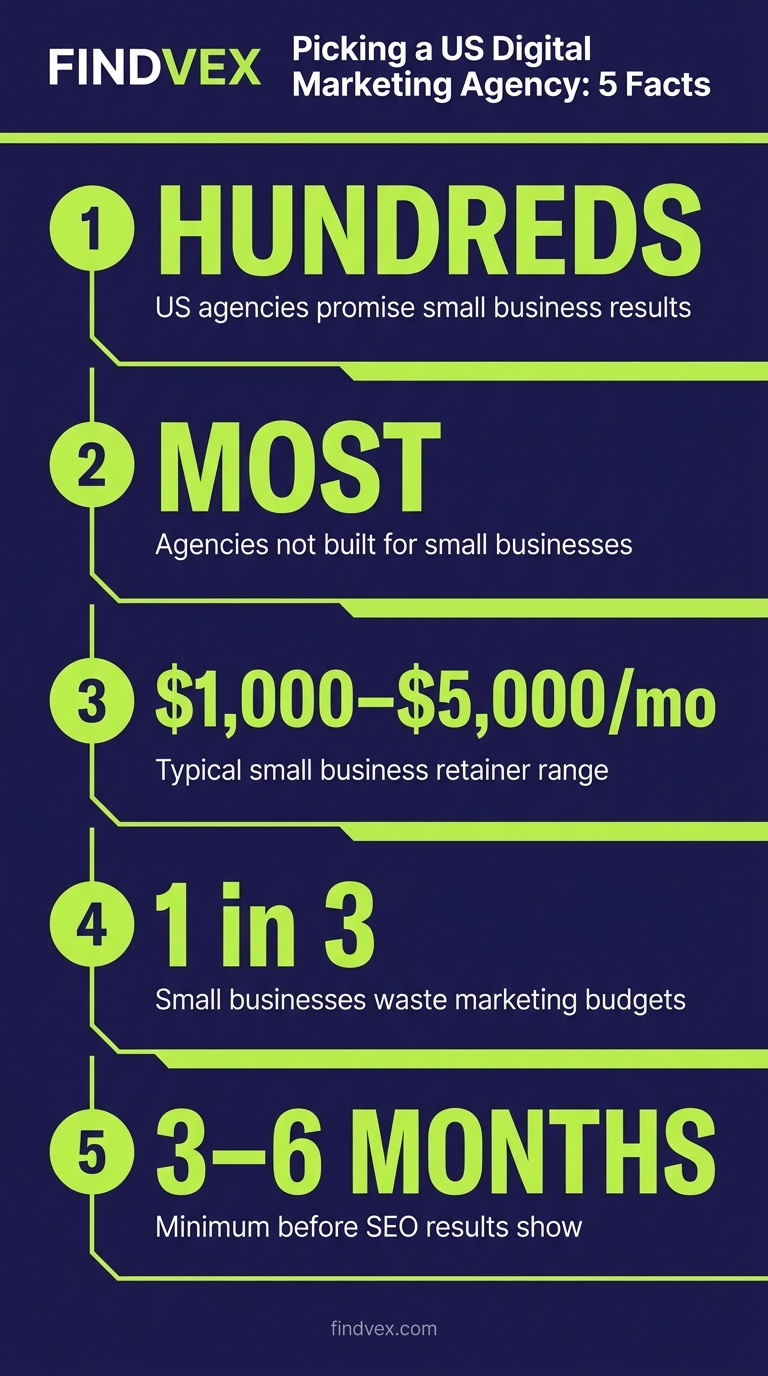
Hundreds of US digital marketing agencies promise results. Most aren't set up to serve small businesses well. This guide tells you what to actually look for — and how to avoid wasting your budget on retainers that don't move the needle.
Quick answer
A US digital marketing agency worth hiring for a small business should specialize in your channel (usually SEO, local search, or paid ads), have clear reporting, and show prior results in your industry or business size. Expect to pay $750–$3,000/month for legitimate small business SEO services. Before signing anything, ask for a sample deliverable, a clear scope of work, and references from clients with similar budgets.
Section 1
Searching for a digital marketing agency in the USA feels overwhelming fast. There are tens of thousands of options — from local boutiques to national firms — and most of their websites say the same things. 'Data-driven.' 'Results-focused.' 'Full-service.' None of that helps you decide.
If you run a small business with a limited budget and real revenue goals, you need a different filter than what most agency directories offer. This guide cuts through the noise and tells you what actually separates agencies that move the needle from ones that just produce slide decks.
What a Digital Marketing Agency Actually Does (vs. What They Sell)
Most agencies market themselves as 'full-service,' which sounds good until you realize it often means they do everything passably but nothing exceptionally. For small businesses, that's a budget killer.
The core services a US digital marketing agency might offer include: SEO (organic search), pay-per-click advertising (Google Ads, Meta Ads), social media management, email marketing, content creation, website design, and conversion rate optimization. Some agencies specialize in one or two of these. Others bundle them into packages regardless of whether you need all of them.
The honest truth: most small businesses with under $5K/month in marketing spend don't need all of these simultaneously. They need to pick the one or two channels with the clearest path to revenue, execute those well, then expand.
- SEO: Best for businesses with a 6–12 month horizon and consistent demand (law firms, dentists, contractors, restaurants)
- Google Ads/PPC: Best for businesses that need leads now and have a clear cost-per-acquisition target
- Local SEO: Best for any service-area business trying to show up in Google Maps and 'near me' searches
- Social media ads: Best for visual products or businesses with strong brand awareness goals
- Content marketing: Best for businesses with a longer sales cycle where trust drives conversions
“AI agents do in hours what teams used to do in weeks. The advantage compounds.”
Why Most National Agencies Aren't Built for Small Businesses
The agencies that dominate review platforms like Clutch — firms like WebFX, Ignite Visibility, and SmartSites — are excellent at what they do. But they're structured for accounts spending $5,000 to $50,000+ per month. When a small business signs with one of these firms at a lower tier, they often end up with junior staff, templated deliverables, and minimal strategic attention.
That's not a knock on those agencies. It's just a mismatch. A 12-person HVAC company in Phoenix competing locally doesn't need a 200-person agency's enterprise reporting suite. They need someone who understands local pack rankings, Google Business Profile optimization, and service-area landing pages.
When evaluating any US digital marketing agency, the size of the firm matters less than whether your account gets a dedicated point of contact, a strategy tailored to your market, and monthly reporting you can actually understand.
5 Things That Actually Separate Good Agencies from Expensive Ones
Here's what to actually evaluate — not the awards or case study percentages on their homepage.
- 1. Channel specialization: An agency that leads with SEO will usually do SEO better than one that offers ten services equally. Ask what percentage of their client base uses the specific service you need.
- 2. Industry familiarity: If you're a local dentist or restaurant owner, an agency that has worked in your vertical will understand the competitive landscape, the local intent queries, and the conversion triggers that matter. See our guides on SEO for dentists and restaurant SEO for examples of what vertical-specific strategy looks like.
- 3. Transparent reporting: Before signing, ask to see a sample monthly report. It should include keyword ranking movement, organic traffic trends, and conversion actions — not just vanity metrics like impressions.
- 4. Realistic timelines: Any agency that promises first-page rankings within 30 days is either lying or planning to use tactics that can hurt you long-term. SEO typically takes 3–6 months to show meaningful movement. Paid ads can show traction faster, but require ongoing optimization.
- 5. Scope clarity: The contract should say exactly what deliverables you receive each month — number of pages optimized, links built, ads managed, reports delivered. Vague scopes always favor the agency.
What Does Digital Marketing Actually Cost for Small Businesses in the USA?
Pricing transparency is rare in this industry, so let's be direct about what you can realistically expect.
For SEO services specifically, the range for small businesses is wide — from $300/month from budget providers to $8,000+/month from premium firms. But the sweet spot for legitimate, effective small business SEO typically falls between $750 and $3,000/month depending on your market's competitiveness and scope.
Our breakdown of affordable SEO services in the USA goes deeper on what different price points actually deliver — it's worth reading before you start getting proposals.
For paid search (Google Ads), expect to spend at minimum $1,000–$1,500/month in ad spend alone, separate from management fees. Agencies typically charge 15–20% of ad spend or a flat management fee. Below $500/month in ad spend, the campaigns rarely generate enough data to optimize effectively.
Be skeptical of packages priced under $300/month for 'full SEO.' At that price, you're likely getting automated reporting and templated blog posts — not strategic work.
- Local SEO only (Google Business Profile, local citations, basic on-page): $500–$1,500/month
- SEO + content (blog posts, landing pages, link building): $1,500–$3,500/month
- SEO + Google Ads management (without ad spend): $2,000–$5,000/month
- Full-service (SEO, PPC, social, content): $4,000–$10,000+/month
Red Flags That Should Stop You Before You Sign
These aren't edge cases. They're common enough that you should treat each one as a deal-breaker until explained.
- Guaranteed rankings: No agency can guarantee a specific Google ranking. Anyone who does is either misrepresenting how SEO works or planning to game the algorithm in ways that create long-term risk.
- No access to your own accounts: You should own your Google Analytics, Google Search Console, Google Ads, and any CMS accounts. If an agency won't give you admin access, walk away.
- Proprietary 'secret sauce' strategy: Effective digital marketing is not secret. If an agency can't explain what they do in plain language, that's a problem.
- Lock-in contracts over 6 months without deliverable milestones: Long contracts aren't inherently bad, but they should be tied to defined deliverables at each stage — not just a monthly retainer with vague 'ongoing work.'
- No dedicated point of contact: If you're being passed between account managers every few months, your strategy is always starting over.
- Reporting that only shows traffic growth, not leads or conversions: Traffic without conversions isn't a business result. Insist on tracking that connects to your actual revenue goals.
Should You Hire an SEO Agency or a Full-Service Digital Marketing Agency?
For most small businesses, starting with an SEO-focused agency makes more sense than a full-service firm. Here's why: SEO compounds over time. The content, links, and technical improvements you build in year one keep delivering in year two and three. Paid ads stop the moment you stop paying.
Once your organic presence is established and generating consistent leads, layering in paid ads or social makes strategic sense. But trying to run all channels at once on a small budget often means none of them get enough investment to work.
If your business is seasonal, highly visual, or genuinely competing in a market where paid ads dominate (like insurance or legal), the calculus shifts. But for most local service businesses — contractors, clinics, restaurants, real estate agents — SEO is the foundation worth building first.
Read how local SEO turns website traffic into booked calls for a direct look at how this plays out in real-world service businesses.
The New Variable: AI Search and What It Means for Your Agency Choice
If you're evaluating agencies in 2026, AI search visibility is now a legitimate consideration alongside traditional Google rankings. Tools like ChatGPT, Perplexity, and Google's AI Overviews increasingly surface answers before users click any link — and which businesses get cited in those answers is increasingly shaped by the same signals that drive organic SEO.
A good agency should at minimum be aware of this shift. Better ones will have started building it into their content strategy — structuring pages to answer specific questions clearly, earning citations from authoritative local sources, and ensuring your brand information is consistent across the web.
This doesn't require a completely different strategy. It requires more precise execution of the fundamentals: clear, well-structured content, strong local authority signals, and a Google Business Profile that's fully optimized. Our 90-day GEO playbook for local search covers the mechanics in detail if you want to go deeper.
7 Questions to Ask Any Agency Before You Hire
Use these in your first call. The answers — and how they're delivered — will tell you a lot.
- 1. What does your onboarding process look like, and what do you need from us in the first 30 days?
- 2. Can I see a sample monthly report from a current client at my budget level?
- 3. Who will be the main point of contact on my account, and how many accounts do they manage?
- 4. What does success look like at the 3-month mark, and how will we measure it?
- 5. Do you build links, and if so, how do you acquire them? (Listen for 'outreach to relevant sites' — be wary of 'we have a network.')
- 6. Will I retain ownership of all content, accounts, and data if I cancel?
- 7. What industries have you worked in, and can you share two or three references from businesses similar to mine?
Do This This Week: Your Agency Evaluation Checklist
If you're actively looking for a US digital marketing agency right now, here's a focused action plan to move from confused to confident in five to seven days.
- Day 1–2: Define your primary goal (more inbound calls? More e-commerce sales? Local foot traffic?) and set a realistic monthly budget including ad spend if applicable.
- Day 2–3: Run a quick audit of your current situation — Google Search Console for organic performance, Google Analytics for traffic sources, Google Business Profile for completeness. This will tell you which channels need the most work and help you ask better questions.
- Day 3–4: Shortlist 3–5 agencies. Use Clutch or the Semrush Agency Directory to find candidates, but filter by your budget range and industry — not just star ratings.
- Day 4–5: Send each agency your brief (goal, budget, timeline, current performance baseline) and ask for a capabilities overview and sample deliverables. Agencies that respond thoughtfully and ask clarifying questions are worth a call.
- Day 5–7: Run discovery calls using the seven questions above. Compare the specificity of their answers, not the confidence of their pitch.
- Before signing: Request references from clients at your budget level and actually call them. Ask specifically whether the agency's reporting reflected real business impact, not just traffic numbers.
How FindVex Approaches Small Business Digital Marketing
FindVex is built specifically for small and mid-size businesses that need SEO and digital marketing to generate real revenue — not just rankings. We focus on local search, content strategy, and technical SEO foundations that compound over time.
We're not the right fit for every business. But if you want a straightforward conversation about what would actually move your numbers — without being sold a package you don't need — we're happy to take a look at your current situation and give you honest feedback.
Start with a free site audit, or explore our small business SEO packages to understand exactly what different engagement levels include.
FAQs
How much does a digital marketing agency cost for a small business in the USA?
For small businesses, legitimate SEO services typically range from $750 to $3,000 per month. Full-service packages including paid ads can run $4,000 to $10,000+/month. Budget providers under $300/month usually deliver templated, automated work with little strategic value. Always ask what specific deliverables are included at your price point.
What's the difference between a digital marketing agency and an SEO agency?
A digital marketing agency covers multiple channels: SEO, paid ads, social media, email, and content. An SEO agency specializes in organic search. For most small businesses, starting with an SEO-focused agency delivers better ROI because the results compound over time, whereas multi-channel work at low budgets often means all channels are underfunded.
How long does it take to see results from a digital marketing agency?
SEO typically takes 3–6 months to show measurable ranking and traffic movement, and 6–12 months for meaningful lead volume. Paid ads (Google Ads, Meta) can generate leads within days or weeks, but require continuous spending and ongoing optimization to remain efficient. Any agency promising SEO results in under 30 days is a red flag.
Should I hire a local digital marketing agency or a national one?
For local SEO and businesses competing in a specific city or region, a local agency often has an advantage in understanding the market. For technical SEO, content, or paid ads, geography matters less than specialization and experience. The most important factor is whether the agency has handled businesses at your scale and in your vertical.
What questions should I ask a digital marketing agency before hiring?
Ask who your dedicated point of contact will be, how many accounts they manage, what a sample monthly report looks like, how they measure success for your specific goals, whether you retain ownership of all accounts and data, how they build links, and for references from clients at your budget level. Strong agencies answer these questions with specifics — not sales language.
Do I need a full-service agency or just SEO?
Most small businesses with limited budgets are better served by focusing on one or two channels done well rather than spreading a small budget across all channels simultaneously. Start with the channel most directly tied to your revenue goal — usually local SEO or Google Ads — then expand once you have a reliable baseline of leads.
What are the biggest red flags when hiring a US digital marketing agency?
Key red flags include guaranteed rankings, no access to your own accounts, long lock-in contracts without defined deliverables, reporting that shows only traffic (not conversions), vague explanations of their process, and no dedicated account manager. Any of these should prompt more questions before you sign.
Related reading
- small business seo packages — Small Business SEO Packages: What You Actually Get vs. What Agencies Sell You
- seo services for small business — SEO Services for Small Business: What You're Actually Buying (and What Moves the Needle)
- affordable seo services usa — Affordable SEO Services in the USA: What Small Businesses Actually Get for Their Money
- generative engine optimization services — Generative Engine Optimization Services: What Small Businesses Actually Get (and What to Ask For)
- geo services for small business — GEO Services for Small Business: What They Actually Include and Whether They're Worth It
- aeo services for small business — AEO Services for Small Business: What You Actually Need (and What to Skip)
- ai seo agency — What to Expect from a Modern AI SEO Agency (And Red Flags to Watch)
- answer engine optimization services — Answer Engine Optimization Services: What Small Businesses Actually Get (and Whether It's Worth Paying For)
- google business profile audit — Google Business Profile Audit Checklist: 23 Things That Actually Affect Your Local Ranking
- crawl budget seo — Crawl Budget SEO: Why Google Skips Pages on Small Business Sites (and How to Fix It)
Research notes
Background claims used while researching this article. Verify with the cited authorities before quoting.
- Pricing ranges for small business SEO services ($750–$3,000/month range)
- Google Ads minimum spend thresholds for effective optimization
Sofia Patel
Head of Content & Growth · Findvex
Sofia Patel leads content and growth at Findvex. She writes about local SEO, conversion-focused content, and AEO/GEO strategy — the work that turns search visibility into booked calls and qualified leads for service businesses.
Expertise: Local SEO · Conversion content · AEO / GEO strategy · Content-led link building
Related reads
Google TurboQuant and Entity-Driven SEO: What the Compression Breakthrough Actually Means for Your Site
TurboQuant is a vector quantization algorithm from Google Research that dramatically compresses the mathematical representations AI uses to understand meaning. If it reaches production search infrastructure, it could lower the cost of semantic retrieval at scale — making entity-based content signals more dominant and keyword-match signals relatively less important.
SEO NewsHow AI Is Changing Local Search Visibility: What the SOCi + Google Webinar Revealed
Google and SOCi's joint webinar on local search visibility highlighted a fundamental shift: AI-powered discovery across Google Search, Maps, and Gemini now requires a different optimization playbook than the one most small businesses are running. Here's what changed and what to prioritize.
Strategic Technical SEODuplicate Content SEO: What Google Actually Penalizes vs. What It Silently Handles
Duplicate content rarely triggers a manual penalty. Google usually picks one version and ignores the rest. But the wrong choice by Google can split your ranking signals, waste crawl budget, and suppress pages you actually want ranked. Here's how to diagnose the difference.