Small Business SEO Packages: What You Actually Get vs. What Agencies Sell You
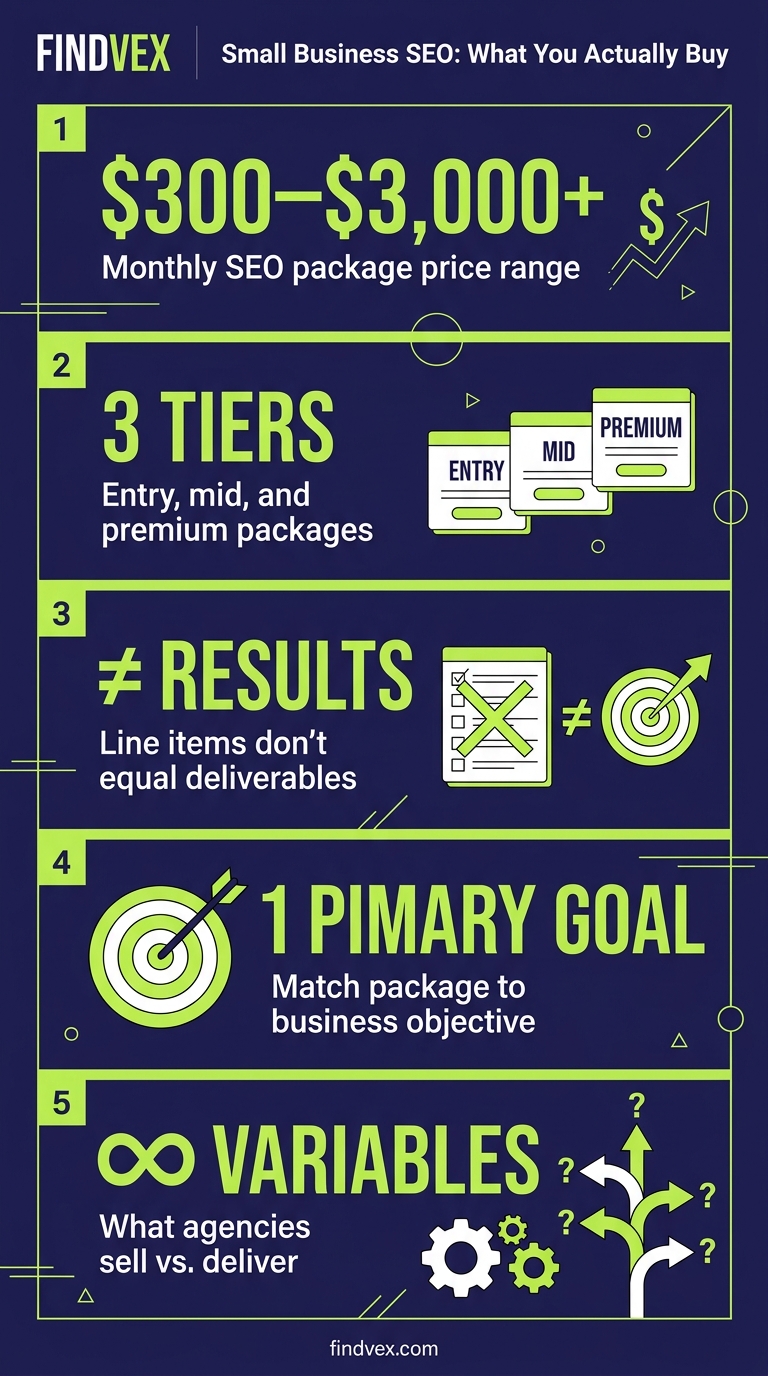
SEO packages for small businesses range from $300 to $3,000+ per month — but the line items rarely tell you what you're actually buying. This guide breaks down what each tier delivers, what to demand from any agency, and how to match a package to your real business goals.
Quick answer
Small business SEO packages typically fall into three tiers: starter ($300–$750/month for local visibility basics), growth ($750–$1,500/month for content and link building), and authority ($1,500–$3,000+/month for competitive markets). The right package depends on your competition level, how fast you need leads, and whether you're targeting local or national traffic. Before signing anything, verify that the package includes monthly reporting, a technical audit at onboarding, and clear ownership of any content produced.
Why SEO Package Pricing Feels Impossible to Compare
Type 'small business SEO packages' into Google and you'll find prices from $99/month to $10,000/month — often with nearly identical bullet points on the sales page. 'Keyword research. On-page optimization. Monthly reporting.' Every agency offers them. Almost none explain what those things mean for your specific business.
The confusion is real and it costs business owners money. They either underspend on a package that does nothing meaningful, or overspend on deliverables that don't connect to revenue. This guide gives you a framework to evaluate any SEO package before you buy — and tells you exactly what each tier should and shouldn't include.
What's Actually Inside Most SEO Packages (The Real Breakdown)
Most SEO packages bundle work across four core areas: technical SEO, on-page optimization, content production, and link acquisition. The ratio of each changes dramatically by price tier. A $400/month package is mostly setup and light maintenance. A $2,000/month package is active content and link building every single month.
Here's what each core area actually means in practice — not the agency jargon version.
- Technical SEO: Fixing crawl errors, improving site speed, resolving indexing issues, setting up canonical tags, and auditing robots.txt. This is foundation work. Without it, everything else underperforms.
- On-page optimization: Rewriting title tags and meta descriptions, improving heading structure (H1/H2/H3), adding internal links, and aligning page content with target keywords.
- Content production: Writing new blog posts, service pages, location pages, or FAQs that target search queries your customers actually use.
- Link acquisition: Earning backlinks from credible, relevant websites — through outreach, digital PR, citations, or content partnerships. This is the hardest part to do well and the easiest part for agencies to fake.
“AI agents do in hours what teams used to do in weeks. The advantage compounds.”
The Three Real Tiers of Small Business SEO Packages
Ignore the names agencies use ('Silver,' 'Gold,' 'Platinum'). Judge packages by what work gets done and how often. Here's how the three functional tiers typically break down in the US market.
Tier 1 — Starter ($300–$750/month): Local Visibility Basics
This tier is appropriate for businesses with a very localized customer base (a single-location service business, a solo practitioner, a neighborhood restaurant) who are not yet visible in Google Maps or local organic results. It's a foundation, not a growth engine.
What you should get: an initial technical audit, Google Business Profile optimization, citation cleanup across directories (Yelp, Apple Maps, etc.), title tag and meta description fixes across your core pages, and a monthly report showing keyword movement and traffic. What you should not expect: new content creation, active link building, or major competitive keyword targeting.
- Good fit for: single-location service businesses, new websites under 12 months old, businesses targeting one city or zip code
- Red flag if included: 'guaranteed first page rankings' — no ethical agency promises this
- Red flag if missing: Google Business Profile work — at this budget, GBP optimization is the highest ROI activity available
Tier 2 — Growth ($750–$1,500/month): Content and Competitive Keywords
This is the most common package for established small businesses that have basic visibility but aren't ranking for competitive service keywords or generating consistent inbound leads from search. At this tier, the agency should be producing content, building links, and expanding your keyword footprint every single month — not just maintaining what's already there.
Expect: 2–4 pieces of content per month (service pages, blog posts, or location pages), active link building (minimum 2–5 quality links per month), Core Web Vitals monitoring, and conversion-focused page optimization. If your agency is billing you $1,000/month and producing zero new content or links, ask exactly what they're doing with your retainer hours.
- Good fit for: multi-location businesses, service businesses in competitive local markets, businesses with 6+ months of existing SEO history
- Demand: content ownership in writing — any pages created should belong to you, not the agency
- Demand: link reporting with source domains listed — 'we built 10 links' means nothing without knowing where
Tier 3 — Authority ($1,500–$3,000+/month): Competitive Markets and National Reach
At this level, you're competing against other businesses that are also investing in SEO. The work is more strategic: competitor gap analysis, digital PR campaigns, topical authority building across a content cluster, and consistent high-authority link acquisition. This tier is also appropriate for businesses targeting regional or national keywords rather than a single metro area.
What separates a legitimate $2,000/month package from an inflated one: the agency should be able to show you a clear content roadmap, a link prospecting list, and measurable movement in target keyword rankings within 90 days. If they can't, you're likely paying for a growth-tier package at authority-tier prices.
- Good fit for: e-commerce businesses, multi-location franchises, professional services competing regionally (law firms, medical practices, financial advisors)
- Demand: a documented strategy, not just a list of deliverables
- Watch for: agencies that sub-contract all work overseas without disclosing it — ask who is actually writing the content and building the links
5 Things to Demand From Any SEO Package Before You Sign
These aren't nice-to-haves. If an agency won't commit to these in writing, keep looking.
- 1. Onboarding technical audit: Every engagement should start with a full audit of your site's indexing, crawlability, speed, and on-page signals. If they skip this, they're optimizing blind.
- 2. Monthly keyword ranking report: Not just traffic — actual keyword positions. You need to see if your target terms are moving, holding, or dropping.
- 3. Content and asset ownership: Any blog posts, service pages, or landing pages created during your engagement belong to your business. Get this in the contract.
- 4. Link transparency: A monthly link report showing every new backlink acquired, the source domain, and its relevance. Generic 'link building included' language is not enough.
- 5. A clear cancellation policy: Ethical agencies don't lock you into 12-month contracts without performance milestones. Most reputable US agencies work month-to-month or offer 3–6 month minimum commitments with defined deliverables.
Package Red Flags That Should Make You Walk Away
The SEO agency market in the US has a significant noise-to-signal problem. Here are the specific things that signal a package is unlikely to produce real results — or could actively harm your site.
- Guaranteed rankings: No agency can guarantee a specific Google ranking. Anyone who does is either lying or about to use tactics that will eventually penalize your site.
- Packages that never include content: SEO without content is just maintenance. If a $1,000/month package doesn't produce at least 2 pieces of original content, ask what the retainer hours are actually going toward.
- Private blog network (PBN) links: If an agency's link building involves 'our network of partner sites,' ask to see those sites. PBN links can trigger manual penalties.
- No access to your own Google Search Console or Analytics: You should always own your data. Agencies that won't share access are hiding performance.
- Identical packages for every business: A dentist in Phoenix and a plumber in Tampa have completely different SEO needs. Cookie-cutter packages are a sign the agency isn't doing real strategy.
Local SEO Packages vs. National SEO Packages: The Key Differences
Most small businesses need local SEO — targeting customers in a specific city, county, or metro area — not national SEO. The tactical mix is different and so is the pricing justification.
Local SEO packages prioritize Google Business Profile optimization, local citation building, location-specific landing pages, and review management. National SEO packages prioritize topical authority, high-volume keyword rankings, and link acquisition from nationally recognized publications. You can expect local packages to show movement faster (sometimes within 60–90 days) because the competition is lower. National campaigns typically require 6–12 months before meaningful keyword movement.
- If 90%+ of your customers come from within 30 miles: choose a local-focused package
- If you serve clients across multiple states or sell online: you need a national or e-commerce SEO strategy
- Multi-location businesses need both: local optimization per location plus authority building at the brand level
One Thing Most SEO Package Descriptions Don't Mention: AI Search Visibility
In 2026, a growing share of search queries — particularly informational and comparison queries — are being answered directly by AI Overviews in Google, or by tools like ChatGPT and Perplexity. If your business shows up in Google's organic results but not in AI-generated answers, you're losing visibility to a segment of users who never scroll past the AI box.
Most standard SEO packages don't include GEO (Generative Engine Optimization) work. If AI search visibility matters to your business, ask your agency specifically whether they optimize for AI citation signals — structured content, entity clarity, citation-worthy formatting, and named expert content. This is still an emerging area, but it's becoming a meaningful differentiator between agencies that are ahead of the curve and those that aren't.
Do This This Week: How to Evaluate Any SEO Package You're Considering
Don't spend another week reviewing agency decks without a clear decision framework. Here's a five-step process you can complete in under two hours.
- Step 1 — Audit your own site first: Use Google Search Console's Pages report to see how many of your pages are indexed and which ones have errors. This gives you baseline data before any agency call. (If you haven't done a technical audit yet, start with FindVex's technical SEO audit checklist before calling any agency.)
- Step 2 — Define your actual goal: More calls? More online bookings? Rank for a specific service keyword? Write it down before talking to any agency. Agencies that don't ask about your goal in the first conversation aren't strategic partners.
- Step 3 — Ask every agency for 3 client case studies in your industry or market size: Not logo testimonials. Actual before/after keyword rankings and lead volume data. If they can't provide this, that tells you something important.
- Step 4 — Request a sample monthly report: You need to see what you'll actually receive each month before you commit. Vague traffic graphs with no keyword data are a red flag.
- Step 5 — Compare packages on work output, not feature lists: Count the deliverables. How many pages of content per month? How many links? How many hours? Normalize across packages so you can compare apples to apples.
Which Package Elements Actually Drive Leads (Not Just Traffic)
Traffic is vanity. Leads are revenue. The SEO activities that most reliably convert traffic into booked calls and form submissions are not the same as the activities that improve raw traffic numbers.
The highest-lead-impact activities in a well-run SEO package are: local landing pages optimized for service + city keywords (because these match high-intent queries), Google Business Profile optimization (because it drives calls and direction requests directly), and conversion-optimized service pages (clear CTAs, trust signals, and specific service descriptions). Blog content drives traffic and brand awareness but typically converts at a lower rate — it's valuable for topical authority, not for direct lead generation. Make sure your package prioritizes the high-intent pages first.
- Highest lead impact: local landing pages, GBP optimization, service page CRO
- Medium lead impact: review acquisition campaigns, FAQ pages targeting 'best [service] in [city]' queries
- Lower (but valuable) lead impact: blog content, informational keywords, brand awareness content
FAQs
How much should a small business pay for SEO per month?
Most small businesses in competitive US markets spend between $500 and $2,000 per month on SEO services. Single-location service businesses with limited local competition can see results at $500–$800/month. Businesses in competitive markets or targeting multiple locations typically need $1,000–$2,000/month to move the needle. Anything under $300/month is unlikely to include meaningful active work beyond basic maintenance.
What's the difference between an SEO package and an SEO retainer?
An SEO package is a predefined bundle of services at a fixed monthly price. An SEO retainer is an ongoing engagement where you're paying for a set number of hours or a defined scope of work that can flex month to month. Packages are easier to compare across agencies; retainers give more flexibility. For most small businesses, a clearly scoped package is easier to manage and evaluate.
How long before an SEO package starts showing results?
For local SEO (Google Maps, local organic), you can typically see movement in 60–90 days if technical issues are addressed early. For competitive service keywords in organic search, expect 4–6 months before meaningful ranking changes. For national or e-commerce SEO, 6–12 months is realistic. Any agency promising top-3 rankings in 30 days is either targeting extremely low-volume keywords or using tactics that won't hold.
Can I do SEO myself instead of buying a package?
Yes — especially for local SEO basics. You can optimize your Google Business Profile, fix title tags and meta descriptions, build local citations, and publish location-specific content yourself. Where DIY breaks down is in consistent content production, technical issue resolution, and link acquisition. If you have more time than budget, start with the technical SEO audit and local basics before hiring an agency.
What should I watch out for in cheap SEO packages?
The biggest risks in sub-$400/month SEO packages: link schemes (PBNs, link farms) that can trigger Google penalties; spun or AI-generated content published without quality review; no real human strategy — just automated reports; and contracts that make it difficult to leave. The agency market has many legitimate budget options, but they're typically focused on a narrow scope of work rather than trying to do everything cheaply.
Do SEO packages include Google Ads?
No — standard SEO packages cover organic search optimization only. Google Ads (PPC) is a separate paid channel with its own pricing structure. Some digital marketing agencies offer bundled SEO + PPC packages, but the two should be priced and reported on separately so you can evaluate ROI on each channel independently.
Is a month-to-month SEO contract better than a 12-month contract?
Month-to-month arrangements give you more flexibility but can sometimes mean the agency prioritizes faster-turnaround work over long-term strategy. A 3–6 month minimum with clearly defined deliverables and performance milestones is typically the best balance — enough time for the agency to show real results, but not a year-long commitment before you can evaluate whether it's working.
Related reading
- affordable seo services usa — Affordable SEO Services in the USA: What Small Businesses Actually Get for Their Money
- digital marketing agency usa — How to Choose a Digital Marketing Agency in the USA: What Small Businesses Actually Need to Know
- llm seo services — LLM SEO Services: How to Get Cited by ChatGPT, Claude, and Perplexity
- geo services for small business — GEO Services for Small Business: What They Actually Include and Whether They're Worth It
- seo services for small business — SEO Services for Small Business: What You're Actually Buying (and What Moves the Needle)
- aeo services for small business — AEO Services for Small Business: What You Actually Need (and What to Skip)
- generative engine optimization services — Generative Engine Optimization Services: What Small Businesses Actually Get (and What to Ask For)
- generative engine optimization — What Is Generative Engine Optimization (GEO)? How Small Businesses Get Found in AI Search
- AI local search visibility — How AI Is Changing Local Search Visibility: What the SOCi + Google Webinar Revealed
- answer engine optimization services — Answer Engine Optimization Services: What Small Businesses Actually Get (and Whether It's Worth Paying For)
Research notes
Background claims used while researching this article. Verify with the cited authorities before quoting.
- Pricing ranges for small business SEO packages ($300–$3,000/month) cited in this article reflect general US market observations. Editor should verify against a current industry pricing survey (e.g., Ahrefs, BrightLocal, or Moz annual industry reports) before publishing.
Sofia Patel
Head of Content & Growth · Findvex
Sofia Patel leads content and growth at Findvex. She writes about local SEO, conversion-focused content, and AEO/GEO strategy — the work that turns search visibility into booked calls and qualified leads for service businesses.
Expertise: Local SEO · Conversion content · AEO / GEO strategy · Content-led link building
Related reads
Google TurboQuant and Entity-Driven SEO: What the Compression Breakthrough Actually Means for Your Site
TurboQuant is a vector quantization algorithm from Google Research that dramatically compresses the mathematical representations AI uses to understand meaning. If it reaches production search infrastructure, it could lower the cost of semantic retrieval at scale — making entity-based content signals more dominant and keyword-match signals relatively less important.
SEO NewsHow AI Is Changing Local Search Visibility: What the SOCi + Google Webinar Revealed
Google and SOCi's joint webinar on local search visibility highlighted a fundamental shift: AI-powered discovery across Google Search, Maps, and Gemini now requires a different optimization playbook than the one most small businesses are running. Here's what changed and what to prioritize.
Strategic Technical SEODuplicate Content SEO: What Google Actually Penalizes vs. What It Silently Handles
Duplicate content rarely triggers a manual penalty. Google usually picks one version and ignores the rest. But the wrong choice by Google can split your ranking signals, waste crawl budget, and suppress pages you actually want ranked. Here's how to diagnose the difference.