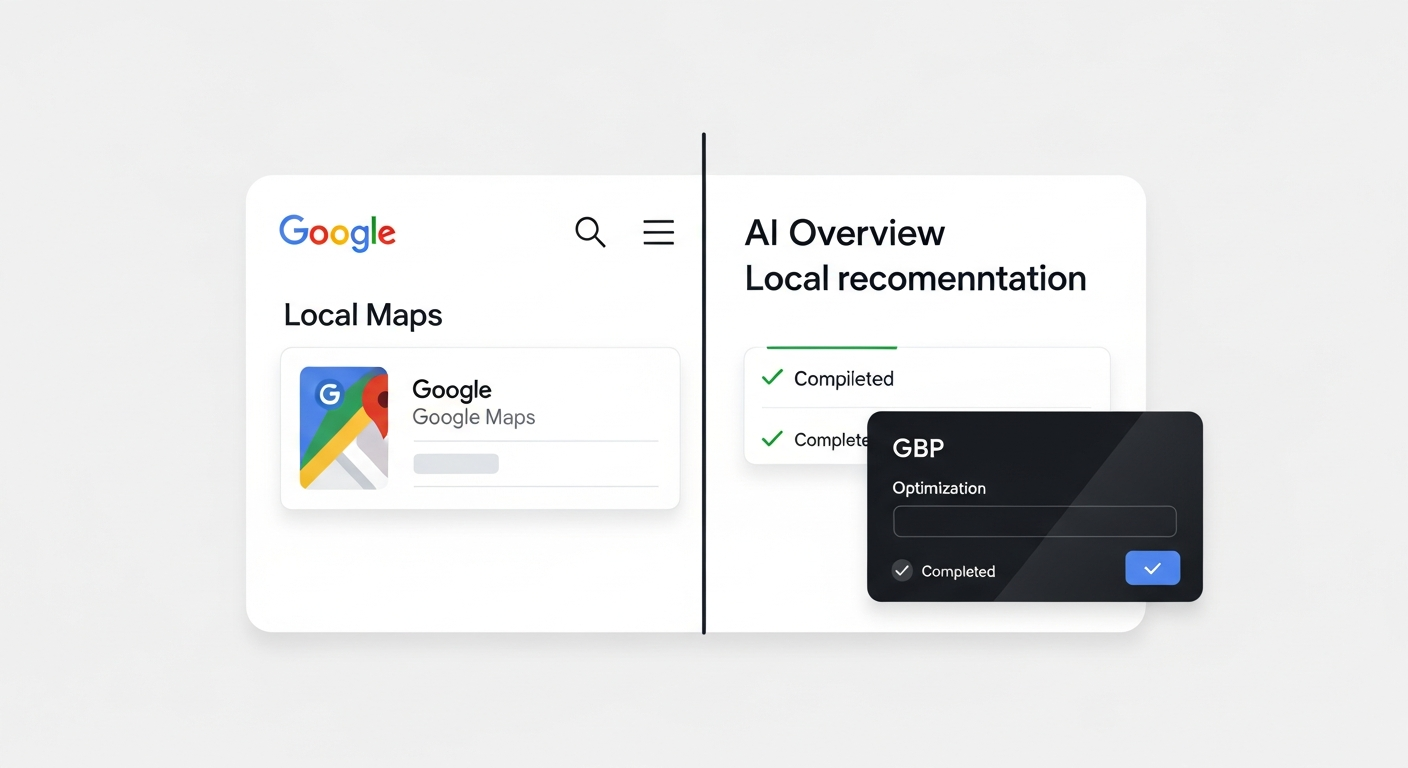
How AI Is Changing Local Search Visibility: What the SOCi + Google Webinar Revealed
Google and SOCi's joint webinar on local search visibility highlighted a fundamental shift: AI-powered discovery across Google Search, Maps, and Gemini now requires a different optimization playbook than the one most small businesses are running. Here's what changed and what to prioritize.
Quick answer
AI is changing local search by shifting discovery from keyword-matched blue links to AI-generated answers across Google Search, Maps, and Gemini. To stay visible, small businesses need a complete Google Business Profile, consistent NAP data, structured schema markup, recent reviews with sentiment detail, and content that answers specific local questions in plain language — not just keyword-optimized pages.
The Shift That's Already Happening
Local search doesn't look like it did two years ago. According to a joint webinar between SOCi and Google covered by Search Engine Land, AI-driven discovery is now central to how consumers find local businesses — not just via traditional Google Search, but through Google Maps, AI Overviews, and Gemini. The businesses that show up are increasingly the ones whose data, content, and credibility are structured in ways AI can read and trust.
This isn't a future-state warning. It's happening in your market right now. If your Google Business Profile is thin, your reviews are sparse, or your website answers questions the way a brochure does rather than the way a local expert would, you're losing ground to competitors who've already adapted.
Here's what the shift actually means — and the concrete steps you can take this week to close the gap.
What the SOCi and Google Webinar Actually Revealed
The core message from the webinar, as reported by Search Engine Land, is that AI-powered search surfaces are now active participants in local discovery — not passive indexes. Google's AI systems synthesize signals from your GBP, your website, third-party mentions, and review sentiment to decide whether your business is the right answer to a local query.
Three channels are now critical for local visibility: traditional Google Search (including AI Overviews), Google Maps (including the AI-assisted Ask Maps feature), and Gemini-powered discovery inside Google products. Each channel has its own weighting logic, but they share common inputs — structured business data, review quality, and content relevance.
The implication for small businesses is that optimizing for one channel in isolation no longer works. A strong Maps listing with a weak website will lose to a competitor who has both locked in.
“AI agents do in hours what teams used to do in weeks. The advantage compounds.”
Which Businesses Feel This Most
Any local business where the customer journey starts with a search is affected — but the impact is sharpest for service businesses with high purchase intent queries. Think: HVAC contractors, dentists, restaurants, law firms, real estate agents, and home services providers. These are the categories where someone types (or now asks AI) a specific need and expects a direct, confident recommendation.
If your business falls into those categories, your competitors are already appearing in AI Overviews and Gemini responses. Whether you appear depends entirely on how well your digital footprint matches what AI systems look for when composing a local answer.
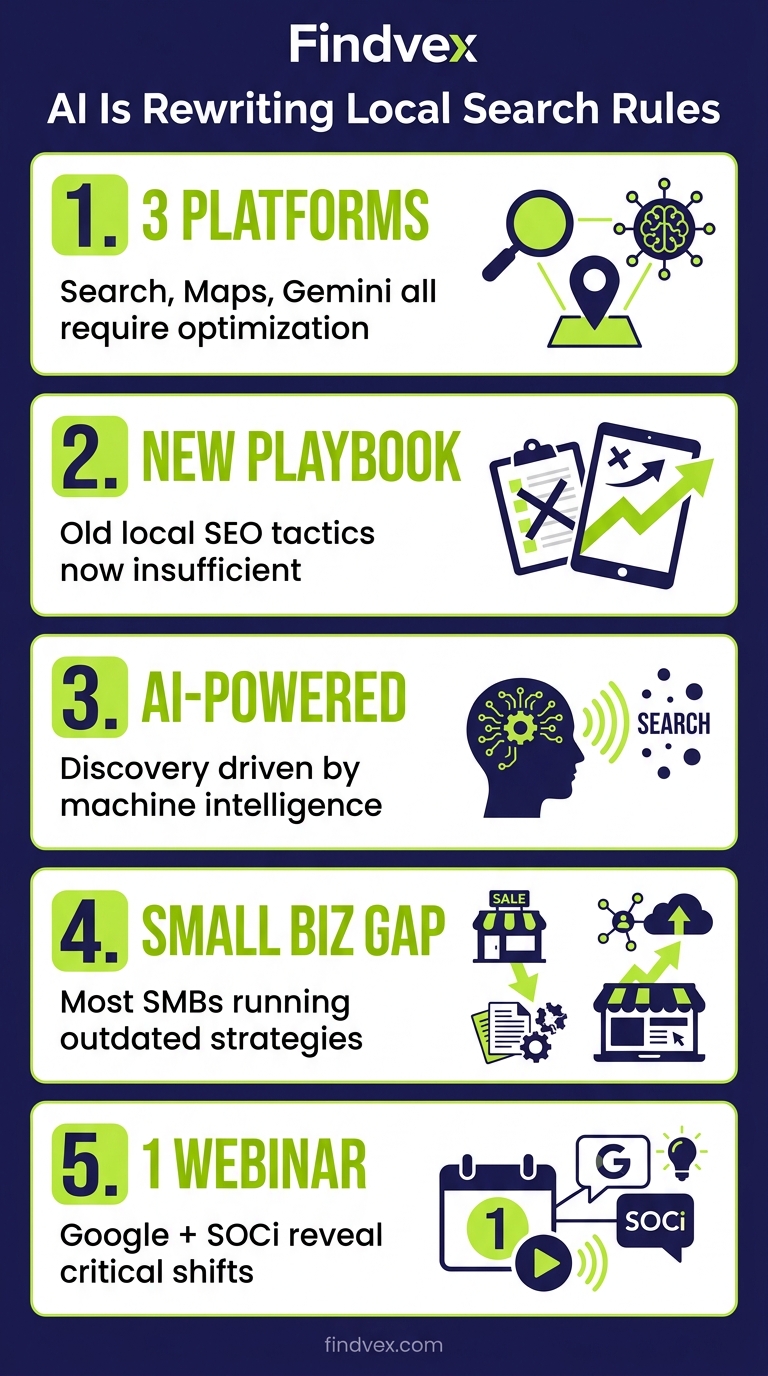
The Signals AI Uses to Pick Local Businesses
AI-driven local discovery isn't arbitrary. It pulls from a recognizable but evolving set of signals. Understanding them is the first step to acting on them.
- Google Business Profile completeness: Category accuracy, service list depth, operating hours, photos, Q&A responses, and post frequency all contribute. An incomplete GBP is the most common gap we see — and the easiest to fix.
- Review volume, recency, and sentiment language: AI systems don't just count stars. They read review text for specific service and location language. A review that says 'fixed our furnace same day in Naperville' carries more local signal than 'great service.' Encourage detailed reviews, not just star ratings.
- NAP consistency across citations: Your name, address, and phone number need to match exactly across Google, Yelp, Bing Places, Apple Maps, and industry directories. Discrepancies erode trust signals AI uses to verify a business is legitimate.
- Website content that answers specific local questions: Pages that answer 'do you serve [neighborhood]?' or 'what does [service] cost in [city]?' give AI something concrete to cite. Generic homepage copy does not.
- Structured data (schema markup): LocalBusiness schema, FAQPage schema, and Service schema help AI systems extract and verify your business data without guessing.
- Third-party mentions and citations: Appearances on local news sites, chamber of commerce directories, and niche industry sites act as credibility signals that reinforce what your GBP and website claim.
How This Differs from Traditional Local SEO
Traditional local SEO optimized for a position — rank #1 in the local pack, show up on page one. The new model optimizes for citation frequency — being the business an AI confidently recommends when a relevant local query arrives.
The practical difference: you're not just trying to satisfy a ranking algorithm, you're trying to become the clearest, most credible answer to a specific question. That means your content needs to be direct, your data needs to be verifiable, and your reputation needs to be visible in review platforms that AI tools already trust.
For a deeper dive into what GEO means for local businesses specifically, the FindVex 90-Day GEO Playbook for Local Search covers the full framework. The short version: traditional SEO gets you indexed; GEO gets you cited.
Do This This Week: A Local AI Visibility Action Plan
You don't need a six-month strategy to start improving your AI search visibility. Here's what will move the needle fastest, in priority order.
- Audit your Google Business Profile today: Check that your primary and secondary categories are accurate, your services list is complete with descriptions, and your hours are current. Run through the 23-point GBP audit checklist to find quick wins.
- Request three new detailed reviews this week: Contact recent customers directly and ask them to mention the specific service they received and your city or neighborhood. Even a handful of detailed reviews can shift how AI reads your sentiment profile.
- Add a plain-language FAQ to your homepage or service pages: Write three to five questions your customers actually ask ('Do you serve [neighborhood]?' / 'How much does [service] cost?' / 'How quickly can you respond?') and answer them in one to three sentences each. This is the format AI Overviews and Gemini pull from most reliably.
- Check your NAP consistency on Google, Bing Places, Apple Maps, and Yelp: Google your business name and look at every listing. If the address format, phone number, or business name varies across platforms, standardize it.
- Add or update LocalBusiness schema on your website: If you're on WordPress, plugins like Yoast or Rank Math can generate this automatically. If you're on a custom site, implement the JSON-LD block manually. This is one of the fastest ways to signal structured, machine-readable business data.
- Identify two or three local citation sources you're missing: Local chamber of commerce, city business directory, or an industry-specific directory relevant to your niche. Getting listed — even without a backlink — adds a trust signal AI uses to verify your legitimacy.
What This Means for Your Leads, Not Just Your Rankings
This isn't a vanity metric exercise. When a consumer asks Gemini or ChatGPT for a local recommendation and your business appears, the intent behind that query is usually high — they're ready to call, book, or visit. Being absent from that moment means a competitor captures the lead.
The businesses most likely to see a direct impact on booked calls and new customers are those who combine a complete GBP, fresh reviews, and a website with clear local FAQ content. These three things together create a profile AI can confidently recommend — which translates to visibility in AI Overviews, Maps recommendations, and Gemini responses.
If you want to understand how local SEO visibility connects to actual phone calls and appointments rather than just impressions, the FindVex guide on how local SEO turns website traffic into booked calls covers the conversion mechanics in detail.
Format Your Content So AI Can Extract It
One of the clearest takeaways from the SOCi and Google webinar is that AI systems favor content that is structured for extraction, not just optimized for reading time. That means short paragraphs, direct answers, labeled sections, and specific local language.
Compare these two approaches for a plumbing company's service page:
Weak: 'We offer a wide range of plumbing services to homeowners throughout the greater metropolitan area. Our experienced team is ready to help with any issue you may have.'
Strong: 'We provide emergency plumbing repair, water heater installation, and drain cleaning in Chicago's North Side and surrounding neighborhoods including Lincoln Park, Wicker Park, and Logan Square. Same-day appointments available.'
The second version gives AI a city, specific neighborhoods, specific services, and a key differentiator. That's the difference between being a vague result and being a citable answer.
For businesses running service area pages, local landing pages that rank without sounding generic goes deeper on how to structure location-specific content that satisfies both AI extraction and real human readers.
How to Know If It's Working
Traditional rank tracking won't show you AI Overview or Gemini citation frequency. You need a broader monitoring approach.
Start simple: search your key service + city combination in Google and look for AI Overviews at the top. Does your business appear? Does a competitor? Do the same on Perplexity and ChatGPT (search mode) for 'best [service] in [city]' style queries. Screenshot your current state so you have a baseline.
Over 60 to 90 days, monitor whether your GBP impressions in Search Console are growing, whether your GBP calls and direction requests are increasing, and whether you start appearing in AI Overview blocks. These are the leading indicators that your AI visibility improvements are compounding.
FAQs
Does optimizing for AI search mean I can ignore traditional local SEO?
No — they reinforce each other. The signals AI uses to recommend local businesses (GBP completeness, reviews, structured data, content quality) are largely the same signals Google Maps and local pack rankings use. Getting both right is a compounding advantage, not a trade-off.
How does Gemini find local businesses to recommend?
Gemini draws on Google's index and data ecosystem, which includes Google Business Profile data, web content, review signals, and structured data. A complete GBP, a website with clear local content, and strong review sentiment are the primary inputs Gemini uses when composing a local recommendation.
How long does it take to see results from these changes?
GBP updates are often reflected within days. Schema markup changes can take one to two weeks to be processed. Review improvements compound over weeks to months. Content changes typically affect AI visibility within four to eight weeks. Most businesses see measurable GBP engagement improvements within 30 days of a full optimization.
Does it help to appear on platforms like Yelp, Bing Places, or Apple Maps for AI visibility?
Yes. ChatGPT's local recommendations pull from Bing Places and third-party review platforms. Perplexity cross-references multiple sources. Apple Maps feeds Siri. Being consistent and complete across all major platforms gives AI systems more corroborating evidence to cite your business confidently.
What is the single most impactful thing a small business can do right now for AI local search visibility?
Complete and optimize your Google Business Profile — accurate categories, full services list with descriptions, current hours, and recent photos. It's the most referenced data source across Google Search, Maps, Gemini, and AI Overviews for local queries, and it's free to update.
Related reading
Sofia Patel
Head of Content & Growth · Findvex
Sofia Patel leads content and growth at Findvex. She writes about local SEO, conversion-focused content, and AEO/GEO strategy — the work that turns search visibility into booked calls and qualified leads for service businesses.
Expertise: Local SEO · Conversion content · AEO / GEO strategy · Content-led link building
Related reads
Answer Engine Optimization (AEO): The 2026 Guide for Small Businesses
Learn answer engine optimization (AEO) in 2026. This practical guide helps small businesses get found in AI search, voice assistants, and answer engines.
SEOGenerative Engine Optimization (GEO): The 2026 Guide for Small Businesses
Learn how generative engine optimization helps small businesses get found in AI search. Our 2026 GEO guide covers strategies, tactics, and tips to boost visibility.
SEOSEO Agency in USA: AI-Powered SEO for Small Businesses | Findvex
Findvex is a leading SEO agency in USA delivering AI-powered SEO strategies that help small businesses rank higher, drive traffic, and grow revenue. Get started today.