From SEO Expert to AI Search Expert: How to Control What AI Says About Your Brand
Search engine optimization is no longer just about rankings — it's about controlling what AI says when someone asks about your industry, your competitors, or your brand. Here's the strategic shift every SEO and business owner needs to make now.
Quick answer
The SEO job description expanded in 2025–2026. You're no longer just optimizing for Google rankings — you're also responsible for what AI models like ChatGPT, Perplexity, and Google's AI Overviews say about your brand, your category, and your competitors. Controlling AI answer accuracy requires a different skill set: structured content, entity authority, citation sourcing, and active monitoring of what AI surfaces — not just what ranks on page one.
The Job Description That Changed Without Your Permission
A year ago, an SEO's core deliverable was clear: rankings, traffic, and conversions from organic search. Google's ten blue links were the battlefield. You knew the rules. You tracked positions. You built links and optimized content. Then, without a formal announcement to anyone's inbox, the scope of the job expanded.
AI-powered answer engines — Google AI Overviews, ChatGPT Search, Perplexity, Microsoft Copilot — began answering queries directly. And unlike a ranked list of pages, these answers are synthesized, authoritative-sounding, and often the last thing a user reads before making a decision. The problem: AI models don't always get it right. They hallucinate. They pull from outdated sources. They summarize competitors more favorably. And they can surface negative reviews or inaccurate brand claims to users who never went looking for them.
According to a Search Engine Journal on-demand session published in May 2026, practitioners are now expected to track both SERP rankings and AI answer accuracy simultaneously — and to actively manage what AI models say when they speak for, or about, a brand. That's a fundamentally different job.
What 'AI Answer Accuracy' Actually Means for Your Business
When someone asks ChatGPT or Perplexity 'Who is the best HVAC contractor in Austin?' or 'What are the side effects of [medication]?', the AI synthesizes an answer from its training data, indexed content, and real-time retrieval. That answer may or may not mention you. If it does mention you, it may or may not be accurate. And you have no algorithm penalty system to appeal to — no Google Search Console equivalent for AI hallucinations.
AI answer accuracy has three distinct failure modes every SEO-turned-AI-search-expert needs to understand:
- Omission: Your brand or business simply isn't mentioned when it should be. The AI recommends competitors because they have stronger entity presence, more citation authority, or more structured data.
- Misrepresentation: The AI describes your services, pricing, location, or positioning incorrectly — typically because your own website content is ambiguous, outdated, or poorly structured for machine extraction.
- Negative amplification: AI Overviews surface negative reviews or complaints without a user ever searching for them specifically, as covered in FindVex's analysis of how AI Overviews surface negative reviews.
“AI agents do in hours what teams used to do in weeks. The advantage compounds.”
Why the Search Stack Changed and What's Driving It
This isn't a Google algorithm update. It's a structural shift in how search works. Multiple AI systems are now functioning as answer engines — and each has its own retrieval logic, training data, and citation preferences. Google AI Overviews draw from indexed content and Knowledge Graph entities. ChatGPT Search retrieves from Bing's index alongside its training data. Perplexity runs real-time retrieval. Claude and other models use whatever they were trained on.
The practical consequence: visibility is now fragmented across systems that don't share a single ranking signal. You can rank #1 on Google and be invisible — or worse, misrepresented — in ChatGPT. That's the core tension the SEO industry is now grappling with.
The SEJ session referenced in this article frames it directly: you aren't just fighting for clicks anymore. You're fighting to ensure that when an AI model speaks about your brand, it actually mentions you — and says the right things. That's a reputation management problem as much as it is an SEO problem.
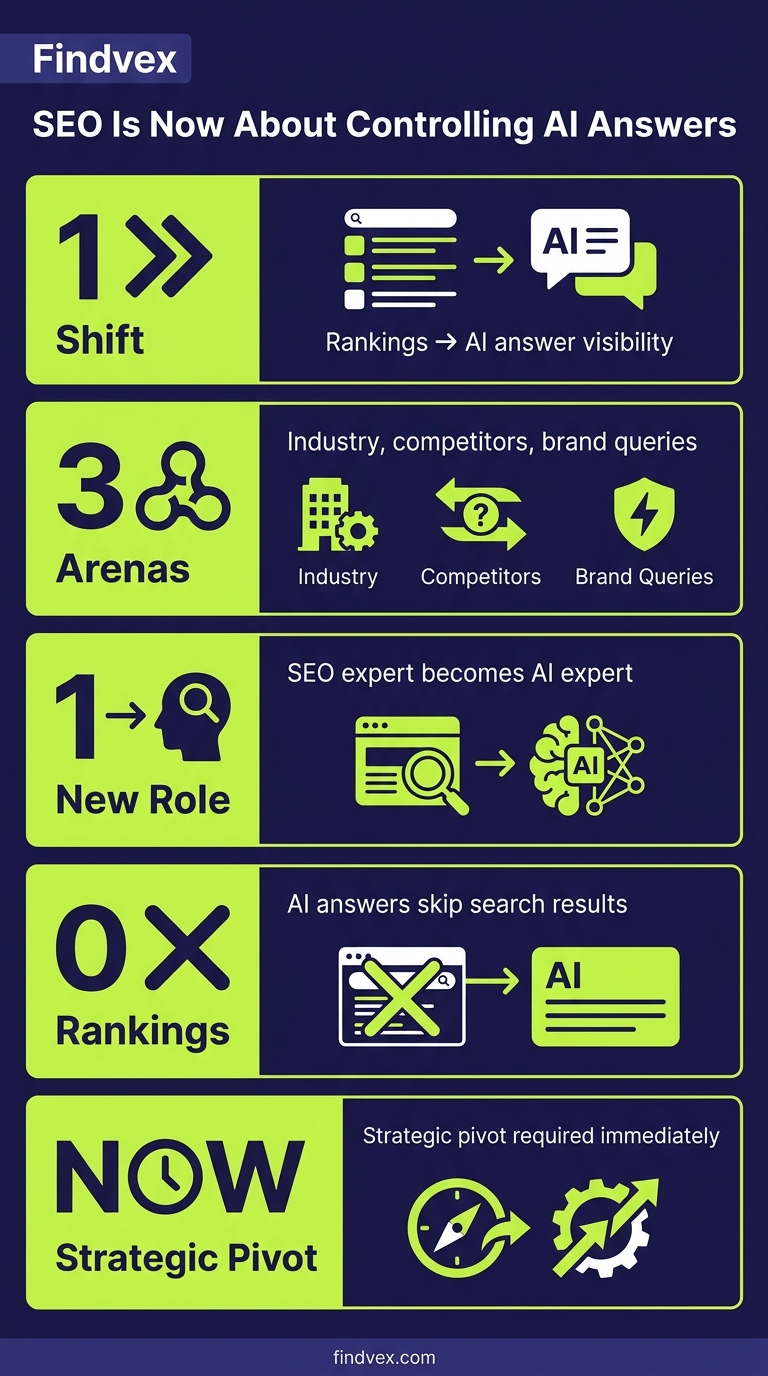
3 Strategies to Control What AI Says About Your Brand
There is no single 'fix' for AI answer accuracy the way there's a fix for a broken canonical tag. What exists is a set of practices that increase the probability that AI models retrieve accurate, favorable, and complete information about your brand. Here's how to approach it strategically.
Strategy 2: Structure Your Content for Machine Extraction, Not Just Human Readers
AI models extract answers by finding dense, clearly structured, unambiguous content. Paragraphs that bury your core claims in qualifications, jargon, or marketing language are harder for language models to parse accurately. The fix is deliberate content architecture.
Concretely, this means leading with direct answers in the first sentence of every key section. It means using structured data (schema markup) to formally declare what your business does, where it operates, and what its credentials are. And it means writing FAQ sections, comparison tables, and step-by-step processes — formats AI systems tend to extract cleanly.
Schema markup for LocalBusiness, FAQPage, and Service types isn't just a technical SEO play anymore. It's a foundational layer of AI-readability. Our guide to the 5 schema types that actually affect small business rankings covers the implementation specifics.
Strategy 3: Track AI Citation Accuracy as a Standing KPI
You can't manage what you don't measure. The new monitoring obligation for SEOs and marketing teams is to query AI platforms regularly — using the same language your customers use — and document what each system says. Is your brand mentioned? Is the information accurate? Are competitors cited instead of you?
This is manual work today, though platforms are emerging to automate it. At minimum, establish a monthly audit: run 10–20 branded and category queries through ChatGPT, Perplexity, and Google's AI Overviews. Log what's returned. Flag inaccuracies. Then trace those inaccuracies back to their source — because most AI errors can be corrected upstream by fixing the source content or citation that the model is drawing from.
If AI systems are skipping your content entirely, the diagnosis framework in our article on why AI search skips your content walks through the technical and structural reasons this happens.
Who This Affects — and How Urgently
The urgency is uneven. If you're running SEO for a consumer brand, a healthcare provider, a financial services firm, or any business where AI is likely to synthesize recommendations in your category, the stakes are high now. If you're a purely transactional e-commerce site, the immediate pressure is lighter — but the trajectory is the same.
For in-house SEO teams, the transition to AI search expert is partly a skills gap and partly an organizational one. You may need to make the case that AI answer monitoring belongs on your dashboard alongside keyword rankings and organic traffic. For agency practitioners, the transition means expanding deliverables: rank tracking plus AI citation audits plus entity consistency reviews.
Small businesses are not exempt. When a local user asks ChatGPT for a plumber, a dentist, or a contractor recommendation, the AI draws on whatever it knows. If you haven't built the content and citation infrastructure to be known accurately, you're invisible or wrong.
Strategic Takeaway: This Is a Reputation Infrastructure Problem
The frame shift I'd offer to any SEO or business owner is this: AI answer accuracy is fundamentally a reputation infrastructure problem, and solving it requires the same deliberateness you'd apply to any infrastructure project. You audit the current state. You identify gaps between what AI says and what's true. You fix the upstream sources. You monitor for drift.
The good news is that the underlying skills — structured content, technical SEO, entity building, citation management — are already in the SEO toolkit. What's new is the monitoring layer and the audience: you're now writing for both human readers and AI retrieval systems simultaneously.
The businesses that move first to build this infrastructure will have a compounding advantage. Every AI model trained on or retrieving from the web will encounter a clear, consistent, accurate signal about what those businesses do and why they're authoritative. The businesses that don't will find themselves either missing from AI answers or — worse — described incorrectly in them.
If you're thinking about how this fits into a broader SEO and GEO strategy for 2026, our 2026 small business SEO strategy guide lays out the full prioritization framework.
Your 30-Day AI Search Accuracy Action Plan
You don't need to overhaul everything at once. Here's a sequenced starting point:
- Week 1 — Audit: Run 15–20 queries about your business category, services, and brand name through ChatGPT, Perplexity, and Google AI Overviews. Document what's returned. Flag omissions and inaccuracies.
- Week 2 — Entity audit: Check your business listings on Yelp, BBB, Google Business Profile, and any industry-specific directories. Ensure name, address, phone, service description, and hours are consistent and current. Use our Google Business Profile audit checklist as a starting framework.
- Week 3 — Content structure review: Audit your top 10 pages for direct, extractable answers. Add FAQ sections. Implement or update LocalBusiness and Service schema markup. Ensure your 'about' and service pages declare your specialization, geography, and credentials clearly.
- Week 4 — Monitoring setup: Establish a recurring calendar event for monthly AI citation audits. Assign ownership. Define what constitutes an 'inaccuracy' worth escalating versus minor variation.
FAQs
What does 'AI answer accuracy' mean for SEO?
AI answer accuracy refers to whether AI-powered search systems — like Google AI Overviews, ChatGPT Search, and Perplexity — correctly describe, mention, and represent your brand when answering user queries. Poor AI accuracy means your business is omitted, misrepresented, or described with outdated information when AI synthesizes answers in your category.
How do I find out what AI models are saying about my business?
Run manual audits. Query ChatGPT, Perplexity, and Google AI Overviews using the same language your customers use — category searches, competitor comparisons, and direct brand queries. Document what's returned, note inaccuracies, and trace them to the source content that AI systems are drawing from.
Can I correct what an AI says about my business?
Not directly — there's no 'Google Search Console for AI answers.' But you can correct the upstream sources. If an AI is misrepresenting your business, it's typically drawing from your own content, third-party listings, or review platforms. Fix the source content, update your citations, and add structured data — AI systems will eventually retrieve the corrected information.
Is this a problem for small businesses, or just large brands?
Both, but the surface area is different. Large brands face AI misrepresentation at scale. Small businesses face the more common problem of AI omission — they simply aren't mentioned when a potential customer asks for a recommendation. Building entity authority and structured content is the fix either way.
What's the difference between GEO and traditional SEO?
Traditional SEO optimizes content for search engine crawlers and ranking algorithms to appear in blue-link search results. Generative Engine Optimization (GEO) optimizes content for AI retrieval systems that synthesize answers rather than list pages. GEO focuses on entity clarity, structured content, citation authority, and answer extractability — not just keyword placement and backlinks.
How long does it take to improve AI citation accuracy?
There's no reliable timeline because each AI system has its own retrieval and training cycles. Changes to your website content may be reflected in real-time retrieval systems like Perplexity within days. Training-data-dependent changes in models like ChatGPT take longer — sometimes months — to propagate. Monitoring regularly is the only way to track progress.
Related reading
- how AI models understand your brand — How AI Models Actually 'Understand' Your Brand — and What to Do When They Get It Wrong
- GEO playbook local search — The 90-Day GEO Playbook for Local Search: How To Show Up When AI Does The Searching
- AI local search visibility — How AI Is Changing Local Search Visibility: What the SOCi + Google Webinar Revealed
- google search update — What Changed in Google Search This Week and What Small Businesses Should Do
- llm seo services — LLM SEO Services: How to Get Cited by ChatGPT, Claude, and Perplexity
- answer engine optimization services — Answer Engine Optimization Services: What Small Businesses Actually Get (and Whether It's Worth Paying For)
- geo services for small business — GEO Services for Small Business: What They Actually Include and Whether They're Worth It
- why ai search skips your content — Why AI Search Skips Your Content: A Technical Diagnosis Framework for Site Owners
- generative engine optimization — What Is Generative Engine Optimization (GEO)? How Small Businesses Get Found in AI Search
- aeo services for small business — AEO Services for Small Business: What You Actually Need (and What to Skip)
Research notes
Background claims used while researching this article. Verify with the cited authorities before quoting.
- The Search Engine Journal on-demand session framing that practitioners now track both SERP rankings and AI accuracy, and that the job description has expanded.
Alex Rivera
CEO & Editorial Strategist · Findvex
Alex Rivera leads editorial strategy at Findvex. He sets the weekly content plan, picks topical pillars, and decides what to publish — and what to skip — based on search intent, competitive data, and what genuinely helps US small businesses rank.
Expertise: Editorial strategy · Topical authority · Content prioritisation · Pillar planning
Related reads
Google TurboQuant and Entity-Driven SEO: What the Compression Breakthrough Actually Means for Your Site
TurboQuant is a vector quantization algorithm from Google Research that dramatically compresses the mathematical representations AI uses to understand meaning. If it reaches production search infrastructure, it could lower the cost of semantic retrieval at scale — making entity-based content signals more dominant and keyword-match signals relatively less important.
SEO NewsHow AI Is Changing Local Search Visibility: What the SOCi + Google Webinar Revealed
Google and SOCi's joint webinar on local search visibility highlighted a fundamental shift: AI-powered discovery across Google Search, Maps, and Gemini now requires a different optimization playbook than the one most small businesses are running. Here's what changed and what to prioritize.
Strategic Technical SEODuplicate Content SEO: What Google Actually Penalizes vs. What It Silently Handles
Duplicate content rarely triggers a manual penalty. Google usually picks one version and ignores the rest. But the wrong choice by Google can split your ranking signals, waste crawl budget, and suppress pages you actually want ranked. Here's how to diagnose the difference.