Answer Engine Optimization Services: What Small Businesses Actually Get (and Whether It's Worth Paying For)
Answer engine optimization services help your business appear in AI-generated answers on ChatGPT, Google AI Overviews, Perplexity, and similar platforms. This article breaks down what AEO agencies actually do, how it differs from traditional SEO and GEO, what small businesses should prioritize first, and how to evaluate whether a service is legitimate.
Quick answer
Answer engine optimization (AEO) services help businesses show up in AI-generated answers on platforms like ChatGPT, Google AI Overviews, Perplexity, and voice assistants. Core deliverables include structured content creation, schema markup implementation, FAQ and Q&A page development, entity authority building, and citation monitoring. For most small businesses, AEO is worth investing in once traditional local SEO and on-page fundamentals are solid — not before.
What Answer Engine Optimization Services Actually Are
Answer engine optimization (AEO) is the practice of structuring your content and online presence so that AI platforms — Google AI Overviews, ChatGPT, Perplexity, Claude, Bing Copilot, and voice assistants like Siri — cite your business when a user asks a relevant question.
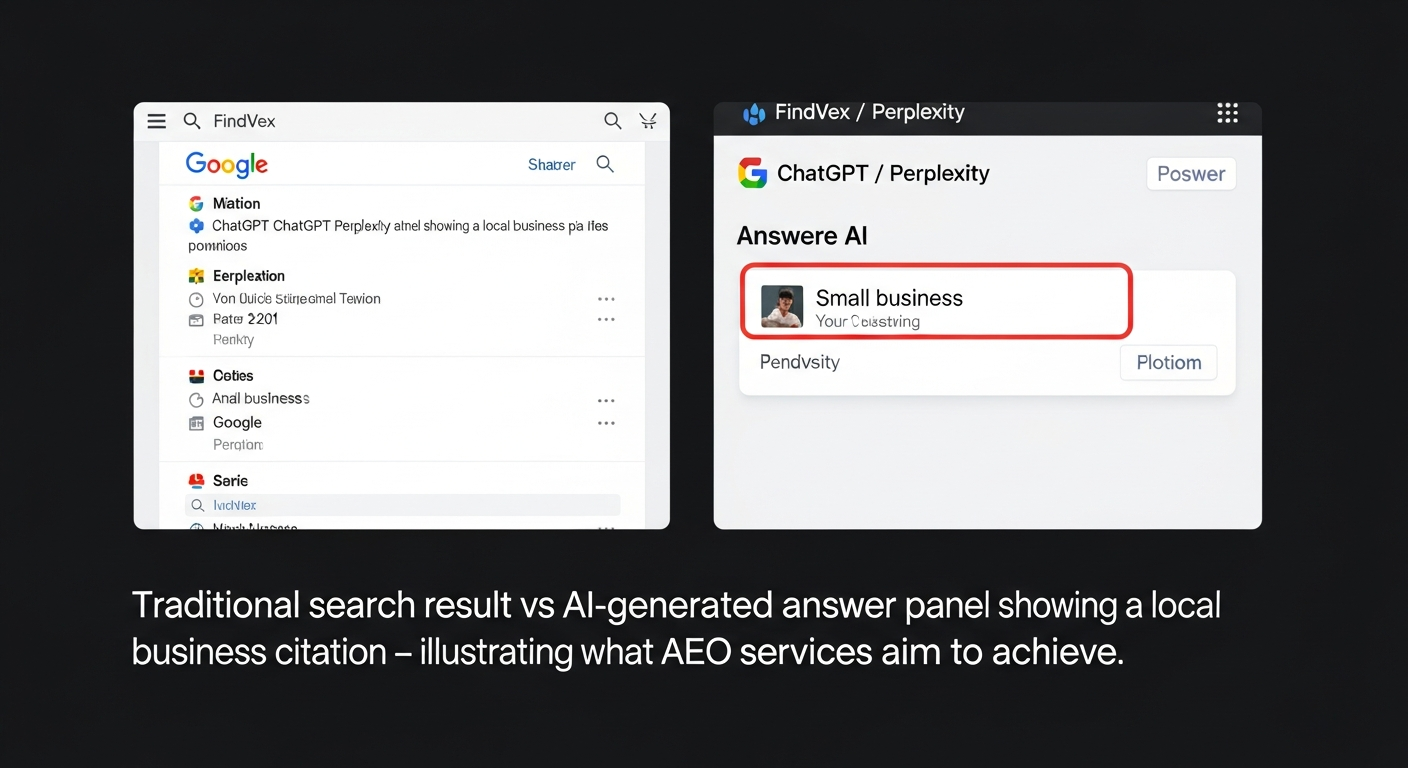
Traditional SEO gets you onto a search results page. AEO gets you into the answer itself — the synthesized response that an AI constructs before the user ever clicks a link. That's a fundamentally different placement, and it requires a different approach.
When someone asks ChatGPT 'what's the best HVAC company in Denver?' or Perplexity 'which plumber in Austin handles emergency calls?', the AI doesn't run a keyword match. It draws on its training data and, increasingly, live web results. AEO services work to make your business the source that gets pulled into that response.
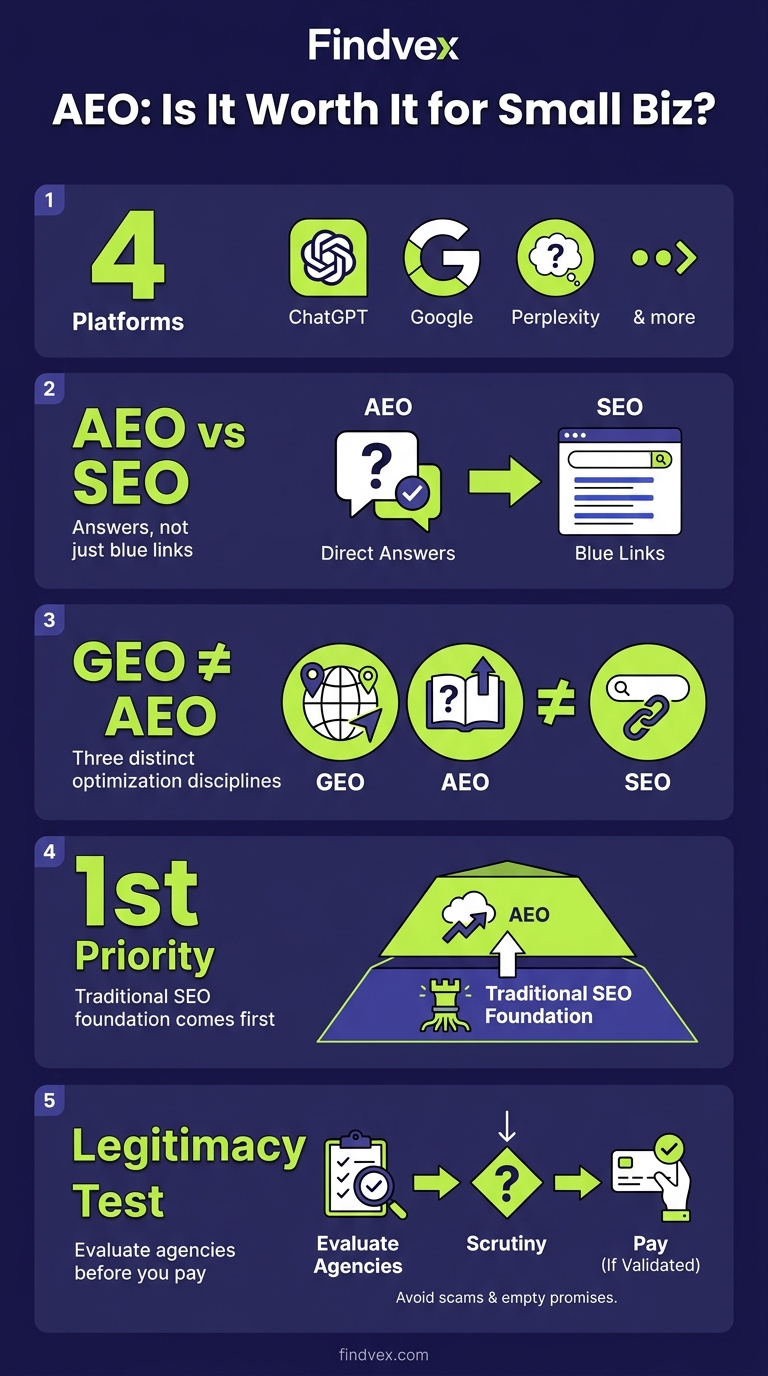
Important distinction: AEO services and GEO (generative engine optimization) services overlap significantly — so much so that many agencies use the terms interchangeably. Where a distinction exists, AEO tends to focus on structured Q&A content and direct-answer formats, while GEO has a broader scope that includes citation signals and entity authority across LLMs. If you're comparing vendors, ask exactly what each term means in their service package.
AEO vs. SEO vs. GEO: How They Fit Together for Small Businesses
These three aren't competing strategies — they're layers. Here's how to think about them in plain terms:
- SEO optimizes for traditional Google search rankings: organic blue links, local pack, featured snippets. Foundation layer. Without it, nothing else works well.
- AEO optimizes for direct-answer placements: AI Overviews, voice search responses, chatbot citations. Builds on top of solid SEO.
- GEO (Generative Engine Optimization) optimizes for citation and mention in long-form AI outputs across LLMs like ChatGPT and Claude. Overlaps heavily with AEO; some agencies treat them as the same thing.
- For a local plumber or dental practice, SEO still drives the majority of trackable leads. AEO and GEO become increasingly relevant as more users start queries in AI assistants rather than the Google search bar — but that shift is still developing, not complete.
- The practical takeaway: don't pay for AEO services if your Google Business Profile is incomplete, your site has indexing problems, or you haven't built basic local SEO. Fix the foundation first. AEO amplifies what's already working — it doesn't substitute for it.
“AI agents do in hours what teams used to do in weeks. The advantage compounds.”
What AEO Services Actually Include (Deliverable by Deliverable)
When you hire an AEO agency or add AEO to a retainer, here's what the legitimate work looks like. Any agency that can't explain their deliverables at this level of specificity is a red flag.
- Q&A content development: Writing FAQ pages, blog posts structured as direct questions and answers, and 'best answer' content blocks that match the query patterns AI platforms are trained to surface. This is the core of AEO work.
- Schema markup implementation: Adding FAQ schema, HowTo schema, LocalBusiness schema, and Speakable schema to relevant pages so that structured data signals are readable by both Google and AI crawlers. See our guide on schema markup types that actually affect rankings.
- Entity optimization: Making sure your business name, address, categories, and key attributes appear consistently across your website, Google Business Profile, Bing Places, Apple Maps, Yelp, and industry directories. AI models use this consistency to confirm your entity.
- Content restructuring for answer formats: Rewriting existing content so it leads with a direct answer in the first paragraph, uses clear H2/H3 headings phrased as questions, and includes concise summary sentences that AI can extract without distortion.
- Citation and mention monitoring: Tracking whether your business is being cited in ChatGPT, Perplexity, and Google AI Overviews for target queries. Tools like Profound, Brandwatch, or manual prompt testing are typically used.
- Authority signal building: Earning mentions in well-indexed third-party publications, getting your business listed in topically relevant directories, and building a backlink and citation profile that AI models can cross-reference when generating answers.
- AI crawler access review: Ensuring that GPTBot, OAI-SearchBot, and other AI crawlers aren't accidentally blocked in your robots.txt file. A blocked crawler can't index your content for AI-generated answers.
What Actually Moves the Needle for Small Business AEO
Not everything in an AEO service package will produce equal results for a small business. Here's where the real leverage is, based on how AI platforms surface local and service-based businesses.
- FAQ pages with specific, local answers — not generic industry content. 'What's the average cost of a dental crown in Phoenix?' outperforms 'How much does a dental crown cost?' because it matches how local queries actually get phrased in AI assistants.
- Google Business Profile completeness — AI Overviews for local queries frequently pull from GBP data. Every category, service, attribute, and photo slot should be filled. This is table-stakes AEO for local businesses.
- Consistent NAP data across the web — Name, address, phone number. Inconsistencies confuse AI models trying to confirm your entity. An AEO agency should audit and clean this as a first step.
- Structured 'about us' and 'services' pages — AI models synthesize business descriptions. Pages that clearly state what you do, who you serve, and where you serve them in plain, direct language are more likely to get surfaced accurately.
- Third-party mentions on indexed sites — A mention in a local news article, a regional business journal, or a niche directory carries more weight in AI citation than a mention on your own site. Link building and digital PR are part of real AEO work.
Red Flags When Evaluating AEO Service Providers
This space is new enough that there's no shortage of agencies that have rebranded existing content services as 'AEO' without changing much. Here's how to tell the difference between a vendor doing real work and one selling a label.
- No monitoring deliverable: If an agency can't show you how they'll track whether you're appearing in AI-generated answers, they're not doing AEO — they're doing content with a new name.
- Guaranteed AI citations: No one can guarantee a placement in ChatGPT or Perplexity. These are probabilistic systems. Any guarantee is a red flag.
- No mention of schema or structured data: Schema markup is foundational to AEO. An agency that doesn't include it in their scope hasn't thought through the technical layer.
- Selling AEO as a replacement for SEO: AEO builds on SEO. A vendor positioning them as either/or either doesn't understand the space or is trying to up-sell you out of a working strategy.
- Can't show you prompt testing results: Ask to see how they manually test whether a business is being cited in AI platforms. If they don't have a process for this, they're not measuring outcomes.
What AEO Services Cost and What to Expect at Different Budget Levels
AEO services are typically sold as a standalone retainer, an add-on to an existing SEO package, or a one-time project. Pricing varies significantly by agency size and scope. The figures below are general market observations — not guarantees of what any specific vendor charges.
At the lower end of the market (roughly $500–$1,500/month), you're typically getting templated FAQ content, basic schema implementation, and quarterly reporting. This can be useful for businesses just starting out, but the monitoring and citation tracking is often minimal.
Mid-market engagements ($1,500–$4,000/month) typically include custom content development, entity-focused link building, GBP optimization, AI citation monitoring via dedicated tools, and monthly reporting with prompt-test screenshots.
Higher-tier AEO work ($4,000+/month) — more common in enterprise or competitive B2B contexts — includes original research, digital PR outreach for third-party citations, technical structured data audits, and multi-platform monitoring across ChatGPT, Perplexity, AI Overviews, and voice.
For most small businesses with a budget under $2,000/month, the most cost-effective move is to ensure your existing SEO retainer includes AEO fundamentals — structured content, schema, entity consistency — rather than hiring a separate AEO-only agency.
Do This This Week: Your AEO Starting Checklist
You don't need to hire an agency to start building AEO fundamentals. Here's what you can do right now — before you spend a dollar on AEO services:
- Run your own prompt tests: Open ChatGPT, Perplexity, and Google AI Overviews. Ask '[service] in [your city]' and variations. Note whether your business appears, and if competitors do. This is your baseline.
- Check your robots.txt file: Make sure GPTBot and OAI-SearchBot aren't blocked. Visit yourdomain.com/robots.txt and look for Disallow rules that reference these crawlers.
- Complete your Google Business Profile: Every field, every service, every category. This is the fastest single win for local AEO.
- Add FAQ schema to your top 3 pages: If you're on WordPress, plugins like Rank Math or Yoast make this straightforward. Prioritize your homepage, main service page, and a high-traffic blog post.
- Write one FAQ page this week: Pick the five most common questions your customers ask before booking. Answer each one in 2–4 sentences, directly and specifically. Publish it as a dedicated page, not buried in a blog post.
- Audit your NAP consistency: Search your business name on Google. Check that your name, address, and phone number match exactly across your website, GBP, Yelp, and any directory listings.
How AEO Affects Leads, Not Just Visibility
Here's the honest answer on what AEO actually does for your revenue pipeline: it changes where in the buyer journey you get found.
Traditional SEO puts you in front of someone actively searching. AEO puts you in front of someone asking a question — often an earlier, more exploratory stage. That means AEO-driven visits often have higher educational intent and lower immediate purchase intent than someone clicking a 'plumber near me' search result.
The exception is AI-driven local queries with clear intent: 'best emergency plumber open now in Chicago' or 'highly rated dentist accepting new patients in Austin.' When AI surfaces a specific business in response to that kind of query, the click — if there is one — has strong conversion potential.
The practical implication: track AEO outcomes separately from traditional SEO. Monitor branded search volume (a proxy for AI-driven awareness), direct traffic, and 'how did you hear about us?' responses over time. Don't expect AEO to replace your local pack traffic in the short term — expect it to supplement it as AI query volume grows.
For businesses in competitive service categories where comparison queries are common ('who's the best accountant for small businesses in Seattle?'), AEO can become a genuine lead driver — especially as younger demographics increasingly start product and service research in ChatGPT rather than Google.
FAQs
What is answer engine optimization (AEO)?
Answer engine optimization (AEO) is the process of structuring your content and online presence so that AI platforms — including Google AI Overviews, ChatGPT, Perplexity, and voice assistants — cite your business or content when users ask relevant questions. It differs from traditional SEO in that the goal is placement within an AI-generated answer, not just a link on a results page.
How is AEO different from SEO and GEO?
SEO optimizes for traditional search engine rankings and organic clicks. AEO focuses specifically on getting your business cited in direct AI-generated answers. GEO (generative engine optimization) overlaps significantly with AEO and is used by many agencies interchangeably — both aim for citation in LLM outputs. SEO is the foundation; AEO and GEO build on top of it.
Should a small business invest in AEO before fixing its basic SEO?
No. AEO amplifies what's already working. If your Google Business Profile is incomplete, your site has indexing issues, or you don't have solid on-page SEO, those problems will limit AEO results too. Fix the foundation first — then layer in AEO work.
How do I know if my business is appearing in AI-generated answers?
Manual prompt testing is the most direct method. Search for your service and city in ChatGPT, Perplexity, and Google AI Overviews using the kinds of questions your customers would ask. Paid tools like Profound can automate this monitoring at scale, but manual testing is free and gives you an immediate baseline.
Can any agency guarantee my business will appear in ChatGPT or AI Overviews?
No. AI citations are probabilistic — no agency can guarantee a specific placement in ChatGPT, Perplexity, or Google AI Overviews. Any vendor making that guarantee should be treated with skepticism. What legitimate AEO work can do is improve the probability of citation by building the right signals.
What's the most important thing a local business can do for AEO right now?
Complete your Google Business Profile fully, publish a dedicated FAQ page with direct answers to your customers' most common questions, add FAQ schema markup to key pages, and make sure AI crawlers like GPTBot aren't blocked in your robots.txt. These four steps form the practical foundation of local AEO.
How much do AEO services cost for small businesses?
AEO services range widely. Entry-level packages with basic FAQ content and schema run roughly $500–$1,500/month. Mid-market engagements with custom content, citation monitoring, and entity-building run $1,500–$4,000/month. For most small businesses, the most cost-effective approach is ensuring AEO fundamentals are included in an existing SEO retainer rather than hiring a separate AEO-only vendor.
Related reading
- geo services for small business — GEO Services for Small Business: What They Actually Include and Whether They're Worth It
- aeo services for small business — AEO Services for Small Business: What You Actually Need (and What to Skip)
- generative engine optimization services — Generative Engine Optimization Services: What Small Businesses Actually Get (and What to Ask For)
- llm seo services — LLM SEO Services: How to Get Cited by ChatGPT, Claude, and Perplexity
- ai seo agency — What to Expect from a Modern AI SEO Agency (And Red Flags to Watch)
- google business profile optimization services — Google Business Profile Optimization Services: What Local Businesses Actually Get (and What Moves the Needle)
- generative engine optimization — What Is Generative Engine Optimization (GEO)? How Small Businesses Get Found in AI Search
- seo services for small business — SEO Services for Small Business: What You're Actually Buying (and What Moves the Needle)
- GEO playbook local search — The 90-Day GEO Playbook for Local Search: How To Show Up When AI Does The Searching
- clinic seo services — Clinic SEO: How to Rank for "Doctor Near Me" Searches
Research notes
Background claims used while researching this article. Verify with the cited authorities before quoting.
- AI search traffic has grown significantly and has potential to surpass traditional search by a certain date
- Pricing ranges for AEO services ($500–$4,000+/month)
Sofia Patel
Head of Content & Growth · Findvex
Sofia Patel leads content and growth at Findvex. She writes about local SEO, conversion-focused content, and AEO/GEO strategy — the work that turns search visibility into booked calls and qualified leads for service businesses.
Expertise: Local SEO · Conversion content · AEO / GEO strategy · Content-led link building
Related reads
Google TurboQuant and Entity-Driven SEO: What the Compression Breakthrough Actually Means for Your Site
TurboQuant is a vector quantization algorithm from Google Research that dramatically compresses the mathematical representations AI uses to understand meaning. If it reaches production search infrastructure, it could lower the cost of semantic retrieval at scale — making entity-based content signals more dominant and keyword-match signals relatively less important.
SEO NewsHow AI Is Changing Local Search Visibility: What the SOCi + Google Webinar Revealed
Google and SOCi's joint webinar on local search visibility highlighted a fundamental shift: AI-powered discovery across Google Search, Maps, and Gemini now requires a different optimization playbook than the one most small businesses are running. Here's what changed and what to prioritize.
Strategic Technical SEODuplicate Content SEO: What Google Actually Penalizes vs. What It Silently Handles
Duplicate content rarely triggers a manual penalty. Google usually picks one version and ignores the rest. But the wrong choice by Google can split your ranking signals, waste crawl budget, and suppress pages you actually want ranked. Here's how to diagnose the difference.