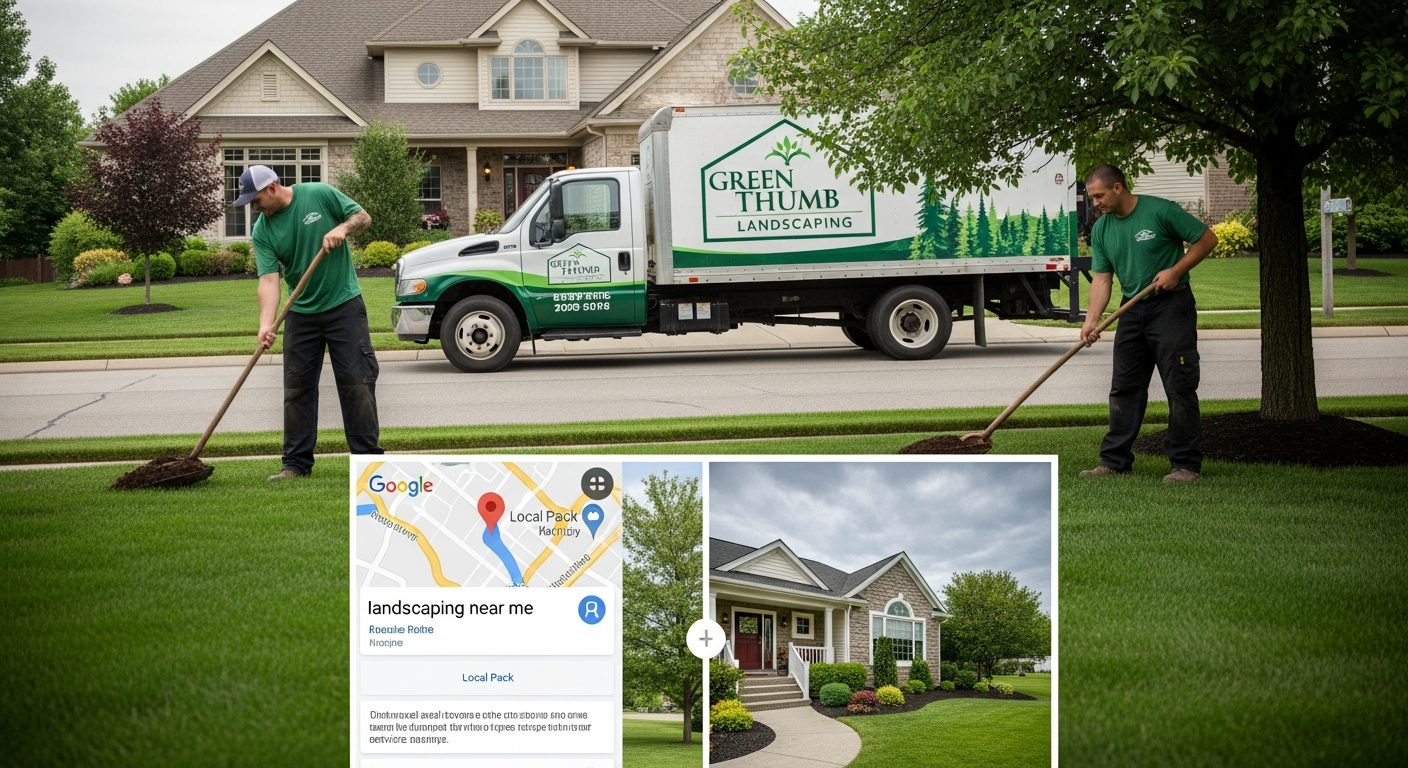
Landscaping SEO: How to Fill Your Schedule Without Paying for Every Lead
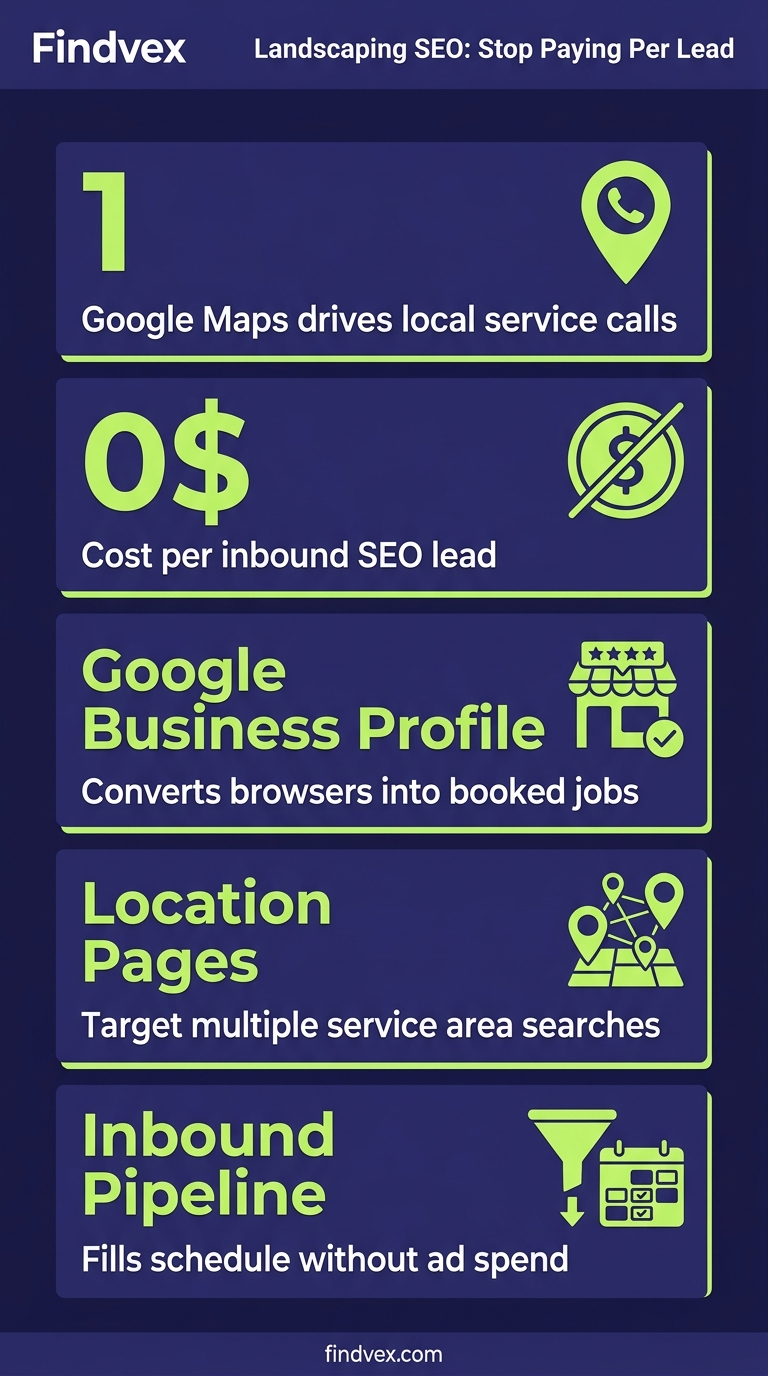
Landscaping SEO builds a pipeline of inbound calls and quote requests without paying a platform for every lead. The key: dominate Google Maps for local service searches, build location-specific pages, and maintain a Google Business Profile that converts browsers into booked jobs.
Quick answer
Landscaping SEO works by optimizing your Google Business Profile, building service-area landing pages, and earning local citations so that homeowners searching 'landscaping near me' or 'lawn care [city]' find your business before your competitors — and contact you directly instead of through a paid lead marketplace.
Why Landscaping Companies Bleed Money on Lead Platforms
If you've ever paid for a lead only to discover two other landscapers got the same name and phone number, you already know the problem. Lead aggregators like Angi and HomeAdvisor are built to monetize your customer, not build your business. Every job that comes through a paid platform costs you margin twice: once on the lead fee, and once because the customer has no loyalty to you specifically.
Landscaping SEO changes the math. When a homeowner in your service area types 'lawn care company near me' or 'landscaping contractor [your city]' into Google and calls you directly from a search result, that lead costs you nothing per call. The investment goes into your website and Google presence once — and it keeps working every season.
The companies filling their schedules with inbound calls aren't necessarily the best landscapers in town. They're the ones Google trusts enough to show first. That's an achievable position, and this article explains exactly how to get there.
How Landscaping SEO Actually Works (The Short Version)
Search engine optimization for landscaping companies is almost entirely local SEO. Very few customers drive 40 miles for a lawn care service. They search with location intent — 'landscaping company in [city]' or 'lawn maintenance near me' — and Google returns results it believes are nearby, relevant, and trustworthy.
Three things determine whether you appear in those results: your Google Business Profile (which controls your Maps/Local Pack placement), your website's on-page signals (which control organic rankings below the map), and your local authority (citations, reviews, and links that tell Google you're a real, established business in that area).
When all three align, your phone rings without a middleman taking a cut.
“AI agents do in hours what teams used to do in weeks. The advantage compounds.”
Your Google Business Profile: The Single Highest-ROI Asset in Landscaping SEO
For most landscaping searches on mobile, the Google Map Pack — the three businesses with map pins at the top of results — gets the majority of clicks. If you're not in that pack, you're invisible to the customers most ready to book.
Getting into the Local Pack starts with your Google Business Profile (GBP). Most landscapers have one set up, but very few have it properly optimized. Here's what actually moves the needle.
- Choose the right primary category. For most landscaping companies, 'Landscaper' is correct. If you focus heavily on lawn maintenance, 'Lawn Care Service' may be more relevant. You can add secondary categories (Landscape Designer, Irrigation Service, Snow Removal Service) to capture additional query types.
- Write a description that includes your services and your main service cities — not just a generic paragraph about caring for customers.
- Upload photos consistently. Before-and-after project photos, photos of your crew and trucks, and seasonal photos of completed work all signal an active, credible business. Google rewards profile activity.
- Respond to every review, positive and negative. Review velocity and response rate are ranking factors. A landscaper with 80 reviews and a consistent response pattern will outrank a competitor with 150 reviews and zero responses.
- Use the Posts feature to announce seasonal services (spring clean-ups, fall aeration, snow contracts). This signals freshness to Google and gives potential customers a reason to call now.
- Set your service area correctly. Don't list every city in the state — be accurate and specific to the areas you actually serve. Google cross-references your service area with the locations of your reviewers and the addresses on your website.
Reviews: The Ranking Factor Most Landscapers Ignore Until Spring Rush
Google uses review quantity, recency, rating, and keyword content as local ranking signals. A landscaping company with fresh reviews that mention specific services ('great job on the sod installation,' 'best lawn aeration in [city]') ranks higher than one with the same star rating but no recent activity.
Build a post-job review request into your operations. The best time to ask is immediately after completing a job — when the customer is looking at clean beds and fresh edging. A simple text message with a direct link to your Google review page converts far better than an email three days later.
Don't ask for reviews in bulk. Steady accumulation over time looks more natural to Google than 20 reviews in one week followed by nothing for months.
One more thing: negative reviews don't destroy your ranking if they're rare and you respond professionally. A measured, solution-oriented response to a 1-star review often converts hesitant customers better than five more 5-star reviews.
Website SEO for Landscaping Companies: What Your Site Needs to Rank
Your website does two jobs: it tells Google what you do and where you do it, and it convinces a homeowner to call you instead of closing the tab. Most landscaping websites fail at both.
Here's the structure that works.
Dedicated Service Pages (Not One Big 'Services' Page)
Every core service should have its own page: lawn maintenance, landscape design, hardscaping, irrigation installation, fall clean-ups, snow removal, etc. A single page listing all services dilutes your relevance for any one query.
Each service page should include: the service name and location in the H1 and title tag, a description of what the service includes, the areas you serve, pricing context if you're comfortable sharing it (even a range builds trust), and a clear call-to-action to get a quote.
This is where most landscaping websites leave ranking opportunity on the table. If 'hardscape patio installation [city]' has meaningful search volume in your market and you have zero dedicated content for it, you will not rank for it — regardless of how good your GBP is.
Location Pages That Actually Rank
If you serve multiple cities or neighborhoods, build a page for each one. A page titled 'Landscaping Services in [City, State]' that includes local landmarks, neighborhood-specific project references, and a city-specific testimonial is worth far more than a contact page listing 12 town names.
The key is making each page genuinely different. Google penalizes 'doorway pages' — thin location pages with swapped city names and identical content. Write at least 300 words of unique, useful content per city page. Mention the type of soil common in the area, local seasonal timing, or a specific neighborhood where you've done notable work.
For a deeper look at how to build location pages that rank without thin content, see our guide to local landing pages that rank without sounding generic.
On-Page Essentials: What Every Page Needs
You don't need to be an SEO expert to get the basics right. Run through this checklist for every key page on your site.
- Title tag includes primary keyword and location (e.g., 'Lawn Care Services in Austin, TX | [Company Name]')
- H1 matches or closely mirrors the title tag topic
- Meta description is unique, written for humans, and includes a call-to-action
- NAP (Name, Address, Phone) is consistent with your GBP listing — exact match, not close
- At least one image with descriptive alt text referencing the service and city
- A clickable phone number and a quote request form on every service page
- Internal links from blog posts and location pages back to your core service pages
Which Keywords to Target for Landscaping SEO
The highest-converting keywords for landscaping companies are service + location queries. These are searches made by people who already know what they want and need someone in their area.
Examples with strong commercial intent:
Beyond the obvious queries, don't overlook seasonal and problem-based searches. Homeowners searching 'why is my lawn turning yellow' or 'how much does sod installation cost' are in the early research phase. A helpful blog post capturing those searchers builds trust before they're ready to buy — and your company is who they call when they are.
To find the specific keywords your competitors rank for that you don't, the fastest method is a simple gap analysis. Our guide on finding competitor keyword gaps without wasting budget walks through this in about 30 minutes.
- 'landscaping company [city, state]'
- 'lawn care service near me'
- 'landscape design [city]'
- 'fall yard clean-up [city]'
- 'sod installation [city]'
- 'irrigation system installation [city]'
- 'hardscape contractor [city]'
Schema Markup for Landscaping Websites
Schema markup is structured data you add to your website's code that helps Google understand exactly what your business does. For a landscaping company, the most valuable schema types are LocalBusiness (or the more specific LandscapeService type), Service, Review, and FAQPage.
Adding LocalBusiness schema with your correct NAP, service area, and opening hours directly supports your local rankings and makes your business eligible for rich results in Google Search. This takes about 30 minutes to implement and most website platforms support it via a plugin or a simple code block.
For a full breakdown of which schema types actually move the needle for small businesses, see our guide to schema markup for small business websites.
Content Strategy That Fills Your Calendar in the Off-Season
The smartest landscaping companies use SEO content to generate leads year-round, not just during peak season. Blog content that captures homeowners in the research phase — before they start calling around — builds a pipeline that doesn't dry up in October.
Topics that convert for landscaping companies:
Each piece of content should end with a specific CTA: not 'contact us,' but 'Get a free estimate for spring clean-ups in [your city] — we're booking now.' Specificity drives action.
Content also builds the topical authority that helps your service pages rank. Google rewards sites that demonstrate expertise in a subject area. A landscaping company with 15 well-written articles about lawn care, planting, and hardscaping will outrank a competitor with a 5-page brochure site — assuming the on-page basics are solid.
- 'How much does landscaping cost in [city]?' (high commercial intent, drives quote requests)
- 'Best grass types for [region]'
- 'When to overseed your lawn in [state]'
- 'Landscaping ideas for small yards in [city]'
- 'How to prepare your garden for winter in [city]'
- 'Signs you need a new irrigation system'
Turning Search Traffic Into Booked Jobs
Rankings and traffic mean nothing if visitors don't convert. A landscaping website needs one job: make it easy for someone to request a quote or call you right now.
The conversion elements that matter most for landscaping sites:
If you want to understand the full funnel from search click to booked appointment, our article on how local SEO turns website traffic into booked calls covers this in detail.
- Click-to-call phone number visible in the header on mobile (tapping a number should dial immediately)
- A quote request form on every service page — not just the contact page
- Response time commitment displayed prominently ('We respond to all inquiries within 2 business hours')
- Before-and-after project photos on service pages (not just in a gallery)
- Google review stars visible on the homepage and key service pages
- Clear service area statement so visitors know immediately whether you serve their zip code
Do This Week: Your Landscaping SEO Action Plan
You don't need to do everything at once. This is the order that generates the fastest return.
- Day 1 — Audit your Google Business Profile: Check that your primary category, service area, hours, and photos are complete and current. Add at least 5 new project photos.
- Day 2 — Fix your NAP consistency: Search your business name on Google and check that your name, address, and phone number are identical across your website, GBP, Yelp, Angi, and Houzz.
- Day 3 — Set up a review request system: Create a short text message template with a direct link to your GBP review page. Send it to your last 10 completed jobs manually, then build it into your post-job workflow.
- Day 4 — Audit your website's service pages: Do you have a dedicated page for each core service? If not, create the one for your highest-revenue service first.
- Day 5 — Identify one location page to add: Pick the city in your service area where you want more work. Build a 400-word page about your services in that specific area.
- Week 2 — Write one piece of content: Choose a question your customers ask repeatedly ('How much does lawn care cost in [your city]?') and write a helpful, specific answer as a blog post.
3 Landscaping SEO Mistakes That Cost You Leads Every Month
- Listing your home address on your GBP when you're a service-area business. If you don't have a commercial location customers visit, use Google's service-area-only setting. Listing a home address can create confusion and citation inconsistencies.
- Having a site that loads slowly on mobile. Most landscaping searches happen on a phone. A site that takes more than 3 seconds to load loses a significant share of mobile visitors before they even see your services. Run your site through Google's PageSpeed Insights and fix the top flagged issues.
- Ignoring seasonal keyword shifts. The searches that fill your calendar in March ('spring lawn clean-up near me') are different from September ('fall aeration service [city]'). Update your GBP posts and on-page content to match what customers are searching right now.
How Long Does Landscaping SEO Take to Work?
GBP optimizations and review accumulation can show results in 4–8 weeks, especially if you're fixing clear gaps (missing category, sparse reviews, no photos). Organic website rankings typically take 3–6 months to meaningfully improve for competitive keywords in established markets.
The most important mindset shift: SEO is not a campaign with a start and end date. It's infrastructure. Every service page you build, every review you earn, and every citation you clean up compounds. A landscaping company that commits to 6 months of consistent SEO work generally outranks a competitor paying $50–$100 per lead indefinitely — and the organic leads are exclusively theirs.
FAQs
How much does landscaping SEO cost?
It depends on whether you do it yourself or hire an agency. DIY SEO (your time plus a few low-cost tools) can cost under $100/month. An SEO agency or consultant focused on local service businesses typically charges $500–$2,000/month depending on market competitiveness and scope. The key question isn't the monthly cost — it's the cost per lead compared to what you're paying on Angi or HomeAdvisor. Organic leads from SEO have no per-lead fee once rankings are established.
Should I focus on Google Maps or organic search results for my landscaping company?
Both, but Google Maps (the Local Pack) first. For high-intent searches like 'landscaping near me' or 'lawn care [city],' the map pack appears above organic results and captures the majority of clicks. Your Google Business Profile drives Local Pack placement. Organic results matter more for informational content and less competitive long-tail keywords. A strong GBP and a well-structured website address both.
Can a landscaping company rank in multiple cities?
Yes, but you need dedicated content for each city. Build a separate service-area landing page for each target city with unique, locally-relevant content. Don't copy the same page and swap city names — Google treats those as thin content. You can rank organically in multiple cities this way, though your GBP placement will be strongest in your primary service area.
How important are reviews for landscaping SEO?
Very important. Review quantity, recency, and content (whether reviewers mention specific services and locations) are all local ranking signals. A consistent flow of new reviews — even 2–3 per month — will outperform a company that collected 50 reviews two years ago and hasn't received one since. Build a post-job review request into your standard workflow.
Do I need a blog for my landscaping website?
Not immediately, but eventually yes. Your highest priority is getting your service pages and GBP right. Once those are in place, a blog helps you capture homeowners in the research phase, build topical authority, and rank for lower-competition long-tail keywords. Even 6–8 well-written posts per year about seasonal lawn care topics in your region can meaningfully expand your organic traffic.
What's the difference between landscaping SEO and paying for Google Ads?
Google Ads puts you at the top of search results immediately, but you pay for every click and the traffic stops the moment your budget runs out. SEO builds rankings that don't require per-click fees and compound over time. Most successful landscaping companies use both: Ads to generate leads in year one while SEO builds, then rely increasingly on organic as rankings improve.
Will AI search (ChatGPT, Google AI Overviews) affect landscaping lead generation?
For hyper-local, high-intent searches like 'landscaping contractor near me,' traditional Google Maps results still dominate. AI Overviews are more common for informational queries. That said, being cited in AI answers builds brand awareness, and the technical SEO foundation that helps you rank on Google also helps AI systems recognize your business as a credible local provider. The basics haven't changed.
Related reading
- roofing seo — Roofing SEO: How to Rank in the Local Pack Before Storm Season Hits
- schema markup for small business — Schema Markup for Small Business Websites: The 5 Types That Actually Affect Your Rankings
- plumber seo services — Plumber SEO Services: How to Get More Local Calls Without Paying Per Lead
- restaurant seo — Restaurant SEO: How to Rank for Local Dining Searches
- real estate seo — Real Estate SEO: How Local Agents Win Search in 2026
- local seo services — How Local SEO Turns Website Traffic Into Booked Calls
- seo for dentists — SEO for Dentists: A Practical Playbook for More Local Patients
- AI local search visibility — How AI Is Changing Local Search Visibility: What the SOCi + Google Webinar Revealed
- local landing pages seo — Local Landing Pages That Rank Without Sounding Generic
- clinic seo services — Clinic SEO: How to Rank for "Doctor Near Me" Searches
Research notes
Background claims used while researching this article. Verify with the cited authorities before quoting.
- The Local Pack captures the majority of clicks for local service searches on mobile
- Review velocity and response rate are ranking factors in Google's local algorithm
- A site that takes more than 3 seconds to load loses a significant share of mobile visitors
Sofia Patel
Head of Content & Growth · Findvex
Sofia Patel leads content and growth at Findvex. She writes about local SEO, conversion-focused content, and AEO/GEO strategy — the work that turns search visibility into booked calls and qualified leads for service businesses.
Expertise: Local SEO · Conversion content · AEO / GEO strategy · Content-led link building
Related reads
Google TurboQuant and Entity-Driven SEO: What the Compression Breakthrough Actually Means for Your Site
TurboQuant is a vector quantization algorithm from Google Research that dramatically compresses the mathematical representations AI uses to understand meaning. If it reaches production search infrastructure, it could lower the cost of semantic retrieval at scale — making entity-based content signals more dominant and keyword-match signals relatively less important.
SEO NewsHow AI Is Changing Local Search Visibility: What the SOCi + Google Webinar Revealed
Google and SOCi's joint webinar on local search visibility highlighted a fundamental shift: AI-powered discovery across Google Search, Maps, and Gemini now requires a different optimization playbook than the one most small businesses are running. Here's what changed and what to prioritize.
Strategic Technical SEODuplicate Content SEO: What Google Actually Penalizes vs. What It Silently Handles
Duplicate content rarely triggers a manual penalty. Google usually picks one version and ignores the rest. But the wrong choice by Google can split your ranking signals, waste crawl budget, and suppress pages you actually want ranked. Here's how to diagnose the difference.