Plumber SEO Services: How to Get More Local Calls Without Paying Per Lead
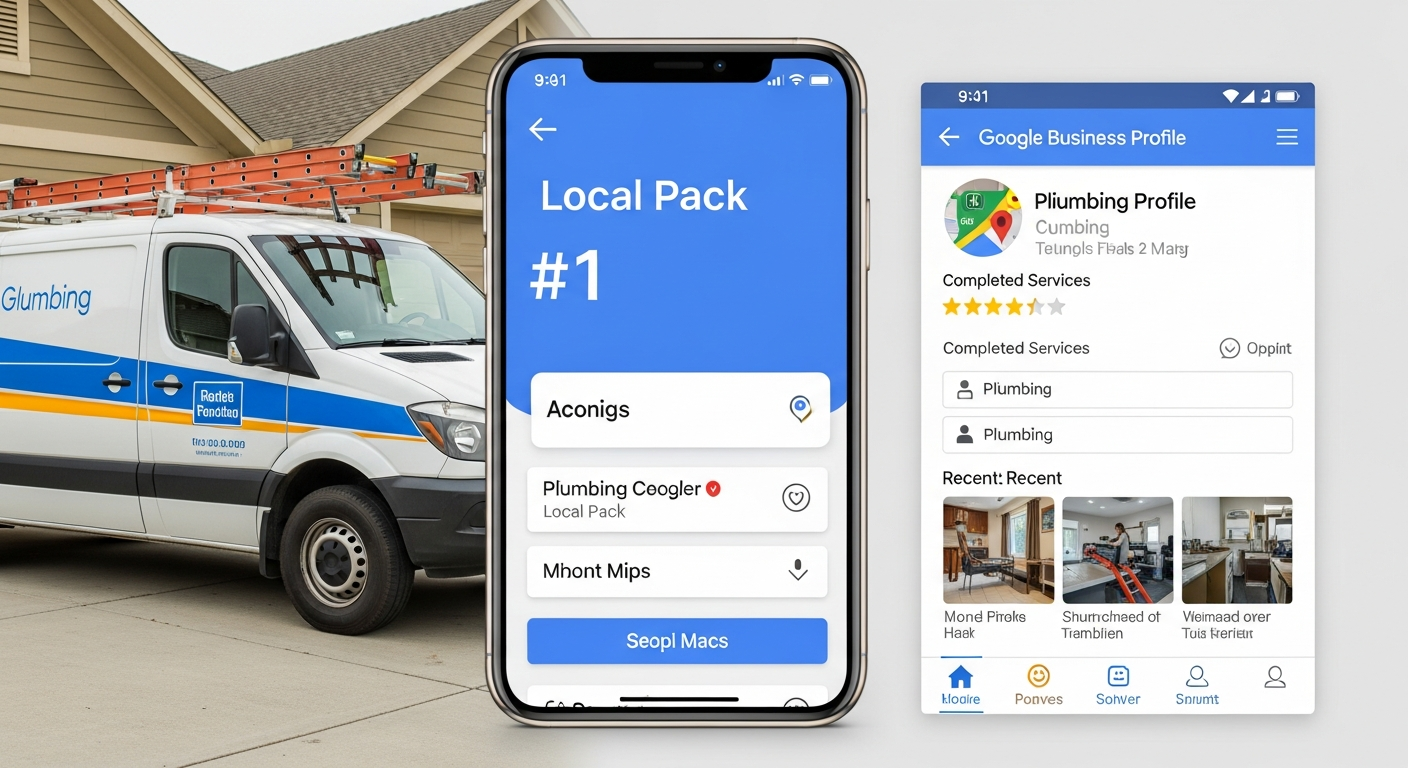
Plumber SEO services help local plumbing businesses rank on Google Maps, dominate 'plumber near me' searches, and turn organic traffic into booked service calls — without paying per lead to HomeAdvisor or Angi.
Quick answer
Plumber SEO services optimize your Google Business Profile, website, and local citations so your plumbing company appears in the Google Maps local pack and organic results when someone searches 'plumber near me' or '[city] emergency plumber.' The goal is a steady stream of inbound calls from homeowners who are already looking to hire — without paying a per-lead fee to aggregator platforms.
Why Plumbers Are Leaving Free Leads on the Table
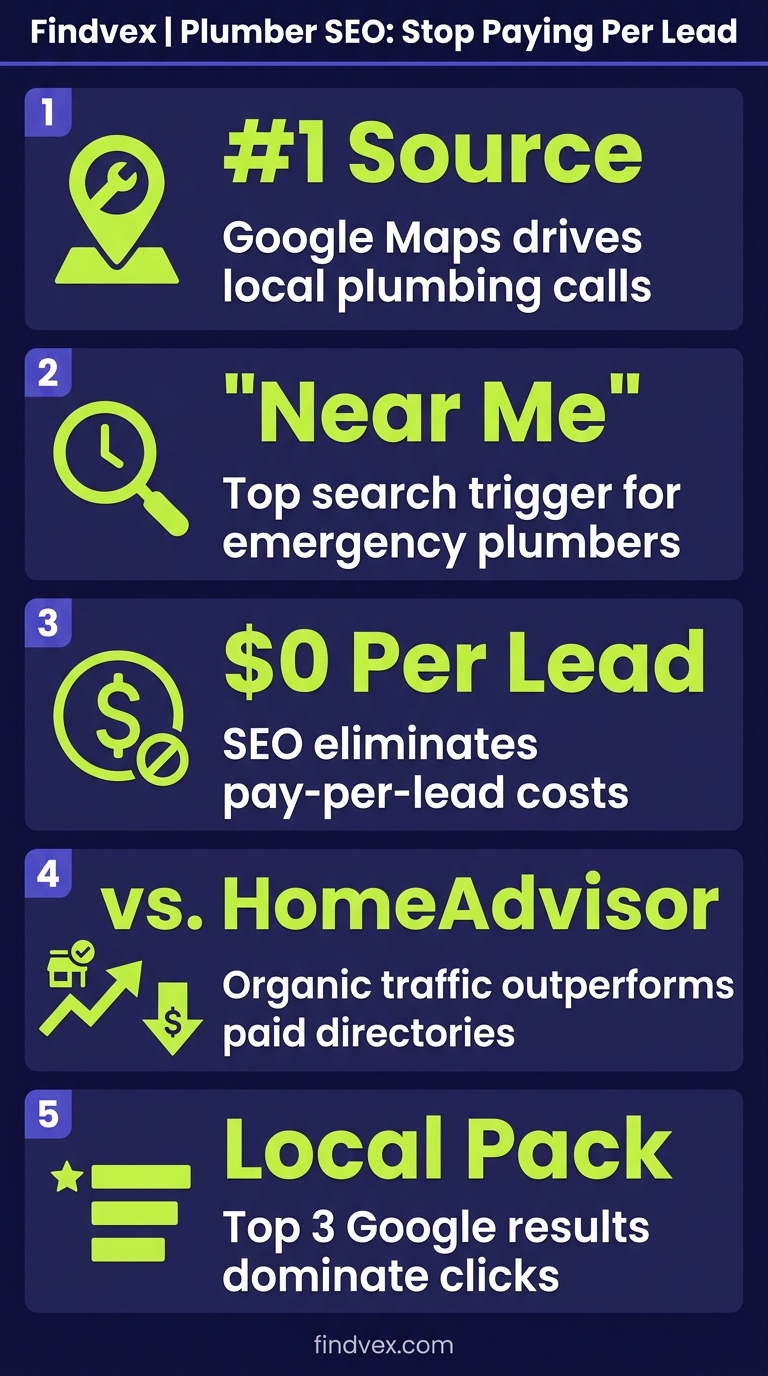
Every day, homeowners in your service area open Google and type 'emergency plumber near me,' 'water heater repair [city],' or 'drain clog fix.' Most of those searches end with a call to whoever appears in the top three Google Maps results — the local pack. If your business isn't there, a competitor is taking that call instead.
Pay-per-lead platforms like Angi and HomeAdvisor will happily fill that gap — for a fee on every single job, whether you win it or not. Plumber SEO services are the alternative: you invest once in building search authority, and the leads keep arriving without a per-call toll.
This article breaks down what plumber SEO services actually include, what moves the needle most for local plumbing businesses, and exactly what to do first this week.
What Plumber SEO Services Actually Include
The phrase 'SEO services' is vague enough to mean almost anything. For a plumbing business specifically, there are five core components that directly affect how many calls you receive.
- Google Business Profile (GBP) optimization — Your GBP listing is the single highest-leverage asset for local plumbing search. It controls what appears in the Maps pack, your star rating display, your service list, photos, and whether Google calls your business 'verified.' Most plumbers have a claimed profile that's only 40–60% complete.
- Local citation building and cleanup — Citations are mentions of your business name, address, and phone number (NAP) across directories like Yelp, Angi, BBB, and plumbing trade associations. Inconsistent NAP data across sources sends conflicting signals to Google and suppresses local rankings.
- Service area and location pages — A single homepage can't rank for 'plumber [suburb]' across every town you serve. Dedicated, well-written service area pages tell Google exactly where you operate and give each location a fighting chance to rank independently.
- On-site technical SEO — Page speed, mobile usability, crawlability, and proper schema markup affect whether Google can index and trust your site. A slow site that passes a basic technical audit will outrank a faster site with blocking errors.
- Review acquisition strategy — Volume and recency of Google reviews directly influence your Maps pack placement. An active process for requesting and responding to reviews is a ranking tactic, not just a reputation one.
- Content for high-intent plumbing queries — Blog posts and FAQ pages targeting questions like 'how much does it cost to replace a water heater in [city]' or 'signs you need a sewer line inspection' pull in homeowners early in the decision process and prime them to call you.
“AI agents do in hours what teams used to do in weeks. The advantage compounds.”
Google Business Profile: The Fastest Win for Most Plumbers
Before anything else, your Google Business Profile needs to be complete, accurate, and active. 'Complete' means every section filled in — not just name, address, phone, and hours. It means services listed with individual descriptions, a defined service area radius, photos of your truck, team, and recent jobs, and at least one post per month.
'Active' means responding to every review (positive and negative) within 48 hours, answering Google Q&A, and adding new photos regularly. Google's local algorithm rewards engagement signals. A plumbing company with 80 reviews and a 4.7 average star rating that replies to each one will consistently outrank a competitor with 200 reviews and no replies, all else being equal.
If you serve multiple towns, set your service area in GBP to reflect the actual radius you cover — but keep your physical address accurate. Do not use a virtual office address or a P.O. box to try to rank in additional cities. Google has hardened its policies on this and suspensions are common for plumbing and home service businesses.
- Add a minimum of 10 photos: truck exterior, truck interior with equipment, team on a job, before/after shots of completed work
- List every specific service: water heater repair, drain cleaning, pipe burst repair, sewer line inspection, etc. — not just 'plumbing'
- Set your primary category to 'Plumber' and add relevant secondary categories (e.g., 'Water Damage Restoration Service' if applicable)
- Post a Google Business update at least twice a month — a completed job photo, a seasonal tip, or a limited-time offer
Service Area Pages: How to Rank in Every Town You Serve
If you serve a metro area with 10 surrounding suburbs, you need 10 location-specific pages — not one page that lists all the towns in a paragraph. Each page needs its own URL, its own unique content about that location, local landmarks or neighborhoods referenced naturally, and a clear call to action with a phone number.
The mistake most plumbing websites make is copying a single template page and swapping out the city name. Google recognizes this as thin, duplicate content and either ignores the pages or de-indexes them. A location page for 'Plumber in Naperville, IL' should read differently from 'Plumber in Aurora, IL' — different neighborhoods, different common plumbing issues (older housing stock, new developments, well water vs. municipal), different local trust signals.
For more detail on what makes location pages rank without feeling templated, our guide on local landing pages that rank without sounding generic walks through the exact content structure.
- Each service area page needs: unique opening paragraph, local address or service area mention, service list for that location, a local review or testimonial if available, embedded Google Map, and a click-to-call CTA
- Target a primary keyword per page: 'plumber in [city],' '[city] drain cleaning,' '[city] water heater replacement'
- Internally link service area pages from your homepage and from each other where geography overlaps
Schema Markup for Plumbers: Tell Google Exactly What You Do
Structured data (schema markup) is code you add to your website that explicitly tells Google what your business is, where it operates, what services it offers, and what customers say about it. For plumbing companies, the most impactful schema types are LocalBusiness (with the Plumber subtype), Service, and Review/AggregateRating.
Without schema, Google has to infer this information from your page content — and it sometimes gets it wrong or underprioritizes your pages in competitive queries. With properly implemented schema, you're feeding Google the answers directly, which can improve how your listings appear in both the local pack and organic results.
You don't need to write schema by hand. Tools like Google's Rich Results Test and Schema.org's generator can produce the code. The important thing is that your schema matches your actual content — mismatched schema (claiming 5-star reviews when your page doesn't display them) can trigger a manual penalty.
- Use
@type: Plumbernested withinLocalBusinessschema - Include
areaServedwith all cities/zip codes in your service area - Add
hasOfferCataloglisting your specific services with descriptions - Implement
AggregateRatingonly if reviews are visibly displayed on the page
Reviews Are a Ranking Factor — Here's How to Build Them Systematically
Review volume, recency, and keyword relevance all influence your Google Maps ranking. 'Keyword relevance' means that when customers mention specific services in their reviews — 'fixed our burst pipe,' 'fastest water heater replacement in town' — those mentions reinforce your relevance for those search queries.
The best time to ask for a review is immediately after job completion, before the customer has left the site or while you're still on the phone with them confirming the work is done. A simple text message with a direct link to your Google review form converts far better than an email sent days later.
Build a system: every technician asks at job completion, a follow-up text goes out within two hours, and a second follow-up (with a different message) goes out 48 hours later if no review was left. This alone can double your review acquisition rate compared to asking passively.
- Create a short Google review link using Google's Place ID Finder and shorten it for easy texting
- Train every technician to ask: 'If the work met your expectations today, we'd really appreciate a quick Google review — I'll send you the link right now'
- Respond to every review within 48 hours — thank positive reviewers by name, address concerns in negative reviews professionally
- Never incentivize reviews (discount, gift card, etc.) — this violates Google's policies and can result in review removal or GBP suspension
Plumbing Content That Pulls In Ready-to-Book Customers
Content marketing for plumbers isn't about writing general advice. It's about capturing the search queries homeowners type right before they need to call someone. These are high-intent, problem-aware searches with commercial value.
The most effective content formats for plumbing businesses are: cost guides ('how much does it cost to replace a water heater in [city]'), emergency guides ('what to do if your pipes burst'), comparison posts ('tankless vs. tank water heater — which is right for my home'), and FAQ pages organized around the questions your team hears on every call.
This content works two ways: it brings in organic traffic from people researching the problem, and it builds E-E-A-T (Experience, Expertise, Authoritativeness, Trustworthiness) signals that strengthen your overall domain authority — which lifts your local pack rankings too.
- High-priority content targets: '[city] water heater replacement cost,' 'how to unclog a drain without chemicals,' 'signs of a sewer line break,' '[city] emergency plumber 24/7'
- Content format: FAQ-style with direct answers in the first paragraph (optimizes for Google's AI Overviews and featured snippets)
- Internal linking: Each service blog post should link to the relevant service area page and to your contact/quote page
- Frequency: 2–4 new pages or posts per month is sufficient for most single-location plumbing businesses building from scratch
Technical SEO Checks Every Plumbing Website Needs to Pass
Most plumbing websites were built by a generalist web designer who prioritized aesthetics over search performance. That means there are often basic technical issues suppressing rankings that no amount of content or link building will overcome.
Run a free crawl with Google Search Console or Screaming Frog to identify the most common issues: pages blocked by robots.txt, duplicate title tags, images without alt text, pages returning 404 errors, and missing or broken canonical tags. These aren't glamorous fixes, but they're often the difference between page one and page three.
Site speed is non-negotiable for plumbing searches. When someone's toilet is overflowing, they're on a phone, stressed, and will bounce from a site that takes four seconds to load. Core Web Vitals — specifically Largest Contentful Paint (LCP) and Interaction to Next Paint (INP) — are direct ranking signals. Our guide to Core Web Vitals explains what to fix first if your scores are low.
- Mobile-first: test every page at 375px width — most plumbing searches happen on mobile
- Click-to-call: your phone number should be a tappable
tel:link in the header on every page - Page speed: aim for LCP under 2.5 seconds on mobile (test with PageSpeed Insights)
- HTTPS: every page must be served over HTTPS — a non-secure site loses trust signals and ranking power
- No duplicate pages: www vs. non-www, HTTP vs. HTTPS, trailing slash vs. no trailing slash — all should 301-redirect to a single canonical version
What Plumber SEO Actually Costs and When It Pays Off
Plumber SEO services from a reputable local SEO agency in the US typically range from $500–$2,500/month depending on the number of service areas, competition level, and scope of work. Some agencies offer one-time audit and setup packages that a plumbing company can then maintain in-house.
Realistic timeline: most plumbing businesses see measurable ranking improvements (movement from page 3 to page 1 for secondary keywords) within 90 days, and meaningful lead volume increases within 4–6 months. Competitive metro markets with established local pack incumbents may take 6–12 months to break into the top three Maps results consistently.
The calculation that matters: if a typical plumbing job averages $350 and SEO generates 10 additional booked calls per month, that's $3,500/month in incremental revenue from an investment that scales without adding per-lead cost. Compare that to paying $40–$80 per lead on aggregator platforms for the same volume.
For a broader view of how local SEO investment maps to different business types, our breakdown of local SEO services USA ROI by industry is worth reading before you sign any contract.
Do This This Week: Your Plumber SEO Quick-Start Checklist
You don't need to hire an agency to start gaining ground. Here's what a plumbing business owner can action in the next five business days:
- Day 1 — GBP audit: Log into your Google Business Profile. Confirm your address, phone, hours, and website URL are correct. Add any missing service categories. Set your service area to your actual coverage radius.
- Day 2 — Photo upload: Add at least 5 new photos: truck, team, and a before/after from a recent job. Photos are a GBP freshness signal.
- Day 3 — Review request system: Create a direct Google review link using Google's Place ID Finder. Draft a two-sentence text message asking for a review and send it to your last 10 completed customers.
- Day 4 — Citation check: Search your business name on Google. Check that your NAP (name, address, phone) is consistent across Yelp, BBB, Angi, and your website. Fix any discrepancies.
- Day 5 — Technical check: Open Google Search Console (set it up if you haven't). Go to Pages > Not Indexed. If any core service pages are excluded, investigate why and fix the most critical one.
- Ongoing (weekly): Post one Google Business update, respond to any new reviews, and track your Maps pack position for your top 3 keywords.
Plumber SEO vs. Pay-Per-Lead Platforms: The Honest Comparison
Pay-per-lead platforms are not the enemy — they're a useful bridge when you're new and have zero search presence. But relying on them long-term creates two problems: margin compression on every job, and zero equity. If you stop paying, the leads stop immediately.
SEO builds an asset. Your Google Business Profile reputation, your domain authority, your service area pages — these compound over time. A plumbing company that has invested consistently in local SEO for two years has a sustainable competitive moat. A competitor who only buys leads has a monthly bill.
The smart approach for most plumbing businesses: run paid leads while SEO is being built (months 1–4), then reduce paid lead spend as organic volume increases. By month 6–9, many plumbing companies find they can cut pay-per-lead platforms significantly or drop them entirely for their core service area.
Our article on how local SEO turns website traffic into booked calls goes deeper on the conversion side — because ranking is only half the job.
FAQs
How long does plumber SEO take to show results?
Most plumbing businesses see early ranking movement (secondary keywords, lower-competition suburbs) within 60–90 days of starting SEO work. Breaking into the top three Google Maps results for competitive city-level searches typically takes 4–9 months, depending on how established your competitors are and how consistently SEO work is maintained.
What is the most important SEO factor for plumbers?
Your Google Business Profile is the single highest-impact factor for local plumbing search visibility. A fully completed, actively managed GBP with consistent NAP data, recent photos, and a steady flow of genuine reviews will outrank most competitors with better websites but neglected profiles.
Do I need a website to do SEO as a plumber?
You can rank in Google Maps with just a GBP listing, but you'll plateau quickly without a website. A website lets you create service area pages, publish content targeting specific queries, earn backlinks, and implement schema markup — all of which reinforce your Maps rankings and give you organic results below the local pack.
How many Google reviews does a plumber need to rank in the local pack?
There's no fixed number. What matters is having more recent, high-quality reviews than your direct competitors. In smaller markets, 30–50 reviews with a 4.5+ rating may be sufficient. In competitive metros, 150+ may be needed to compete. Review recency matters — a business with 40 reviews in the past year often outranks one with 200 reviews spread over five years.
Can I do plumber SEO myself or do I need an agency?
You can handle GBP optimization, citation cleanup, and basic review acquisition yourself — these have the highest ROI and lowest technical barrier. Technical SEO, service area page creation, and link building benefit from agency expertise. A common approach is to handle GBP and reviews in-house while outsourcing the website and content work.
What's the difference between plumber SEO and general SEO?
Plumber SEO is local SEO applied to a service-area business. The priorities are Google Maps visibility, NAP consistency, service area pages, and local review acquisition — not just organic rankings. General SEO often focuses on national keyword rankings, content volume, and domain authority building, which are secondary concerns for a plumbing business targeting a 20-mile service radius.
Should a plumber use separate pages for each service or one page for all services?
Separate pages for each major service perform significantly better. A dedicated page for 'water heater replacement' can rank for dozens of related queries independently. A single 'Services' page trying to cover drain cleaning, pipe repair, water heaters, and sewer lines will rank for none of them well. Each service page should target a specific keyword and include pricing context, process description, and a clear CTA.
Related reading
- restaurant seo — Restaurant SEO: How to Rank for Local Dining Searches
- landscaping seo — Landscaping SEO: How to Fill Your Schedule Without Paying for Every Lead
- seo for dentists — SEO for Dentists: A Practical Playbook for More Local Patients
- restaurant seo services — Restaurant SEO Services: What Actually Drives More Covers, Reservations, and Takeout Orders
- google business profile optimization services — Google Business Profile Optimization Services: What Local Businesses Actually Get (and What Moves the Needle)
- clinic seo services — Clinic SEO: How to Rank for "Doctor Near Me" Searches
- generative engine optimization — What Is Generative Engine Optimization (GEO)? How Small Businesses Get Found in AI Search
- law firm seo — Law Firm SEO: What Actually Moves Rankings for Solo Attorneys and Small Practices
- local seo services — How Local SEO Turns Website Traffic Into Booked Calls
- roofing seo — Roofing SEO: How to Rank in the Local Pack Before Storm Season Hits
Research notes
Background claims used while researching this article. Verify with the cited authorities before quoting.
- Average plumbing job value in the US
- Pay-per-lead cost range on aggregator platforms ($40–$80)
Sofia Patel
Head of Content & Growth · Findvex
Sofia Patel leads content and growth at Findvex. She writes about local SEO, conversion-focused content, and AEO/GEO strategy — the work that turns search visibility into booked calls and qualified leads for service businesses.
Expertise: Local SEO · Conversion content · AEO / GEO strategy · Content-led link building
Related reads
Google TurboQuant and Entity-Driven SEO: What the Compression Breakthrough Actually Means for Your Site
TurboQuant is a vector quantization algorithm from Google Research that dramatically compresses the mathematical representations AI uses to understand meaning. If it reaches production search infrastructure, it could lower the cost of semantic retrieval at scale — making entity-based content signals more dominant and keyword-match signals relatively less important.
SEO NewsHow AI Is Changing Local Search Visibility: What the SOCi + Google Webinar Revealed
Google and SOCi's joint webinar on local search visibility highlighted a fundamental shift: AI-powered discovery across Google Search, Maps, and Gemini now requires a different optimization playbook than the one most small businesses are running. Here's what changed and what to prioritize.
Strategic Technical SEODuplicate Content SEO: What Google Actually Penalizes vs. What It Silently Handles
Duplicate content rarely triggers a manual penalty. Google usually picks one version and ignores the rest. But the wrong choice by Google can split your ranking signals, waste crawl budget, and suppress pages you actually want ranked. Here's how to diagnose the difference.