Law Firm SEO: What Actually Moves Rankings for Solo Attorneys and Small Practices
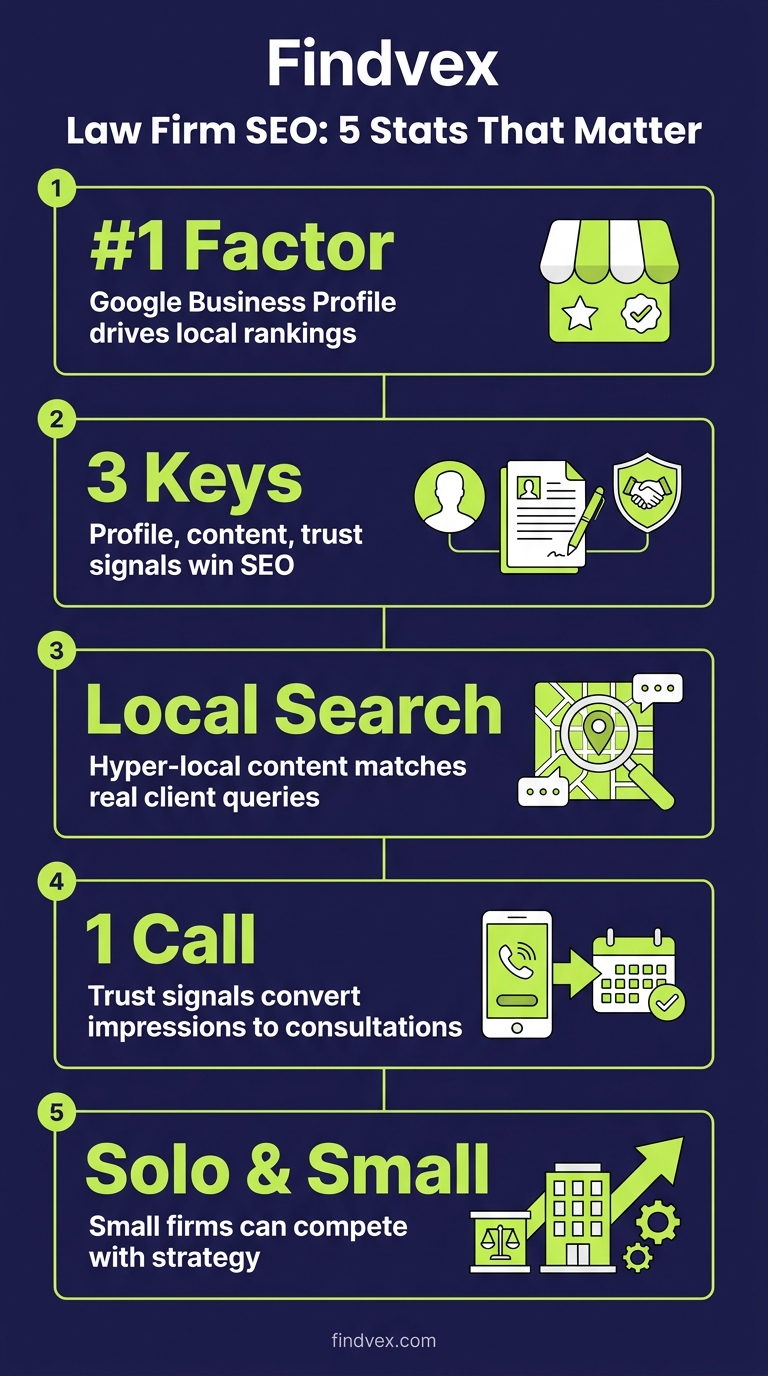
Law firm SEO is won or lost on three things: Google Business Profile authority, hyper-local content that matches how clients actually search, and the kind of trust signals that convert a search impression into a consultation call. This guide covers what actually moves the needle—and what to stop spending time on.
Quick answer
Law firm SEO for solo attorneys and small practices comes down to four priorities: (1) a fully optimized Google Business Profile in the Local Pack, (2) practice-area landing pages that match how clients search, (3) structured data and E-E-A-T signals like bar admissions and case-type credentials, and (4) consistent NAP citations across legal directories. These four levers drive the consultation calls that turn into clients—not domain authority scores or blog volume alone.
Why Law Firm SEO Is Different from Generic Local SEO
Most small business SEO advice assumes your customer is ready to buy a service commodity—a pizza, a plumber, an oil change. Legal search behavior is different. A potential client searching 'DUI attorney Austin' or 'divorce lawyer near me' is often in distress, comparing multiple attorneys, and looking for credibility signals before they ever click a phone number. That changes what you optimize for.
Generic checklists—robots.txt, sitemap submission, Core Web Vitals—are table stakes. They matter and you need them clean. But they will not win you clients in a competitive legal market on their own. What separates solo attorneys and small firms that rank and convert from those that don't comes down to three things: local authority, practice-area specificity, and demonstrated expertise. The rest of this guide breaks down exactly how to build each one.
One more distinction worth noting upfront: the legal vertical is one of the most competitive in local search. Personal injury, criminal defense, and family law queries in any mid-size US market typically have multiple well-funded law firms competing. That means your strategy needs to be deliberately targeted, not broad.
The Local Pack Is Where Legal Clients Start—and Where Most Firms Lose
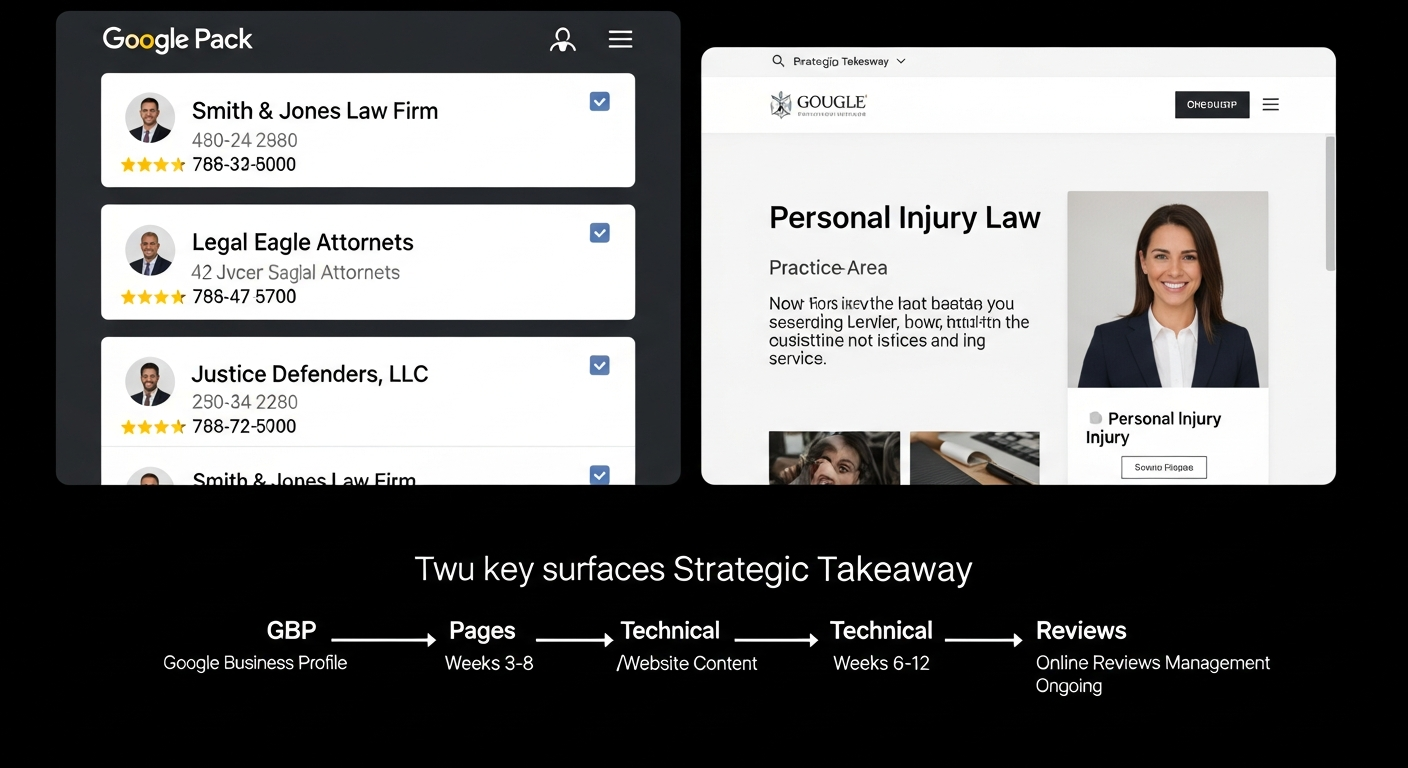
For queries like 'employment lawyer [city]' or 'personal injury attorney near me,' Google's Local Pack (the map with three results) appears above the organic blue links. Appearing in this pack matters more than ranking #1 organically for many legal queries—especially on mobile, where clients are often searching in moments of urgency.
Your Google Business Profile is the single highest-leverage asset in law firm SEO. A GBP that is incomplete, uncategorized, or lacking reviews will not compete. One that is fully built out, consistently updated, and accumulating genuine client reviews will compound its advantage over time.
The key variables that influence Local Pack placement for attorneys are: (1) proximity to the searcher, which you can't fully control; (2) relevance, driven by your primary and secondary business categories and the content of your GBP posts and Q&A; and (3) prominence, driven primarily by review volume and quality, and by citation consistency across the web. Focus your energy on the two you can control.
- Set your primary GBP category to the most specific practice area available—'Personal Injury Attorney,' not just 'Lawyer'
- Add all relevant secondary categories for each practice area you handle
- Fill out every attribute field Google offers: appointment links, consultation availability, accessibility features
- Publish GBP posts at least twice monthly—case outcomes (where ethically permissible), legal tips, or office updates
- Respond to every review within 48 hours, including negative ones
- Use the Q&A section to pre-answer the questions potential clients actually ask before calling
- Ensure your office address, phone number, and website URL exactly match what appears on your website and in legal directories
“AI agents do in hours what teams used to do in weeks. The advantage compounds.”
Practice-Area Landing Pages: Stop Trying to Rank a Homepage
One of the most common technical and strategic mistakes solo attorneys make is trying to rank their homepage for every service they offer. Google needs to understand what a specific page is about to rank it for a specific query. If your homepage says 'We handle personal injury, family law, criminal defense, and estate planning,' Google has to guess what you're most relevant for.
The fix is a dedicated landing page for each practice area you want to rank for, built around the terms clients actually use—not legal jargon. A client does not search 'tortious interference.' They search 'business contract dispute lawyer.' A client does not search 'dissolution of marriage.' They search 'divorce attorney [city].'
Each practice-area page should be built around a primary keyword (the query a client types when they have a problem you solve), supported by a clear explanation of what you do, who you help, and what happens when they call. These pages are not brochures—they are the answer to a question someone is actively asking.
For solo attorneys or small firms with limited content budgets, prioritize the two or three practice areas where you want the most cases. Build those pages first, build them well, and do not scatter your effort across ten thin pages.
- One URL per practice area: /personal-injury-attorney-austin/, /criminal-defense-lawyer-austin/, etc.
- Target one primary keyword per page, supported by three to five semantic variations
- Include city and neighborhood references naturally—not stuffed—throughout the page
- Add a specific FAQ section addressing the questions clients ask before hiring (fees, timeline, process)
- Link to your GBP from the page's contact section to reinforce local signals
- Include your bar admission, years of experience, and any relevant case-type credentials on each page
E-E-A-T for Attorneys: Why Google Treats Legal Content as YMYL
Google classifies legal, medical, and financial content as 'Your Money or Your Life' (YMYL)—meaning it holds content in these categories to a higher standard of expertise, authoritativeness, and trustworthiness. For solo attorneys, this has concrete implications for what your website needs to contain.
Google's quality raters look for signals that the author has real-world expertise in the topic. For a law firm, that means: attorney bios with bar admission numbers and state, law school credentials, years in practice, and ideally peer recognition such as bar association memberships or awards. These are not vanity elements—they are trust signals that influence both human visitors and Google's quality assessment.
Your content should be written from direct experience. A page about what to expect in a Texas DUI case should include specific information about Texas law, local court procedures, and realistic timelines—not generic boilerplate that could apply to any state. Specificity is a proxy for genuine expertise, and Google has gotten better at detecting generic legal content that was produced without practitioner knowledge.
Beyond credentials, link acquisition from relevant legal directories and state bar websites functions as an authority signal. Martindale-Hubbell, Avvo, FindLaw, Justia, and your state bar association directory are not just citation sources—they are authoritative links in the legal vertical that send meaningful domain authority signals.
- Every attorney bio should include: full name, bar number, state of admission, law school, years in practice, practice areas
- Add schema markup using the LegalService and Attorney schema types (covered in the schema section below)
- Secure listings on Avvo, Martindale, FindLaw, Justia, and your state bar directory—these are the canonical legal citations
- Attribute all content to a named attorney, not a generic firm byline
- Include a physical office address with a real suite number—virtual offices raise trust flags in legal search
Keyword Strategy for Solo Attorneys: How Clients Actually Search
Legal keyword strategy has two layers that most small-firm SEO gets wrong. The first layer is the high-volume 'money' keywords: 'personal injury lawyer Houston,' 'divorce attorney Chicago.' These are competitive and expensive. A solo practice with a new website will not outrank Morgan & Morgan for 'personal injury lawyer' in a major market within six months.
The second layer—where solo attorneys and small practices actually win—is specificity. Clients searching for an attorney often include their problem, not just the practice area. 'What happens if I miss a court date in Texas,' 'can I modify custody agreement after job change,' 'cost of uncontested divorce California.' These longer, more specific queries have lower competition, higher commercial intent, and are exactly the kind of searches your content and FAQ sections should answer.
A useful framework: think of your keyword strategy in three rings. The inner ring is your core practice-area pages targeting moderately competitive city-level terms. The middle ring is problem-specific blog content and FAQ pages targeting the questions clients ask before they hire. The outer ring is educational content that builds topical authority over time. Solo attorneys should invest first in the inner ring, then use the middle ring to capture clients earlier in the decision journey.
- Use Google's 'People Also Ask' boxes for legal queries to identify the exact questions potential clients are typing
- Target city + practice area combinations for core pages: 'family law attorney [city]', 'employment lawyer [city]'
- Build problem-specific FAQ content: 'what to do after a car accident in [state]', 'how long does a divorce take in [state]'
- Do not ignore neighborhood and suburb-level keywords—a client in a suburb is more likely to search '[suburb] divorce attorney' than '[major city] divorce attorney'
- Monitor your Google Search Console for queries you're already appearing for but not ranking well—these are your fastest wins
Citation Consistency and Legal Directory Presence
For law firm local SEO, citations—your Name, Address, and Phone number appearing consistently across the web—serve two purposes. First, they are a relevance and prominence signal in the Local Pack algorithm. Second, legal directories like Avvo and Justia are independently authoritative domains that rank for their own legal queries, meaning your profile there can appear in search results even when your website doesn't.
The most common citation error for solo attorneys is inconsistency between the firm name on the GBP, the website, and directory listings. A GBP that says 'Rivera Law LLC' and a Justia profile that says 'Alex Rivera, Attorney at Law' creates a signal mismatch. Use the same exact entity name, address format, and phone number everywhere.
For attorneys who recently moved offices or changed firm names, cleaning up old citation data is often the single fastest-acting fix in law firm SEO. Outdated addresses in directories actively suppress Local Pack performance.
- Priority legal directories: Avvo, Martindale-Hubbell, FindLaw, Justia, Lawyers.com, your state bar website
- Secondary citations: Google Business Profile, Yelp, BBB, Bing Places, Apple Maps
- Use exactly the same firm name format across all listings
- Verify and update your state bar directory profile—it is often the most authoritative citation source for attorneys
- Check for duplicate listings on major directories and request removal of the older, incorrect ones
Schema Markup for Law Firms: The Three Types That Actually Matter
Schema markup tells search engines exactly what your content represents. For law firms, the right schema types can trigger rich results, improve how AI Overviews describe your practice, and clarify entity relationships that affect both local and organic rankings.
The three schema types that have the most practical impact for solo attorneys and small practices are: LegalService (or Attorney, a subtype), LocalBusiness with the law-specific attributes, and FAQPage for your question-and-answer content. You can read a full breakdown of which structured data types affect rankings for small businesses in our guide to schema markup for small business websites.
Implement schema using JSON-LD (not microdata), placed in the <head> of each relevant page. Your practice-area pages should each carry a LegalService schema block with the specific practice area named, the geographic area served, and links to your GBP and attorney profiles.
- LegalService schema: include name, description, areaServed (city and state), priceRange if applicable, and sameAs links to your Avvo and state bar profiles
- Attorney schema: include name, jobTitle, alumniOf (law school), memberOf (state bar association), and knowsAbout (practice areas)
- FAQPage schema: apply to any page with a structured Q&A section—this is your best path to featured snippet and AI Overview inclusion
- LocalBusiness schema: include geo coordinates, openingHoursSpecification, and telephone
- Validate all schema using Google's Rich Results Test before publishing
AI Overviews and Attorney Search: What Changed and What to Do
Google's AI Overviews are appearing with increasing frequency for legal queries, particularly for informational searches like 'how does workers' comp work in Ohio' or 'steps to file for divorce in Florida.' For solo attorneys, this creates both a risk and an opportunity.
The risk: if your website's content is not structured to be extractable—clear headings, concise answers in the first paragraph of each section, FAQ schema—AI Overviews will pull answers from competitors' sites and list those firms, not yours. Clients who get their question answered by the Overview may not click through at all, or they click the source that was cited.
The opportunity: attorneys who produce specific, well-structured, locally relevant content are being cited in AI Overviews. You do not need to be a large firm to appear—you need to produce the clearest, most specific answer to the question being asked. A solo practitioner who writes a genuinely useful 600-word page about 'what to do in the first 24 hours after a DUI arrest in Texas' can appear in an AI Overview that drives consultation calls.
For a framework on diagnosing why AI search is skipping your content and what to fix, see our technical diagnosis guide on why AI search skips your content.
- Structure every informational page with a direct answer in the first paragraph, followed by supporting detail
- Use H2 and H3 headings that mirror the exact phrasing of questions clients ask
- Add FAQPage schema to all Q&A content
- Ensure your site is crawlable by AI bots (check robots.txt for inadvertent blocks)
- Build topical depth: three related pages on a specific topic are stronger than one general page covering everything
Technical SEO for Law Firm Websites: What to Audit First
Most law firm websites—particularly those built on legal-specific platforms like Clio Grow, Lawmatics, or legacy Martindale-owned templates—have predictable technical issues. Before investing in content or link building, confirm your technical foundation is clean.
The most common technical failures on law firm sites are: slow page speed (especially on mobile, where legal searches increasingly originate), duplicate content from practice-area pages that are too similar to each other, improper use of noindex on pages that should be visible, and broken internal links from outdated blog posts that reference pages that no longer exist.
Run a technical SEO audit using Google Search Console's Coverage report as your starting point. If pages you want to rank are showing as 'Excluded' or 'Crawled but not indexed,' that is the first problem to solve—before any content work. For a prioritized audit process, our technical SEO audit checklist for small business websites covers the exact sequence to follow.
- Confirm all core practice-area pages are indexed: use site:yourdomain.com/page-slug in Google
- Check mobile page speed with PageSpeed Insights—legal clients search on mobile
- Audit for duplicate practice-area content: pages that differ only by swapping city names are a thin-content risk
- Ensure your consultation booking page is not accidentally noindexed
- Fix any broken internal links from older blog posts to practice-area pages
- Confirm HTTPS is active and there are no mixed-content warnings
Reviews Are a Ranking Factor and a Conversion Factor—Treat Them as Both
In legal SEO, reviews perform double duty. They influence your Local Pack ranking directly (Google treats review volume and recency as a prominence signal), and they influence whether a prospective client chooses to call you after they find you. A firm with 4 reviews and a 5.0 average loses to a firm with 47 reviews and a 4.7 average—both in the algorithm and in client psychology.
The ethical rules around attorney advertising vary by state, but in every jurisdiction, asking a satisfied client to leave an honest review is permissible. The key word is 'honest'—you cannot incentivize reviews or script them. What you can do is make the process frictionless: send a direct link to your GBP review page at case close, add it to your email signature, and include a QR code in your office waiting area.
Respond to every review, including negative ones, without disclosing any privileged information. A measured, professional response to a negative review often impresses prospective clients more than a perfect score—it demonstrates judgment, which is exactly what someone hiring an attorney is evaluating.
- Set a target of one new Google review per month at minimum—consistency matters more than spikes
- Create a direct Google review link: search 'Google review link generator' to get your firm's unique URL
- Diversify reviews across Avvo, Google, and Facebook—multi-platform review presence strengthens prominence signals
- Never respond to a negative review with case-specific information, even if the reviewer discloses it first
- Monitor your reviews weekly using Google Business Profile Manager notifications
Strategic Takeaway: Where to Invest First and What to Deprioritize
Solo attorneys and small practices have limited time and budget. The question is not 'what does good law firm SEO include'—it is 'what should I do in what order to generate consultation calls.' The sequencing matters as much as the tactics.
Start with your Google Business Profile. A fully optimized GBP in a competitive local market can generate consultation calls within weeks. It is the fastest ROI in law firm SEO and costs nothing but time. If your GBP is incomplete, fix it before touching anything else.
Second, build or improve your top two or three practice-area landing pages. These are the pages that will rank for commercial queries and convert visitors into callers. Invest real effort here: specific content, proper schema, FAQs, and clear calls to action.
Third, fix any technical issues that are preventing indexation. An unindexed page ranks nowhere. Confirm your core pages are indexed and crawlable before creating new content.
Fourth, begin a systematic review acquisition process. This is ongoing, not a one-time task. Treat it like case intake: build it into your post-matter workflow.
What to deprioritize until the above is done: high-volume blog content, aggressive link building campaigns, social media SEO, and paid directory upgrades beyond the free tiers. These are amplifiers—they work best when the foundation is already solid. Investing in amplifiers before the foundation is built is how attorneys spend money on SEO without seeing results.
For a broader view of how local SEO connects to actual booked consultations, see how local SEO turns website traffic into booked calls.
- Week 1–2: GBP audit and completion, citation consistency check across top legal directories
- Week 3–6: Build or rebuild practice-area landing pages with proper schema and FAQs
- Week 6–8: Technical SEO audit using GSC Coverage report, fix indexation issues
- Ongoing: Review acquisition, GBP post cadence, monitoring GSC for new keyword opportunities
- Quarter 2+: Problem-specific FAQ content, neighborhood/suburb landing pages, link acquisition from legal directories
The Tradeoffs Worth Knowing Before You Hire a Legal SEO Agency
Legal SEO services vary enormously in quality and focus. Many agencies selling 'law firm SEO' are general digital marketing shops that treat legal clients like any other local service business. The result is generic content, boilerplate schema, and link-building strategies that don't account for the ethical rules governing attorney advertising.
The key question to ask any legal SEO agency is: what is your actual plan for getting my practice-area pages to rank in my specific market, and how do you measure success? If the answer centers on rankings alone—not consultation calls or contact form submissions—the incentives are misaligned. Rankings are a means; booked consultations are the outcome.
For solo attorneys on a limited budget, a focused engagement with a specialist is usually more productive than a broad retainer with a generalist agency. Define the scope tightly: GBP optimization, two to three practice-area pages, technical audit, and a review strategy. Measure against consultation volume, not traffic volume.
FAQs
How long does law firm SEO take to produce results?
Google Business Profile optimization and review acquisition can produce Local Pack visibility improvements within four to eight weeks. Organic rankings for practice-area pages in competitive markets typically take three to six months to move meaningfully, depending on how competitive your market is and how much existing domain authority your site has. Budget-level adjustments like fixing indexation issues or completing your GBP can show faster results.
Do solo attorneys need a blog to rank in Google?
Not necessarily, and not as the first priority. A well-built set of practice-area landing pages with proper schema, a fully optimized GBP, and consistent citations will generate more consultation calls than a blog that publishes generic legal content. Blog content becomes valuable for capturing problem-specific queries and building topical authority, but it is a second-phase investment after the core pages and local signals are solid.
Is Avvo worth paying for in 2026?
The free Avvo listing is worth completing—it is an authoritative citation and the profile can rank independently in search results for attorney queries. The paid promotion tiers are less clearly valuable, and the decision depends on your market's competitiveness and what other channels are generating consultation volume. Prioritize the free tier across all major legal directories before paying for upgrades on any single platform.
Can I do law firm SEO myself, or do I need an agency?
GBP optimization, citation management, practice-area page content, and review acquisition are all manageable without an agency if you're willing to invest the time. Technical SEO—diagnosing indexation issues, implementing schema correctly, auditing JavaScript rendering—benefits from professional help or a qualified tool. Most solo attorneys benefit from a one-time technical audit and page-build engagement rather than an ongoing monthly retainer in the early stages.
What schema markup should a law firm use?
At minimum: LegalService schema on practice-area pages (with areaServed, name, and sameAs links to your GBP and bar directory profile), LocalBusiness schema on your homepage (with NAP data, geo coordinates, and hours), Attorney schema on your bio page, and FAQPage schema on any page with a structured question-and-answer section. Validate everything with Google's Rich Results Test before publishing.
How do attorney ethics rules affect law firm SEO?
Ethics rules vary by state bar. Common restrictions affect how you can describe results ('I won $2M for my client' may require a disclaimer), testimonials, and the use of terms like 'specialist' or 'expert' without specific certification. Review your state bar's advertising rules before publishing any content that makes claims about outcomes or comparative positioning. Most content SEO best practices—answering client questions clearly, demonstrating expertise—are ethically unproblematic in every jurisdiction.
Does Google's AI Overview affect legal search results?
Yes. AI Overviews are appearing for many informational legal queries. They typically cite well-structured, specific content that directly answers the query. Solo attorneys who produce clear, location-specific, expertly-attributed content can appear in AI Overviews even when competing against larger firms. The key structural requirements are a direct answer in the first paragraph, FAQ schema, and clean crawlability for AI bots.
Related reading
- restaurant seo — Restaurant SEO: How to Rank for Local Dining Searches
- real estate seo — Real Estate SEO: How Local Agents Win Search in 2026
- plumber seo services — Plumber SEO Services: How to Get More Local Calls Without Paying Per Lead
- google business profile audit — Google Business Profile Audit Checklist: 23 Things That Actually Affect Your Local Ranking
- restaurant seo services — Restaurant SEO Services: What Actually Drives More Covers, Reservations, and Takeout Orders
- home services seo — Home Services SEO Benchmark: What It Actually Takes to Rank in the Top 3 in 2026
- seo for dentists — SEO for Dentists: A Practical Playbook for More Local Patients
- google search update — What Changed in Google Search This Week and What Small Businesses Should Do
- small business seo strategy — The 2026 SEO Strategy Small Businesses Should Actually Follow
- schema markup for small business — Schema Markup for Small Business Websites: The 5 Types That Actually Affect Your Rankings
Research notes
Background claims used while researching this article. Verify with the cited authorities before quoting.
- Review volume and recency as a Google Local Pack prominence signal for attorneys
- YMYL classification for legal content and E-E-A-T requirements
Alex Rivera
CEO & Editorial Strategist · Findvex
Alex Rivera leads editorial strategy at Findvex. He sets the weekly content plan, picks topical pillars, and decides what to publish — and what to skip — based on search intent, competitive data, and what genuinely helps US small businesses rank.
Expertise: Editorial strategy · Topical authority · Content prioritisation · Pillar planning
Related reads
Google TurboQuant and Entity-Driven SEO: What the Compression Breakthrough Actually Means for Your Site
TurboQuant is a vector quantization algorithm from Google Research that dramatically compresses the mathematical representations AI uses to understand meaning. If it reaches production search infrastructure, it could lower the cost of semantic retrieval at scale — making entity-based content signals more dominant and keyword-match signals relatively less important.
SEO NewsHow AI Is Changing Local Search Visibility: What the SOCi + Google Webinar Revealed
Google and SOCi's joint webinar on local search visibility highlighted a fundamental shift: AI-powered discovery across Google Search, Maps, and Gemini now requires a different optimization playbook than the one most small businesses are running. Here's what changed and what to prioritize.
Strategic Technical SEODuplicate Content SEO: What Google Actually Penalizes vs. What It Silently Handles
Duplicate content rarely triggers a manual penalty. Google usually picks one version and ignores the rest. But the wrong choice by Google can split your ranking signals, waste crawl budget, and suppress pages you actually want ranked. Here's how to diagnose the difference.