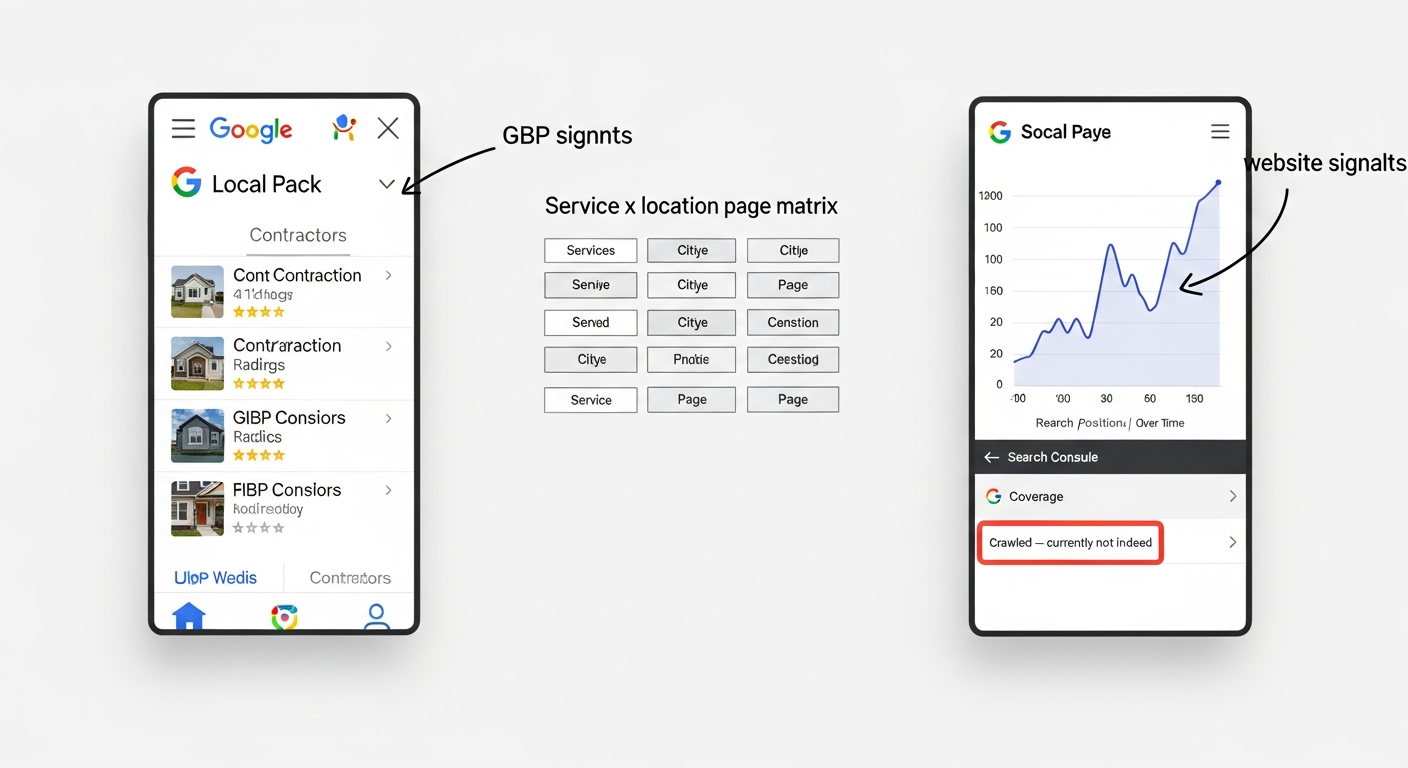
Home Services SEO Benchmark: What It Actually Takes to Rank in the Top 3 in 2026
Ranking in the top 3 for home services searches requires more than a Google Business Profile and a few reviews. This benchmark breaks down the technical, local, and content signals that separate first-page contractors from everyone else.
Quick answer
To rank in the top 3 for home services searches in 2026, you need: a fully optimized Google Business Profile with consistent recent reviews, a fast mobile website with local landing pages for each service area, proper LocalBusiness schema markup, clean crawlability (no blocked resources, no redirect chains), and topical authority built through service-specific content. The Local Pack and organic results draw on overlapping but distinct signals — you need to compete in both simultaneously.
What 'Top 3' Actually Means for Home Services Searches
When a homeowner searches 'plumber near me' or 'HVAC repair [city]', they see two distinct top-3 opportunities: the Local Pack (the map with three business listings) and the organic blue links below it. These are separate ranking systems fed by partially overlapping signals.
The Local Pack is driven primarily by your Google Business Profile (GBP), proximity, review velocity, and category relevance. Organic results are driven by your website's technical health, content depth, backlink authority, and on-page signals. Most home service contractors optimize for one or the other. The businesses that consistently dominate do both.
A third surface is emerging: AI Overviews and AI Mode results, which increasingly pull from structured, crawlable, authoritative content. If Google's AI summarizes 'best HVAC contractors in Phoenix,' the businesses cited tend to have strong organic signals, not just a good GBP.
Diagnosis Checklist: Where Most Home Service Sites Are Losing Ground
Before benchmarking against top competitors, audit your own baseline. The issues below are the most common reasons home service contractors stall at positions 4–10.
- GBP category mismatch — primary category doesn't match the service you most want leads for
- No recent reviews or review velocity lower than local competitors (check: when was your last 5-star review?)
- Website served without HTTPS — still present on older contractor sites
- Core pages returning 200 status but not indexed — check Google Search Console Coverage report
- Service area pages either missing, thin (<400 words), or duplicated with only the city name swapped
- LocalBusiness or Service schema absent or malformed — validate at schema.org/validator
- Mobile LCP (Largest Contentful Paint) above 4 seconds — common on image-heavy contractor sites
- robots.txt accidentally blocking CSS or JS files that render key page content
- Canonical tags pointing service pages to the homepage or a parent category
- No internal link structure connecting service pages to location pages
- GBP posts not updated in 90+ days
- NAP (Name, Address, Phone) inconsistent across GBP, website footer, and citation directories
“AI agents do in hours what teams used to do in weeks. The advantage compounds.”
Local Pack Ranking Signals: The GBP Factors That Move the Needle
The Local Pack uses proximity, relevance, and prominence as its core ranking dimensions. Proximity is largely outside your control — Google shows nearby businesses. Relevance and prominence are where you compete.
Relevance comes from how well your GBP category, services listed, and business description match the search query. A plumbing company that lists 'Plumber' as its primary category but has no secondary categories for 'Emergency Plumber' or 'Drain Cleaning Service' is leaving relevance signals on the table. Add every applicable secondary category.
Prominence is the combination of review quantity, review recency, review sentiment, backlinks pointing to your website, and citation consistency across directories like Yelp, Angi, HomeAdvisor, and the BBB. Review velocity matters more than total count — a business with 40 reviews received over the past 6 months will typically outrank one with 200 reviews that stopped accumulating 2 years ago.
GBP posts, Q&A responses, and photo uploads are behavioral signals. They don't have large direct weight, but they indicate an active, managed profile — and Google's systems are designed to surface businesses that engage with their profiles.
- Set the correct primary GBP category for your highest-value service
- Add all applicable secondary categories
- Complete every GBP attribute (licensed, insured, women-led, veteran-owned if applicable)
- Maintain a review velocity of at least 2–4 new reviews per month
- Respond to every review — positive and negative — within 7 days
- Upload geo-tagged photos of completed jobs at least twice monthly
- Define service areas accurately — don't claim a 100-mile radius if you operate in a 20-mile zone
- Keep NAP identical across GBP, website, and all directories — character-for-character
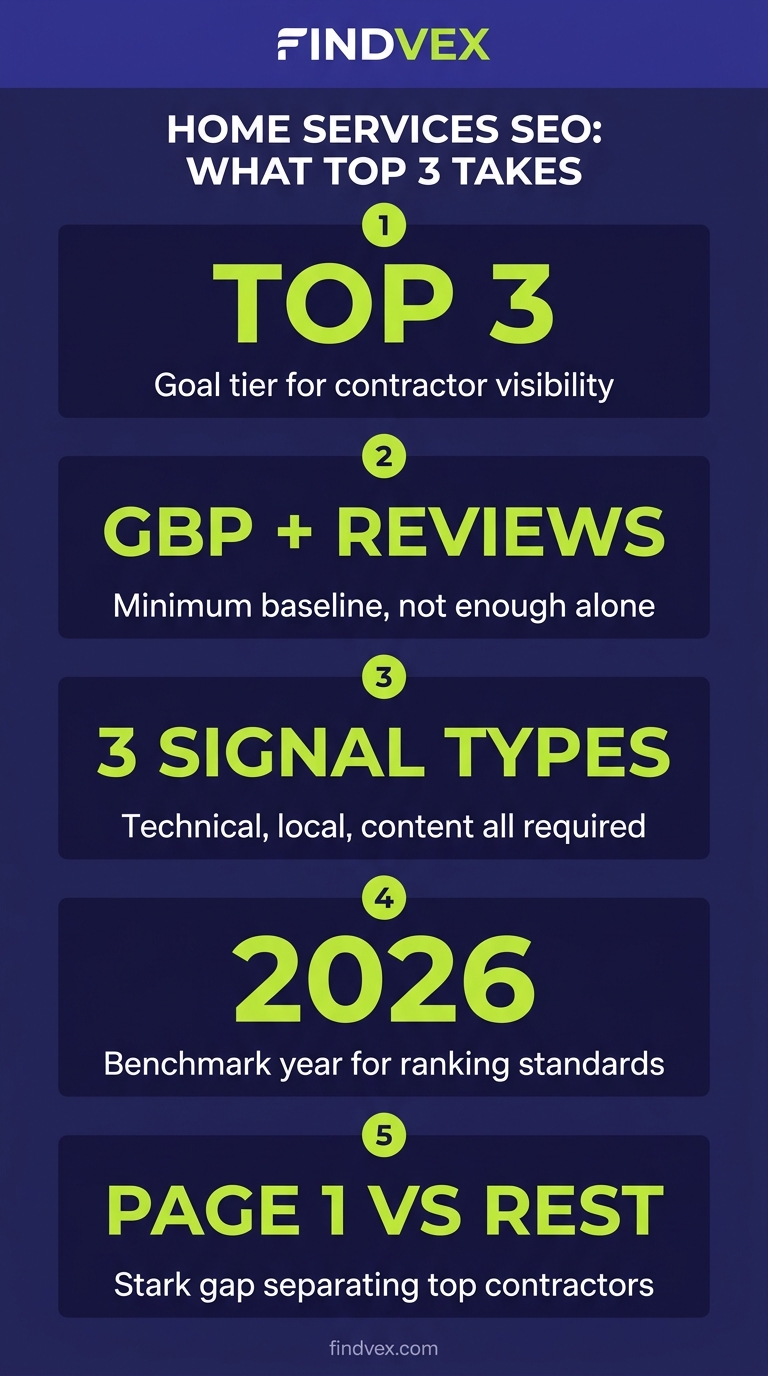
Website Technical Requirements for Top-3 Home Services Rankings
Your website is a ranking signal for the Local Pack (Google reads it to verify business information) and the primary signal for organic rankings. Technical failures here suppress both.
The most common and damaging technical issue on home service websites is slow mobile performance. Most searches for plumbers, HVAC companies, and landscapers happen on mobile, often in urgent situations. A page that takes 6 seconds to load on a 4G connection loses users and ranking signals simultaneously.
Indexability is the second major failure point. If Googlebot can't crawl and render your service pages, they can't rank. This includes pages blocked by robots.txt errors, pages excluded from your sitemap, pages with noindex tags left from a staging environment, and pages that require JavaScript execution to display their main content — a common issue on contractor sites built with page-builder tools.
- LCP target: under 2.5 seconds on mobile (measure with Google Search Console's Core Web Vitals report or PageSpeed Insights)
- INP (Interaction to Next Paint): under 200ms — critical if your site uses chat widgets or booking forms
- CLS (Cumulative Layout Shift): under 0.1 — layout shifts caused by late-loading ads or images frustrate users and are penalized
- All service and location pages must return HTTP 200 and be listed in your XML sitemap
- robots.txt must not block /wp-content/, image files, or key CSS/JS resources
- Canonical tags on location pages must self-reference, not point to the homepage
- Every page reachable within 3 clicks from the homepage (crawl depth)
- HTTPS across all pages, including form submission endpoints
Service Area Pages: The Content Architecture That Determines Organic Reach
The most scalable organic ranking strategy for home service businesses is a service × location page matrix. This means a dedicated, substantive page for each combination of service and city you serve — 'Water Heater Repair in Scottsdale,' 'Drain Cleaning in Tempe,' and so on.
The pages that rank are not thin location templates with swapped city names. They contain specific details: local permits or codes relevant to that service in that area, honest service area radius from your base location, local reviews or project references where possible, and a clear call-to-action with a phone number that matches your GBP.
The pages that fail are identical except for the city name. Google's systems identify this as thin content and either don't index them or suppress them in rankings. Each page needs at least one unique, locally relevant signal beyond the city name.
Internal linking between service pages and location pages is equally important. A strong home services site links each service page to its corresponding city pages, and links each city page back to the primary service. This creates a crawlable topic cluster that distributes authority and helps Google understand your service footprint.
- Create a dedicated page for each primary service × each primary city you serve
- Minimum 600–800 words of genuinely useful content per page — not padded filler
- Include a unique local signal on every page (permit info, local code reference, neighborhood-specific context)
- Use consistent H1 format: '[Service] in [City, State]' or '[City] [Service] Contractor'
- Add LocalBusiness + Service schema with serviceArea specified
- Link service pages to relevant city pages and vice versa
- Include the local phone number and address in the page body, not just the footer
Schema Markup for Home Service Contractors: What to Implement and Why
Structured data doesn't directly boost rankings, but it helps Google parse your entity correctly — which does affect how you appear in rich results, AI Overviews, and Local Pack context. For home service businesses, three schema types are non-negotiable.
LocalBusiness (or a more specific subtype like Plumber, HVACBusiness, or RoofingContractor) should appear on your homepage and contact page with complete name, address, phone, URL, opening hours, and geo coordinates. Using the most specific applicable type improves entity disambiguation.
Service schema should appear on each service page, referencing the parent LocalBusiness and specifying the service name, area served, and description. This is how you tell Google's systems 'this page is about water heater repair in Tempe' rather than leaving it to infer from body text alone.
Review/AggregateRating schema, when pulled from legitimate reviews (not self-generated), can produce star ratings in organic results — a visible trust signal that improves click-through rate even without a ranking change.
- LocalBusiness schema on homepage — use the most specific subtype (Plumber, Electrician, etc.)
- Service schema on every service page — include serviceArea and provider
- FAQPage schema on pages with FAQ sections — eligible for rich results
- BreadcrumbList schema to reinforce site architecture
- AggregateRating schema only if reviews are verified and attributable — do not fabricate
- Validate all markup at search.google.com/test/rich-results before deployment
What to Check in Google Search Console
Google Search Console is the closest thing to a direct signal from Google about how your site is performing technically. For home service businesses, these are the specific reports that matter most.
- Coverage report → 'Excluded' tab: look for 'Crawled — currently not indexed' entries on your service and location pages. This is the most common silent ranking killer.
- Coverage report → 'Valid' tab: confirm your key money pages are actually indexed, not just submitted
- Core Web Vitals report: separate mobile and desktop scores. Mobile failures on home service sites are extremely common and directly affect rankings
- Performance report → filter by 'Page' → identify which service/location pages get impressions but low clicks (CTR below 3% suggests title/meta description issues or low ranking position)
- Performance report → filter by 'Query' → look for queries where you rank 6–15 and have impressions. These are your easiest ranking improvements with page-level optimization
- Links report: check internal links to confirm your service area pages are being linked to from other pages — orphaned pages rarely rank
- Sitemap report: confirm your sitemap was accepted and how many URLs Google has indexed vs. submitted — large gaps indicate crawl or indexation problems
- Manual Actions report: verify no manual penalties are active — rare but catastrophic if present
How to Read the Gap Between You and the Top-3 Competitors
Benchmarking isn't about matching the market leader — it's about identifying the specific deficits keeping you off the first page for your highest-value queries. The analysis has three layers: GBP signals, website authority, and content depth.
For GBP signals, manually search your target keyword from within your service area. Note the top-3 Local Pack results. Check their review count, their most recent review date, their photo count, and whether their website links match their GBP URL. These are observable signals you can compare directly.
For website authority, use a tool like Ahrefs or Semrush (or the free version of Moz's Link Explorer) to compare referring domain counts between your site and the top-3 organic results. If a competitor has 150 referring domains and you have 12, content improvements alone won't close the gap — you need a local link-building effort targeting local news, chambers of commerce, supplier pages, and industry directories.
For content depth, manually audit your top competitor's service pages. Count their word count, check whether they have schema, and note what unique local signals they include. If their 'AC Repair in [City]' page has 1,200 words, local permits information, and a case study from a neighborhood project — and yours has 400 words and a contact form — that's the gap to close.
- Compare GBP: review count, recency, photo count, categories used
- Compare website: referring domain count, page authority of key service pages
- Compare content: word count, schema presence, unique local signals, internal link count
- Compare mobile speed: run competitor pages through PageSpeed Insights and record their LCP scores
- Check if competitors have service × location page matrices or are ranking with a single location page
Developer Handoff Notes: Technical Fixes That Require Code-Level Changes
Some of the issues identified in this benchmark require developer involvement. If you're working with a web developer or handing this to an agency, these are the specific items to communicate clearly — along with the risk level of each change.
Be direct with your developer about what the business impact is. Framing a canonical tag fix as 'it will help our service pages show up in Google' is more actionable than technical jargon.
- RISK: LOW — Add self-referencing canonical tags to all service and location pages. Instruct developer: 'Each page's canonical tag should point to its own URL, not the homepage.'
- RISK: LOW — Implement LocalBusiness and Service schema on appropriate pages. Provide the completed JSON-LD to the developer for insertion in the <head> tag.
- RISK: LOW — Add XML sitemap if not present; exclude paginated, filtered, or parameter URLs. Submit to Google Search Console after deployment.
- RISK: MEDIUM — Fix render-blocking JavaScript on key landing pages. Developer should defer non-critical JS and inline critical CSS. Test in PageSpeed Insights before and after.
- RISK: MEDIUM — Compress and convert hero images to WebP format; add explicit width/height attributes to prevent CLS. Test Core Web Vitals after changes.
- RISK: MEDIUM — Audit robots.txt to ensure /wp-content/uploads/ and theme CSS/JS are accessible to Googlebot. Change: remove any Disallow rules blocking these paths.
- RISK: HIGH — Do not implement site-wide 301 redirects or change URL structures without a complete redirect map and pre/post ranking monitoring in place.
AI Overviews and AI Mode: The Emerging Third Surface for Home Services
Google's AI Overviews and AI Mode are beginning to appear for home services queries, particularly informational ones like 'how much does a water heater replacement cost' or 'what to do when your AC stops working in summer.' These are pre-purchase research queries that feed into hiring decisions.
Being cited in an AI Overview for a home services query requires your content to be: clearly structured (H2/H3 headings, short paragraphs), factually specific (concrete costs, timelines, or procedures — not vague generalities), and sourced from a crawlable, indexed, authoritative domain. Generic contractor content with no specific data points doesn't get pulled.
This creates a concrete content strategy: publish genuinely useful, specific pages addressing the pre-purchase questions your customers ask. 'How long does a furnace replacement take?' answered with actual time ranges and what affects them is the type of content that earns AI Overview citations. This also builds topical authority that benefits your organic rankings simultaneously.
Priority Order: What to Fix First If You Have Limited Time
Home service business owners rarely have unlimited time or budget. Here's how to sequence the work based on impact-to-effort ratio, starting with the highest-leverage actions.
- Week 1 — GBP audit: correct primary category, add secondary categories, verify NAP consistency, upload 10 new photos, respond to any unanswered reviews
- Week 2 — GSC triage: identify all service/location pages with 'Crawled — currently not indexed' status and resolve the underlying cause (thin content, canonical errors, or robots.txt blocks)
- Week 3 — Schema deployment: implement LocalBusiness schema on homepage, Service schema on top 3 service pages
- Week 4 — Mobile speed: run PageSpeed Insights on your homepage and top service page; address the single largest LCP issue (usually an uncompressed hero image)
- Month 2 — Content: build or improve service × location pages for your top 3 service + city combinations
- Month 2–3 — Review velocity: implement a systematic review request process (post-job text or email) targeting 2–4 new reviews per month
- Month 3 — Link building: identify 5 local organizations (chamber, supplier, local news) for citation or backlink outreach
FAQs
How long does it take to rank in the top 3 for home services searches?
For the Local Pack, a fully optimized GBP with consistent review activity can start moving up within 4–8 weeks in markets with moderate competition. Organic top-3 positions typically take 3–6 months of consistent technical and content work in competitive markets, longer in high-density metro areas where established contractors have years of domain authority. Quick wins — like fixing indexation errors or GBP category mismatches — can produce visible movement in 2–4 weeks.
Do I need a separate page for every city I serve?
Yes, if you want to rank organically for city-specific queries. A single homepage doesn't rank for 'plumber in Tempe' and 'plumber in Scottsdale' simultaneously. You need a dedicated service area page for each city you actively serve, with substantive, locally specific content on each. Thin pages that only swap the city name are counterproductive — Google either ignores them or treats them as duplicate content.
What's more important for home services: Local Pack ranking or organic ranking?
Local Pack positions typically generate more calls for high-intent queries like 'plumber near me' because the map format is visually dominant on mobile. However, organic results capture more traffic for research-phase queries and longer-tail terms. Businesses that appear in both the Local Pack and organic top 3 for the same query see significantly more total visibility. The technical and content investments that improve organic rankings also reinforce Local Pack prominence — they're not separate strategies.
How many reviews do I need to rank in the Local Pack?
There's no fixed threshold. What matters more than total count is review velocity (recent reviews signal an active business), average rating, and how you compare to your direct local competitors. In a market where the top Local Pack result has 80 reviews, ranking with 15 is unlikely regardless of other signals. Audit your top 3 competitors' review counts and recency to set a realistic target for your specific market.
Does my website speed affect my Local Pack ranking?
Indirectly, yes. Google uses your website as a relevance and trustworthiness signal for Local Pack rankings. A site with severe performance issues, security warnings, or indexability problems sends negative signals that can suppress Local Pack prominence. More directly, site speed affects your organic rankings and your conversion rate from Local Pack clicks — a slow mobile site loses leads even if it ranks.
What schema type should a home service contractor use?
Use the most specific LocalBusiness subtype that applies to your trade. Schema.org has specific types including Plumber, Electrician, HVACBusiness, RoofingContractor, GeneralContractor, and others. Using a specific type rather than the generic LocalBusiness helps Google disambiguate your entity and associate your business correctly with relevant queries. Combine this with Service schema on individual service pages for maximum structured data coverage.
Should home service businesses worry about AI Overviews?
For transactional queries ('emergency plumber near me'), AI Overviews rarely appear — Google defaults to the Local Pack and organic results. For informational and research queries ('how much does a water heater replacement cost,' 'signs your HVAC needs repair'), AI Overviews are increasingly present. Publishing specific, factual, well-structured content on these topics earns AI Overview citations and builds the topical authority that helps your transactional pages rank. It's a secondary priority behind GBP and technical fundamentals, but worth building toward.
Related reading
- google business profile audit — Google Business Profile Audit Checklist: 23 Things That Actually Affect Your Local Ranking
- technical seo audit checklist — Technical SEO Audit Checklist for Small Business Websites
- what is a technical seo audit — What Is a Technical SEO Audit? The 7 Areas That Actually Determine Whether Google Can Rank Your Site
- turboquant entity driven seo — Google TurboQuant and Entity-Driven SEO: What the Compression Breakthrough Actually Means for Your Site
- core web vitals seo — Core Web Vitals for SEO: What Business Owners Need to Fix First
- duplicate content seo — Duplicate Content SEO: What Google Actually Penalizes vs. What It Silently Handles
- crawl budget seo — Crawl Budget SEO: Why Google Skips Pages on Small Business Sites (and How to Fix It)
- seo news — Tracking Parameters in Internal Links Are Hurting Your SEO — Here's How to Fix Them
- hreflang seo — Hreflang Is Not for You: Why US-Only Small Businesses Don't Need It (And What to Do Instead)
- openai crawl activity tripled since gpt-5 — OpenAI Crawl Activity Tripled Since GPT-5: What It Means for Your Website
Research notes
Background claims used while researching this article. Verify with the cited authorities before quoting.
- Review velocity and recency signal active business management to Google's Local Pack algorithm — verify via Google Business Profile Help documentation or Google's 'How Google determines local ranking' support page — verify current language on prominence and review signals
- Mobile searches dominate home services queries, particularly for urgent needs — verify via Google/Think With Google data on mobile search share for home services verticals — verify current figures before citing specific percentages
Marcus Chen
Head of Technical SEO · Findvex
Marcus Chen heads technical SEO at Findvex. He writes about Core Web Vitals, indexing, schema, and JavaScript SEO — translating Google’s documentation into checklists small business owners can actually act on.
Expertise: Core Web Vitals · Indexing & crawlability · Schema / structured data · JavaScript SEO
Related reads
Answer Engine Optimization (AEO): The 2026 Guide for Small Businesses
Learn answer engine optimization (AEO) in 2026. This practical guide helps small businesses get found in AI search, voice assistants, and answer engines.
SEOGenerative Engine Optimization (GEO): The 2026 Guide for Small Businesses
Learn how generative engine optimization helps small businesses get found in AI search. Our 2026 GEO guide covers strategies, tactics, and tips to boost visibility.
SEOSEO Agency in USA: AI-Powered SEO for Small Businesses | Findvex
Findvex is a leading SEO agency in USA delivering AI-powered SEO strategies that help small businesses rank higher, drive traffic, and grow revenue. Get started today.