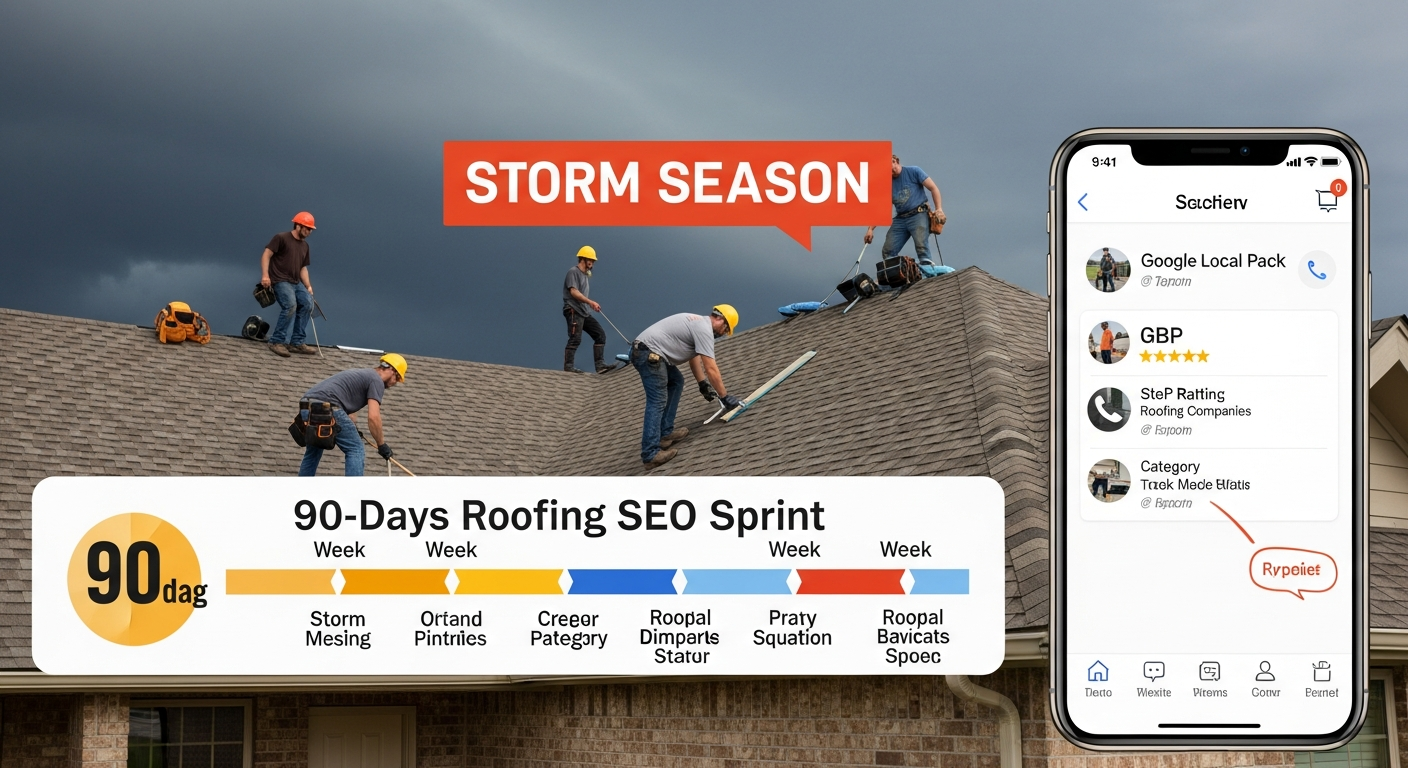
Roofing SEO: How to Rank in the Local Pack Before Storm Season Hits
Storm season creates a surge in roofing searches — but only the contractors already ranking in Google's Local Pack capture that demand. Here's how to get your roofing business positioned before the calls start flooding in.
Quick answer
To rank in Google's Local Pack for roofing searches before storm season, you need: a fully optimized Google Business Profile with roofing-specific categories and photos, consistent NAP citations, location-specific service pages on your website, an active review-generation system, and local backlinks from suppliers and trade associations. Start 90 days before your region's peak storm window — Local Pack rankings take time to build.
Why Storm Season Rewards the Roofers Who Already Did the Work
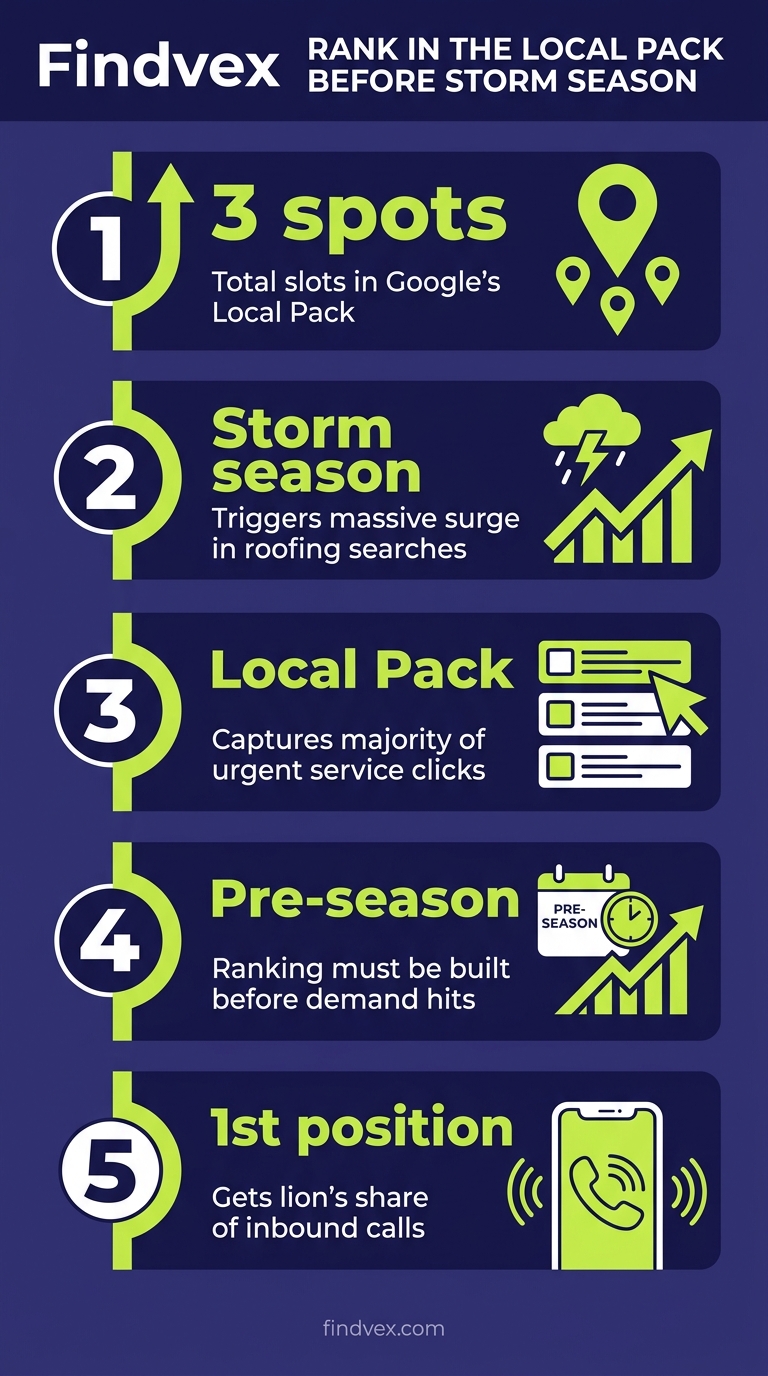
When a hailstorm rolls through a neighborhood, homeowners don't ask their neighbors who to call. They search 'roof repair near me' and call one of the first three results in the Local Pack. The roofers who appear there didn't get lucky — they prepared months in advance.
The Local Pack (also called the Map Pack) shows three roofing businesses with star ratings, phone numbers, and proximity signals. It sits above organic results and captures the majority of high-intent clicks on local service searches. If you're not there, the storm leads are going to your competitors.
This guide breaks down exactly what roofing contractors need to do — on their Google Business Profile, on their website, and off it — to secure Local Pack rankings before the busy season arrives. The timeline matters: most of these signals take 60–90 days to register, so the time to act is now.
Google Business Profile: The Foundation of Local Pack Rankings for Roofers
Your Google Business Profile (GBP) is the single most important asset for Local Pack visibility. Google uses it to determine whether your business is relevant, prominent, and proximate for a given roofing search. All three factors need work.
Start with your primary category. 'Roofing Contractor' is the correct primary category — not 'General Contractor' or 'Home Improvement.' Your secondary categories can include 'Gutter Installation Service,' 'Siding Contractor,' or 'Waterproofing Service' if you offer those. Getting the category right tells Google exactly what business type you are, which affects which searches trigger your listing.
Next, audit your business description. It should mention your service area explicitly, your core services (roof repair, replacement, storm damage inspection, insurance claims), and how long you've operated. Keep it factual and skip the marketing copy — Google reads this for context, not conversion.
- Set 'Roofing Contractor' as your primary GBP category
- Add all relevant secondary categories that match your actual services
- Upload at least 20 photos: completed jobs, team photos, before/after storm damage work
- Add your service area cities — don't just rely on your physical address
- Enable messaging and respond within 24 hours
- Use the Products or Services section to list each service with a short description
- Post a GBP update at least once every two weeks — project completions work well
- Ensure your business name, address, and phone number exactly match your website
“AI agents do in hours what teams used to do in weeks. The advantage compounds.”
Reviews: The Local Pack Signal Most Roofers Ignore Until It's Too Late
Review velocity — how frequently you receive new reviews — is one of the strongest signals Google uses to rank local businesses. A roofing company with 80 reviews that received 10 this month will typically outrank a competitor with 200 reviews that got none in six months.
Build a review request into every job close. After final walkthrough, send the homeowner a direct link to your Google review page via text message. A simple message like 'It was great working on your home. If you're happy with the job, a quick Google review helps us a lot — here's the link' converts at a much higher rate than a generic follow-up email.
Don't batch your review requests. Sending 20 requests at once after a slow period looks unnatural and can trigger Google's spam filters. Steady, consistent review generation — two to four per week — builds the kind of momentum that holds up across algorithm updates.
Respond to every review, positive and negative. Your response is indexed and visible in your GBP listing. For positive reviews, acknowledge what they mentioned specifically. For negative reviews, stay professional and offer to resolve the issue offline. This signals to both Google and prospective customers that you're an active, accountable business.
Service Pages and Location Pages: What Your Website Needs to Rank Locally
Your GBP gets you into the Local Pack, but your website determines whether Google trusts you enough to keep you there — and whether the visitors who click actually convert. Most roofing websites underperform on both counts.
Every major service needs its own dedicated page: roof replacement, roof repair, storm damage restoration, gutter installation, commercial roofing (if applicable). Combining all services on one page dilutes your keyword relevance and makes it harder for Google to understand what each page is about.
Each service page should answer the questions a homeowner actually has: What does this service involve? How long does it take? What does it cost (even a range)? Does your company handle insurance claims? What areas do you serve? Pages that answer real questions build topical authority and improve the likelihood of appearing in AI Overviews for informational roofing queries.
If you serve multiple cities or counties, build location-specific landing pages — one per service area. A page for 'Roof Repair in [City Name]' that includes local context (neighborhoods, common storm patterns, local permits) performs far better than a single 'Service Areas' page that just lists city names.
- Dedicated page for each service: repair, replacement, storm damage, gutters
- Location pages for each city or county you actively serve
- Include your phone number in the header and as a click-to-call button
- Add a contact form above the fold on every service page
- Embed your Google Maps listing on your contact page
- Use LocalBusiness and RoofingContractor schema markup on your homepage and service pages
- Ensure your NAP (name, address, phone) is identical across every page
Schema Markup for Roofing Contractors: What to Implement
Structured data doesn't directly cause Local Pack rankings, but it does help Google understand your business entity more precisely — which feeds into trust and relevance signals. For a roofing contractor, three schema types matter most.
LocalBusiness schema (using the 'RoofingContractor' subtype) on your homepage tells Google your business name, address, phone number, geographic coordinates, hours of operation, and service area. This reinforces your GBP data and reduces the chance of Google choosing a different canonical version of your business information.
Service schema on each service page signals what you do and where. Review schema, if implemented correctly, can display star ratings in organic results — which increases click-through rate even when you're not in the top Local Pack position.
For implementation, plugins like Rank Math (WordPress) or a manually added JSON-LD block handle this without a developer. If you want to go deeper on which schema types actually move the needle, our guide on schema markup for small business websites covers the five types that matter most.
NAP Consistency and Citations: The Unsexy Work That Still Matters
Google cross-references your business information across dozens of directories and data aggregators. If your business name is listed as 'Premier Roofing LLC' on your website but 'Premier Roofing' on Yelp and 'Premier Roofing Co.' on Angi, those inconsistencies create doubt about which signals to trust.
Audit your existing citations first. Search your business name and phone number to find every listing. Fix discrepancies in your business name, address, and phone number across the top directories: Yelp, Angi, HomeAdvisor, BBB, Houzz, and your local Chamber of Commerce.
For roofing specifically, industry directories carry extra weight: the National Roofing Contractors Association (NRCA) directory, state roofing association listings, and manufacturer certification pages (if you're a CertainTeed SELECT ShingleMaster, GAF Master Elite, or similar certified contractor, get listed on their contractor finders — those links carry genuine authority).
The goal isn't to be listed everywhere — it's to be listed correctly in the places Google actually checks. Twenty accurate, high-quality citations outperform one hundred inconsistent ones.
Local Link Building for Roofers: Where to Get Authority Links Without Gimmicks
Backlinks from locally relevant, authoritative websites signal to Google that your business is established and trusted in your community. For roofing contractors, there are several legitimate sources that competitors typically ignore.
Supplier and manufacturer pages are the easiest win. If you're an authorized dealer or certified installer for a shingle brand, roofing material supplier, or gutter system, request a listing on their contractor locator. These pages link out to contractor websites and carry domain authority from established industry brands.
Local news coverage is worth pursuing, especially around storm events. A quote from you as a local roofing expert in a news article about storm preparedness or insurance claims earns a backlink and builds E-E-A-T signals. Introduce yourself to local journalists before storm season — not during.
Sponsoring local events — a youth sports team, a community fundraiser, a neighborhood association — often comes with a website listing that includes a backlink. These links are modest in authority but locally contextual, which matters for local search.
Avoid directory spam, link schemes, or any service that promises 'hundreds of backlinks' for a flat fee. Those tactics create risk and rarely produce Local Pack movement.
Content That Captures Storm-Driven Search Demand Before and After the Storm
Homeowners search differently before and after a storm. Before: 'how to prepare your roof for hurricane season,' 'roof inspection checklist,' 'what does hail damage look like.' After: 'emergency roof repair [city],' 'storm damage roof insurance claim,' 'how to tell if your roof needs replacement after storm.'
Publishing answers to these questions — in dedicated blog posts or FAQ sections on your service pages — positions your website to capture both types of demand. This content also increases the probability of appearing in Google AI Overviews, which increasingly cite local service providers for question-based queries.
Focus on questions that have genuine search volume and that your competitors haven't answered well. A 600-word post on 'How to Document Roof Storm Damage for an Insurance Claim' answers a real question, demonstrates expertise, and attracts exactly the kind of homeowner who is about to hire a roofer.
Don't publish five posts the week before storm season. Publish one strong piece per month, year-round. Consistency builds topical authority faster than seasonal bursts.
- 'What Does Hail Damage Look Like on a Roof?' — informational, high intent
- 'How to File a Roof Insurance Claim in [State]' — high commercial intent
- 'Roof Inspection Checklist Before Hurricane Season' — captures pre-season demand
- 'Emergency Roof Repair vs. Full Replacement: How to Decide' — decision-stage content
- 'How Long Does a Roof Replacement Take?' — common homeowner question
Do This This Week: Your 90-Day Roofing SEO Sprint
Storm season waits for no one. Here's what to work through over the next 90 days, in order of impact.
- Week 1: Audit your GBP — fix your category, add photos, complete every field, verify your service areas
- Week 1: Confirm NAP is identical on your website, GBP, and top 10 directories — fix any discrepancies
- Week 2: Set up a review request text message workflow — send to every completed job going forward
- Week 2–3: Audit your service pages — create any missing pages (repair, replacement, storm damage, gutters)
- Week 3–4: Add LocalBusiness schema (RoofingContractor subtype) to your homepage and service pages
- Week 4–5: Build or request listings on manufacturer certification pages and industry directories
- Week 5–6: Publish your first storm-season content piece targeting a high-intent homeowner question
- Week 6–8: Identify local link opportunities — supplier pages, Chamber of Commerce, local sponsorships
- Week 8–12: Continue review generation, GBP posting cadence, and one content piece per month
- Week 12: Run a full GBP audit against the 23-point checklist and check Google Search Console for any indexing issues on your service and location pages
Turning Local Pack Rankings Into Booked Jobs — Not Just Clicks
Ranking in the Local Pack gets you the click. Converting that click into a booked inspection or signed estimate is a different problem — and one that most roofing websites handle poorly.
Your homepage and service pages should make it frictionless to contact you. Phone number clickable and visible at the top of every page. A contact form that asks only what's necessary (name, phone, address, brief description). A clear statement of your service area. If you offer free storm damage inspections, say so prominently — that offer removes the price objection that stops homeowners from calling.
Social proof matters at the conversion stage. A feed of recent Google reviews embedded on your homepage, photos of completed local jobs, and any industry certifications (GAF, CertainTeed, manufacturer warranties) displayed clearly tell a nervous homeowner that you're the safe choice.
Speed also affects conversion. A slow-loading page loses the lead before they ever see your offer. If your site is on WordPress and your Core Web Vitals scores are in the red, fixing those issues should be part of your pre-season sprint — it affects both your Google rankings and your ability to convert the traffic you earn.
FAQs
How long does roofing SEO take to produce Local Pack rankings?
Most roofing contractors see meaningful Local Pack movement within 60–90 days of consistent GBP optimization, review generation, and citation cleanup. Competitive metro markets may take 4–6 months. The key is starting before storm season — not during it.
What Google Business Profile category should a roofing contractor use?
Use 'Roofing Contractor' as your primary category. Secondary categories can include 'Gutter Installation Service,' 'Siding Contractor,' or 'Waterproofing Service' depending on your actual service mix. Using an incorrect primary category (like 'General Contractor') will reduce your visibility in roofing-specific searches.
Does a roofing company need a website to rank in the Local Pack?
You can appear in the Local Pack without a website, but you'll have a hard time sustaining or improving that ranking. A website with properly structured service pages, consistent NAP, and local schema markup reinforces your GBP signals and increases Google's confidence in your business.
How many reviews does a roofing company need to rank?
There's no universal number — it depends on your market. In smaller markets, 30–50 reviews with a strong rating may be enough. In competitive cities, you may need 100+ with active review velocity (new reviews consistently coming in). Review recency matters as much as total count.
Should roofing contractors create separate pages for storm damage repair?
Yes. Storm damage restoration is a distinct service with its own search behavior, homeowner intent, and insurance claim process. A dedicated page targeting 'storm damage roof repair [city]' will outperform a combined services page and captures high-intent searches immediately after weather events.
What's the difference between organic rankings and the Local Pack for roofers?
The Local Pack (Map Pack) shows three local businesses with ratings, distance, and contact info at the top of results for local queries. It's driven primarily by your Google Business Profile. Organic rankings appear below the Local Pack and are driven by your website's content, authority, and technical SEO. Both matter, but for service-area roofing businesses, Local Pack visibility typically drives more immediate phone calls.
Do roofing companies need to run Google Ads alongside SEO?
Not necessarily, but paid ads can fill the gap while your organic and Local Pack rankings build. If storm season is weeks away and your rankings aren't where you need them, Local Services Ads (LSAs) for roofing can drive leads immediately. Long-term, SEO is more cost-effective — you're not paying per click indefinitely.
Related reading
- landscaping seo — Landscaping SEO: How to Fill Your Schedule Without Paying for Every Lead
- schema markup for small business — Schema Markup for Small Business Websites: The 5 Types That Actually Affect Your Rankings
- home services seo — Home Services SEO Benchmark: What It Actually Takes to Rank in the Top 3 in 2026
- plumber seo services — Plumber SEO Services: How to Get More Local Calls Without Paying Per Lead
- seo for dentists — SEO for Dentists: A Practical Playbook for More Local Patients
- local landing pages seo — Local Landing Pages That Rank Without Sounding Generic
- google business profile audit — Google Business Profile Audit Checklist: 23 Things That Actually Affect Your Local Ranking
- real estate seo — Real Estate SEO: How Local Agents Win Search in 2026
- restaurant seo — Restaurant SEO: How to Rank for Local Dining Searches
- law firm seo — Law Firm SEO: What Actually Moves Rankings for Solo Attorneys and Small Practices
Research notes
Background claims used while researching this article. Verify with the cited authorities before quoting.
- Review velocity is a Local Pack ranking signal — verify via Google's official documentation or a credible SEO study confirming review recency/velocity as a Local Pack factor — Google's developer docs on local search ranking factors or a Whitespark/BrightLocal local ranking factors study would suffice.
- Manufacturer certification pages (GAF Master Elite, CertainTeed SELECT ShingleMaster) carry authority for local backlinks — verify via No study required — this is a standard industry practice verifiable by checking the manufacturer contractor finder pages directly. Editor should confirm the correct certification tier names for GAF and CertainTeed before publishing.
Sofia Patel
Head of Content & Growth · Findvex
Sofia Patel leads content and growth at Findvex. She writes about local SEO, conversion-focused content, and AEO/GEO strategy — the work that turns search visibility into booked calls and qualified leads for service businesses.
Expertise: Local SEO · Conversion content · AEO / GEO strategy · Content-led link building
Related reads
Google TurboQuant and Entity-Driven SEO: What the Compression Breakthrough Actually Means for Your Site
TurboQuant is a vector quantization algorithm from Google Research that dramatically compresses the mathematical representations AI uses to understand meaning. If it reaches production search infrastructure, it could lower the cost of semantic retrieval at scale — making entity-based content signals more dominant and keyword-match signals relatively less important.
SEO NewsHow AI Is Changing Local Search Visibility: What the SOCi + Google Webinar Revealed
Google and SOCi's joint webinar on local search visibility highlighted a fundamental shift: AI-powered discovery across Google Search, Maps, and Gemini now requires a different optimization playbook than the one most small businesses are running. Here's what changed and what to prioritize.
Strategic Technical SEODuplicate Content SEO: What Google Actually Penalizes vs. What It Silently Handles
Duplicate content rarely triggers a manual penalty. Google usually picks one version and ignores the rest. But the wrong choice by Google can split your ranking signals, waste crawl budget, and suppress pages you actually want ranked. Here's how to diagnose the difference.