Bing Grounding vs. Search Indexing: What Microsoft's Framework Means for Your Site's AI Visibility
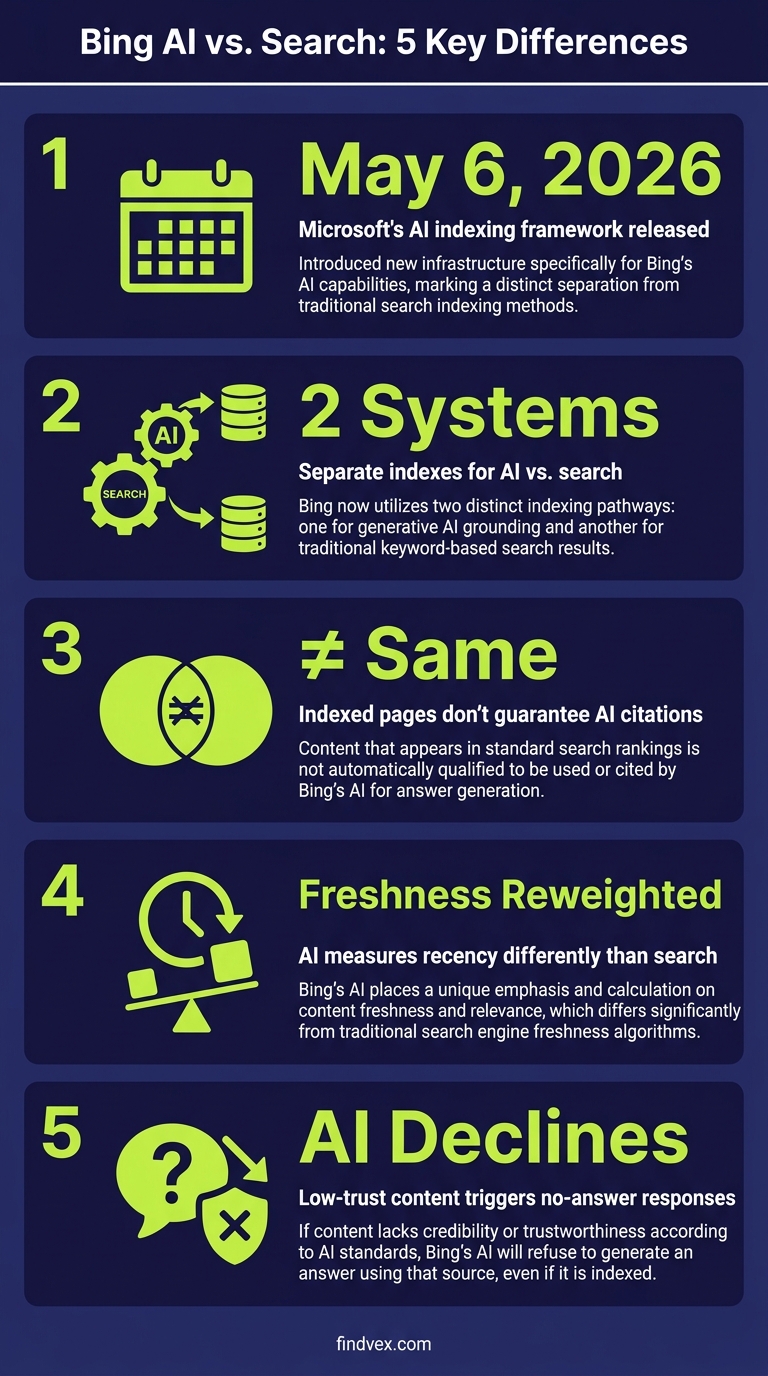
Microsoft's Bing team released a detailed framework on May 6, 2026, explaining how indexing for AI-generated answers differs from traditional web search. The difference is not cosmetic — it changes what content gets cited, when AI declines to answer, and how freshness is measured. Here's what it means in practice.
Quick answer
Bing's grounding system and its traditional search index share the same crawlers and quality signals, but they measure content differently. Traditional search ranks documents by relevance. Grounding evaluates individual passages for factual fidelity, source attribution quality, freshness, coverage of high-value facts, and contradiction-free consistency. If your content fails those tests, Bing's AI will decline to use it — even if that same page ranks on page one.
What Microsoft Published and Why It Matters
On May 6, 2026, Microsoft's Bing team published a technical blog post titled 'Evolving role of the index: From ranking pages to supporting answers,' co-authored by Krishna Madhavan, Knut Risvik, and Meenaz Merchant. It is one of the most detailed public explanations Microsoft has offered of how its indexing infrastructure handles AI-generated answers differently from conventional web search.
The core argument: both systems use the same foundation — the same crawlers, quality signals, and relevance infrastructure. But what each system does with that foundation is fundamentally different. Traditional search points users to documents. Grounding constructs answers from those documents. That distinction changes what you need to do to be cited.
Same Crawlers, Different Purpose: How the Two Systems Diverge
Think of it this way: traditional search is a librarian who hands you a list of books. Grounding is a researcher who reads those books, extracts specific claims, and writes a briefing. The librarian cares about which books are most relevant and authoritative. The researcher cares whether individual sentences can be trusted, sourced, and defended.
According to Microsoft's post, the unit of value shifts from the document to the evidence chunk. A page that ranks well for a query may still be bypassed by grounding if its individual passages do not meet the evidence quality bar. This is not a ranking problem — it is a content structure and factual integrity problem.
“AI agents do in hours what teams used to do in weeks. The advantage compounds.”
The 5 Areas Where Grounding Measures Your Content Differently
Microsoft's framework identifies five measurement areas where grounding diverges from ranking. Understanding each one tells you exactly where to focus your content and technical work.
- Factual fidelity. Can each individual passage be verified as accurate? Vague, hedged, or unattributed claims are harder to use as grounding material. Content that makes specific, sourced assertions fares better.
- Source attribution quality. Does the page clearly signal who produced the information, when, and on what authority? Authorship markup, publication dates, and organizational credentials all contribute here. This connects directly to E-E-A-T signals, though Microsoft frames it in terms of what the AI can responsibly cite.
- Freshness. Grounding penalizes stale content more aggressively than traditional ranking does. A ranking page can hold position for months on domain authority alone. A grounding system checking a time-sensitive fact will bypass a page with a 2023 publication date even if it ranks position one.
- Coverage of high-value facts. Does your content actually answer the specific factual questions users are asking? Pages that circle a topic without committing to concrete answers are poor grounding candidates. FAQ-style structures and direct definitions score better.
- Contradiction handling. If your site contains conflicting information — different prices on two pages, contradictory eligibility claims, updated policies alongside old ones — grounding systems may flag the contradiction and decline to use either source.
Abstention: Why Bing's AI Says 'I Don't Know' (and What Triggers It)
One of the most practically important concepts in Microsoft's framework is abstention. Unlike a traditional search result that will always return something, Bing's grounding system is designed to withhold an answer when the evidence is missing, stale, or conflicting. Microsoft explicitly calls this a feature, not a failure.
For site owners, this has a direct implication: if your content on a given topic is thin, out of date, or internally inconsistent, you are not just ranking lower — you may be triggering abstention and losing the citation entirely. A page that would have generated a click from a ranked result gives you nothing if grounding skips it.
Abstention also operates at a query level, not just a page level. If Bing cannot find sufficient grounding evidence across any indexed source to answer a question confidently, it declines to answer rather than hallucinate. This is structurally different from how Google's AI Overviews currently behave, though both systems are moving toward evidence accountability.
Iterative Retrieval: The Index Is Queried More Than Once
Microsoft's post describes grounding retrieval as a loop rather than a single step. When constructing an answer, the system may query the index multiple times, checking whether retrieved evidence holds up, looking for corroborating sources, and refining the answer iteratively.
What this means technically: a single well-written page on a topic may be retrieved, evaluated, partially accepted, and then supplemented or replaced by another source mid-loop. Pages that are comprehensive — covering a topic with enough depth that follow-up retrieval queries find consistent answers on the same domain — are more likely to anchor the final answer.
This is one reason that thin topical coverage hurts AI visibility more than it hurts traditional rankings. In traditional search, a focused 500-word page can rank for a narrow query. In a grounding loop, that page may get retrieved, used for one sentence, and then bypassed for the rest of the answer.
Diagnosis Checklist: Is Your Site Ready for Bing Grounding?
Run through these checks before assuming your traditional SEO work covers you.
- Chunk review: Open your key service or product pages. Can you extract a single paragraph that cleanly answers a specific question without needing surrounding context? If not, your content is not chunking well for grounding retrieval.
- Publication and update dates: Are dates visible and accurate on content that covers time-sensitive topics (pricing, regulations, availability, statistics)? Undated pages or pages with stale dates are high-risk for grounding bypass.
- Author and organization signals: Does your site identify who wrote or approved important content? Schema markup using
author,Organization, anddateModifiedproperties helps signal attribution quality. - Internal contradiction audit: Search your own site for duplicate or conflicting information — especially service descriptions, FAQs, and location pages. Contradictions between pages are a grounding disqualifier.
- Direct answer coverage: For the top 10 questions your customers actually ask, does your site have a page that directly and unambiguously answers each one? Circuitous answers that require reading an entire article to extract a fact are poor grounding candidates.
- Freshness schedule: Do you have a documented process for reviewing and updating content on a schedule? For fast-moving topics, quarterly is a minimum.
What to Check in Google Search Console (and Bing Webmaster Tools)
Google Search Console does not surface grounding-specific signals, but proxy indicators exist. Bing Webmaster Tools is the more relevant platform here, though its AI-specific reporting is limited at the time of publication.
In Bing Webmaster Tools: Check crawl errors and indexing status for your highest-value content pages. Pages not indexed cannot be grounded. Confirm your sitemap is submitted and current. Check for blocked resources — if Bing's crawler cannot access CSS, JavaScript, or images needed to render your content, content extraction quality degrades.
In Google Search Console as a proxy: Review the Pages report for 'Crawled but not indexed' — pages with indexing issues on Google likely have parallel issues on Bing. Review the Core Web Vitals report — slow pages are deprioritized by both traditional and grounding systems. Check for structured data errors; broken schema reduces attribution signal quality.
Developer Handoff Notes: Technical Changes Worth Prioritizing
The following changes are worth communicating to your developer or CMS manager. Risk levels are noted for each.
- Add
dateModifiedto Article and WebPage schema. Risk: low. Impact: signals content freshness to both Bing and Google grounding systems. Implementation: update your schema plugin or template to includedateModifiedpulled from your CMS's last-updated timestamp. - Add
authorschema withPersonorOrganizationentity. Risk: low. Impact: improves source attribution quality scores. Implementation: includeauthorobject in your Article schema with name, URL, and optionallysameAslinks to LinkedIn or professional profiles. - Structure FAQ content as proper
FAQPageschema. Risk: low. Impact: makes direct answers machine-readable and extractable as grounding chunks. Implementation: any page with a Q&A section should carry FAQPage structured data. See our guide on schema markup types for implementation details. - Audit and consolidate duplicate or near-duplicate pages. Risk: medium (canonicalization errors can cause indexing drops if done incorrectly). Impact: eliminates contradiction signals that trigger abstention. Implementation: use canonical tags or 301 redirects; do not delete pages without redirecting.
- Ensure Bingbot is not blocked in robots.txt. Risk: low to check, medium if changes are made incorrectly. Impact: fundamental — if Bingbot cannot crawl, grounding cannot happen. Implementation: review your robots.txt file at yourdomain.com/robots.txt and confirm no
Disallowrules apply to Bingbot or important content paths.
Does This Apply to Google's AI Overviews Too?
Microsoft's post is specific to Bing's infrastructure, but the underlying logic applies broadly. Google's AI Overviews and AI Mode operate on similar principles — retrieving evidence chunks, evaluating factual reliability, and constructing answers rather than ranking documents. Google has not published an equivalent framework with this level of specificity, but the content characteristics that perform well in Bing's grounding system — direct answers, clear attribution, freshness signals, contradiction-free pages — are the same characteristics that perform well in Google's generative systems.
The practical takeaway: optimizing for Bing grounding is not a separate workstream from optimizing for Google AI Overviews. The same content improvements serve both. If you are already working on your site's AI search visibility, Microsoft's framework gives you a more explicit checklist to test against.
A Prioritized Action Plan for Site Owners
Given the framework Microsoft published, here is how to sequence your work.
- Week 1 — Contradiction audit. Pull a list of your most important pages. Search for duplicate topics, conflicting facts, and outdated claims. Resolve contradictions first — they are the most direct grounding disqualifier.
- Week 2 — Freshness signals. Add visible publication and last-updated dates to all content that covers time-sensitive topics. Implement or verify
dateModifiedin your schema. - Week 3 — Attribution markup. Add or fix author schema across blog posts and key service pages. Confirm your organization schema is complete and consistent with your Bing Places and Google Business Profile listings.
- Week 4 — Direct answer coverage. Map the top 10–15 questions your customers ask. Ensure each has a page or section that answers it directly in the first two sentences. Add FAQPage schema where appropriate.
- Ongoing — Freshness schedule. Set a quarterly calendar reminder to review top-performing pages for stale statistics, outdated pricing, changed regulations, or superseded recommendations.
Need Help Auditing Your Site for AI Search Readiness?
The grounding framework Microsoft published gives SEOs a concrete diagnostic lens that traditional audits do not cover. If your current audit process was built around crawlability and keyword optimization, it is likely missing the content structure and freshness signals that determine whether your pages get cited in AI-generated answers.
FindVex's technical SEO audits now include AI grounding readiness checks — covering schema completeness, contradiction detection, content chunking quality, and freshness signal review. If you want a clear picture of where your site stands, start with a structured audit before the gap between ranked and cited widens further.
FAQs
What is Bing grounding in AI search?
Grounding is the process by which Bing's AI system pulls evidence from indexed web content to construct a factually defensible answer. Unlike traditional search, which ranks documents by relevance, grounding evaluates individual passages for factual accuracy, source attribution, freshness, topic coverage, and internal consistency before using them in an AI-generated response.
How is Bing grounding indexing different from traditional search indexing?
Both systems use the same crawlers and quality infrastructure, but they measure different things. Traditional indexing ranks documents. Grounding indexing evaluates whether specific passages within those documents can responsibly support a factual claim. A page can rank well in traditional search and still be bypassed by the grounding system if its content is stale, contradictory, or poorly attributed.
What does abstention mean in Bing's AI system?
Abstention is when Bing's grounding system declines to generate an answer because it cannot find evidence that meets its quality threshold. This happens when content on a topic is missing, out of date, or contains contradictions. Microsoft describes it as a deliberate feature — the system would rather say nothing than fabricate an answer.
Will optimizing for Bing grounding also help with Google AI Overviews?
In practice, yes. Google has not published an equivalent framework, but both systems evaluate content similarly: they prefer direct answers, clear attribution, fresh information, and contradiction-free pages. Work you do to improve grounding readiness for Bing will generally improve your position in Google's AI-generated answers as well.
How do I check whether Bingbot is crawling my site correctly?
Log into Bing Webmaster Tools at bing.com/webmasters and check the Crawl section for errors, blocked URLs, and indexing status. Also review your robots.txt file at yourdomain.com/robots.txt and confirm no Disallow rules are blocking Bingbot. Submit or verify your sitemap in Bing Webmaster Tools to ensure all key pages are discoverable.
What schema markup helps with AI grounding specifically?
The most impactful schema types for grounding readiness are: Article or WebPage with dateModified and author properties (signals freshness and attribution); Organization schema with consistent NAP details (establishes source authority); and FAQPage schema on pages with Q&A content (makes direct answers machine-readable and extractable as evidence chunks).
Does content length affect whether Bing's grounding system cites my page?
Length alone is not the determining factor — density of direct, verifiable claims is. A 400-word page that answers one question clearly and unambiguously may outperform a 2,000-word page that circles a topic without committing to specific answers. The grounding system extracts evidence at the passage level, so each paragraph needs to stand on its own as a citable unit.
Related reading
- turboquant entity driven seo — Google TurboQuant and Entity-Driven SEO: What the Compression Breakthrough Actually Means for Your Site
- crawl budget seo — Crawl Budget SEO: Why Google Skips Pages on Small Business Sites (and How to Fix It)
- technical seo audit checklist — Technical SEO Audit Checklist for Small Business Websites
- why ai search skips your content — Why AI Search Skips Your Content: A Technical Diagnosis Framework for Site Owners
- AI crawler blocking strategy — The AI Crawler Protection Paradox: Why Brands Block Bots Then Pay to Be Seen
- duplicate content seo — Duplicate Content SEO: What Google Actually Penalizes vs. What It Silently Handles
- robots txt seo — Robots.txt for Small Business Websites: What to Block, What to Allow, and What Silently Breaks Your SEO
- generative engine optimization — What Is Generative Engine Optimization (GEO)? How Small Businesses Get Found in AI Search
- openai crawl activity tripled since gpt-5 — OpenAI Crawl Activity Tripled Since GPT-5: What It Means for Your Website
- core web vitals seo — Core Web Vitals for SEO: What Business Owners Need to Fix First
Sources & Citations
Marcus Chen
Head of Technical SEO · Findvex
Marcus Chen heads technical SEO at Findvex. He writes about Core Web Vitals, indexing, schema, and JavaScript SEO — translating Google’s documentation into checklists small business owners can actually act on.
Expertise: Core Web Vitals · Indexing & crawlability · Schema / structured data · JavaScript SEO
Related reads
Google TurboQuant and Entity-Driven SEO: What the Compression Breakthrough Actually Means for Your Site
TurboQuant is a vector quantization algorithm from Google Research that dramatically compresses the mathematical representations AI uses to understand meaning. If it reaches production search infrastructure, it could lower the cost of semantic retrieval at scale — making entity-based content signals more dominant and keyword-match signals relatively less important.
SEO NewsHow AI Is Changing Local Search Visibility: What the SOCi + Google Webinar Revealed
Google and SOCi's joint webinar on local search visibility highlighted a fundamental shift: AI-powered discovery across Google Search, Maps, and Gemini now requires a different optimization playbook than the one most small businesses are running. Here's what changed and what to prioritize.
Strategic Technical SEODuplicate Content SEO: What Google Actually Penalizes vs. What It Silently Handles
Duplicate content rarely triggers a manual penalty. Google usually picks one version and ignores the rest. But the wrong choice by Google can split your ranking signals, waste crawl budget, and suppress pages you actually want ranked. Here's how to diagnose the difference.