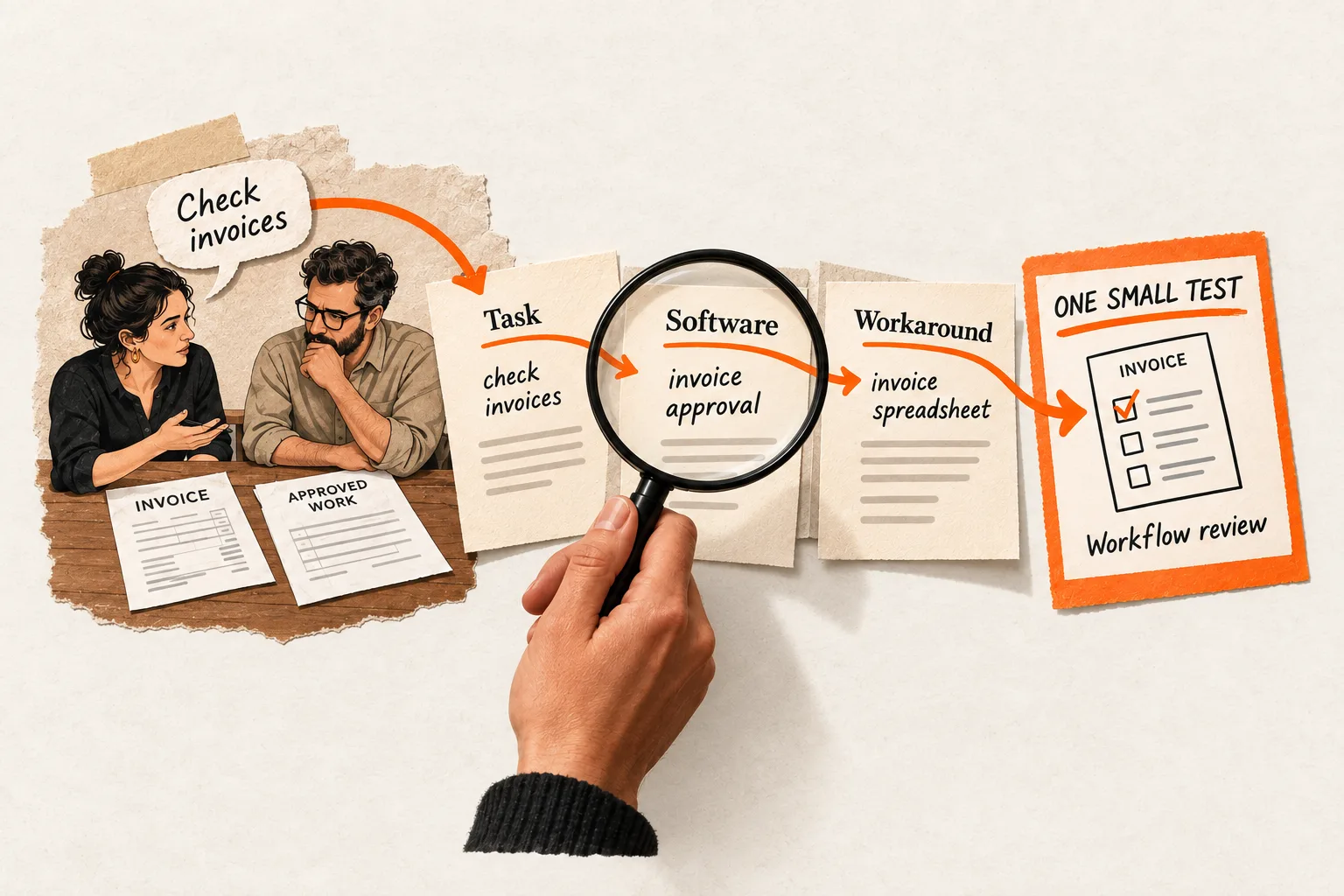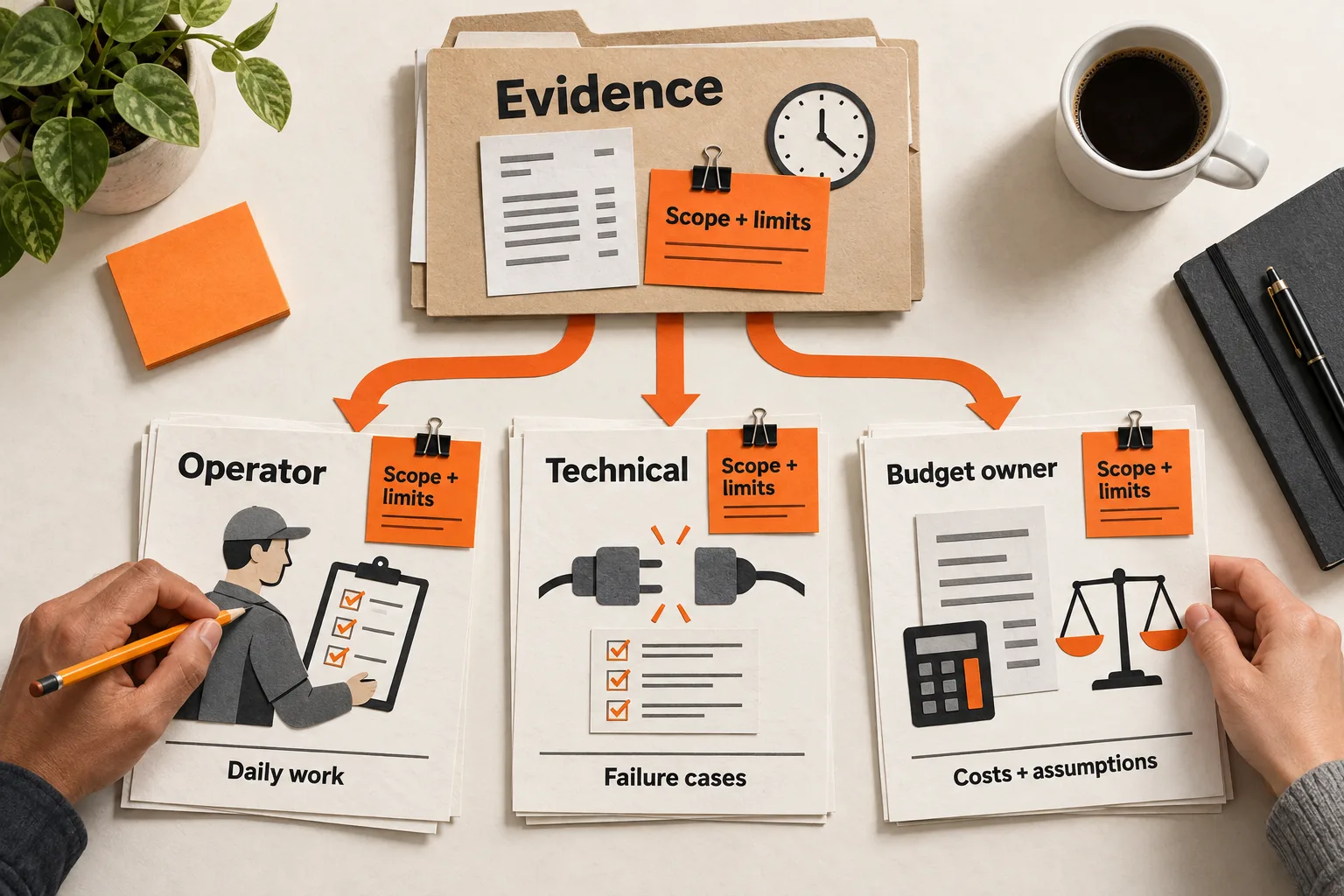
To explain a technical product’s value to different buying roles, start with one documented result. Lead each message with the decision that person needs to make, and keep the evidence and its limits consistent.
Imagine a pilot shows that software reduced the time needed to review an exception report. The operator wants to know which checks still require attention. The technical evaluator needs to understand integration and failure handling. The budget owner asks whether the improvement justifies the cost.
Write a short message for each responsibility, with a link to the same evidence record. Keep material caveats in the message itself so they survive when someone forwards it.
Document the result before adapting the message
Choose one completed workflow with a result you can inspect. A feature description such as “AI-powered exception detection” leaves too much unanswered: what did the team do before, what changed, and what work remained?
Create a shared evidence record:
| Field | What to record |
|---|---|
| Workflow and baseline | The task, previous process, and definition of a completed result |
| Measurement | Before and after values, units, sample size, dates, and collection method |
| Conditions | Users, input types, product configuration, and exclusions |
| Remaining work | Setup, review, corrections, maintenance, and exception handling |
| Evidence location | The approved report or underlying record, plus its owner |
| Claim limit | What the observation establishes and what remains unknown |
Keep observations separate from calculations and forecasts. A recorded reduction in review time is an observation. Multiplying that reduction by future workload is a projection. Multiplying projected hours by a labor rate estimates the value of staff capacity; it does not establish that payroll spending will fall.
Forrester’s Total Economic Impact methodology evaluates costs, benefits, flexibility, and risk. Use those categories to check what your business case leaves out, while keeping your own assumptions visible. Forrester’s methodology
If you have only a qualitative result, keep it qualitative. FindVex’s guide to writing a customer case study without metrics explains how to document workflow changes without manufacturing numbers.
Identify the decision each person must make
Start with responsibilities. In a small company, one founder may approve the budget, evaluate the software, and use it. Elsewhere, several people share those decisions.
Ask each participant:
- What must you decide before this project can proceed?
- What happens in the current workflow when this task goes wrong?
- What evidence would make a trial worthwhile?
- What would prevent you from accepting the result?
Record their wording alongside the source and context. Keep your interpretation in a separate field. For example, a request for fewer interruptions during month-end close would not, by itself, establish a goal of reducing staffing costs.
Joanna Wiebe’s account of rewriting the Crazy Egg home page describes surveys, customer interviews, and a research summary used to develop messages for testing. Apply that research sequence to learn which questions deserve attention in your copy. The project’s reported outcome does not predict yours. Copyhackers’ research process
Use these questions to begin the conversation, then confirm them with the people involved:
| Responsibility | Question the message should answer |
|---|---|
| Operates the workflow | What changes in my daily work? |
| Evaluates implementation | What must work, and what can fail? |
| Owns the budget | What benefit could justify the total cost? |
| Sponsors the project | What can I explain and defend internally? |
These responsibilities overlap. An operator may identify the most consequential implementation risk, and a technical evaluator may also control the budget.
Worked example: translate one invoice-review result
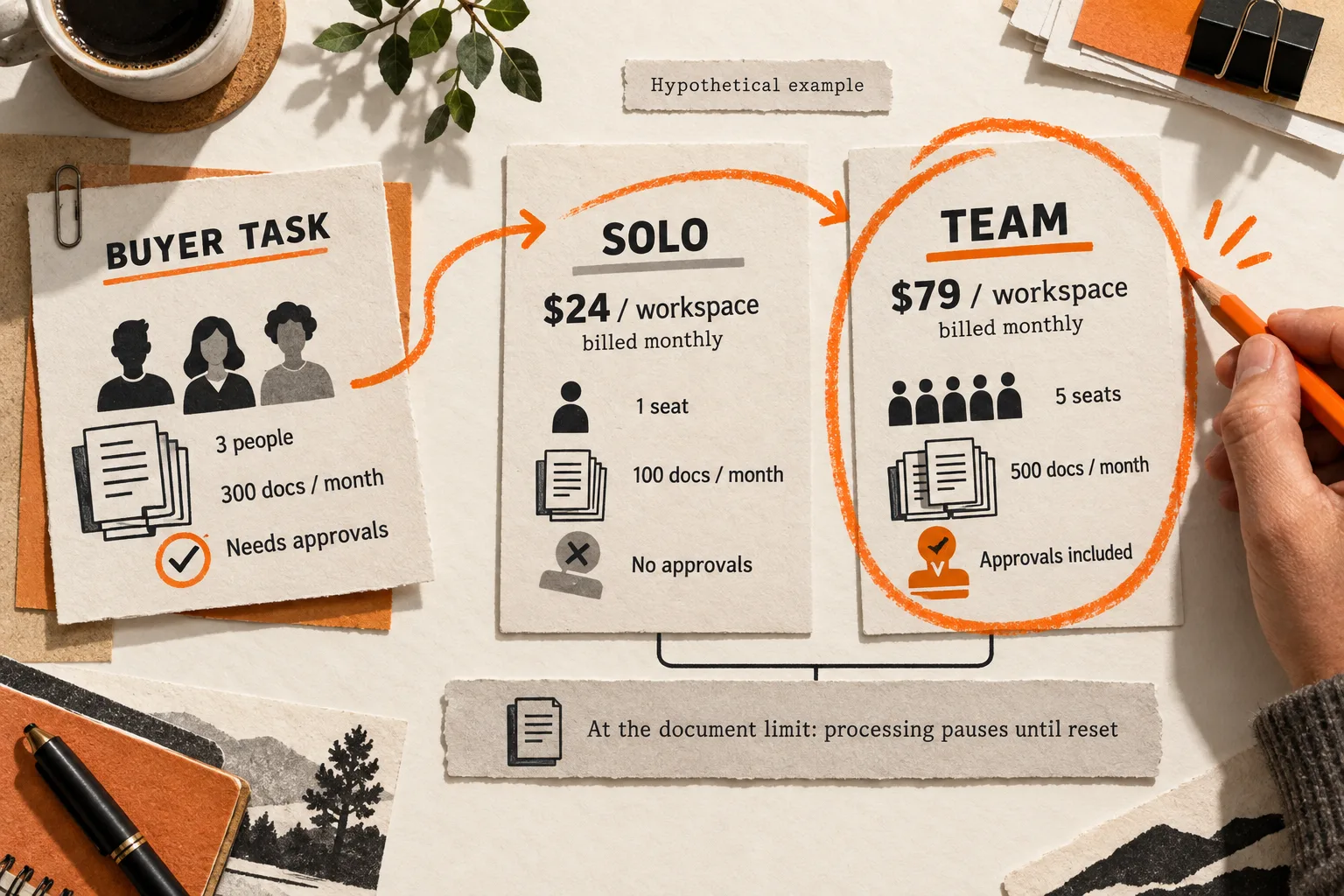
Everything in this example is fictional, including the measurements and sample messages. It illustrates the method, not a customer result or benchmark.
Suppose a SaaS product flags discrepancies in supplier invoices. A pilot compares manual and software-assisted review on 100 invoices. For this illustration, assume comparable inputs and controls for reviewer familiarity.
The evidence record contains these observations:
- Average active review time fell from 12 minutes to 8 minutes per invoice, including corrections.
- Both approaches identified the same 18 discrepancies against a predefined reference set.
- Reviewers checked every invoice before approval.
- The pilot covered one supplier format and excluded handwritten invoices.
- Initial setup took six staff hours, recorded separately from review time.
The four-minute difference amounts to about 6.7 review hours across the sample. That figure excludes the six setup hours. Finding the same reference discrepancies in this sample does not establish equivalent accuracy on other inputs.
Each message below should travel with this scope note and a link to the evidence record:
Pilot scope: 100 invoices, one supplier format, no handwritten invoices. Reviewers checked every invoice before approval; review time includes corrections. Six staff hours of setup were measured separately. Results on other inputs remain untested.
Operator: explain the work that changes
On the invoices tested, assisted review reduced average active review time from 12 to 8 minutes, including corrections. You still check each invoice before approval. Which supplier formats create the most rework for your team? Let’s use those to scope the next trial.
Pair this message with a walkthrough of a flagged discrepancy and the correction step. Keep the scope note visible beside it.
Technical evaluator: identify what still needs testing
Assisted review averaged 8 minutes per invoice versus 12 minutes manually. Both methods found the same 18 reference discrepancies in the sample. Before expanding, we need to test other formats, document failure handling, and measure integration and maintenance effort. Can we agree on the inputs and failure cases for that evaluation?
Attach the test protocol and results. Provide separate evidence for data handling and access controls; a time study cannot establish those capabilities.
Budget owner: expose the assumptions behind the value
The pilot observed four fewer review minutes per invoice. If that result holds across an assumed 600 eligible invoices per month, it would free 40 staff hours monthly. We need to establish how much of that time can be used productively and compare its value with subscription, setup, and ongoing operating costs. Can we review those assumptions together before estimating ROI?
Make the calculation inspectable:
| Step | Calculation or input | Status |
|---|---|---|
| Review-time difference | 12 − 8 = 4 minutes per invoice | Observation within the fictional pilot |
| Eligible monthly workload | 600 invoices | Assumption |
| Projected monthly capacity | 600 × 4 ÷ 60 = 40 hours | Projection if the pilot result repeats |
| Loaded labor rate | $45 per hour | Assumption |
| Monthly capacity value | 40 × $45 = $1,800 | Modeled value before costs |
| Scenario with half the time usable | 20 × $45 = $900 | Sensitivity check before costs |
Neither $1,800 nor $900 establishes cash savings. A cash-saving claim needs identifiable spending the organization would avoid. The six setup hours also belong in the cost calculation, even though they were excluded from the review-time measurement.
AWS’s guidance for migration business cases recommends checking whether freed staff time can be put to productive use and considering conservative scenarios. Apply those checks here; its migration estimates do not validate this invoice example. AWS guidance on detailed business cases
Internal sponsor: make the next decision easy to explain
Give the sponsor a paragraph they can forward with the scope note and evidence link:
The pilot reduced average active review time from 12 to 8 minutes per invoice. At an assumed 600 eligible invoices monthly, repeating that result would free 40 staff hours before accounting for setup and ongoing operating effort. We have not established how much capacity would be usable or whether spending would fall. The next decision is whether to approve a broader trial that tests additional supplier formats and records the full operating effort.
The sponsor can now explain the result, the projection, and the reason for another trial without reconstructing them from a presentation.
Keep the financial translation traceable
When a buyer asks for ROI, agree on the time horizon and which benefits count. A simple undiscounted calculation is:
ROI = (benefits over the period − costs over the period) ÷ costs over the period × 100%.
Use the same period for benefits and costs. Include implementation, training, subscription, usage charges, ongoing administration, and remaining manual work that creates incremental cost. Label observed inputs and buyer-supplied assumptions separately. More complex investments may require discounted cash flows or other financial treatment.
Avoid counting the same hours twice. If you value freed time as capacity, adding the full value of output produced during those hours may duplicate the benefit. Faster review also does not establish faster payment, fewer disputes, or higher revenue; those outcomes need their own evidence.
If the evidence supports only a pilot decision, write a pilot case. Specify what the trial must resolve before anyone relies on an annual ROI estimate.
Test understanding before testing response rates
Show each version, including its scope note, to someone who performs the relevant responsibility. Ask them to explain what changed, what remains uncertain, and what they need before taking the proposed next step.
Listen for consequential misunderstandings. If a budget owner repeats “$1,800 in monthly savings,” revise the capacity explanation. If an operator expects automatic approval, make the review requirement more prominent.
Track the revised message and the action it supports: agreement to supply test inputs, completion of a technical review, or acceptance of a pilot scope. A few conversations can expose confusion; they cannot establish a reliable conversion lift.
Choose a format that helps the recipient inspect the decision. An operator might need a workflow demonstration, while a budget owner needs an assumptions worksheet. FindVex’s customer story reuse map can help organize those assets around a shared approved source.
Use this worksheet for your next buyer conversation
Copy the fields below once for each buying responsibility:
| Field | Your notes |
|---|---|
| Person and responsibility | |
| Decision they need to make | |
| Their words about the problem, with source and date | |
| Observed workflow result and evidence link | |
| Why that result matters to their work | |
| Calculation or assumption, clearly labeled | |
| Scope note that must travel with the message | |
| Remaining work, cost, or uncertainty | |
| Evidence still needed | |
| Short message and appropriate format | |
| Requested next step |
Check that every number traces to an observation or labeled assumption, each message retains material limitations, and the requested action fits the evidence.
Next task: draft two messages from one result
Choose one documented result and two people who need to make different decisions. Complete a worksheet for each, then draft their messages side by side with the same scope note.
Read each message on its own. Can the recipient tell what happened, where the result applies, and what you are asking them to decide? Resolve any disagreement between the versions before creating more content.