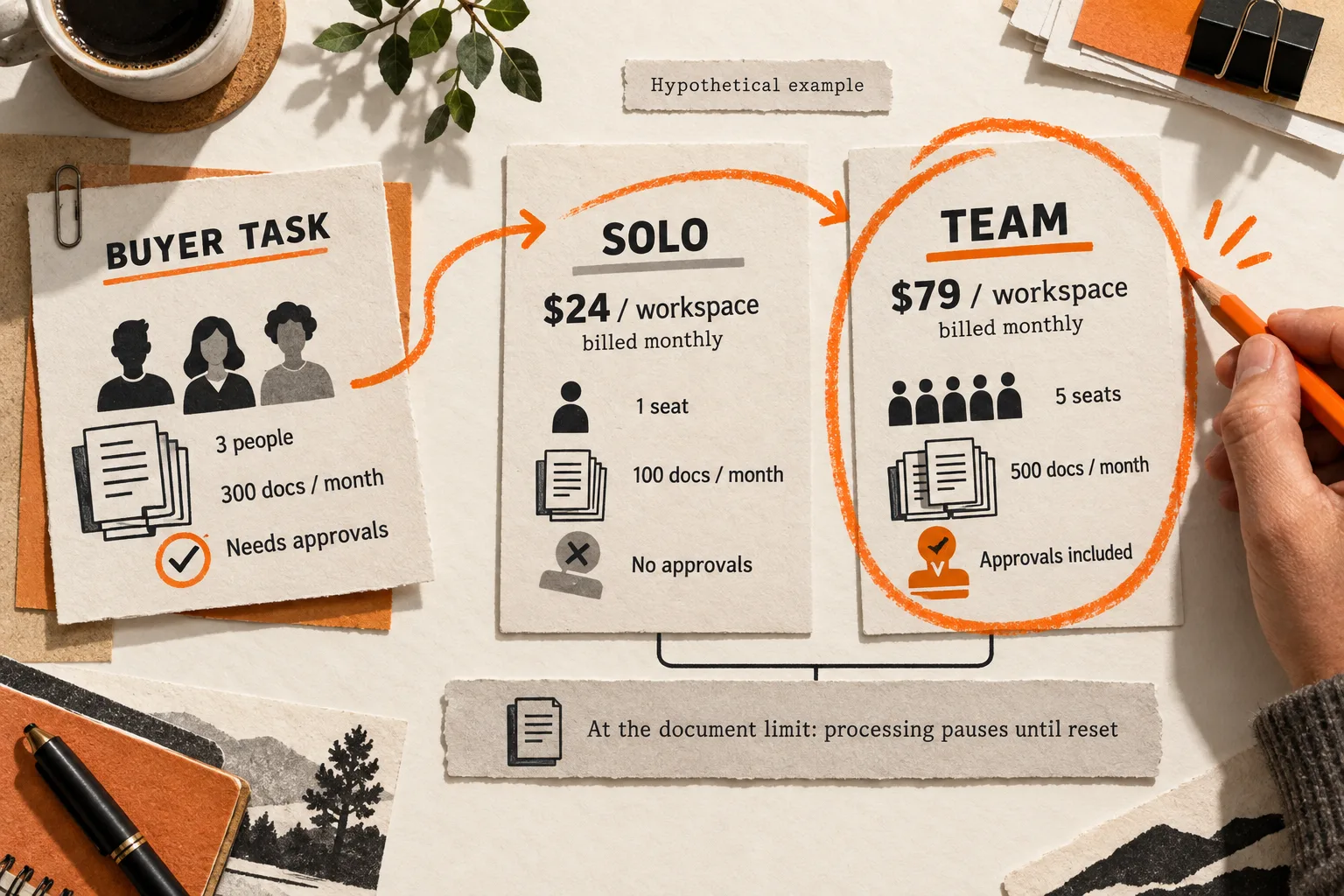
A buyer needs three people to review 300 documents a month. Your pricing page offers Starter, Pro, and Business, each with a long column of checkmarks. Can that buyer identify a suitable plan, calculate the payment, and explain what happens when they reach the document limit?
Put the differences that determine plan choice near the price: who can use the plan, how much work it covers, and which required capabilities it includes. Keep supporting detail easy to find. You can reorganize this information without changing your prices, then check whether a prospective buyer can use it correctly.
Start with the questions that change plan choice
Collect the questions prospects ask before signing up or upgrading. Use support conversations, sales notes, and interviews you have permission to review. Preserve the original wording separately from your interpretation.
Look for questions that would change a purchase decision: whether reviewers need paid seats, whether a required integration is included, or whether usage is shared across a workspace.
Turn each relevant question into a comparison row. A question about a manager checking a draft might become a row explaining reviewer permissions and seat charges. Verify the answer against the product and billing configuration before writing the copy. A question need not recur to matter; a required capability can rule out a plan for the buyer who needs it.
Give each plan a short description of the situation it supports. “For one person preparing documents” gives buyers more to work with than “For ambitious innovators.” If the descriptions differ only in feature counts, identify which additional capability makes the higher plan useful and for whom.
With little customer research, keep descriptions provisional and test them with prospective buyers. Do not invent customer language to fill gaps.
Separate shared capabilities from meaningful differences
Move capabilities included in every plan into a clearly labeled shared section, while preserving any differences in their limits. A checkmark for document processing cannot explain the difference between an allowance of 100 documents and one of 500.
Start the main comparison with the buyer or workflow each plan supports. Place the price, billing unit, and payment schedule together, followed by capacity limits and the capabilities that determine fit. Keep other details available below.
Adjust that order to the decision. If buyers require a particular security control before they can consider your product, put it earlier.
Use the same units and labels across plans. Compare documents with documents and seats with seats. Replace vague cells such as “Advanced access” with a specific permission or capability. Mark an add-on as an add-on instead of giving it an unqualified checkmark.
Buyers may overlook a separate shared-capabilities section. Keep a short summary close to the plans and make the complete comparison easy to find. Restrictions that could change the purchase decision belong beside the affected plan.
Make the billing unit and commitment explicit
Plan names do not explain how charges are calculated. Stripe distinguishes flat-rate subscriptions, per-seat pricing, quantity-based tiers, and usage-based models. Explain the calculation your product uses. Stripe’s recurring pricing models
A price should answer “per what?” and “paid when?” If an annual plan costs the equivalent of $40 per month, show the $480 annual charge nearby. Label the selected billing option and update both the equivalent rate and amount due when the buyer changes it.
Define a billable user. For example, Slack’s Fair Billing Policy lists multi-channel guests as paid and single-channel guests as free. The policy applies to plans and add-ons purchased through its website using credit card or self-serve invoicing. Your policy may differ, but buyers need to know which roles incur a charge. Slack’s Fair Billing Policy
For an AI product, define the consumption unit too. If buyers purchase credits, explain what consumes them, whether different operations consume different amounts, and when credits reset or expire. If consumption varies, give a labeled estimate with assumptions instead of implying a fixed number of outputs.
Keep the consequence of exceeding a limit beside that limit. Does work pause, does an overage charge apply, or must the customer upgrade? Link to full terms for detail, while keeping the answer that affects plan choice on the pricing page.
Worked hypothetical example: a document review app
The following product, packages, prices, and buyers are invented to demonstrate the method. They are not a case study or a pricing recommendation.
Suppose an AI document review app presents two plans as “Core AI tools” and “Advanced AI tools.” Both include upload, analysis, and export. Buyers must search an FAQ to discover the seat limits and document allowance.
Replace those vague distinctions with a comparison they can use:
| Decision | Solo | Team |
|---|---|---|
| Intended use | Individual review | Review with approvals |
| Monthly charge | $24 per workspace | $79 per workspace |
| Included seats | 1 | 5 |
| Documents per billing month | 100 | 500 shared across the workspace |
| Approval workflow | Not included | Included |
| After the document allowance is used | Processing pauses until the next allowance reset | Processing pauses until the next allowance reset |
Directly below the table, explain the shared rules. Both plans include upload, analysis, and export. One document means one successfully processed file of up to 20 pages; failed processing does not consume the allowance. Allowances reset each billing month without rollover. Additional seats are unavailable on these hypothetical packages.
A three-person team processing 300 documents monthly and requiring approval before export fits Team at $79 per workspace per month. The three people are covered by the five included seats. Solo fails the seat, document-volume, and approval requirements.
For a single person processing 80 documents without approvals, Solo is sufficient. The page should make that choice just as clear.
Suppose Team also has an annual option priced at $65 per month equivalent. Display “$780 billed annually; five seats included” beside it. The buyer pays $780 for the year, while the 500-document allowance still resets monthly. Annual payment does not make the year’s document allowances available at once.
At 650 documents a month, neither package fits. Explain whether a larger allowance is available. Offer a request route only if the business supports one; otherwise, make the limit clear before the buyer signs up.
Keep the comparison usable on a phone
Test the actual page at a narrow viewport with realistic text and prices. Check whether buyers can keep track of the plan names while reading limits and terms.
For a small plan set, try stacked cards that repeat the same fields in the same order. With more complex plans, consider a focused comparison between selected options. Preserve the full details for buyers who need them.
If you use a data table, its underlying structure must connect cells with their headers. W3C explains that assistive technologies use those relationships to provide context; visual alignment alone is insufficient. W3C’s tables tutorial
Make billing controls usable by keyboard, label their selected state, and keep essential terms available without hovering. Use the FindVex guide to accessible comparison tables to check table structure, visible conditions, and navigation.
Test whether buyers can choose and calculate correctly
Before testing conversion, give a prospective buyer a realistic task with a team size, expected usage, and required capability. Ask them to choose a plan, calculate the payment due, and explain what happens when usage exceeds the allowance.
For the hypothetical app, the task could read:
Your team has three people, processes 300 documents a month, and needs approval before export. Choose a plan with monthly billing. What would the workspace pay each month? What would happen if the team needed to process 501 documents in one billing month?
Prepare the expected answers before the session: Team, $79 per workspace per month, and processing pauses after the 500-document allowance is used until the next reset. Keep that answer sheet out of the participant’s view.
Observe where the participant hesitates or answers incorrectly. Avoid explaining the page while they work. Record any help you give so you can distinguish an unaided answer from one that required clarification.
Copy this worksheet for each session:
Page version, test date, device, and billing option:
Buyer scenario and required capabilities:
Expected plan, or reason no plan fits:
Expected payment and billing schedule:
Expected behavior at the usage limit:
Product or billing owner who verified these answers:
Participant's choice, calculation, and explanation:
Where they hesitated or misunderstood a term:
Help given during the task:
Proposed copy or layout change:
Follow-up task and observed result:
If you later run an A/B test, define the decision and outcome in advance. Track completed purchases or qualified trials alongside signs of misunderstanding, such as billing questions and early cancellations. A higher button-click rate alone does not establish better plan selection.
Keep prices and packages stable if the test concerns presentation. Low traffic may leave a conversion result inconclusive. A few usability sessions can reveal specific misunderstandings, but they cannot establish a conversion lift.
Review one plan boundary today
Choose two adjacent plans. Write down when the cheaper plan is sufficient, what requirement makes the higher plan necessary, and when neither plan fits.
Check that the page puts the price, billing unit, payment schedule, and minimum commitment together. Confirm that limits, add-ons, and overage behavior agree with checkout and actual billing.
Rewrite the first unclear distinction and give one prospective buyer a selection task using the worksheet. Record what they could answer unaided and what remained unclear. Use that observation to choose the next revision.