Before you commission ten SEO articles, find out how buyers look for help when the problem your product solves becomes urgent. They might search for software, describe a broken workflow, ask a colleague, or keep using a spreadsheet.
An unfamiliar category name can hide an existing search opportunity: buyers may search for the task using words your team never uses. A familiar keyword can also attract people whose needs your product cannot meet.
Collect buyers’ language, inspect the results for plausible searches, and choose one small test before committing to a content plan.
Separate category awareness from the need to change
For this exercise, demand capture means helping people who are already looking for a solution find and evaluate yours. Demand creation means helping potential buyers recognize a problem, understand a different approach, and develop a reason to act.
Both can happen within the same channel. A search article can teach someone why a workflow needs changing. A community conversation can reach someone already comparing vendors.
Use buyer behavior to decide what to investigate:
| What buyers describe | What to investigate next |
|---|---|
| They name a category and compare products. | Category and comparison searches that match your product. |
| They describe a recurring problem without naming a category. | Task, troubleshooting, and workaround searches. |
| They tolerate the current process and have not investigated alternatives. | Whether the problem is costly or urgent enough to justify changing. |
That last situation needs care. Limited budget, switching costs, or satisfaction with a workaround may explain the lack of buying activity. More education will not necessarily change those constraints.
Collect language before opening a keyword tool
Choose one buyer role and one situation. “Small businesses using AI” is too broad. “Operations managers at small agencies who reconcile contractor invoices each month” gives you a workflow to investigate.
Start with five conversations as a manageable first batch. This is too small and selective to represent the market. Include people beyond enthusiastic customers or founder friends. Where possible, speak with someone who evaluated a solution and someone who kept the old process.
Ask about the last time the problem happened:
- What triggered the need to do something?
- How did you handle it, and what did that cost in time or money?
- Where did you look for help? If you searched, what words do you remember using?
- What alternatives did you consider, including doing nothing?
- What stopped you from changing, or made the change worthwhile?
Ask before introducing your category name. Label remembered searches as recalled language. If someone voluntarily shows a relevant search or evaluation document, record that separately so you can distinguish recollection from an observed record.
Public reviews can supply language to investigate when interviews are scarce. Joanna Wiebe’s review-mining method starts with the audience, desired outcome, and solutions people already use. Her Flow example also shows recurring complaints becoming questions about the product’s actual capabilities. Read the original Copyhackers method.
Keep the person’s exact words in one field and your interpretation in another. A complaint about copying invoice totals does not automatically mean the person wants an “autonomous finance agent.”
Build a short query list and inspect the results
Translate the evidence into roughly eight to twelve candidate searches. Include category names buyers used, descriptions of the task, current workarounds, and named alternatives. Mark phrases you invented as hypotheses, even when they sound close to what a buyer said.
Search those phrases in Google using US location and English language settings. Record the date, device, and location shown. Review the first page and open several results; titles alone can hide a mismatch.
For each query, identify the apparent audience, the task the pages help complete, and the requirements your product would need to meet. A page for an individual disputing an invoice serves a different reader from a page for an agency approving contractor payments.
If results are mostly downloadable spreadsheets, investigate whether searchers want a free template, a better process, or automation. The presence of templates does not establish that buyers want to replace their spreadsheet.
Vendor pages, pricing pages, and comparisons suggest a commercial interpretation worth testing. Tutorials suggest an informational task. Mixed results leave intent uncertain. These are working interpretations of the pages you inspected; they do not tell you how many qualified buyers exist or whether your site can compete.
Keep related queries together when they serve the same buyer task. Once you find a plausible task, use the guide to mapping SaaS keywords to the buyer’s next decision to choose a useful page format.
Use search estimates to qualify the opportunity
Add keyword estimates after checking relevance. Record the exact phrase, country, provider, reporting period, and metric update date when available. Keep unknown demand distinct from a provider’s estimate of zero.
Google says Keyword Planner’s average monthly searches include a keyword and its close variants, depend on the selected time range, location, and network, and are rounded. Its competition field measures advertisers, so it cannot tell you how difficult organic ranking will be. Google’s explanation of Keyword Planner metrics describes these limits.
Avoid adding overlapping variants into a market-size estimate or assigning a broad category’s volume to your narrower use case. Search counts cannot tell you how many unique buyers will become customers.
Google Trends can add context about relative interest. Its index is normalized on a 0 to 100 scale, and low-volume terms can appear as zero. A blank-looking chart therefore gives you little basis for rejecting a narrow SaaS opportunity. Google’s Trends FAQ explains both points.
When estimates are small or unavailable, examine recent evaluations, spending on workarounds, and repeated attempts to solve the task. Those behaviors can justify a modest test while leaving the best acquisition channel unresolved.
Worked hypothetical: an AI invoice-checking tool
Imagine a two-person startup whose product checks contractor invoices against approved work. The founders call it an “AI vendor assurance agent.” All interview counts, search observations, and test thresholds in this example are hypothetical.
They interview five agency operations managers. Three describe manually comparing invoices with project records. Two recently looked for help; one asked a bookkeeper instead of searching. Nobody uses the founders’ category name.
The team creates three query hypotheses. Assume their search review produces these observations:
| Query hypothesis | Assumed results | Question left open |
|---|---|---|
| check contractor invoices | Advice aimed mainly at individuals | Can a page reach agency operations managers with this task? |
| invoice approval software | Software aimed at larger finance teams | Do small agencies need the same capabilities? |
| invoice reconciliation spreadsheet | Downloadable templates | Would readers consider automation or prefer the template? |
The interviews give the founders a reason to investigate invoice checking. The searches leave audience and product fit unresolved, so the team cannot yet justify a broad SEO plan.
They choose one test: a practical page explaining how a small agency can check an invoice against approved work, with a sample checklist and a description of where automation helps. They invite relevant interview participants to try the workflow with a redacted example.
Before starting, they set a learning threshold: three suitable agencies agree to a workflow review, and at least two bring a recent example. These are chosen decision rules, not industry benchmarks or statistical validation.
Meeting the threshold would justify further investigation of the workflow and message. Because participants came from interviews, their response would provide no evidence that organic search brought in buyers. The founders would need to observe search traffic and its quality separately.
If the threshold is missed, the next question is why. A participant who saw the page and found it irrelevant provides different evidence from an invitation that never received a response. Record that difference before changing the product or abandoning the topic.
Choose the next test from the evidence
When buyers describe recent searches and the results serve your use case, build one focused page that helps them evaluate a solution. Define a qualified action in advance, such as an evaluation request from the target role with a current need. Track how people reached the page.
For buyers searching mainly for workarounds, try a useful tutorial or worksheet. Observe whether the right people progress from completing the task to considering a product. Some may prefer the free workaround.
When buyers have not searched, test a concrete explanation or demonstration in a place the intended audience already uses. Look for recognition of the problem’s cost and a meaningful next step, such as bringing a recent example to a workflow review. Agreement that an idea sounds interesting gives you little to act on.
Set a time and effort limit before starting. A short test can expose confusing language or an irrelevant audience, but it cannot settle long-term SEO potential. If few suitable people see the material, record the result as inconclusive.
Copy this demand evidence worksheet
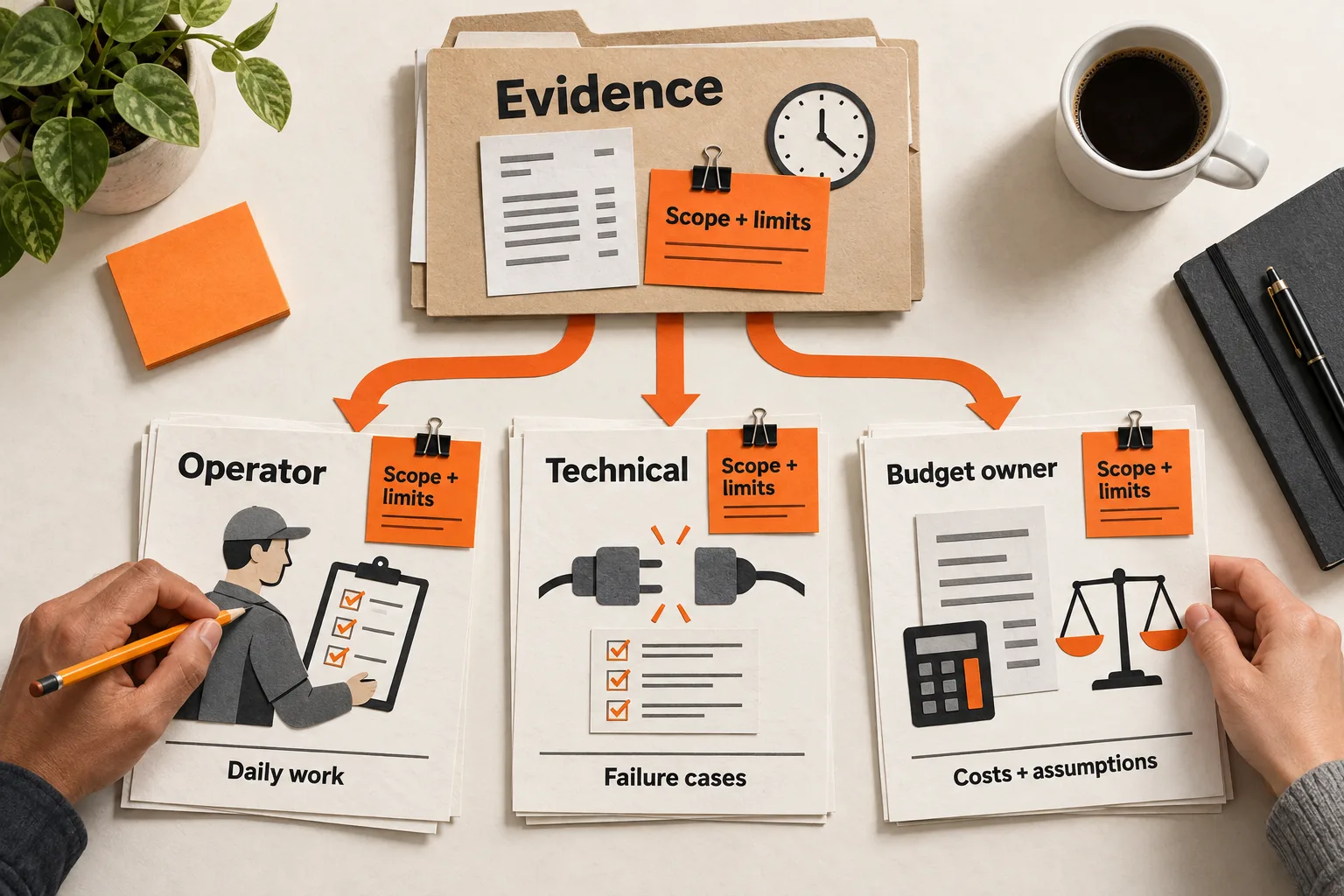
Use one sheet for a single buyer segment and workflow. Create a separate query record for each candidate so you can compare the evidence without blending different audiences.
Buyer role and triggering situation:
Recent problem and its consequence:
Current workaround and reason for keeping it:
Exact buyer language, source, and date:
Your interpretation of that language:
Evidence of searching or evaluating alternatives:

Candidate query:
Query evidence: observed record / recalled search / founder hypothesis
US search check: date, language, device, and location shown
Result URLs inspected, apparent audience, and page types:
Task the searcher appears to want to complete:
Product fit and unmet requirements:
Keyword estimate and status: reported / reported zero / unavailable
Provider, geography, reporting period, and update date:
Evidence against pursuing this query:

Next test and how participants or visitors will reach it:
Qualified action to observe:
Time and effort limit:
Review date:
Result that would justify continuing:
Result that would justify changing direction:
Conditions that would leave the test inconclusive:
Start with three plausible queries
Before approving a content plan, complete three query records for the same buyer and workflow. Choose one test and write down what it can establish: whether the problem matters, whether the explanation helps, or whether search brings suitable buyers.
If you cannot connect a query to a buyer’s recent problem and a useful next step, make the next task another buyer conversation.