Site Architecture SEO: How a Flat Structure Helps Google Find Every Page on a Small Business Site
A flat site architecture keeps every important page within 3 clicks of your homepage, making it easier for Google to crawl, index, and rank your content. This guide explains the structure, the tradeoffs, and exactly how to implement it on a small business website.
Quick answer
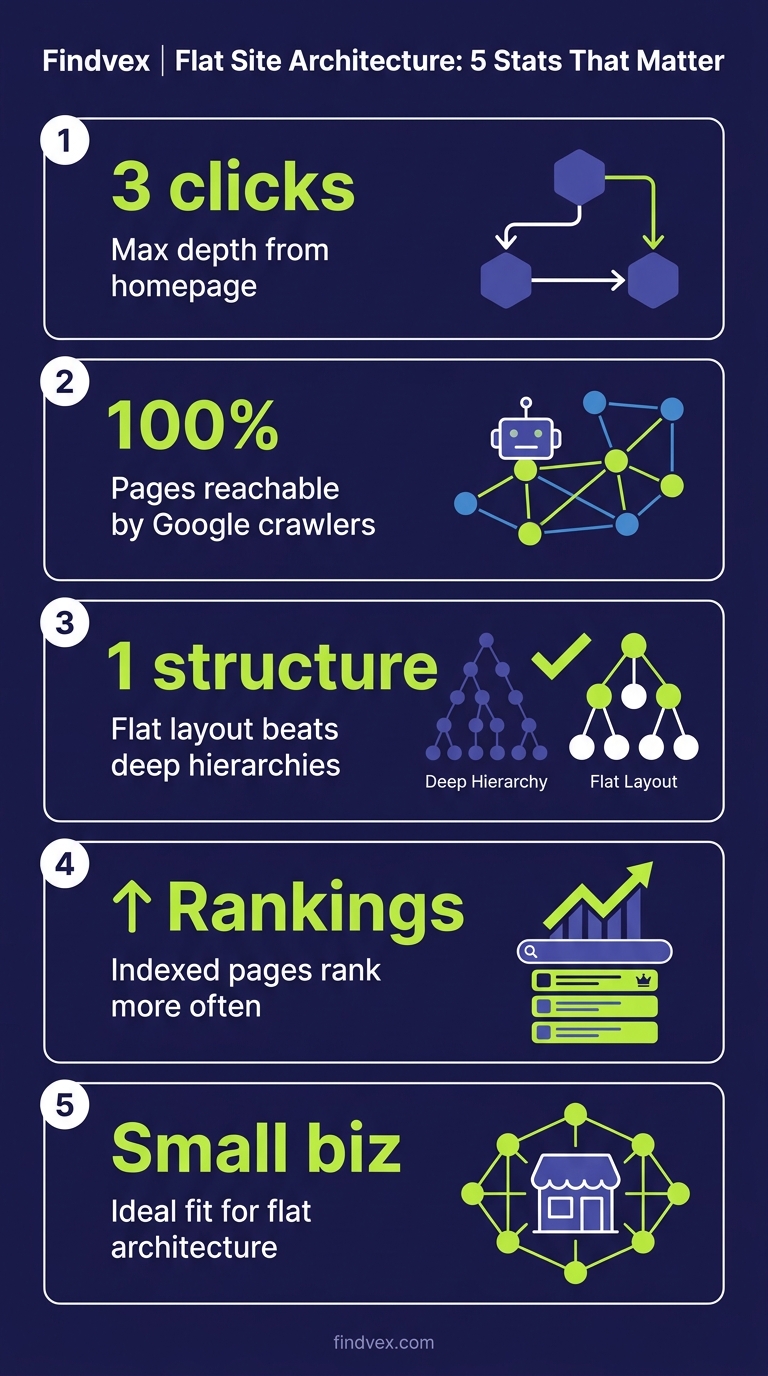
A flat site architecture limits the number of clicks between your homepage and any important page to three or fewer. This reduces crawl depth, concentrates link equity on your key pages, and makes it easier for Google to discover and index your content. For most small business websites with under 500 pages, a flat structure consistently outperforms deep, siloed hierarchies because Googlebot allocates limited crawl budget and PageRank more efficiently across a shallow tree.
Why Site Architecture Is a Ranking Decision, Not a Design Decision
Most small business owners treat their website's structure as a navigation problem — how do visitors find the menu? That framing costs them rankings.
Site architecture is actually a crawl problem. Googlebot visits your site on a fixed budget. It follows links, discovers pages, and passes PageRank (link equity) through the graph of internal connections. If your most valuable pages sit four or five clicks deep, Googlebot may never reach them consistently. When it does reach them, the pages arrive with diluted authority.
The fix is not complicated. A flat architecture — where every important page is reachable within three clicks from the homepage — solves both problems simultaneously. It concentrates crawl activity where it matters and keeps link equity from bleeding out through unnecessary intermediate pages.
This matters more now than it did three years ago. Google's AI Overviews and AI Mode pull answers from pages they can reliably index. A page Google rarely crawls is a page that will rarely appear in AI-generated answers, featured snippets, or the local pack. Architecture is upstream of almost every other ranking factor.
Flat vs. Deep Architecture: What the Difference Actually Looks Like
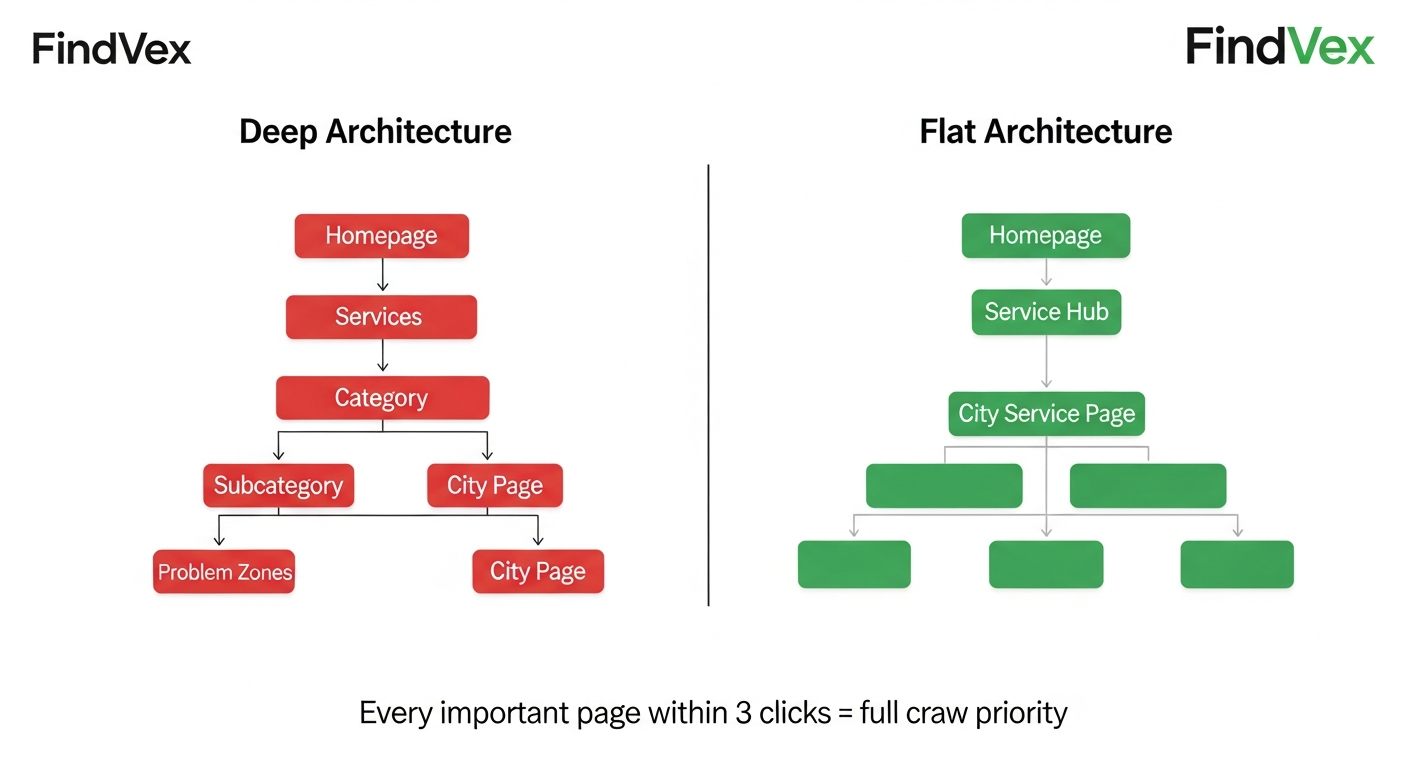
A deep architecture looks like a company org chart: homepage → category → subcategory → sub-subcategory → page. Each layer adds a click. Each click dilutes the PageRank passed to the destination page. A roofing contractor with separate sections for residential, commercial, storm damage, and emergency repair — each with nested city pages — can easily push their most important service pages five or six clicks deep.
A flat architecture collapses those layers. The homepage links directly to service pages and location pages. Those pages link to each other where relevant. Nothing sits more than two to three clicks from the root.
Here is what each model looks like in practice for a home services business:
- Deep (problematic): Homepage → Services → Roofing → Residential Roofing → Storm Damage Repair → [City] Storm Damage Repair (5 clicks)
- Flat (recommended): Homepage → [City] Storm Damage Roof Repair (2 clicks, with direct internal links from the homepage or a services hub)
- The flat version puts the exact page a potential customer — and Googlebot — wants within immediate reach.
- Flat does not mean unorganized. You still use logical groupings (service hubs, location hubs). You simply keep those hubs shallow, not nested.
“AI agents do in hours what teams used to do in weeks. The advantage compounds.”
The Crawl Budget Connection: Why Depth Wastes Google's Time on Your Site
Google's crawl budget for small business sites is finite. If your site has 200 pages but Googlebot consistently crawls only 60 of them on each visit, 140 pages are invisible to ranking algorithms until the next crawl cycle — which could be days or weeks later.
Crawl budget is consumed by page depth, redirect chains, duplicate URLs, and low-value pages that Google encounters before reaching your important content. A flat architecture reduces depth. Fewer hops mean more of your crawl budget is spent on pages that generate leads.
For a deeper look at how crawl budget works and what wastes it on small business sites, see our guide on crawl budget SEO — it covers the specific signals Google uses to deprioritize pages and what you can do to reclaim wasted budget.
Link Equity Flow: How Architecture Determines Which Pages Are Strong Enough to Rank
Every inbound link your site earns deposits authority at the linked page. From there, that authority flows outward through internal links. A flat structure keeps the distance short between your highest-authority pages (usually the homepage and top-level service pages) and your conversion pages.
In a deep architecture, a local landing page for 'emergency plumber in Denver' might receive only a fraction of the homepage's authority because it sits several hops away. In a flat architecture, that page can receive a direct internal link from the homepage or from a high-traffic hub page, giving it substantially more link equity.
This is the strategic reason why internal linking strategy and site architecture must be designed together, not separately. Architecture determines the maximum equity any page can receive. Internal links determine how that equity is distributed.
The Hub-and-Spoke Model: How to Scale Flat Architecture Without Creating Chaos
Flat does not mean every page links to every other page. That creates a crawl mess and dilutes internal link signals. The practical solution for sites with more than 50 pages is a hub-and-spoke model.
A hub page covers a broad topic at the category level — for example, 'Plumbing Services' or 'Denver Service Area.' Spoke pages go deeper on specific subtopics — 'Water Heater Installation Denver' or 'Emergency Drain Cleaning Denver.' Each spoke links back to its hub, and the hub links to all its spokes. The homepage links to each hub.
This creates a navigable, logical structure that keeps maximum click depth at three: Homepage → Hub → Spoke. Google can reach every page in three hops. Internal authority flows from the homepage to hubs to spokes without wasteful intermediate layers.
For businesses building location pages at scale, the hub-and-spoke model also solves the thin content problem. Each spoke can develop genuine depth around a specific service-plus-location combination without duplicating the hub. See our guidance on local landing pages that rank without sounding generic for the content side of this equation.
Flat Architecture Implementation: What to Audit and Fix First
If your site is already live, a full restructure is rarely necessary or advisable — it introduces redirect risk and temporary ranking disruption. The more practical approach is a targeted audit to identify which high-value pages are buried too deep, then flatten only those paths.
Here is the sequence to work through:
- Step 1 — Map your current architecture: Use Screaming Frog (free up to 500 URLs) or Sitebulb to crawl your site. Export the 'crawl depth' report. Flag every page you care about that sits at depth 4 or greater.
- Step 2 — Prioritize by revenue intent: Which buried pages target keywords with direct conversion intent (service pages, location pages, booking pages)? Fix those first. Blog posts at depth 4 are a lower priority.
- Step 3 — Add direct internal links: Before touching your URL structure, add internal links from your homepage, navigation, or hub pages directly to the buried high-value pages. This alone can reduce effective crawl depth without a single redirect.
- Step 4 — Flatten URL paths where practical: If a page's URL has four or more folders, create a new shallow URL, implement a 301 redirect from the old path, and update all internal links to point to the new URL. Update your XML sitemap.
- Step 5 — Audit your XML sitemap: Your sitemap should only list indexable, canonical pages. Buried pages that you have now flattened should appear at their new URLs. Review our XML sitemap best practices to avoid common errors that cause Google to deprioritize your sitemap entries.
- Step 6 — Validate in Google Search Console: After implementing changes, use the URL Inspection tool to confirm the new shallow URLs are being discovered and indexed. Check the Coverage report for any unexpected 'Excluded' or 'Discovered — currently not indexed' statuses.
How Site Architecture Affects AI Overviews and AI Search Citations
This is where architecture becomes a strategic concern in 2026, not just a technical one. AI Overviews, ChatGPT's search function, and Perplexity all retrieve content from pages they can crawl and parse quickly. A page that Google rarely crawls due to deep architecture is a page that is unlikely to be included in an AI-generated answer — even if the content itself is excellent.
The connection is direct: crawl frequency correlates with how up-to-date a page's content is in Google's index. AI Overviews and AI Mode draw from Google's index. A flat architecture increases crawl frequency for your key pages, which keeps your index representation fresh, which increases the probability of being cited in AI-generated answers.
There is also a structural clarity dimension. AI systems that parse your site are better able to understand what your pages are about when your URL structure and internal link hierarchy are coherent. A page at /emergency-plumber-denver/ that is linked from your homepage and your 'Denver Plumbing' hub page has a clear topical context. A page at /services/plumbing/residential/emergency/denver/contact/ does not.
For a broader look at how AI systems retrieve and cite content from websites, see our technical diagnosis framework for why AI search skips your content — architecture is one of the primary failure points identified there.
Strategic Takeaway: Architecture Is a One-Time Investment with Compounding Returns
Most SEO work is ongoing — content creation, link building, technical maintenance. Site architecture is different. Get it right once, maintain it as you scale, and it pays dividends on every piece of content you publish afterward.
The business case is straightforward: a flat architecture means every new service page you add is immediately crawlable at full link equity. A deep architecture means every new page starts at a disadvantage that must be overcome through extra internal linking effort.
For small businesses with limited SEO budgets, architecture is the highest-leverage structural investment available. It does not require ongoing spend. It does not require external links. It requires a one-time audit, targeted fixes, and a discipline to keep future pages shallow.
The tradeoff to acknowledge honestly: flattening a site that has been deep for years introduces short-term ranking disruption from redirect chains and recrawl latency. Plan for two to six weeks of volatility after a significant restructure. Do not restructure right before a high-stakes season for your business.
- Prioritize flattening conversion pages first (service, location, booking) — these have the highest ROI.
- Use 301 redirects for every URL change — never leave old URLs returning 404s.
- Update internal links site-wide after any URL change — redirect chains compound crawl inefficiency.
- Document your architecture decisions so future content additions follow the established hierarchy.
- Run a technical SEO audit before and after any restructure to catch unintended consequences early.
Tools to Audit and Monitor Your Site Architecture
You do not need an enterprise SEO platform to audit site architecture. The following tools cover 95% of what a small business needs:
- Screaming Frog SEO Spider (free up to 500 URLs): crawl depth reports, internal link analysis, URL mapping — the most practical starting point for architecture audits
- Google Search Console → Coverage report: shows which pages Google has indexed and which are excluded, with reasons — essential for confirming post-restructure results
- Google Search Console → URL Inspection tool: test any individual URL for indexability, last crawl date, and canonical status
- Sitebulb (paid): visualizes your site architecture as a tree diagram, making depth problems immediately visible — worth the cost for sites over 200 pages
- Ahrefs or Semrush Site Audit (paid): identifies orphan pages (no internal links), crawl depth issues, and redirect chains in one pass
FAQs
What is flat site architecture in SEO?
Flat site architecture is a website structure where every important page is reachable within three clicks from the homepage. It contrasts with deep architecture, where pages sit behind multiple layers of categories and subcategories. Flat architecture improves crawlability, concentrates link equity on key pages, and makes it easier for Google to discover and rank your content.
How many clicks deep should pages be for SEO?
Most SEO practitioners recommend keeping all important pages within three clicks of the homepage. Pages at four or five clicks deep receive less frequent crawling and diluted PageRank compared to shallower pages. For small business sites where every service page and location page needs to rank, three clicks is the practical maximum.
Does URL structure affect SEO rankings?
Yes, but primarily through indirect mechanisms. A clean, shallow URL structure signals to Google that a page is a first-class content destination. Deeply nested URLs (four or more folders) suggest buried content and can reduce crawl priority. More importantly, URL structure reflects your architecture decisions — the real ranking impact comes from how those decisions affect crawl depth and link equity flow, not from keyword placement in the URL itself.
Can I flatten my site architecture without hurting rankings?
Yes, with proper redirects. Any time you change a URL, implement a 301 redirect from the old path to the new shallow URL, update all internal links to point to the new URL, and update your XML sitemap. Expect two to six weeks of ranking volatility during recrawl. The long-term ranking improvement from better crawlability outweighs the short-term disruption for pages that were genuinely too deep.
What is the difference between site architecture and internal linking?
Site architecture defines the hierarchical structure and URL depth of your pages — it is the map of your website. Internal linking is how you connect pages within that map. Architecture sets the ceiling on how much link equity any page can receive; internal linking determines how that equity is distributed within the ceiling. You need both to work together: a flat architecture with no deliberate internal linking still underperforms.
How does site architecture affect AI Overviews?
AI Overviews pull from Google's index. Pages that Google crawls frequently have fresher, more reliable index representations. A flat architecture increases crawl frequency for your key pages by reducing depth and improving link equity signals. Pages Google rarely crawls are pages that are less likely to appear in AI-generated answers, even if their content is high quality. Architecture is one of the most controllable factors in AI search visibility.
How many pages can a flat site architecture support?
A flat architecture using a hub-and-spoke model can support hundreds or even thousands of pages while maintaining a three-click maximum depth. The homepage links to hubs (service categories, location areas), and hubs link to spokes (specific service-location combinations). This scales without adding depth layers. Most small business sites with under 500 pages can keep every important page at depth two or three with this model.
Related reading
Research notes
Background claims used while researching this article. Verify with the cited authorities before quoting.
- Googlebot assigns crawl budget based on crawl rate limit and crawl demand signals
- PageRank flows through internal links and dilutes with distance from high-authority pages
Alex Rivera
CEO & Editorial Strategist · Findvex
Alex Rivera leads editorial strategy at Findvex. He sets the weekly content plan, picks topical pillars, and decides what to publish — and what to skip — based on search intent, competitive data, and what genuinely helps US small businesses rank.
Expertise: Editorial strategy · Topical authority · Content prioritisation · Pillar planning
Related reads
Answer Engine Optimization (AEO): The 2026 Guide for Small Businesses
Learn answer engine optimization (AEO) in 2026. This practical guide helps small businesses get found in AI search, voice assistants, and answer engines.
SEOGenerative Engine Optimization (GEO): The 2026 Guide for Small Businesses
Learn how generative engine optimization helps small businesses get found in AI search. Our 2026 GEO guide covers strategies, tactics, and tips to boost visibility.
SEOSEO Agency in USA: AI-Powered SEO for Small Businesses | Findvex
Findvex is a leading SEO agency in USA delivering AI-powered SEO strategies that help small businesses rank higher, drive traffic, and grow revenue. Get started today.