Start your first month of SEO with one customer situation, a handful of search questions and enough evidence to answer them well. Make those pages accessible, connect them to the rest of your site and decide what each page should help a reader do next.
That is a useful month even before you have a reliable traffic trend. The schedule below is a proposed working plan for a small team, not a promise of rankings within 30 days.
Our running example is hypothetical: a meeting-notes app for small US customer-success teams. Its proposed strength is turning a call into a reviewable handoff with an owner, deadline and link to the supporting transcript. No keyword volumes, product results or customer interviews in this example are measured data.
Days 1–5: identify the task that could lead to a customer
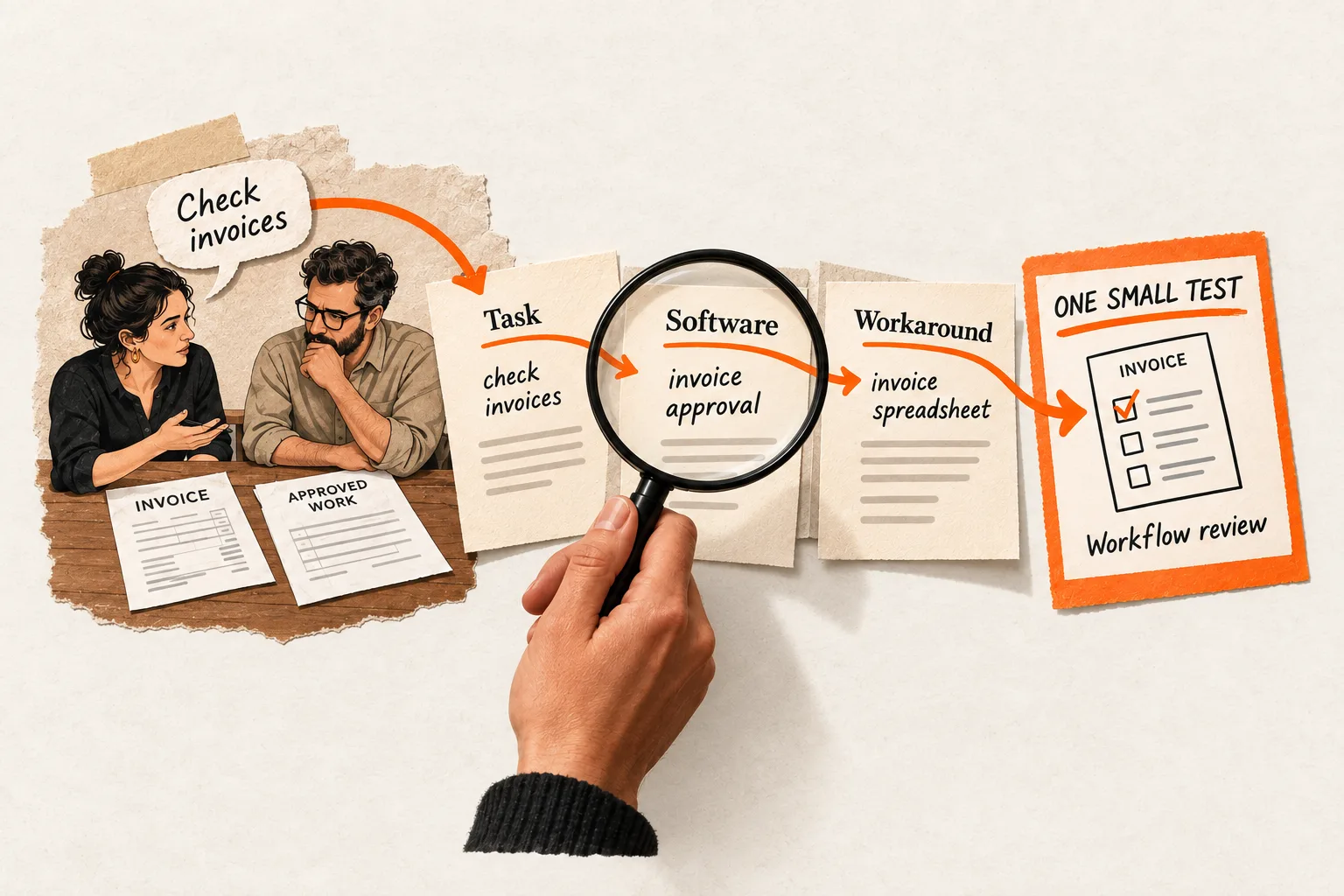
“AI productivity” says very little about who needs the product. “A customer-success manager needs to hand a renewal risk to an account executive after a call” gives you something to investigate.
Benji Hyam’s Pain Point SEO method starts with customers’ problems and buying intent. He groups opportunities around product categories, comparisons or alternatives, and jobs a product helps someone complete. His commercial objective is product-related conversions; that is different from maximizing pageviews or newsletter subscriptions.
Apply that idea by collecting the language behind a recent decision. Ask a prospective customer:
- What happened the last time a follow-up fell through?
- How did you capture and hand off the work?
- What did you try before looking for another option?
- What would make changing the process worthwhile?
Record the situation, current workaround and consequence separately. If the only evidence is your own guess, label it a hypothesis. Do not turn an imagined quote into “what customers say.”
For the fictional app, this might produce three candidate pages:
| Reader’s task | Candidate query to investigate | Page that could help |
|---|---|---|
| Find software for a team workflow | Meeting notes software for customer success | A product use-case page with a real workflow demonstration |
| Decide whether to replace a workaround | Meeting notes app vs manual CRM notes | A comparison that shows where each approach fits |
| Complete a handoff correctly | How to turn customer calls into action items | A worked tutorial with a reusable handoff template |
These are research candidates. We have not established their search demand or inspected their result pages. A plausible phrase is a starting point for research, not a validated keyword.
Days 6–10: check search intent and choose what you can prove
Set the research market to the United States and the language to English. For each candidate, record the exact query, date, location setting, search engine and the results you inspect. A result gathered from a different market should stay labeled with that market.
Look for the task implied by the results. Are readers being offered product pages, tutorials, templates, reviews or discussions? What must a useful page explain before someone can decide? Read the actual pages; titles alone can conceal thin answers or a different audience.
If you use a keyword service, retain the provider, date, geography and any reported volume. Leave unavailable metrics blank or mark them unknown. A tool’s estimate does not establish how many qualified buyers your page will attract.
Then make a publication decision with three questions:
- Fit: Does this task belong to the audience we can help?
- Evidence: Can we demonstrate the answer or support it with inspectable sources?
- Next step: Is there a natural action after the answer?
For our hypothetical team, the action-item tutorial may be ready first because the team can make a sample handoff. A software comparison should wait until it has actually inspected the alternatives. A broad “best AI tools” roundup offers little value if the team has no testing evidence.
This is a capacity decision, not an instruction to always publish informational articles before commercial pages. If your product page already has a convincing demonstration, improve it now.
Days 11–20: make the answer concrete
Give each page one primary task. A tutorial can link to a comparison, but it should first deliver the tutorial someone came for.
Here is a small worked example the fictional team could publish. All names and details are invented:
Sample call note: “Maya will send a draft rollout plan to the customer by Friday. The customer will confirm whether their CRM administrator can attend.”
Reviewable handoff: Owner: Maya. Deliverable: draft rollout plan. Due: Friday, with the exact calendar date confirmed. Dependency: administrator availability. Evidence: link to the relevant transcript passage.
Review check: “Friday” is ambiguous without a call date. Confirm it before creating the task. Do not guess the administrator’s attendance.
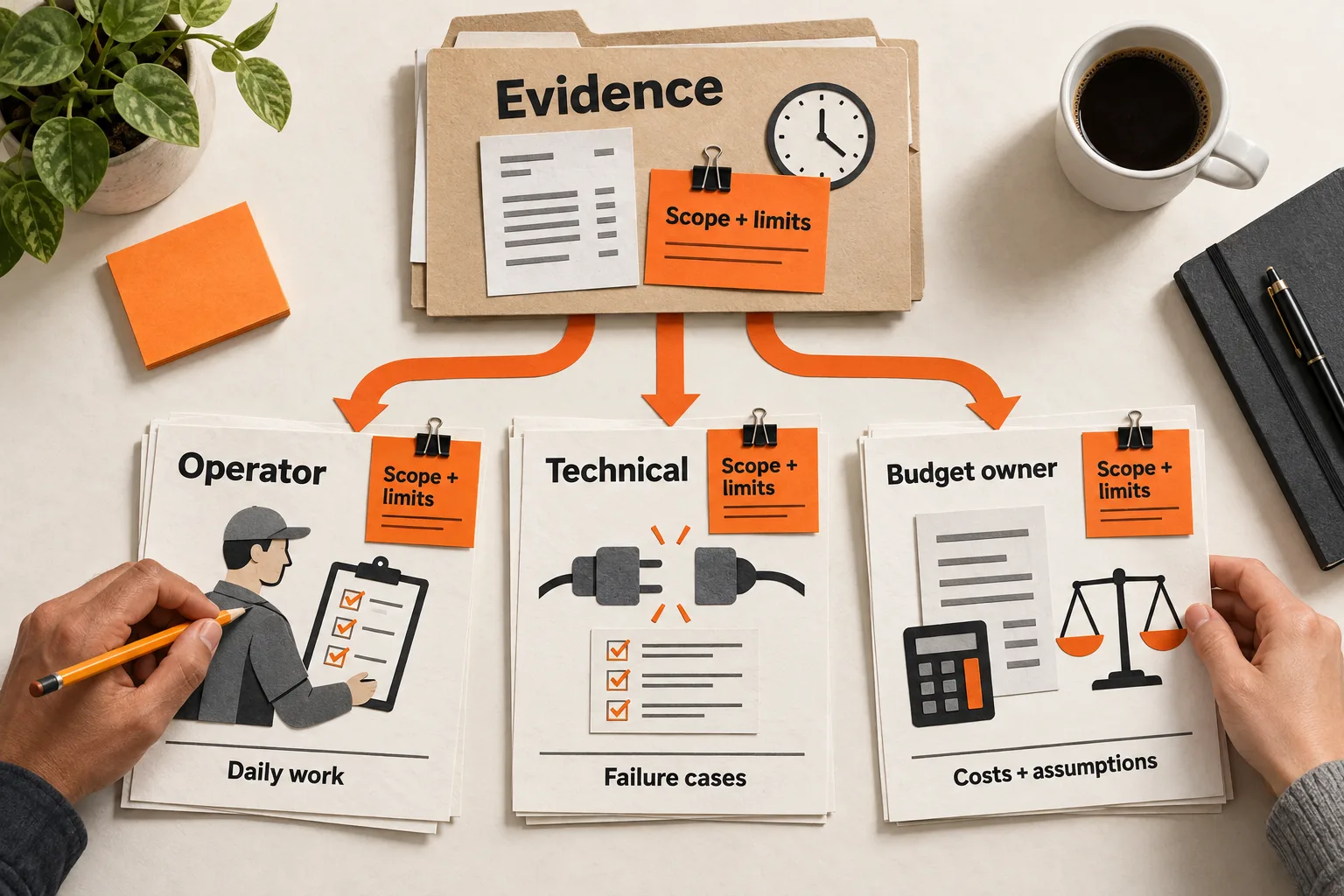
That example teaches a decision: a polished summary can still omit information needed to act. Extend it with an input, an output, a review checklist and a case where the workflow fails. If you show product output, disclose the input, configuration and edits; a mockup must be labeled as one.
Hyam’s diagnosis of SEO that does not produce business results also emphasizes the connection between keyword intent, knowledgeable article writing and conversion measurement. For a small team, a practical application is to interview the person who understands the workflow before drafting it.
Ask that person to explain a failure, a tradeoff and the condition under which the product is unnecessary. Those details often improve a page more than another introductory paragraph about AI.
Choose the next step to match the page:
- A tutorial can offer the template used in its example.
- A use-case page can lead to a relevant product demonstration.
- A comparison can lead to a trial only after explaining who should choose each option.
A template download and a product signup are different outcomes. Track them separately if you have measurement in place. FindVex itself is currently a publication; our worksheets support reading and application, and we do not label them product leads.
Before publishing: check access and the reader’s path
Use this short release check for every new page:
- The intended URL loads successfully and shows the main answer as readable text.
- No unintended login, crawler block or
noindexprevents discovery. - The canonical URL points to the version you intend to publish.
- At least one relevant existing page links to it with descriptive wording.
- The title and main heading describe the actual task, and structured data matches visible content.
- Images, tables, downloads and navigation work on a phone.
Google’s guidance for its AI search features keeps the same SEO foundations relevant. A supporting page must be indexed and eligible for a search snippet; Google does not require special AI schema or an extra AI text file. Eligibility does not guarantee indexing or inclusion.
Check the live URL in Search Console when you have access. A successfully loaded page in your browser is not evidence that Google has indexed it. Record those as separate observations.
Days 21–30: diagnose before adding more pages
Review the work by URL and date range. Keep what happened apart from your explanation of why it happened.
| Observation | Check next | A reasonable action |
|---|---|---|
| Page works but has no confirmed indexing | URL Inspection, canonical and access settings | Resolve a demonstrated issue; allow time for discovery |
| Indexed, but no impressions yet | Query fit, internal links and time since publication | Review the premise before expanding the cluster |
| Impressions for unrelated questions | Page promise and actual content | Clarify the task or separate mixed intents |
| Relevant visits, few next-step actions | Measurement, offer relevance and usability | Test one specific change with a documented reason |
With a small sample, “few actions” is a clue to inspect, not proof that the article failed. Do not rewrite everything because a new page had a quiet week.
At day 30, make one decision per page: keep observing, improve the answer, fix an access problem, or investigate a different task. Preserve a dated note so you can interpret later changes without rewriting the history of the experiment.
Download the first-month SEO decision sheet. It includes market, intent, evidence, next-step and observation fields. Fill the unknowns honestly; the missing information tells you what to research next.
For the other half of the work, read how to reach an audience before you have one. To study source visibility separately, use the AI citation observation method.
Method note: The 30-day schedule, fictional workflow and decision sheet are FindVex’s application of the cited methods. This is a planning guide, not a completed case study. Revised September 26, 2026 to add the intent decisions, worked handoff and evidence fields.