When you have no audience, begin with a narrow customer situation and a useful contribution you can bring to an existing conversation. Choose one place where those people already ask for help. Give them something they can use, then examine what their response teaches you.
The immediate goal is to learn whether your explanation and contribution matter to the right people. You can do that before committing to a publishing calendar across five channels.
This guide proposes a two-week experiment for a founder with roughly four hours a week available for distribution. The product and examples below are hypothetical. They illustrate decisions, not a launch we have run or results you should expect.
Work out what someone would do without you
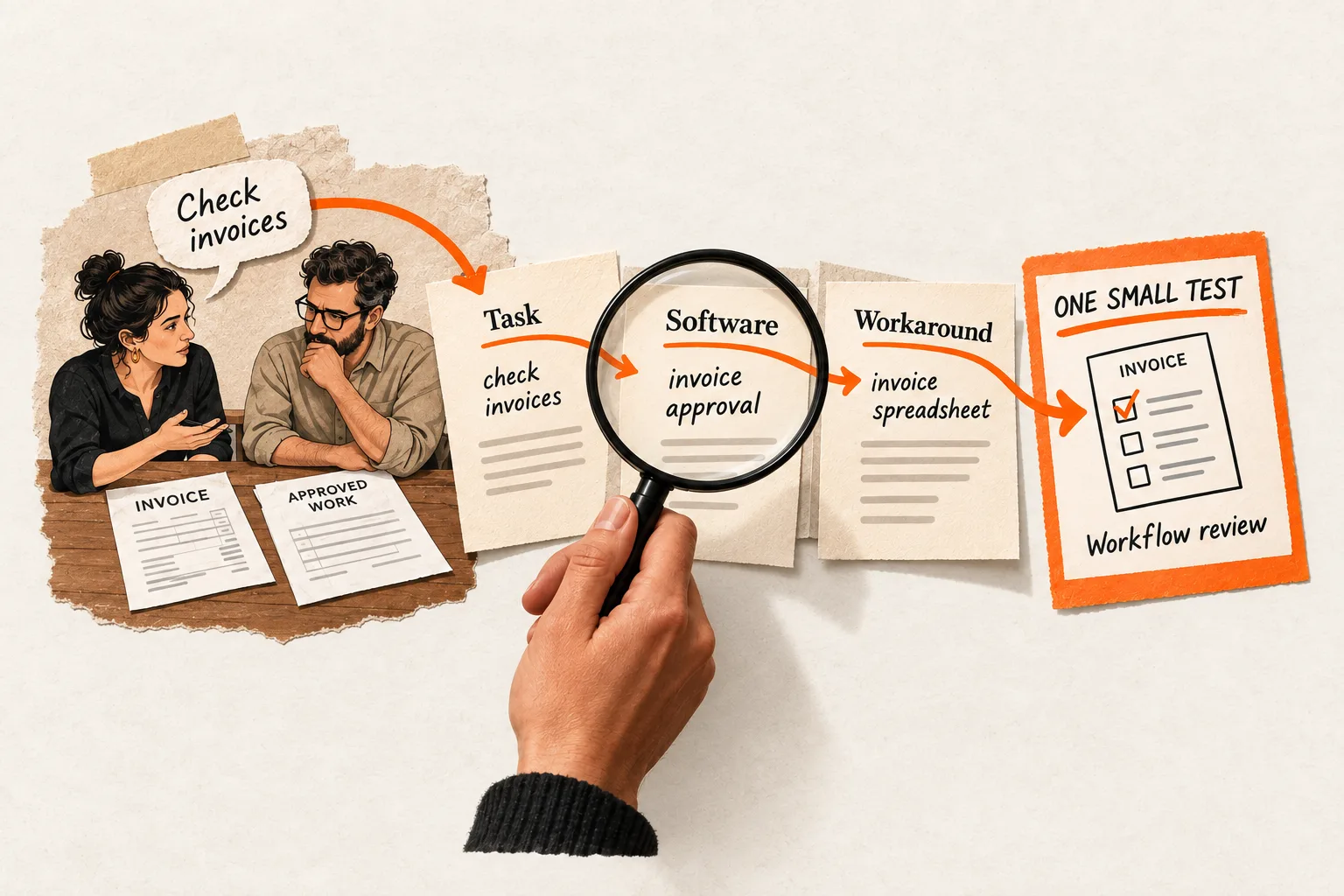
Imagine a founder building an AI tool that turns customer calls into reviewable handoffs. Calling it “an AI productivity platform” leaves the buyer to figure out why it belongs in their work.
April Dunford’s positioning process starts with what customers would use if the product did not exist. From those alternatives, it moves through differentiated capabilities, the value they create, best-fit customers and the market category that makes the value understandable.
Apply that sequence before writing a launch post. For our fictional product:
| Decision | Working hypothesis to test |
|---|---|
| Actual alternative | A customer-success manager copies call notes into a CRM and sends a separate handoff message |
| Relevant capability | A proposed handoff includes an owner, due date and transcript evidence for review |
| Buyer value | The receiving teammate can understand the commitment and check its source |
| Best-fit situation | A small team repeatedly loses context between customer calls and follow-up work |
| Useful category | A meeting-notes tool designed for customer handoffs |
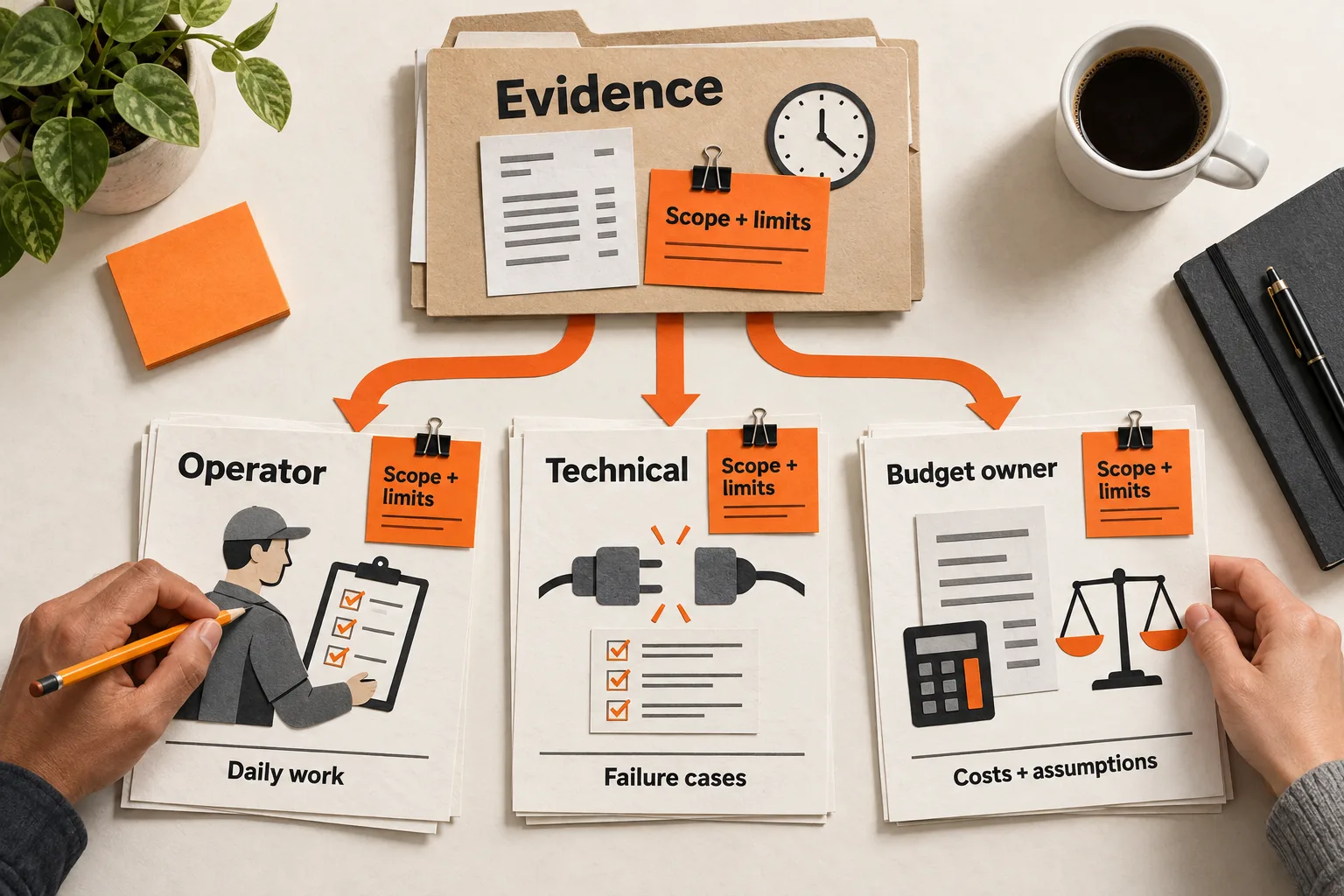
This table contains assumptions until prospective users confirm them. A founder who has never watched the handoff may discover that the real problem is assigning ownership, not writing notes. That finding should change the message and possibly the product.
Have a short conversation about a recent event. Ask someone to show the last handoff, explain what they did next and identify what was difficult. Avoid asking whether your imagined feature “sounds useful.” Agreement with a pitch is weaker evidence than a concrete account of the work.
Write a provisional description from what you know:
For customer-success teams handing work to account owners, this meeting-notes tool creates a draft handoff with an owner, a deadline and supporting transcript passages for review.
Notice the specific use and the word “draft.” The sentence does not promise flawless extraction or a made-up number of hours saved.
Choose a channel by observing the audience
Ross Simmonds’s 2026 SEO Week interview argues for choosing channels that fit the audience and treating distribution as deliberate work. He also criticizes automated product plugs inserted into community discussions. The practical implication for a founder is to investigate the conversation before deciding what to publish there.
Find a small set of recent, relevant discussions. Record where they happened, who appears to be asking, the task they describe and what kind of response helps. Read the current community rules before contributing.
Compare your options using evidence you can inspect:
| Candidate setting | Evidence that would justify a test | Reason to wait |
|---|---|---|
| A professional discussion feed | People in the target role describe this workflow and respond to useful explanations | Most engagement is from other sellers, with little buyer participation |
| A specialist community | Relevant questions recur and the rules allow a contribution in your chosen format | The rules prohibit the intended post or the discussion is unrelated |
| A small industry publication | Existing articles serve this audience and there is an appropriate contribution route | The only apparent route is an unsolicited promotional pitch |
For this experiment, choose one setting you can participate in well. The table is a selection method, not a claim that one platform always wins for B2B software.
If you cannot find the audience, spend the first week learning where people ask for help. More posts will not repair a channel choice based only on familiarity.
Make one asset useful without the product pitch
For the fictional handoff tool, a short example can be more helpful than a generic article about the future of work.
Create a one-page handoff template with five fields: commitment, owner, deadline, evidence and open question. Include one invented call excerpt, its completed handoff and an explanation of what needed human confirmation.
A reader should be able to use the template manually. That gives the contribution a job even when the reader is not ready to try software.
Build three pieces from that single asset:
- The complete example: A page on your site with the input, output and review notes.
- A native explanation: A short post or reply that contains a useful part of the method without requiring a click.
- A demonstration: A concise walkthrough showing where the product helps, provided you have a working product to demonstrate.
A possible discussion contribution, if it fits the question and rules, is:
One thing to check before passing along call notes is whether every commitment has an owner and a date. For example, “send the rollout plan next week” still leaves two decisions open. In a handoff template, I would put the missing owner and exact date under “open questions” instead of guessing. I’m building a tool for this workflow, so I’m interested in where that check still breaks down.
This is a draft example, not a message to post everywhere. Answer the actual question, disclose your connection and include a link only when appropriate. Never describe a fictional example as a customer outcome.
Run a two-week test within a fixed time budget
The schedule below uses eight hours total. Treat it as a constraint for this example, not a minimum required to succeed.
| Period | Work | Time budget |
|---|---|---|
| Days 1–3 | Inspect relevant conversations and refine the customer situation | 90 minutes |
| Days 4–7 | Create and review the template and worked example | 150 minutes |
| Days 8–11 | Share in the selected setting and respond thoughtfully | 120 minutes |
| Days 12–14 | Review responses, inspect the page and choose the next test | 120 minutes |
Write the hypothesis before publishing: “People who handle customer handoffs will find the five-field example relevant enough to describe a missing field, try it or ask about the workflow.”
Record the contribution URL, publication date, time spent and responses. Define a qualified response in advance: a person in the intended role describes their own related workflow, asks a specific follow-up or reports using the asset. A like alone does not meet that definition.
If your analytics is configured, distinguish referred visits, downloads and product actions. If it is not, report only what you can observe. Do not invent visit counts from a post’s impression number.
Use the response to choose the next move
The experiment needs a decision rule before it needs a dashboard. Here are reasonable rules for this small test:
- No meaningful exposure: Investigate placement and format. You have not yet tested whether the asset is useful.
- Exposure but no relevant responses: Revisit the audience, problem and opening explanation. The result is inconclusive, especially with a small sample.
- Useful responses but few visits: Learn from the conversation itself. A native answer can help without sending people to your site.
- Readers try the asset and identify a gap: Improve that part, then share the revision where appropriate.
- People like the asset but do not need the product: Examine the link between the problem and your proposed solution. Do not count appreciation as buying intent.
Change one major element at a time so the next test is interpretable. If you change the audience, asset, channel and offer together, you may get a different outcome without knowing what mattered.
Download the distribution experiment worksheet. It includes the alternative, value hypothesis, channel evidence, time budget, qualified-response definition and next decision.
Once a question repeatedly proves useful, consider making it discoverable through a focused page. Our first-month SEO guide explains how to investigate that opportunity. Sharing an article or appearing in a discussion does not by itself establish that an AI system will cite it; use a separate observation method for that question.
Method note: The positioning sequence is attributed to April Dunford; the channel-selection principle draws on Ross Simmonds’s published interview. The fictional product, sample contribution and eight-hour experiment are FindVex’s application. Revised September 26, 2026 to add the positioning example, contribution draft and decision rules.