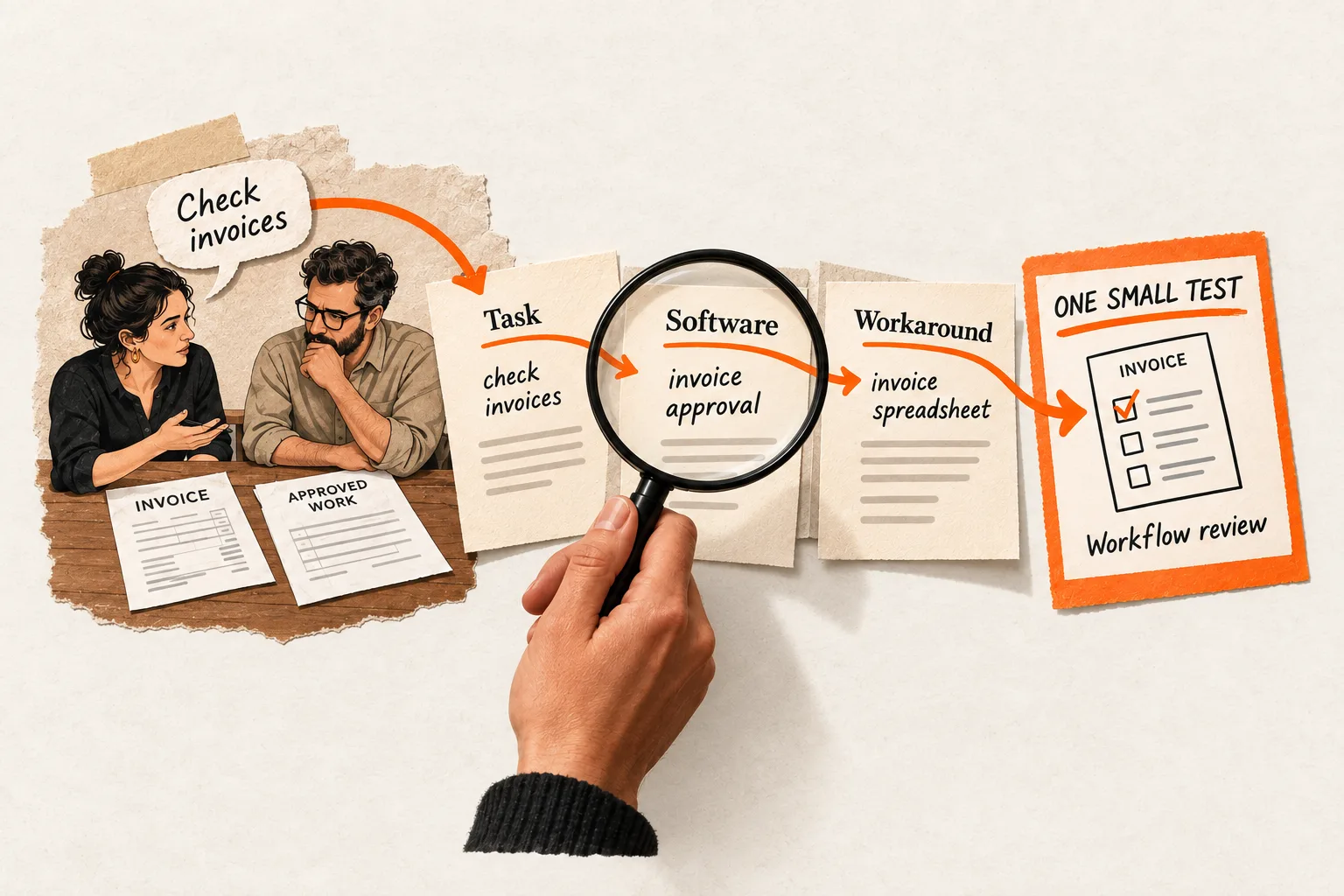
Give a writer the keyword “customer onboarding,” and they still have to choose the reader, identify the problem, and work out which advice your company can support. A content brief should settle those decisions before drafting starts.
Start with one documented customer question. This SaaS content brief template turns it into an article assignment with a specific reader task and an evidence plan. Follow the worked example or jump to the copyable worksheet. Keep the assignment to one page if practical, with longer research notes linked separately.
Record the source question and its context
Choose a question from a support ticket, interview, sales conversation, or community discussion that you are allowed to use. Record its wording, date, source location, and context. Remove identifying details the writer does not need.
Keep the original wording separate from your interpretation. Label a summary as a paraphrase, and use quotation marks only for words you can verify. The Government Digital Service’s research guidance follows this sequence: record what people said or did, then interpret the observations and decide what to do. Read the GDS research analysis guidance.
One question shows that one person asked it. Claims about a recurring problem need additional records; claims about search demand need separate evidence.
Before commissioning an article, decide whether a direct reply or an update to an existing help page would answer the question. An article makes sense when you can teach a reusable process, explain a recurring decision, or demonstrate a task that needs more context. A question about one account’s settings may belong in support.
Define what the reader should be able to do
Complete this sentence: “After reading, the reader can…” Name an observable task, such as choosing a handoff owner, testing an export, or preparing a migration checklist. “Understand onboarding” gives the writer too little direction.
Describe the reader’s current approach. Perhaps they use a spreadsheet, copy information between tools, ask a colleague, or postpone the task. These details give the writer a starting point for the explanation.
Then set a scope boundary. A guide to assigning onboarding responsibilities can leave activation analytics, email sequences, and platform comparisons for separate assignments.
For help deciding which pages to create first, see FindVex’s SEO for a new AI SaaS: your first 30 days. Use this worksheet to brief one article within that plan.
Check search intent and record a hypothesis
Translate the reader’s task into a few plausible search phrases. Search in the market you serve, record the date and location, and open the result pages. Note whether they offer instructions, templates, comparisons, definitions, or troubleshooting steps.
For “SaaS content brief template,” a Google results snapshot recorded for the United States in English on September 26, 2026, included template guides and downloadable examples. One result, thruuu’s SaaS brief template, includes customer pain points, search intent, an outline, and expert input. These observations support a worksheet format for this article. The snapshot does not establish demand for the exact phrase or show that those fields improve rankings.
Record your interpretation as a hypothesis: “Readers appear to want a reusable brief and an example showing how to complete it.” Link the pages you inspected and note any conflicting formats so the writer can assess the reasoning.
Exclude keyword suggestions that serve a different reader task. When demand is unclear, record that uncertainty. A documented question can still justify a useful educational article.
Build an evidence plan for the article’s claims
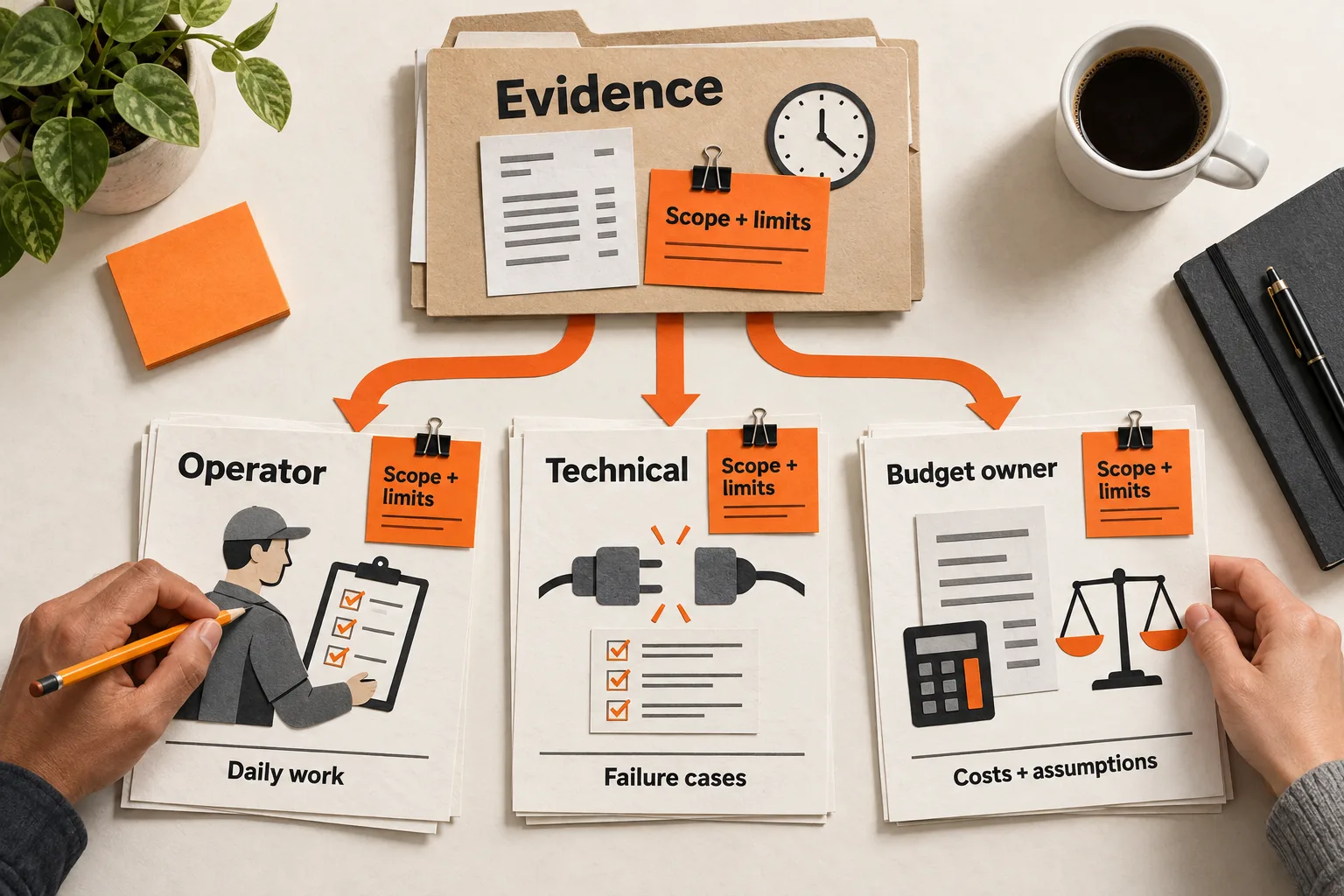
For each important claim, attach a source, the supporting passage, the date checked, and any limits. A pile of links leaves the writer to reconstruct that work.
Use current documentation or a reproducible check for product behavior. Claims about time saved need measurements and an explanation of how they were collected. Present your team’s judgment as a recommendation, and label hypothetical examples.
Google’s content guidance asks whether a page adds original value, provides clear sourcing, and helps readers achieve their goals. Use those questions to review the brief, without treating them as a guarantee of search performance. Google also says it has no preferred word count, so treat length as a planning estimate. See Google’s guidance on helpful, reliable content.
When evidence is missing, assign someone to obtain it, narrow the claim, or remove it. Resolve missing proof behind the article’s central promise before handing it off. Give the writer required technical steps and caveats, while leaving room to change the outline as research develops.
Worked example: brief an onboarding handoff guide
Consider a hypothetical SaaS company where the founder keeps resolving confusion between sales and customer success during onboarding. Both teams use a shared spreadsheet. The assignment is to explain how to make responsibility for the next step clear.
Every scenario detail below is invented for illustration. The source-question entry is sample wording, not a customer quotation or a record of an actual interview.
| Brief field | Hypothetical assignment |
|---|---|
| Source question | Invented sample question: How can we show who takes over after sales finishes its onboarding steps? |
| Source location and date | No customer record or interview date exists for this illustration. In a real brief, replace this entry with a permitted record and its date. |
| Relevant context | Sales and customer success share a spreadsheet, but the founder still has to clarify who acts next. |
| Reader | An operations lead coordinating both teams without a dedicated onboarding manager |
| Current approach | A shared spreadsheet and messages asking who owns the next step |
| Reader task | Define an owner, completion condition, and next recipient for each handoff in one onboarding workflow |
| Working title | How to define onboarding handoffs in a shared spreadsheet |
| Search hypothesis | A practical tutorial may fit. Candidate phrases such as “customer onboarding handoff checklist” still need an intent check; demand is unknown. |
| Deliverable | A blank handoff worksheet and one clearly labeled sample workflow |
| Scope boundary | Exclude tool comparisons, automated integrations, and claims about improving retention |
The outline follows the task: identify the handoff points, assign responsibilities, define what must be complete before transfer, and walk through one sample account.
The evidence plan also needs a completed entry. This one shows how to handle an unsupported claim without inventing proof:
| Claim proposed for the draft | Source and supporting passage | Check status | Limit and required action | Owner |
|---|---|---|---|---|
| The worksheet reduces onboarding delays. | None. The hypothetical scenario provides no measurements. | Unverified; no check date applies. | Remove the outcome claim. Demonstrate how to fill in the worksheet. Any later claim about delays needs measurements and a documented method. | Assign the article’s reviewer to confirm removal before handoff. |
A sample worksheet can remain hypothetical. A description of a company’s actual workflow needs confirmation from the people doing the work.
The guide’s closing task would ask readers to map one onboarding workflow and review unclear handoffs with the people involved. Each handoff should have a named owner, an agreed completion condition, and a next recipient. Any effect on performance would need later observation.
Copy the SaaS content brief template
Replace each bracketed field. Link longer notes so the writer can find the evidence without losing the assignment in it.
ARTICLE BRIEF

Working title: [Specific task or decision]
Writer / reviewer / due date: [Names and date]

SOURCE QUESTION
Original wording or labeled paraphrase: [Question]
Source location and date: [Record or link]
Relevant context: [Role, trigger, constraints]
Sharing limits: [Redactions or permissions needed]

READER AND OUTCOME
Reader: [Role and situation]
Current approach: [What they do today]
After reading, they can: [Observable task]
Out of scope: [Adjacent topics to exclude]

SEARCH HYPOTHESIS
Seed phrase and relevant variants: [Terms]
Market and date checked: [Location, language, date]
Pages inspected: [Links and formats]
Likely intent: [Task and suitable format]
Confidence and unresolved questions: [Limits]

EVIDENCE
For each important claim:
[Claim | source | supporting passage | checked date]
[Limit or missing proof | owner | required action]

STRUCTURE AND HANDOFF
Opening situation: [Specific problem]
Outline: [Sections in the order the reader needs them]
Worked example: [Real and sourced, or hypothetical]
Useful internal link: [Page and reason to include it]
Reader's next step: [Task, worksheet, or related reading]
Acceptance check: [What the draft must let readers do]
Test the brief before handing it to a writer
Fill in the worksheet for one documented question. Ask a teammate to read it without your verbal explanation and describe who the article is for, what the reader will do, and which claims still need evidence. Have them mark any field they had to guess at, then revise those fields before commissioning the draft.