Suppose your LinkedIn post promises less administrative work, while your community post promises better reporting. The community post brings two demo requests; LinkedIn brings none. You changed the message and the channel together, so the results cannot tell you which explains the difference.
Test both messages in both channels, keep the offer stable, and decide beforehand what evidence would justify another round. This small message-channel fit experiment can help you choose what to test next. With limited organic reach, it may leave the stronger channel unresolved.
Define the decision before writing the posts
Write the decision as a question you can act on: “Which benefit should lead our next month of posts for support managers, and where should we test it again?”
Define the audience by its work and situation. “US support managers at small B2B SaaS companies who manually summarize tickets every week” gives you a way to qualify responses. “People interested in AI” leaves that judgment open.
Choose one primary outcome, such as a demo request from someone who fits that definition or a trial signup that completes a specified setup step. Decide what qualifies before responses arrive. Likes and clicks can help you diagnose the path to that outcome, but they do not establish buyer interest by themselves.
Record the test dates, effort or spending cap, conversion follow-up window, and review date. Two weeks may suit your schedule; it does not guarantee enough evidence.
Choose two promises grounded in buyer language
Start with how relevant prospects describe their work, desired outcomes, and objections. Joanna Wiebe’s review-mining method begins with the audience, the outcomes they seek, and the alternatives they use.
Keep each collected phrase beside its source and audience context, with your interpretation in a separate field. One vivid complaint can suggest a message to test. It cannot tell you how common the problem is.
For an AI tool that summarizes support tickets, two candidate messages might be:
- Message A: Reduce the work of preparing the weekly support summary.
- Message B: Find recurring customer problems in support tickets.
Both promises must describe capabilities the product supports. Keep the proof, offer, and call to action consistent so a stronger demonstration or easier next step does not explain the difference.
If each message also gets a different landing page, record that choice. You are comparing two complete message paths, which answers a broader question than a headline test.
Put both messages in both channels
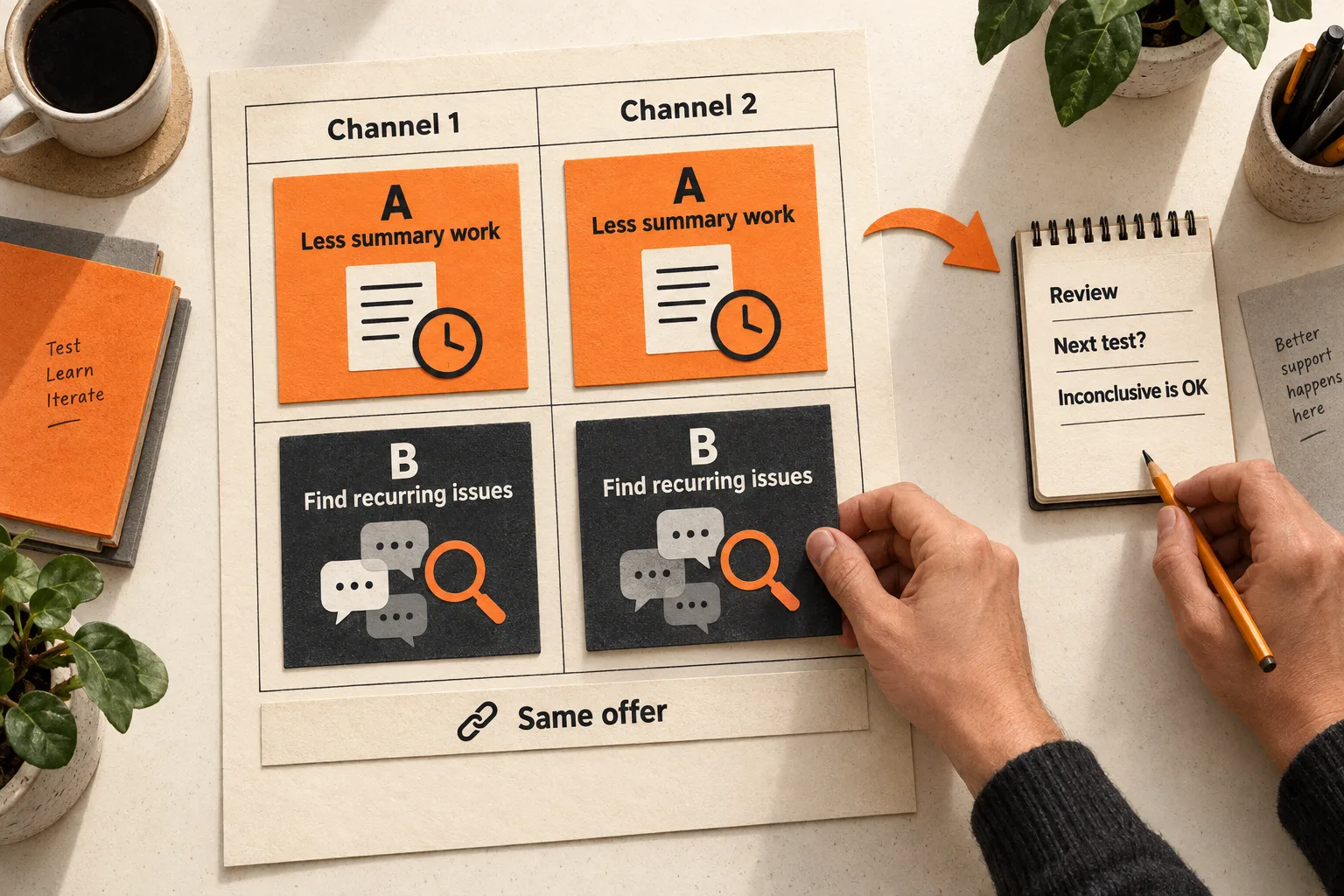
Give each combination its own cell:
| Message | Channel 1 | Channel 2 |
|---|---|---|
| A: Reduce summary preparation work | A1 | A2 |
| B: Find recurring customer problems | B1 | B2 |
This structure borrows from a full factorial design: every setting of one factor appears with every setting of the other. Two factors with two settings each produce four combinations. NIST explains the design principle.
Four filled cells do not automatically make a controlled experiment. Organic distribution usually leaves you unable to assign comparable people randomly to platforms or control who sees each post. Treat the matrix as a structured field comparison unless your setup supports stronger conclusions.
Within each channel, hold the format, proof, offer, destination, and follow-up process as steady as possible. Across channels, preserve the core promise while adapting its presentation. Record the adaptations.
For example, a community may require a useful discussion rather than a promotional post. If that changes the offer or response path substantially, label the execution accordingly. Its results reflect those differences as well as the channel.
Compare the audiences you actually reach
A warm customer newsletter and a public social account may reach the same job titles but very different levels of familiarity and intent. Your conclusion applies to those audiences as reached.
For each channel, record the audience’s role, company type, relationship to your business, and any targeting restrictions. Separate existing users from potential customers.
Where you control recipient assignment, randomly divide eligible recipients between messages within each channel. Random assignment is a defining feature of a randomized design, as NIST’s guidance explains. It does not make two separately sourced channel audiences equivalent.
For organic posts, use comparable time windows and repeat both messages if the channel permits. Reverse their order in the next round so one message does not always get the first slot. Record unusual events, overlapping audiences, and repeat exposure. Alternating order addresses that scheduling imbalance; other sources of bias remain.
If you cannot give all four cells a reasonable opportunity to reach relevant people, start with two messages in one channel. Test the more promising message in a second channel later, with the change in timing and audience stated in your review.
Track exposure, qualified actions, and effort
Keep a row for each post or send. Record its version, date, available reach measure, destination visits, qualified actions, cash cost, and founder time.
Use consistent link tags. Google Analytics supports utm_source, utm_medium, and utm_campaign for campaign identification, with utm_content available to distinguish creative variants. Values are case sensitive. Google’s campaign URL documentation explains these fields.
For example, use message_test_01 as the campaign name and a_round1 or b_round1 as the content value, with a distinct source value for each channel. Test every link and the completion event before starting. FindVex’s guide to testing social referral tracking provides a related preflight task.
Keep denominators visible. Four qualified requests from 80 visits and four from 400 visits describe different paths. Retain reach and effort figures too: a high conversion rate among a handful of visitors may produce too little useful activity for the work involved.
Impressions, delivered emails, and community membership measure different things. Compare messages within each channel first. For a practical channel allocation decision, review qualified outcome counts alongside resource costs and audience differences.
Worked example: choose the next test from four cells
Suppose a small AI SaaS team tests the support-summary messages on LinkedIn and in a support-operations community where the posts are permitted. Both point to the same demo page. A qualified request must come from a support manager at a B2B SaaS company who currently prepares a weekly summary.
These numbers are hypothetical:
| Cell | Visits | Qualified requests |
|---|---|---|
| LinkedIn A | 60 | 3 |
| LinkedIn B | 65 | 1 |
| Community A | 45 | 4 |
| Community B | 50 | 1 |
Message A produced more qualified requests in both channels. That gives the team a reason to test the reduced-work promise again. Nine requests overall, with no random assignment, leave its lasting advantage uncertain.
The community produced five requests against LinkedIn’s four. That small difference does not settle the channel decision. Suppose the community posts required six hours while LinkedIn required two. A team with limited founder time could repeat A against B on LinkedIn and investigate what made the community responses relevant before committing more hours there.
Its review note could read: “These results justify another comparison of the two promises on LinkedIn; they leave the better channel unresolved.”
If A instead leads on LinkedIn while B leads in the community, retain the results by cell. The message may work differently by channel or audience, although noise and execution differences remain plausible explanations. An overall winner would hide that pattern.
Set a review rule that allows an inconclusive result
Write the rule before results arrive. For an exploratory test, finish the planned posts or sends, allow the same follow-up window for each, and check tracking and audience fit before interpreting differences.
Use the observed pattern to choose the next action:
| Result | Next action |
|---|---|
| One message leads in both channels | Repeat it against the alternative with fresh opportunities to reach buyers. |
| Different messages lead by channel | Repeat those combinations before adopting separate channel messages. |
| Both messages struggle in one channel | Check reach, audience fit, presentation, and response friction before dropping the channel. |
| All cells struggle | Investigate the offer, proof, destination, and audience before writing more hooks. |
| Counts are sparse or exposure is badly uneven | Mark the comparison inconclusive. |
A broken link or a substantially different audience can also make a comparison unusable. Record the problem and plan a corrected round.
If your decision requires a statistically supported winner, plan the sample size and analysis before launch, including the baseline rate and minimum effect worth detecting. A fixed number of posts or an arbitrary lead threshold cannot substitute for that planning.
Copy this experiment brief
Complete the brief before producing the four versions:
Decision this test will inform:
Eligible audience and exclusions:
Channel 1 and Channel 2, including audience differences:
Message A and Message B:
Evidence supporting each promise:
Fixed offer, proof, destination, and call to action:
Necessary format adaptations:
Primary outcome and qualification rule:
Assignment method or organic posting schedule:
Tracking tags and denominator for each measure:
Effort cap and test end date:
Equal follow-up window and review date:
Conditions that invalidate the comparison:
Rule for repeating, revising, or calling it inconclusive:
At the review, finish this sentence: “These results justify ___; they leave ___ unresolved.”
Prepare one comparison this week
Choose the audience and two promises, fill in the brief, and assign a review date. Check that each of the four versions keeps the agreed offer and response path intact. If you cannot give all four a fair opportunity, schedule the two-message comparison in one channel first.