Before hiring help with marketing analytics, define what the setup must deliver, how you will test it, and who will maintain it. A proposal that lists a monthly fee and a dashboard still needs to explain whether the work includes fixing signup tracking or connecting payments to acquisition sources.
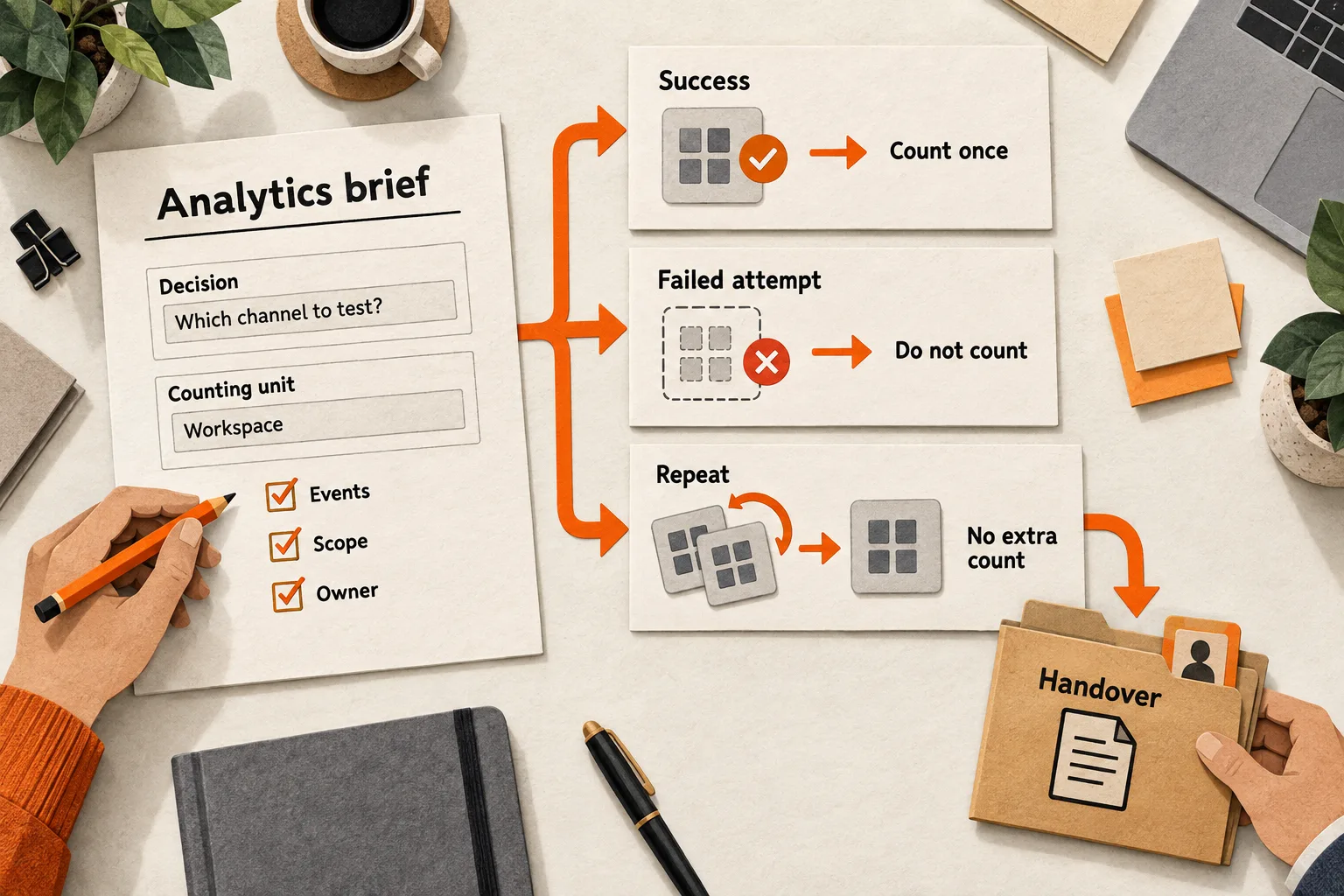
Use a marketing analytics setup brief to get those details into the scope. Start with one business decision, then specify the events, implementation work, acceptance tests, and handover needed to support it.
Start with the decision you need to make
For a small SaaS team, the decision might be which acquisition channel deserves another experiment based on the accounts that reach a useful product outcome.
Define the steps needed to inform that decision: an account is created, someone completes the first useful task, and the account becomes a paying customer. Specify whether you count people, workspaces, subscriptions, or companies. Three people joining one workspace should not become three acquired customers.
Keep known problems separate from hypotheses. A founder’s concern that paid traffic produces weak trials is a question to investigate. It does not establish that the trials are weak or justify every possible attribution report.
If the useful product outcome is unclear, work through FindVex’s guide to removing onboarding steps that delay the first useful result before commissioning the event plan. The activation definition needs to be specific enough for both your engineer and consultant to recognize the same outcome.
Give the project a boundary and an endpoint
List the systems involved: marketing website, application, analytics property, tag manager, billing system, CRM, and reporting destination. Include the relevant domains, current owners, known problems, and available engineering time.
Ask the consultant to price these deliverables separately:
- An audit of the agreed customer journey, identifying gaps and duplicate tracking.
- A tracking plan defining events, properties, counting rules, and destinations.
- Implementation of the approved plan, including specified engineering changes.
- A report answering the selected business question and showing missing data.
- Test evidence, documentation, and a handover session.
Put exclusions beside the deliverables. Historical reconstruction, a warehouse migration, campaign management, and ongoing analysis each need their own scope if you want them. Identify the earliest date from which the new reporting can be trusted; do not assume missing historical events can be recovered.
If the existing setup is poorly understood, commission a capped discovery phase first. Its deliverables should be an audit, proposed implementation scope, dependencies, and estimate. Use those to decide whether to proceed.
Name who will implement application changes and how much engineering time is available. Before adding a domain, integration, or event, require a written estimate of the effect on cost and schedule. A bounded project still needs a way to handle changes.
Require an event plan before implementation
For each event, require a business definition, exact trigger, counting unit, allowed properties, destination, and responsible owner. Include behavior that must not trigger it.
Account creation, for example, should represent a successfully created account. A click on the signup button is a separate action. The plan should explain what happens when the user refreshes, retries, returns later, or adds another teammate.
Define the source of truth for each outcome. Your application may be authoritative for account creation, while billing records establish payment status. Ask the consultant to document how those records connect and which journeys remain unlinked.
Include a small campaign naming convention and a rule for unknown acquisition sources. Keep unknown records visible in the report so the team can see how much information is missing.
Specify what data must stay out of analytics. Google prohibits sending information it can recognize as personally identifiable information to Google Analytics, including email addresses. Its guidance identifies URLs, page titles, and user-entered fields as possible leakage paths. Require checks against Google’s PII guidance.
For an AI product, a sensible project requirement is to exclude raw prompts, uploaded documents, and generated responses unless a separate review establishes a justified collection need and appropriate destination. Counting a completed task rarely requires copying its contents.
Specify access and release responsibilities
Keep accounts under company control. Create an access list with the system, company owner, consultant role, reason for access, and removal date. Use individual invitations instead of shared logins.
Access to edit and authority to release changes can be separate. Google Tag Manager provides distinct container permissions: Edit allows changes without publishing, while Publish includes release rights. Google also recommends multiple active administrators and internal account management. Use its permissions documentation to assign the relevant roles.
Name the person who approves the tracking plan, the engineer who handles application changes, and the person who releases production changes. Reserve time for each and include access or engineering dependencies in the schedule.
Require a record of changed tags, settings, and code, plus instructions for reversing the changes. Include approved consent behavior in the specification and test it explicitly.
Accept the setup through reproducible tests
Ask for a test log that records the journey, expected result, actual result, environment, timestamp, and supporting evidence. A dashboard screenshot alone cannot show whether failed actions or repeated deliveries inflate the counts.
Cover successful actions, failed actions, repeats, and missing data. A refresh should not create another first payment. A failed signup should not count as a created account. A visitor without a known campaign source should remain in an identifiable unknown group.
For GA4, DebugView can help inspect received events and their parameters. Google notes that privacy controls or denied Analytics cookie consent can prevent events from appearing there. DebugView also performs limited attribution analysis; Google directs users to Acquisition reports for attribution information. Build separate checks for event collection and reporting using Google’s DebugView guidance.
If the implementation uses Stripe webhooks, test duplicate delivery. Stripe documents that the same event can arrive more than once and recommends recording processed event IDs to prevent repeat processing. It also describes cases where separate Event objects represent duplicates, identified using the underlying object ID and event type. Ask the implementer which cases apply to your integration. See Stripe’s webhook documentation.
Agree on acceptance criteria before implementation. For a controlled test, require the expected account and payment counts exactly. For production reconciliation, define the comparison period, time zone, exclusions, and treatment of consent or missing identity. Require explanations for discrepancies instead of a promise that every platform total will match.
Passing these tests establishes that the specified implementation works under the tested conditions. It does not establish that a channel caused additional sales or that a small sample supports a budget increase.
Worked example: an AI document tool
Suppose a two-person team sells an AI document review tool. Its marketing site sends visitors into a separate application, and billing runs through Stripe. The founder wants to compare acquisition sources by the workspaces that complete a review and later pay.
The team defines activation as a workspace completing its first successful document review. Opening the upload screen does not qualify. These event names and counting rules are hypothetical design choices:
| Event | Agreed counting rule |
|---|---|
workspace_created |
Once per newly created workspace |
first_review_completed |
Once per workspace after a successful review |
first_payment_received |
Once per workspace after its first successful, nonzero subscription payment |
The consultant must document how website acquisition data connects to the workspace, with unknown sources retained. The proposed report groups workspaces by creation week and shows activation within seven days of creation and first payment within 30 days of creation. Recent groups are marked incomplete until their observation windows close. Those windows are choices for this example, not benchmarks.
The engineer runs two test journeys in an environment configured for the agreed collection behavior:
| Test journey | Expected created workspaces | Expected activated workspaces | Expected first payments |
|---|---|---|---|
| Create workspace A, complete a review, make a qualifying test payment, reload the confirmation page, and redeliver the payment event | 1 | 1 | 1 |
| Abandon signup before workspace creation, then return and successfully create workspace B; complete no review and make no payment | 1 | 0 | 0 |
| Total | 2 | 1 | 1 |
During the abandoned signup attempt, the expected workspace count is zero. It increases only after the successful attempt. The reload and repeated payment delivery must leave workspace A’s counts unchanged. A separate test covers the approved consent behavior.
The project excludes historical backfill, ad management, and additional billing journeys. Renewal and refund reporting can be scoped later; label this report as first-payment reporting so readers do not interpret it as net revenue. The handover includes a recorded walkthrough and an agreed defect correction window. These are proposed scope choices, not customer results or a standard project duration.
Copy this brief before requesting proposals
Fill in the fields and ask each candidate to respond against the same scope:
Decision this setup must support:
Customer journey and counting unit:
Systems, domains, and company owners:
Existing problems and available engineering support:
Included events, properties, integrations, and report:
Source of truth and identity rules for each outcome:
Consent behavior, excluded data, and unknown-source treatment:
Acceptance tests and required evidence:
Historical coverage and explicit exclusions:
Access roles, release owner, and rollback requirements:
Milestones, fees, recurring software costs, and change approval process:
Handover date, defect correction window, and ongoing owner:
Ask candidates to identify assumptions and dependencies beside their estimates. If they propose recurring analysis, monitoring, or support for product changes, request a separate line item describing the responsibilities and cadence.
Check the handover and write your first three tests
Before signing off, have the ongoing owner use the documentation to open the configuration and report, find an event definition, and repeat one acceptance test. Record any missing access or instructions that prevent them from finishing.
Collect the change log, code or configuration exports where applicable, known limitations, and maintenance instructions. Confirm who fixes failures after handover and when the agreed defect correction window ends. Remove temporary access after the support work ends.
Start your brief with one decision and one counting unit. Then write three acceptance tests: a successful journey, a failed attempt, and a repeated action or delivery. Give each an expected count. Use those tests to ask exactly what the next proposal includes.