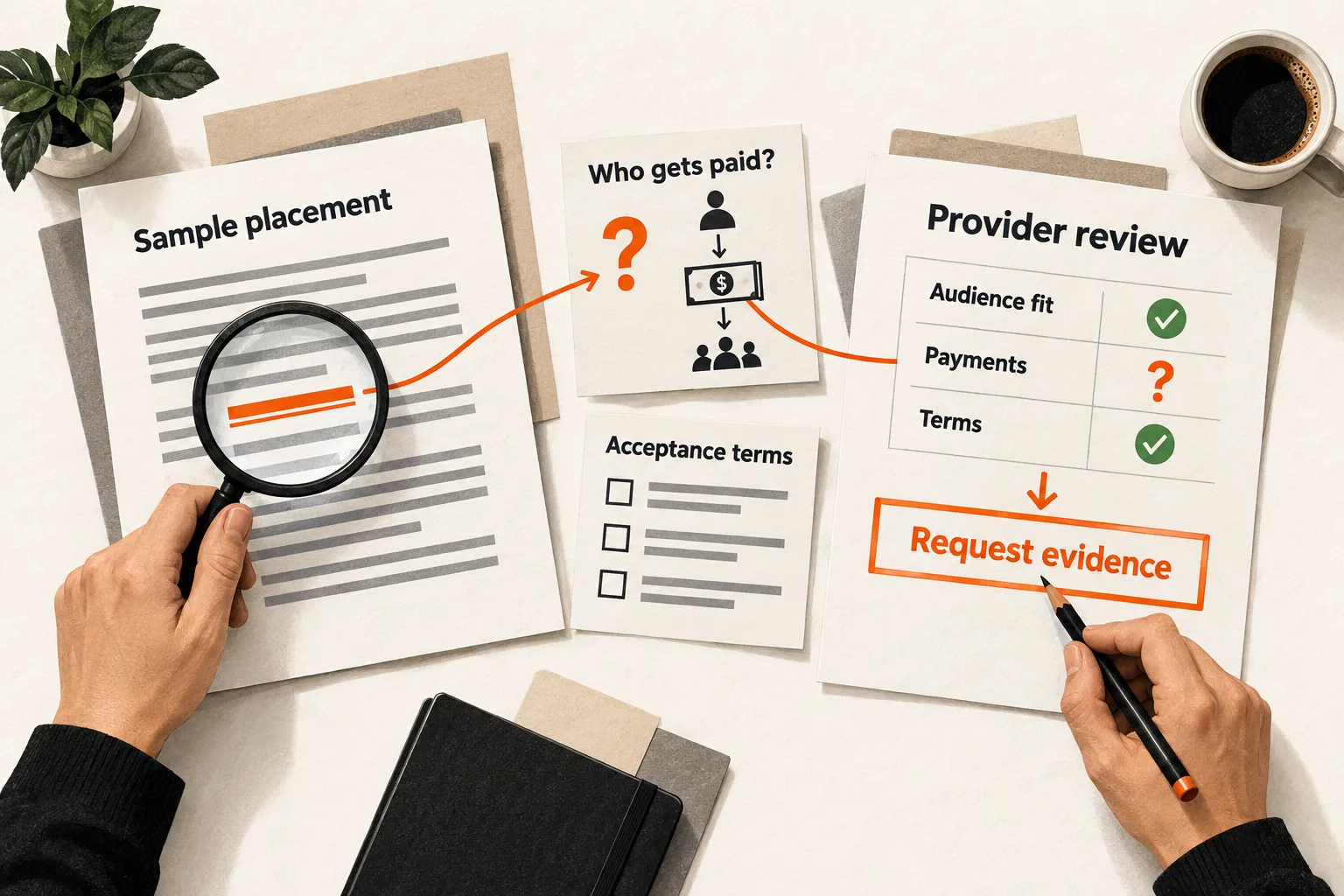
Before buying a link-building package, inspect comparable placements, ask who gets paid, and agree on what counts as acceptable work. Your review should end with a written decision: proceed with a limited scope, request missing evidence, or decline.
Suppose a proposal promises ten links a month from sites with impressive authority scores. Ask the provider to explain how one link would reach the page: who chooses the publication, who receives payment, and who decides whether your product belongs there. Those answers give a small AI or SaaS team more to evaluate than a link count and a price.
Establish what the provider is selling
Ask the provider to separate research, content creation, outreach, publisher payments, and reporting in its proposal. A service fee for researching publications is different from a payment to a publisher in exchange for a link.
Google defines link spam as creating links primarily to manipulate search rankings. Its examples include buying links for ranking purposes, excessive exchanges, automated link creation, and low-value content made to manipulate linking signals. Advertising and sponsorship links are permitted when appropriately qualified. Google’s link spam policy
For paid placements, Google prefers rel="sponsored"; rel="nofollow" remains acceptable. These attributes belong in the link’s HTML and tell Google about its relationship to the destination. A visible sponsorship label does not substitute for that technical qualification. Google’s outbound-link guidance
Have the provider answer these questions in writing:
- Does any publisher, editor, broker, or site owner receive money, services, or another benefit for the placement?
- Does the provider own or control any proposed sites?
- Can the publisher reject the article, omit the link, or change its wording?
- What link attributes and visible sponsorship labels will appear?
- Does another company fulfill any part of the package?
Terms such as “editorial,” “white hat,” and “manual outreach” leave these questions unanswered. Ask for the arrangement behind a specific sample. Sending an email manually tells you nothing about whether the resulting placement was purchased.
A disclosed sponsorship with appropriate link qualification may suit your audience goals. Evaluate it as paid distribution, with its own budget and expected reader value. Decline a proposal that conceals paid placements while selling them as independent editorial endorsements.
Inspect actual pages behind the portfolio
Start by requesting three recent placement URLs and one older example relevant to your market. This is a manageable starting sample, not a quality threshold. Ask what the provider contributed to each placement and whether the examples represent the package you would buy.
Open the pages yourself. Read the paragraph containing the link, then inspect the publication’s main navigation and several neighboring articles. Record four observations:
Audience fit. Explain why your buyer would read the publication. A support operations tool needs a connection to support leaders, service workflows, or related technical work. A generic article mentioning software does not establish that connection.
Reader benefit. Identify what the destination contributes: a method, supporting research, a working tool, or a relevant product explanation. If a commercial keyword appears in an unrelated sentence, ask why the link belongs there.
Editorial judgment. Look for a clear subject area, useful articles, and identifiable authors or editors. Consider whether the sample belongs alongside the publication’s other work. These observations inform your assessment; none proves that a site is trustworthy.
Placement details. Check the destination, anchor text, visible disclosures, and link attributes against the provider’s description. In a browser, use Inspect on the link to examine its href and rel values, or ask someone technical to verify them. Save the URL and check date because pages can change.
If confidentiality prevents sharing client examples, request permission-cleared samples or a walkthrough that protects client details. Leave the assessment unresolved until you can inspect comparable work. A provider’s selected examples also cannot establish the quality of every placement it delivers.
Use authority metrics as supporting evidence
Ahrefs defines Domain Rating, or DR, as the relative strength of a website’s backlink profile within its database. Ahrefs also advises against judging a potential linking site on sitewide authority alone. Ahrefs’ explanation of Domain Rating
A high score does not tell you whether the article serves your buyers or whether its link was purchased. Record metrics alongside your page review, keeping audience fit and placement terms visible.
For traffic figures, ask for the source, measurement date, country, and whether the number describes the domain or the placement page. Label tool estimates as estimates. Traffic to a whole domain does not establish that a new article will receive readers.
For example, a publication could attract substantial traffic to consumer articles while offering you an obscure business-software page. A small specialist publication could have a relevant audience despite modest aggregate metrics. Ask the provider to explain the fit in either case.
Trace one placement through the provider’s process
Choose a sample and have the provider walk through prospect selection, the pitch, editorial feedback, compensation, and the final placement. Request a redacted pitch if one is available.
Then ask what it would do for your product. Which existing resource would it pitch? Why would a particular editor care? What would make it reject a prospective publication?
If your site lacks a useful resource to pitch, include that work in the scope. FindVex’s guide to building a content brief from one customer question can help you define an article or resource before outreach begins.
For an AI product, review how the provider will describe capabilities and limitations. Require approval before it makes performance claims, supplies quotations attributed to your team, or offers access to your product.
Ask for a reference from comparable work. Google’s hiring guidance recommends reviewing previous work and business references, discussing measurement, and avoiding providers that guarantee first place in search results. Google’s advice on hiring an SEO
Use the reference to ask about communication, delivery, and how the provider handled problems. If it shares a traffic chart, ask what else changed during that period, such as content, a site migration, or other marketing activity. The chart alone cannot establish the provider’s contribution.
Put acceptance criteria into the agreement
Turn the answers into terms you can check. Use this table to review the proposed scope:
| Term | What to specify |
|---|---|
| Work and fees | Research, asset creation, outreach, sponsorship, and reporting, with fees separated |
| Audience and exclusions | Suitable topics, markets, publication types, and unacceptable placements |
| Approval | Who approves prospects, pitches, product claims, and paid opportunities before commitments |
| Disclosure | Publisher compensation, provider ownership, subcontractors, expected link attributes, and visible sponsorship labels |
| Reporting | Placement URL, destination, anchor text, publication date, commercial relationship, and latest verification date |
| Remedies and exit | Treatment of rejected, changed, or removed placements; extra charges; cancellation; and ownership of created assets |
Clarify whether a promised link count is a delivery guarantee, a target, or an estimate. Ask what happens if appropriate publishers decline. Do not agree to substitutions that fail your written criteria merely to fill a quota.
Specify how long the provider will monitor placements and what a replacement or refund covers. If the proposal calls links “permanent,” ask what that promise means when a publisher changes or removes a page.
Set a review date and decide what you will assess: completed work, publisher responses, placement quality, referral visits, or relevant inquiries. Keep delivery measures separate from business outcomes so a completed outreach project does not automatically count as a successful acquisition effort.
Worked example: compare two offers for a support SaaS
This hypothetical founder sells an AI tool that helps support teams organize escalation notes. The company has an escalation worksheet but little time for outreach.
Provider A proposes ten monthly links from sites above a DR threshold. Its sample pages cover unrelated subjects. It refuses to identify publisher payments and promises links that pass ranking credit.
The founder declines because of the weak audience fit and refusal to disclose payment arrangements. A lower price would leave both problems unresolved.
Provider B proposes a four-week project to improve the worksheet, research support-industry publications, and pitch selected editors. It shares relevant examples, explains that publishers may decline, and requires separate approval for paid sponsorships with appropriate link qualification.
The founder records this decision:
Request evidence before proceeding. Review a prospect sample for audience fit and get written approval, reporting, and cancellation terms. If those checks are satisfactory, decide whether the worksheet improvements and outreach work justify the fee even if no links result.
Provider B has explained a process the founder can inspect. That supports further review; it does not establish that the project will succeed. At the project’s end, the founder would compare the agreed work with delivery and examine any referral visits or relevant inquiries. A ranking change alone would not establish that the provider caused it.
Copy this provider review sheet
Complete one sheet per proposal. Write “unknown” wherever evidence is missing, and distinguish what the provider says from what you observed.
PROVIDER REVIEW
Provider and review date:
Business objective and intended audience:
Work included, total cost, and founder time required:

COMMERCIAL ARRANGEMENT
Publisher payments or other compensation:
Provider-owned sites and subcontractors:

SAMPLE REVIEW — repeat for each placement
URL and date checked:
Provider’s stated contribution:
Reader benefit and topical fit observed:
Destination and anchor text:
Link attributes and visible sponsorship disclosures:
Metric sources, dates, geographic scope, and limitations:
Mismatch or unanswered question:

PROPOSED TERMS
Approval process and publication exclusions:
Reporting and placement-monitoring period:
Remedies, extra charges, cancellation, and asset ownership:
Review date, delivery measures, and business outcomes to assess:

DECISION
Proceed with limited scope / request evidence / decline:
Reason and supporting evidence:
Unresolved questions, evidence requested, and follow-up date:
Use “request evidence” when a missing answer could change your decision. Decline when the provider refuses necessary disclosure or its proposed work conflicts with your criteria. Proceed with a limited scope only when you understand the work, accept the terms, and can afford the possibility that it produces no useful placements.
Before your next provider call
Inspect one sample page and complete its portion of the sheet. Turn each gap into a specific request, such as the payment arrangement, link attributes, or a comparable example. End the call with a written decision and, if evidence is still missing, a named follow-up item and date.