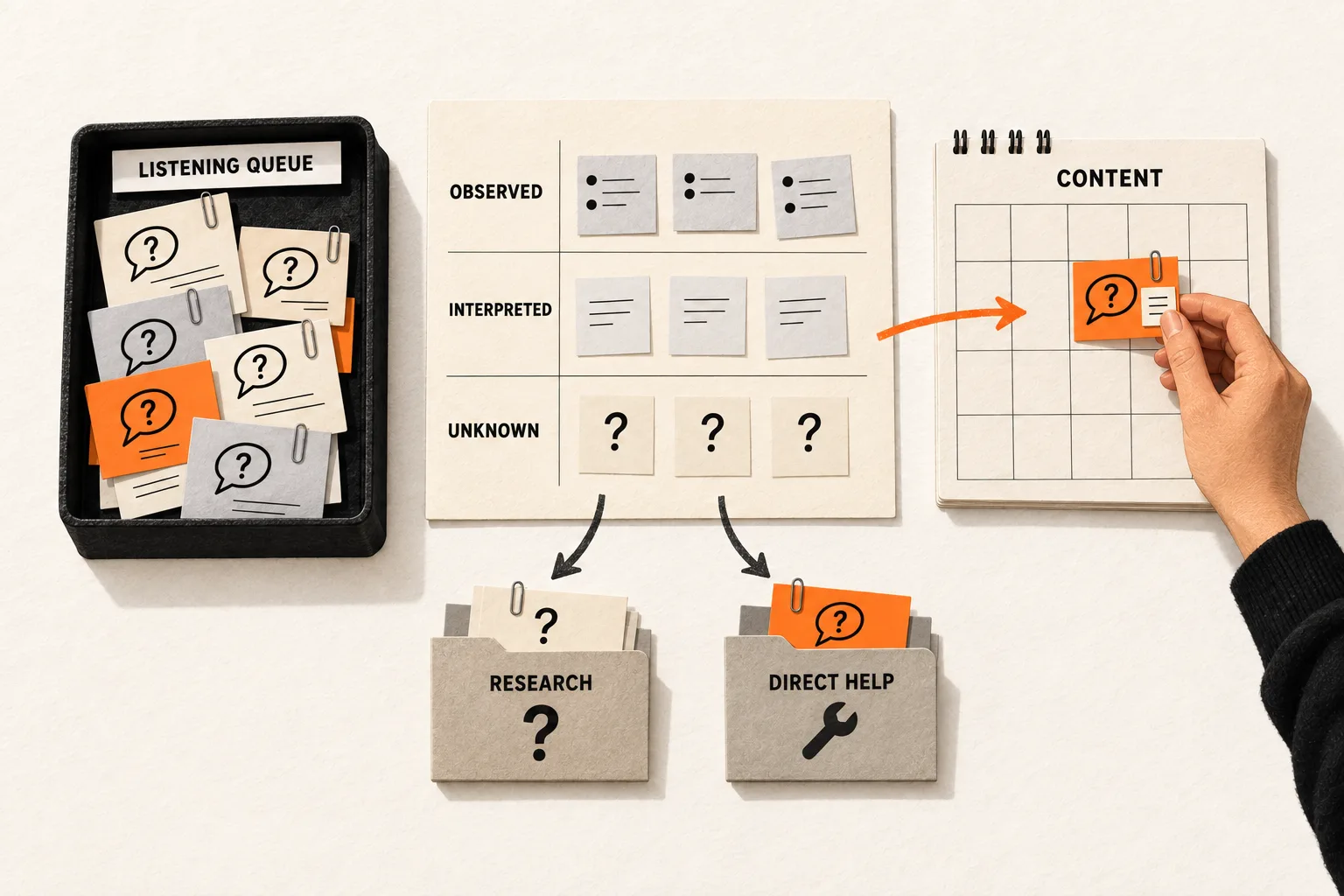
Before assigning your next post, write down the customer question it will answer and where that question came from. If either is missing, start a listening queue: a shared document that keeps observations, interpretations, and unanswered questions together for weekly review.
For a small AI or SaaS team, each entry should help you decide whether to investigate, prepare content, or solve a customer problem directly. Move a question into the calendar when you can explain who needs the answer and support what you plan to say.
Start with one audience and one decision
Choose a narrow listening focus for the next two weeks. For example: operations leads deciding whether an AI meeting assistant fits their client handoff process.
That focus tells you which conversations belong in the queue. A question about recording consent may matter. A popular argument about the future of AI may have little bearing on the decision.
Joanna Wiebe’s review-mining method starts with the intended audience, their goals, and the alternatives they already use. Those choices help determine where to look for useful customer language. Read her explanation of choosing review sources.
Pick two or three places you can check consistently. These might include customer conversations your team is authorized to review, public discussions among likely buyers, and reviews of competing products or manual alternatives.
Record the source type. A prospect describing a blocked purchase and a creator speculating about the industry offer different kinds of evidence. Neither a busy thread nor a memorable complaint tells you how common a problem is across your market.
If you have no customers yet, use public observations to form prospect hypotheses. Leave the person’s role unknown when you cannot establish it.
Separate observations from interpretations in your worksheet
Someone asking about exporting meeting notes has raised an export question. You might suspect they need a reliable handoff to another team. Record that suspicion separately until you have more context.
The Government Digital Service’s research guidance follows this sequence: record what people said or did, interpret the observations, then decide what to change or investigate. Its research analysis guidance provides a useful basis for keeping those steps distinct.
Copy this record into a shared document and fill it in for each question:
LISTENING QUEUE ENTRY

ID: [Stable reference to carry into a brief]
Captured on: [Date]
Source type: [Prospect conversation, support, public discussion, review]
Source reference and conversation date: [Link or permitted internal record]
Audience and situation: [Role, task, constraints; mark unknowns]
Observation: [Short exact excerpt or labeled paraphrase]
Interpretation: [What you think it suggests]
Unresolved question: [What could change that interpretation?]
Related evidence: [Independent examples, duplicates, contradictions]
Next action: [Investigate, prepare content, product/support, archive]
Owner and review date: [Name and date]
Keep private source material in records with appropriate access restrictions. Give writers only the details they need and are allowed to use. For public examples, use approved material or a clearly labeled hypothetical.
Capture enough context to understand the problem without copying an entire conversation. A source link may become unavailable, while a detached excerpt may lose its meaning. Preserve a short observation, its date, and the situation in which it arose.
Use the weekly review to assign the next action
Try a 30-minute weekly review and name one owner, even if several people contribute. Adjust the timebox to the queue; it is a starting schedule, with no claim that it is optimal.
First, check sources and merge duplicates. Multiple replies from one person belong to one conversation and do not establish independent demand. Preserve disagreements when grouping entries around a theme.
Choose a destination for each entry:
| Destination | When to use it |
|---|---|
| Investigate | The situation or underlying need is unclear. |
| Prepare content | You understand the question and can support a useful answer. |
| Product or support | The person needs a fix, direct help, or a capability decision. |
| Archive | The entry is outside the audience, outdated, or too thin to pursue. |
Prioritize by audience fit, the consequence of leaving the question unanswered, and your ability to help. Recurrence adds context, but a single serious blocker can deserve attention. Several vague mentions may still need investigation.
Make each investigation a specific task. Ask what happened the last time the person attempted the work, what they tried, and where the process stopped. The Government Digital Service’s interview guidance recommends open, neutral questions and concrete stories. Use those to explore the situation without steering the person toward your proposed solution.
Select only as much content as the team can produce and verify. If no entry is ready, assign a research task and leave the calendar slot open.
Worked example: turn an export question into a guide
Imagine a two-person team building an AI meeting assistant for small consulting firms. All observations and record IDs in this example are hypothetical.
During one week, the founder captures three entries:
| Entry | Observation | Interpretation or next question |
|---|---|---|
| L-01: prospect conversation | A project lead asks whether action items can move into a client’s existing task system. | The founder suspects a missing integration. What happened during the last handoff? |
| L-02: public discussion | A consultant describes manually checking task owners before sending a meeting recap. | Does the check concern accuracy, accountability, or both? |
| L-03: support conversation | A user asks how to correct an assigned owner before sharing notes. | Provide direct support for the correction. |
These entries suggest a question about reviewing action items before sharing them. They do not establish that consultants broadly want more integrations or that all three people have the same problem.
The founder follows up on L-01 and asks the prospect to walk through the most recent handoff. Suppose the prospect explains that a manager must approve owners and deadlines before anything reaches the client’s task system. Update L-01: for this prospect, export is one step in an approval workflow. Keep L-02’s unresolved question open.
Support handles L-03. Product checks whether the approval step is adequately supported. The content assignment becomes a checklist for reviewing AI-generated action items before a client handoff.
The calendar entry could read:
| Brief field | Hypothetical assignment |
|---|---|
| Reader | Consulting project lead preparing a client handoff |
| Question | What should we verify before sharing AI-generated action items? |
| Useful outcome | Check ownership, deadlines, and unresolved decisions before sharing |
| Evidence references | L-01 and its follow-up support the approval-workflow context. L-02 and L-03 raise related review questions; they do not confirm the same requirement. |
| Verification needed | Test any described product workflow before including it. Exclude private details from the draft. |
| Format and distribution | A short guide with a checklist, followed by a LinkedIn post explaining one review step |
| Open limit | The observations do not establish how widespread this workflow is. |
Use FindVex’s SaaS content brief template to turn that assignment into a brief with an evidence plan. The queue selects the question; the brief specifies what the writer must answer and verify.
Record what readers do with the content
Keep the queue ID attached to the published piece, along with its version and publication date. Before publication, choose a review date and define what feedback would help you decide whether to revise the piece or investigate further.
For the hypothetical handoff guide, useful feedback might be a target reader identifying a missing review step or explaining where the checklist was unclear. Likes alone would not establish whether the guide helped someone complete the task.
At the review date, record the response and the next action. Distinguish likely buyers’ feedback from general encouragement. If you have permission to ask a reader about their experience, ask which step they used and what remained difficult.
A quiet post leaves several explanations open: the answer may be weak, distribution may have missed the intended audience, or too few people may have seen it. Silence does not settle whether the underlying question matters. Enthusiastic replies can justify further investigation without proving revenue impact.
Add a short follow-up to the original queue entry:
CONTENT FOLLOW-UP

Article or post: [Link, version, publication date]
Review date: [Date]
Feedback sought: [What would inform the next decision?]
Observed response: [What happened, with a source reference]
Limits: [Audience uncertainty, limited reach, unanswered questions]
Next action and owner: [Revise, investigate, retain, or archive]
Build your first queue this week
Collect five entries for one audience and one current task. Five is a manageable first exercise, not a validation threshold.
Before the review, check that each entry has a dated source reference and enough context to interpret it. Separate observations from interpretations, mark unknowns, and connect duplicates or contradictory evidence. Assign an owner to every entry you decide to pursue.
At the review, choose one question you can answer and carry its ID into a content brief. Assign one unresolved question for follow-up, with an owner and review date. Route any immediate customer problem to the person who can address it. If nothing is ready for content, use the next calendar slot to finish the research.