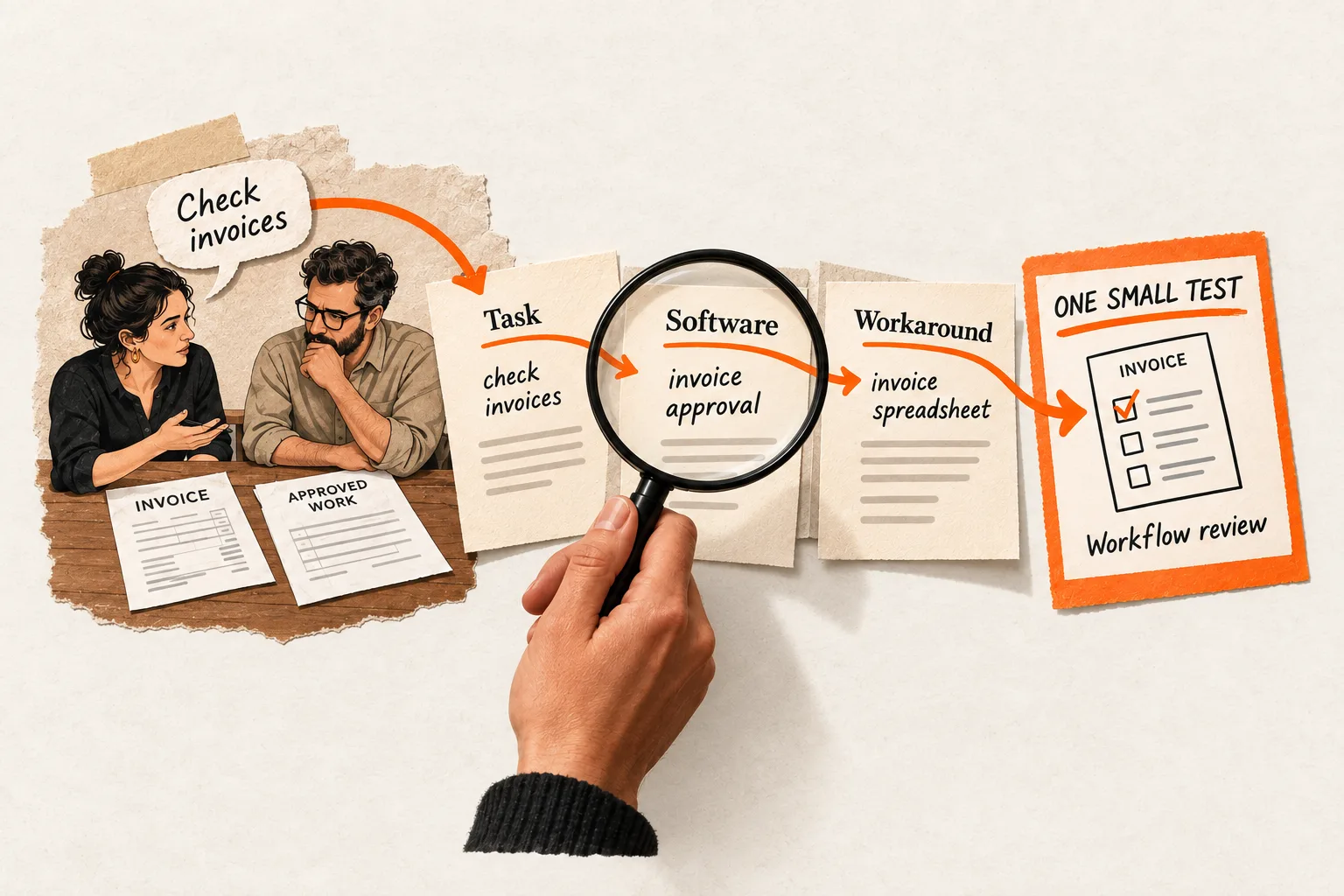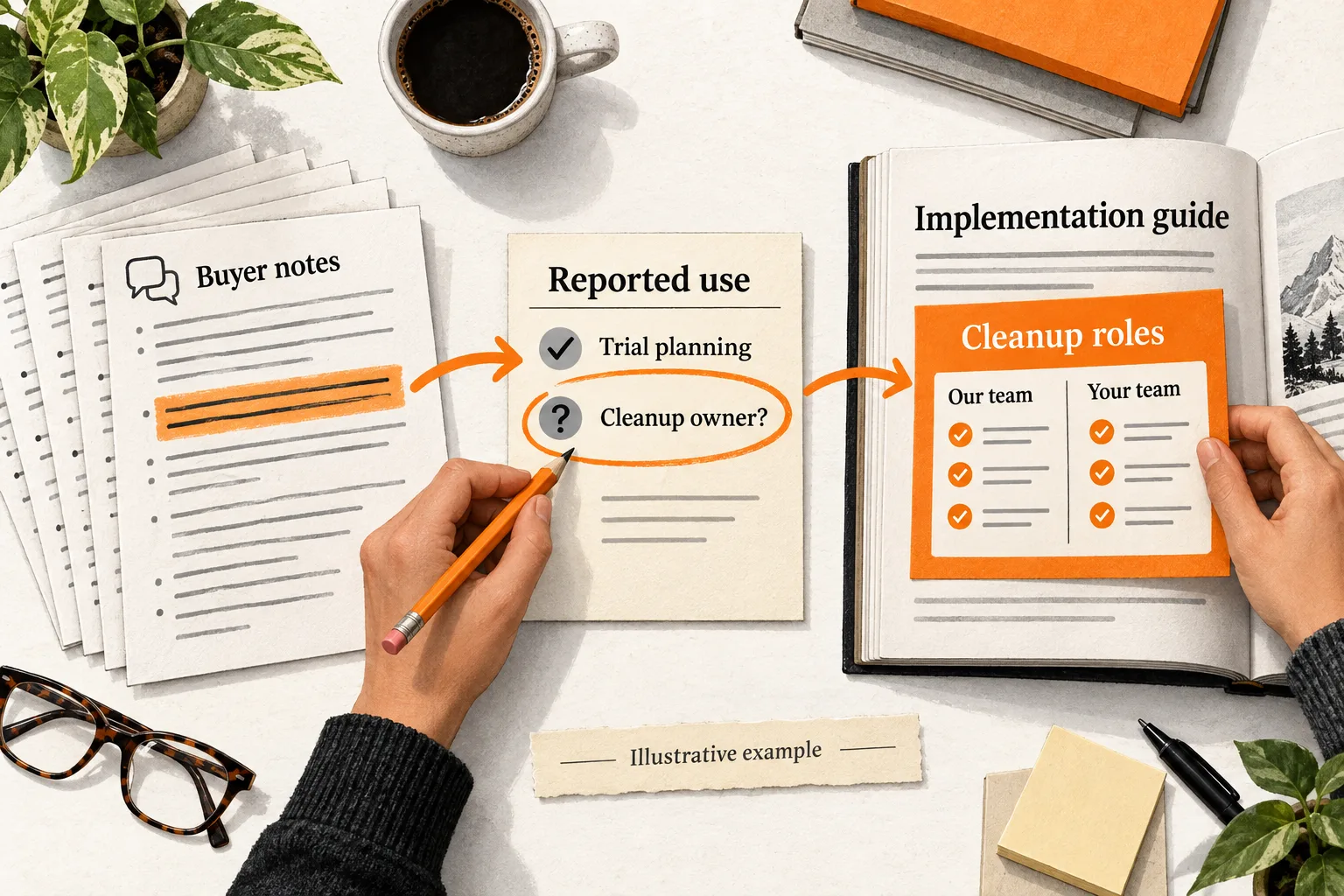
Suppose a buyer mentions your implementation guide halfway through a demo. Their engineering team used it to estimate the work involved in a trial. A traffic report might show visits to the guide; the conversation explains what someone used it for.
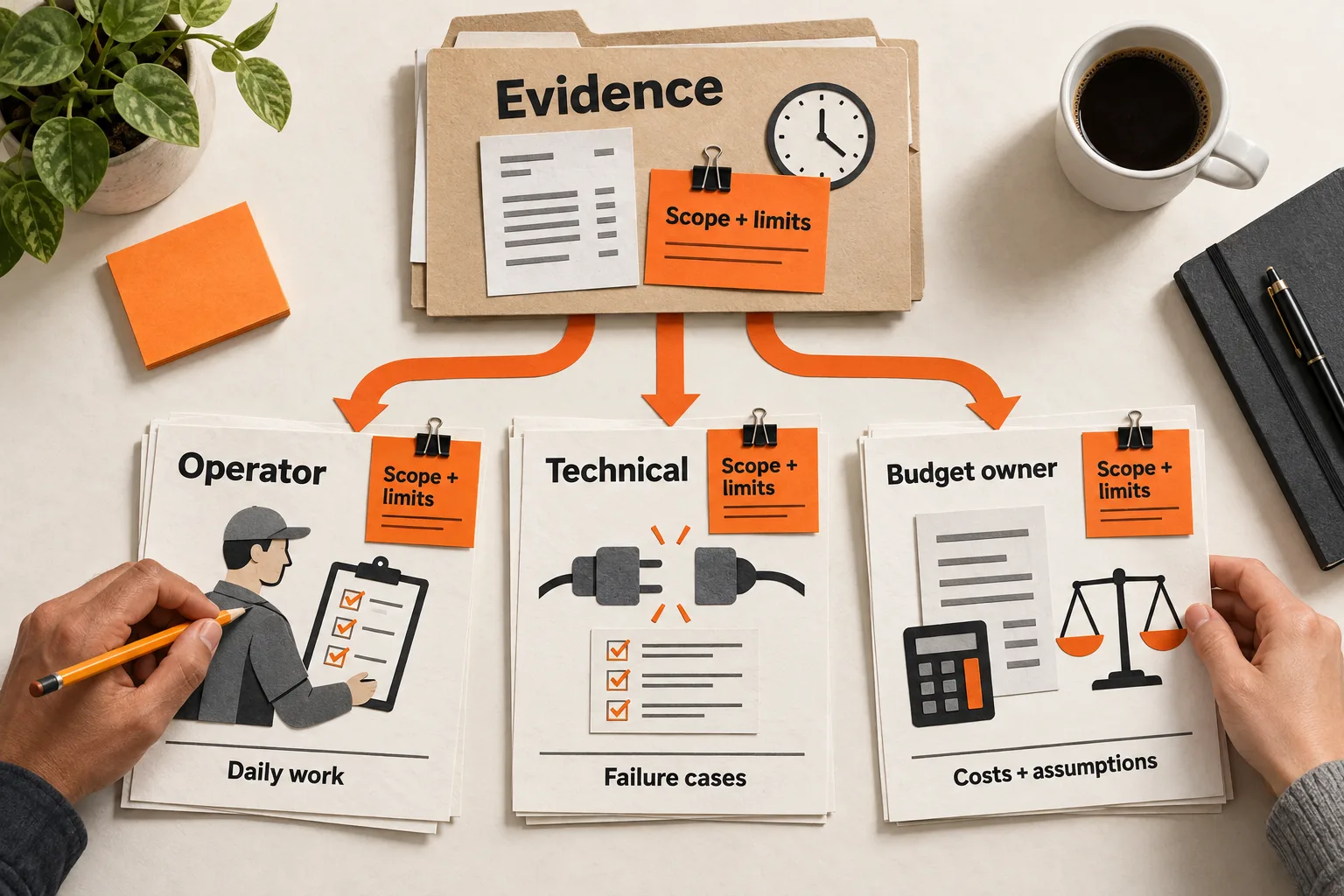
To capture that context, review a defined set of sales conversations and record the content buyers mention, what they report using it for, and what remains unclear. Use those observations to choose a content improvement. A mention alone does not establish that the content caused a sale.
Start with existing notes and a spreadsheet. A first audit can cover five eligible opportunities.
Define what counts as a buyer mention
The audit answers one question: which identifiable pieces of content did buyers bring into their evaluation, and what did they say those pieces helped or failed to explain?
Keep these observations separate:
| Observation | What it supports |
|---|---|
| A rep sent a guide | The rep distributed it |
| A buyer acknowledged receiving it | The buyer recognized the asset |
| A buyer described using it | Reported use and purpose |
| A buyer identified confusion | A possible content problem |
A rep’s account of sending a case study does not count as a buyer mention. A buyer acknowledging receipt does count, but it does not establish that they read it. Record the observation type so a receipt acknowledgment cannot be mistaken for reported use.
Google Analytics defines attribution as assigning credit to interactions along the path to an important action. An attribution model determines how that credit is allocated. Google’s attribution documentation describes this approach.
Your audit records the buyer’s account of an asset’s role. Store it in a separate field, such as buyer-reported role, alongside any existing attribution records.
Choose the sample before reading for successes
Choose a review window, such as opportunities with a discovery or evaluation call in the last 30 days. Include open, won, and lost opportunities that meet the rule. If you need a smaller sample, set the selection rule before reading the notes. For example, select the first five eligible opportunities by discovery-call date.
Record both the eligible population and the selected sample. Review the available conversations within each selected opportunity, including later technical calls where buyers may discuss specific content.
Give each selected opportunity one review status:
| Status | Meaning |
|---|---|
| Reviewed: mention found | At least one buyer reference to content is documented; asset identification may still be unresolved |
| Reviewed: no mention documented | Usable notes contain no buyer reference to content |
| Not assessable | Notes are missing, too thin, or unavailable for this use |
No documented mention does not mean the buyer never consumed content. Exclude opportunities marked not assessable from the reviewed count, but keep their number visible in the summary. Record any missing calls within otherwise usable records, too.
Count distinct opportunities when reporting how widely an asset appeared in the sample. Three mentions of the same guide within one opportunity remain three observations from one opportunity.
Confirm that the records can be used for this audit
Begin with records your team is authorized to use for this purpose. Before opening or exporting recordings, confirm that their collection and proposed use fit your consent process, privacy commitments, and applicable requirements. If permission is unclear, exclude those records until the responsible person resolves it.
For future calls, explain the intended recording or transcription use and obtain the required consent before capture starts. Check automatic recording settings beforehand. HubSpot places responsibility for proper consent on users and recommends obtaining consent when uncertain. Its guidance is not a complete legal assessment for your business. HubSpot’s call recording guidance explains those responsibilities.
Collect only what the audit needs. Use an opportunity ID instead of a person’s name where possible, and retain a restricted source reference with the minimum useful excerpt. Avoid copying whole transcripts into a marketing spreadsheet. Set access permissions and a review or deletion date consistent with your retention obligations. These practices apply the FTC’s guidance on minimizing retained personal information, limiting access, and setting retention rules. FTC guidance on protecting personal information provides the underlying principles.
Treat any proposed public quotation as a separate permission decision. Internal review permission does not establish permission to publish a buyer’s words.
Copy the audit worksheet
First, make an asset list with a stable ID, title, URL, and known version or update date for each guide, video, comparison page, or case study. An old PDF and a revised web page may explain the same topic differently.
Use an opportunity sheet to track coverage and a mention sheet to capture evidence. Copy these fields into your spreadsheet, using one column per field.
OPPORTUNITY SHEET: one row per selected opportunity
Opportunity ID:
Review window and selection rule:
Status at review: open / won / lost
Calls reviewed and dates:
Missing or unavailable calls:
Review status: mention found / no mention documented / not assessable
Reason if not assessable:
Unresolved content references:
Distinct identified asset IDs:

MENTION SHEET: one row per asset mention
Opportunity ID:
Buyer role:
Call date and stage at that time:
Restricted source reference or timestamp:
Evidence form: verified excerpt / contemporaneous paraphrase / later recollection
Buyer wording or clearly labeled paraphrase:
Asset ID and version: identified / unresolved
Observation: acknowledgment / reported use / confusion
Context: spontaneous / general question / asset named in question
Buyer-reported role: awareness / understanding / comparison / internal sharing / concern / unclear
Editor interpretation:
Proposed action:
Owner and review date:
Keep the eligible and selected opportunity totals above the opportunity sheet. Summarize its review statuses there so missing evidence stays visible even when the mention sheet has few rows.
Search notes for asset names and ordinary references such as guide, article, video, comparison, case study, read, watched, and forwarded. Read the surrounding exchange before adding a row. A keyword match may belong to the rep, refer to a competitor, or describe something the buyer has not opened.
Leave vague references unresolved. A piece about security could be your documentation, a third-party review, or a competitor’s page. Retain the reference, but exclude it from counts for a specific asset until you can identify it.
For future calls, try this general question: “What, if anything, did you read or watch while evaluating options?” Then ask, “What did it clarify, and what was still unclear?” If you name a particular guide in the question, record that prompt. Keep prompted acknowledgments separate from spontaneous mentions.
Worked example: an implementation guide
Suppose an AI support software team selects all 12 eligible opportunities from a defined month. Ten have usable notes; two are not assessable. Buyers mention identifiable content in four of the ten reviewed opportunities.
The following entry is hypothetical. The buyer report is a paraphrase, not a quotation.
| Field | Example entry |
|---|---|
| Opportunity | O-17, evaluation stage |
| Source | Technical call note, May 12 |
| Evidence form | Contemporaneous paraphrase |
| Asset | Implementation guide, version 2 |
| Observation and context | Reported use; spontaneous mention |
| Buyer report | Engineering used the guide to estimate trial setup work |
| Remaining concern | Ownership of data cleanup was unclear |
| Interpretation | Guide supported planning but left a responsibility gap |
| Next action | Clarify cleanup responsibilities and review subsequent feedback |
O-17 mentions the guide again on a later call. Another opportunity mentions it once. The guide therefore has three recorded mentions across two opportunities.
A defensible summary is: buyers in two of ten reviewed opportunities mentioned the implementation guide. One described using it for engineering planning. Two other eligible opportunities could not be assessed.
If O-17 later closes, record the outcome separately. The audit cannot establish whether the deal would have closed without the guide or how much revenue to assign to it.
Choose one content change from the evidence
For the hypothetical implementation guide, the task is specific: explain who handles data cleanup, give an example of the work involved, and identify what remains the buyer’s responsibility. Assign an owner and review date. Preserve the current version and record the revision date so later feedback can be matched to the page the buyer saw.
Other observations suggest different tasks. When buyers use a guide to prepare technical questions, consider sharing it before technical calls. When someone forwards a page internally, check whether the next stakeholder has enough context to evaluate the product.
If an asset answers one question but leaves the next decision unexplained, use the FindVex guide to design B2B blog reading paths to plan a relevant next page.
Before retiring content with no recorded mentions, check whether it was distributed, whether its intended audience appears in the sample, and whether the notes were detailed enough to capture references. Poor coverage makes silence difficult to interpret.
Use this short decision note to connect the audit to the work:
In [review window], we reviewed [number] of [number] selected opportunities;
[number] were not assessable.
Buyers in [number] distinct opportunities mentioned [asset and version],
including [number] with reported use rather than acknowledgment alone.
They reported [use or confusion]; we still do not know [evidence limit].
[Owner] will [specific change] by [date] and review [defined next sample]
for [the same question or concern].
Review five opportunities, then check the next sample
For your first session, define the eligible population and select five opportunities before reading their notes. Complete the worksheet and choose one improvement the evidence supports. If the records do not support a content change, identify the missing detail to collect in future conversations.
Before using the summary, check that every counted mention comes from a buyer and has a traceable source. Label paraphrases and interpretations, count each opportunity only once per asset, and report missing notes and unresolved references separately.
Keep the selection rule and general question stable for the next review. Report raw counts with coverage, and record changes in the sales process, distribution, or note-taking practice that could affect comparisons.
A higher mention count after a revision may reflect more frequent distribution or better documentation. Buyers who research more may also differ from other buyers. Use the next set of conversations to check whether the specific confusion persists; the audit alone cannot isolate the revision’s effect on sales.