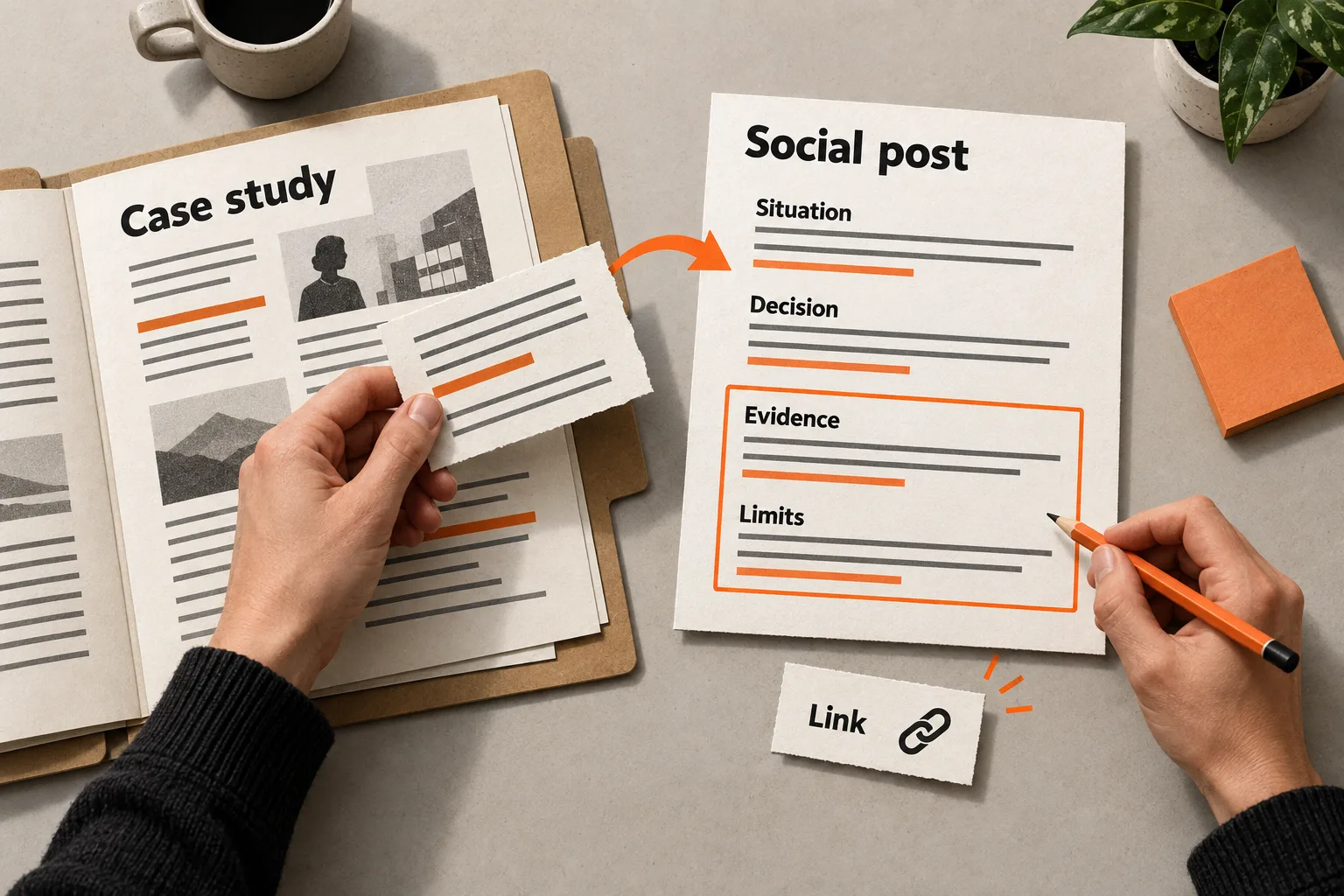
To turn a customer case study into a useful LinkedIn post, choose one decision and explain what supports it. Include the starting problem, what changed, the evidence, and the main limitation. The reader should understand the lesson before clicking through.
Suppose your case study describes an AI support tool and your post repeats a time-saving percentage beside the customer’s logo. A founder still needs to know which tickets changed, what the team did, and whether the result applies to their own queue.
A native post, as used here, gives that explanation on the social platform itself. It can still link to the full story for measurement details or rollout context.
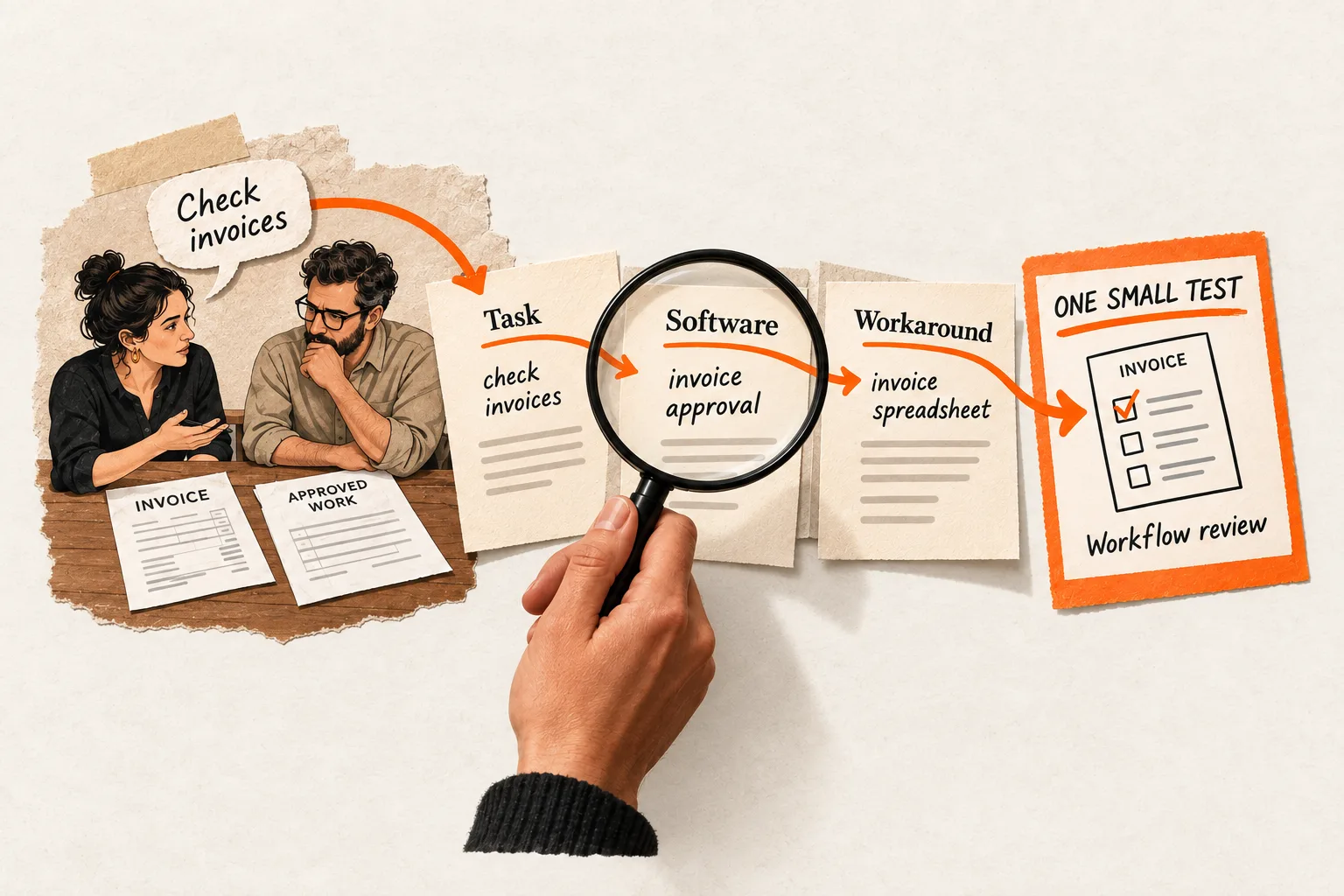
Choose the customer decision your reader faces
Read the case study with a particular reader in mind. An AI SaaS founder considering a support pilot has different questions from an operations leader replacing a ticketing system.
Write down the decision that connects the story to that reader: should a small support team test AI-generated drafts for routine tickets while keeping a person responsible for sending replies?
Use that question to choose the details. The customer’s founding history and unrelated integrations can stay in the full story. Ticket selection and human review belong in the post because they explain the choice.
Customer language can help you write the opening. Joanna Wiebe’s review-mining method starts with the audience, its goals, and the solutions it already uses. Apply that approach to approved interview material: find how the customer described the problem before substituting your product vocabulary.
Keep exact words separate from your paraphrase. A sentence reconstructed from several interview answers is not a quotation, and one customer’s complaint does not establish how common the problem is.
If you need to track approved claims and their uses across channels, start with the customer story reuse map. For this task, choose one decision to explain in one social post.
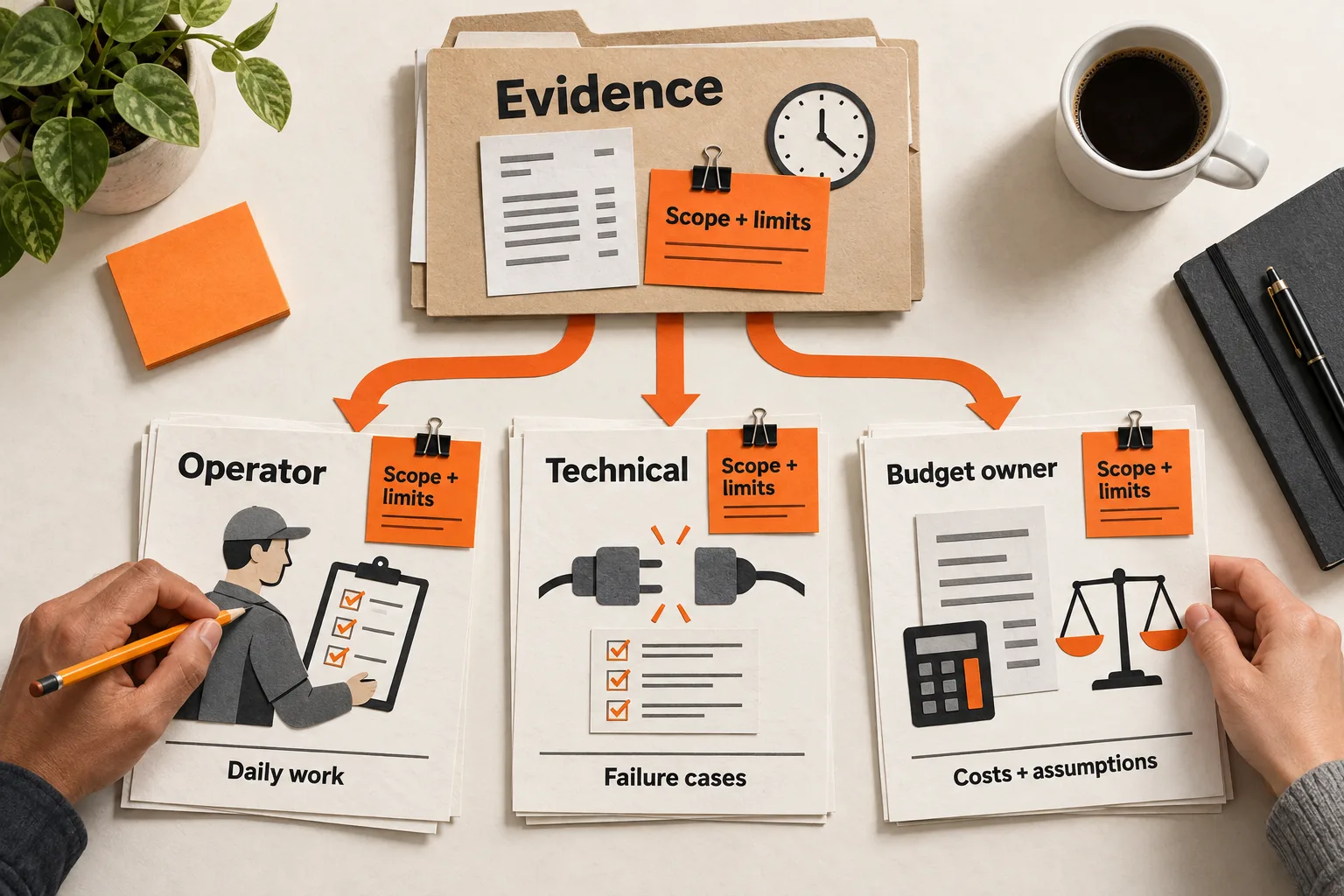
Keep the evidence and its limits together
Before writing the hook, record what each proposed claim rests on. A numerical time-saving claim needs the baseline and resulting values, unit, observation period, and population covered. Distinguish measured behavior from a customer’s estimate, and save the report section or approved interview passage that supports it. The worksheet below gives you one place to collect these details.
Missing information changes the wording. If the customer said work felt faster but nobody measured elapsed time, describe that reported experience. Do not turn it into a numerical productivity claim.
Put the most consequential limit beside the result. If the improvement covered routine tickets only, say so in the post. Leaving that restriction behind a link makes the short version broader than the evidence supports.
A before-and-after comparison may also leave several explanations open. Preserve relevant changes to help content, staffing, or ticket mix instead of attributing the whole improvement to the product.
Check the approval record for the planned excerpt, attribution, and image. Record which names, quotations, logos, screenshots, and distribution uses are covered before building the asset.
Draft the explanation before adding design
Open with the reader’s situation, explain the customer’s decision, and give the evidence with its main limitation. End with one action the evidence justifies. Use as many paragraphs as the explanation needs.
Start with text when the explanation is mostly verbal. Add a visual when it clarifies something specific, such as where human review happens in a workflow or how the same measure changed between two periods.
LinkedIn’s official Page guidance includes uploading PDFs and PowerPoint files. For a document post, one possible sequence is four pages: situation, decision, evidence, and limits with a next step. This is an editorial layout suggestion; the source does not establish that this sequence will improve reach or engagement.
Keep essential qualifications beside the claims they limit, even if the last page discusses them further. If a chart requires tiny labels or loses its caveat to fit, use text.
Worked example: a fictional AI support pilot
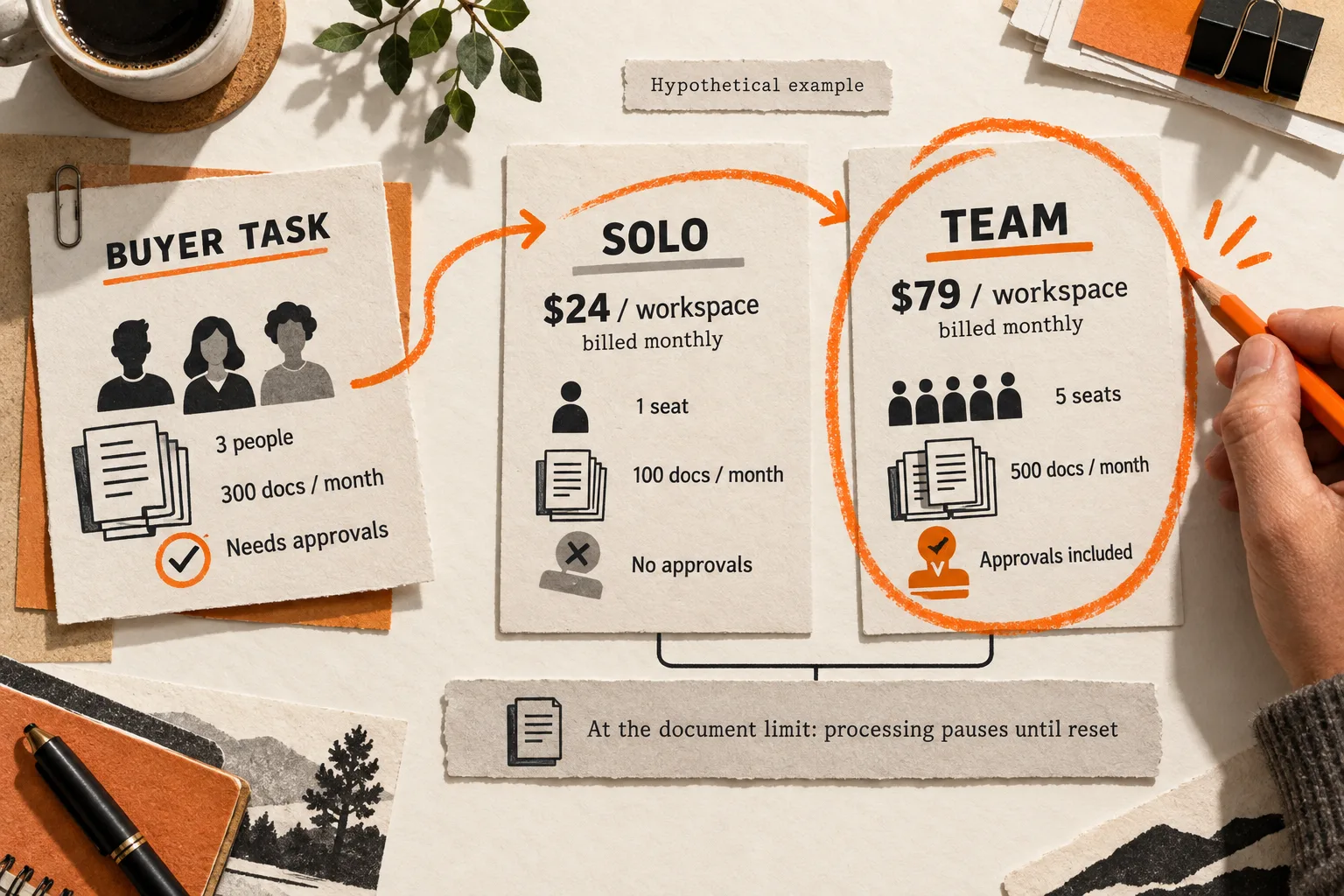
The team, measurements, and sample post below are hypothetical. They illustrate the writing method and provide no evidence of product performance.
Suppose a three-person SaaS support team tested AI reply drafts for password-reset and account-access tickets. Staff checked and sent every reply. The team also revised its help articles during the pilot.
In this example, median handling time was 12 minutes across 100 eligible tickets during a two-week baseline and 9 minutes across another 100 eligible tickets during the following two-week pilot. Billing disputes and technical escalations were excluded. The records establish neither answer quality nor total support costs.
The headline “AI cut support time by 25%” loses the ticket scope and attributes the change to AI alone. The arithmetic cannot resolve that causal uncertainty.
A post that preserves the context could read:
Hypothetical example: a three-person SaaS support team tests AI reply drafts for password-reset and account-access tickets. Staff still review and send every reply.
The decision is whether to try AI drafts in one routine part of the queue before considering a wider rollout.
In this fictional pilot, median handling time is 12 minutes across 100 eligible tickets during a two-week baseline and 9 minutes across another 100 eligible tickets during the next two weeks.
The team also revises its help articles, so the comparison cannot isolate AI’s contribution. Billing disputes and technical escalations are excluded. Answer quality and total support costs are not measured.
For a similar pilot, choose one ticket category, define handling time consistently, and review answer quality alongside speed before expanding.
The reader can identify the decision, comparison, and uncertainty without opening another page. The hypothetical label stays inside the sample so it remains clear if someone copies the text separately.
For your own post, use the actual approved evidence and customer attribution. Link to the case study with a specific reason to read it, such as its measurement method or rollout details. Keep the essential limitation in the post.
Choose a next step you can interpret
Match the ending to the decision. A post about a narrow support pilot can ask readers to identify one eligible ticket category. A post about onboarding can suggest checking where new users first get stuck. Choose one action rather than stacking requests to comment, share, download, and visit another page.
Before posting, decide what response would help you judge its usefulness. A reader describing a comparable constraint, asking about the method, and visiting the case study are different observations. Record them separately; a click alone does not establish understanding.
If you link to your own site and use Google Analytics, campaign parameters can help identify referred traffic. Google documents utm_content as a way to distinguish creatives or link versions. Use a consistent identifier that connects the link to the post version.
Comparisons between separate organic posts remain directional. Audience, timing, and exposure can change, so a stronger response does not isolate the effect of an opening or format. For that separate measurement task, see comparing LinkedIn formats by qualified interest.
Complete the worksheet and test the post without its link
Copy these prompts into a document and fill them in from one approved case study. Mark missing information as unknown.
| Field | Your notes |
|---|---|
| Reader and decision | This post is for ___, who is deciding whether to ___. |
| Starting situation | The relevant team, workflow, and problem were ___. |
| Customer’s change | The customer decided to ___ and changed ___. |
| Evidence | The baseline was ___ and the result was ___, using ___ as the measure, across ___ during ___. This was measured or reported by ___. |
| Source | The supporting report section or approved interview passage is ___. Exact quotations are ___. |
| Limits | Other relevant changes were ___. Missing measurements are ___. The result does not establish ___. |
| Reuse approval | The approval record is ___. It covers these names, quotations, images, and distribution uses: ___. |
| Reader’s next action | Someone in a similar situation can next ___. |
| Link purpose | The full case study adds ___. |
| Useful response | I will look for ___ and record it separately from ___. |
Draft the post, then temporarily remove its link. Ask a teammate to identify the customer decision, supporting evidence, and main limitation from the post alone.
Check every number against its source and every quotation against the approved wording. Make sure the opening claims no more than the body supports. If the teammate needs the full story to understand the central point, bring that missing explanation into the post before restoring the link.