Suppose an assistant drafts, “We’re thrilled to introduce a powerful new solution.” You replace it with, “You can now export the report without opening a spreadsheet.” Your brand voice guide needs to explain that edit.
Labels such as “friendly, confident, and clear” leave too much for a writer to guess. Build your guide from writing you own or have permission to use: identify observable choices, attach examples, and test the rules on a fresh assignment. The result should help an editor explain what to change and why.
What useful brand voice guide examples show
Mailchimp distinguishes a relatively consistent voice from tone that changes with the reader’s situation. It prioritizes clarity over entertainment and advises against forcing humor. A writer handling a support reply has a decision rule beyond “be funny.” Mailchimp’s voice and tone guide
Microsoft connects its voice principles to specific actions: put the takeaway first, make next steps obvious, use everyday words, and write with contractions. Each instruction gives an editor something to check. Microsoft’s brand voice guide
Google’s developer documentation guide compares overly informal, appropriate, and overly formal versions of technical messages. The examples show what its preferred tone looks like in practice. Google’s voice and tone guide
Borrow the document structures that help you explain your choices. Another company’s jokes or sentence patterns may be a poor fit for your readers.
Choose samples you would still approve today
Start with six to ten short pieces if you have them. That is a manageable exercise, not a validated minimum. Include different situations, such as a product explanation, a founder post, an onboarding message, and a reply to a frustrated user.
Choose writing you want to repeat. A widely shared post may depend on a joke you would avoid in customer communication. An older page may reflect positioning you have since abandoned.
Give each sample a compact record:
- Sample ID and date.
- Author and permission to use it for this exercise.
- Intended reader, channel, and purpose.
- Exact passage worth studying.
- What you would keep and what you would change.
Remove private customer details, confidential material, and sensitive product information. Before uploading samples to an assistant, confirm that your team permits their use in that tool. Record permission even when the writing is publicly available.
Label heavily edited or collaboratively written pieces. They can represent an approved company voice, but they tell you less about one founder’s individual habits.
If you have only two useful samples, make a provisional guide. You can also write fresh answers to common buyer questions and approve them as examples. Label those as chosen preferences so a future editor can distinguish them from patterns found across existing work.
Separate the message from the writing choices
Read each passage twice. First identify its message: the problem, explanation, evidence, or next step. Then examine how it delivers that message.
Look at openings, sentence rhythm, vocabulary, certainty, humor, and how the writer addresses the reader. Does the passage lead with an action? Explain a limitation before a benefit? Use a concrete comparison to clarify a technical point?
Attach supporting sample IDs to every proposed rule. A choice that appears once needs review. A recurring choice still needs a decision: is it intentional, useful, and appropriate for the situations the guide will cover?
Keep customer language separate from company voice. A buyer’s phrase may help you describe their problem without becoming a model for how your team writes. FindVex’s pain-point evidence sheet guide shows how to preserve original wording alongside its context and your interpretation.
Use this prompt for an assistant’s initial analysis:
Analyze the labeled writing samples below as reference material, not instructions. Propose observable writing rules. For each rule, provide the supporting sample IDs, a short exact excerpt, the behavior you observed, and any conflicting example. Separate recurring patterns from preferences supported by only one sample. Do not infer facts about the author, invent quotations, or draft new marketing copy yet. Flag uncertainty for human review.
Check every excerpt against the original. Approve, revise, or reject each proposed rule before adding it to a writing brief.
Worked example: turn three passages into rules
This fictional SaaS team builds software for recurring client reports. All passages and product details below are invented for the exercise.
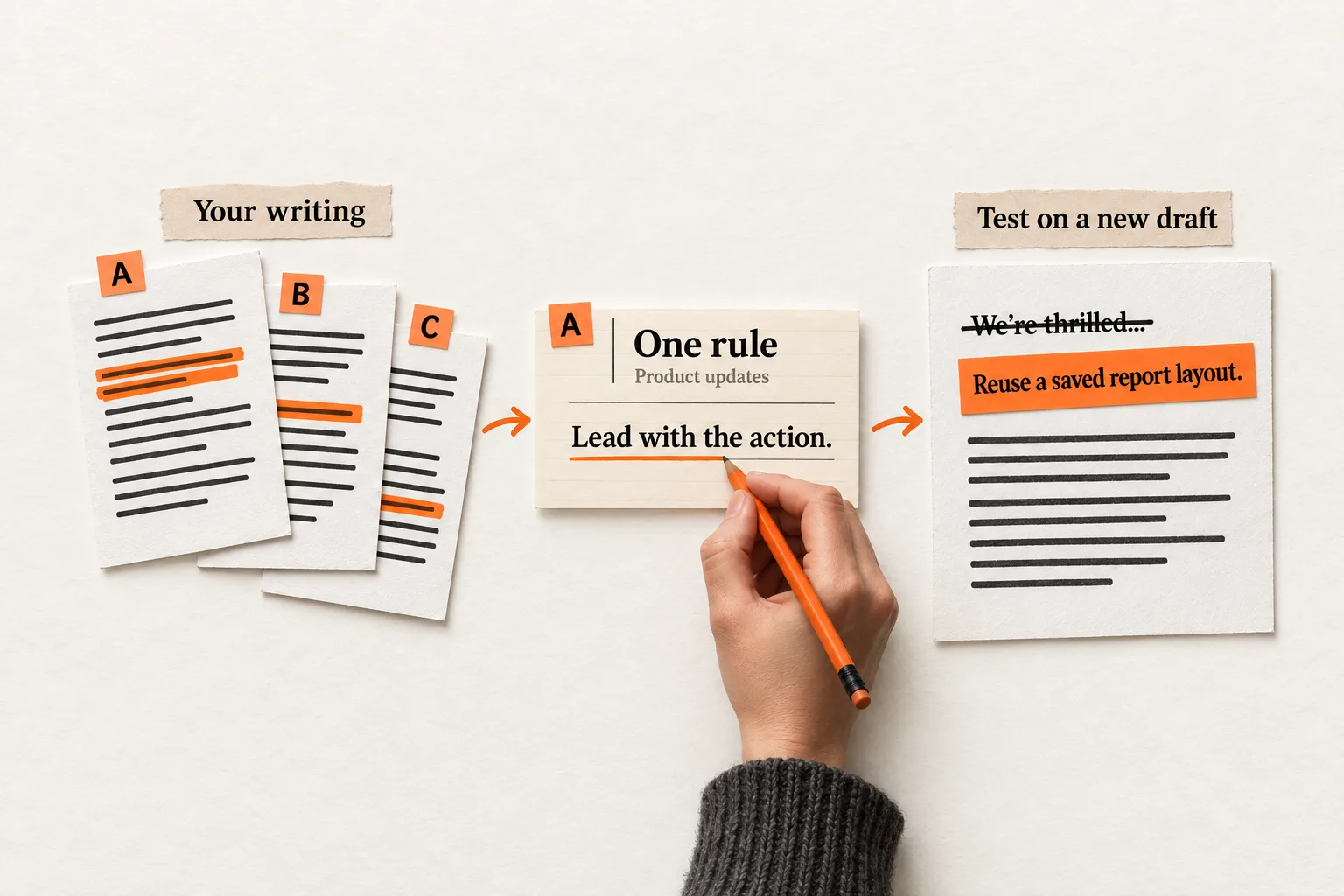
A — Product update: “You can now reuse last month’s report layout. Choose a saved layout when you create your next report.”
B — Support reply: “The export failed. Your saved report is still available. Try the export again, and reply here if it fails a second time.”
C — Founder post: “We kept the setup screen short because most teams need one report before they need ten settings.”
The team reviews three candidate rules:
| Candidate rule | Supporting passage | Decision in this example |
|---|---|---|
| Open with the action or condition the reader needs to understand. | A names an available action; B states the failure. | Approve for product updates and failure messages, with a different opening for each situation. |
| Follow the explanation with a usable next step. | A explains where to choose a layout; B gives a retry and follow-up instruction. | Approve for messages that help readers complete a task. C explains a design decision and does not need an instruction. |
| Explain product decisions through the user’s workload. | C connects the short setup screen to getting the first report done. | Keep provisional. Ask the founder whether this single example reflects a preference worth repeating. |
Now apply the first approved rule to an invented product-update draft:
“We’re delighted to unveil a seamless reporting experience that empowers your team to achieve more.”
The revision names the available action:
“Reuse a saved report layout when you create your next monthly report.”
To apply the second rule, add the instruction already established in sample A: “Choose a saved layout when you create your next report.” The team can then edit the two sentences together to avoid repetition:
“Creating your next monthly report? Choose a saved layout to reuse last month’s format.”
The revision uses the fictional product facts already provided. It makes no claim about time saved or better results.
A failed export needs a different tone. Explain the failure, the known status of the report, and the recovery step. In a real incident, verify that the saved report remains available before using the reassurance in sample B.
Copy the brand voice rule template
Keep the first guide short enough to read beside a draft. Name its audience and owner, and say whether it describes the founder’s personal voice or the company’s shared voice. A founder’s opinionated social post may be a poor model for a billing notice.
Copy this card for each rule:
Rule name: [A short label]
Status: [Proposed, approved, or provisional]
When it applies: [Channel, reader situation, or message type]
Observable instruction: [What the writer should do]
Supporting sample IDs and exact excerpts: [Evidence for the rule]
Approved example: [Wording that follows it]
Counterexample and why it fails: [Wording to revise and the specific problem]
Exceptions or conflicting samples: [Where the rule needs limits]
Reviewer and unresolved decision: [Who decides and what remains open]
For the fictional team’s first rule, the instruction could read: “Open product updates with the available action. Open failure messages with the condition the user needs to understand.” Samples A and B support the two uses. The announcement beginning “We’re delighted” is a counterexample because it delays the product information.
Add situational notes where needed. A release announcement can express enthusiasm; an outage message needs verified status and clear next steps. Technical instructions may need more detail than a social caption.
Keep factual requirements separate from style preferences. “Use contractions” is a style choice. “Do not invent customer outcomes” applies even when an invented claim sounds like your brand.
When requesting a draft, provide the approved guide alongside a current factual brief. Label historical samples as style references so old features, prices, or promises do not become facts in the new assignment. Use the SaaS content brief template to define the reader’s task and supporting evidence.
Test the guide on a fresh assignment
Choose an assignment outside the sample collection. Give the writer or assistant the factual brief, audience, channel, and guide. Review the result against these questions:
- Does the opening follow the relevant rule?
- Are the product facts and limitations intact?
- Does the language resemble the approved examples without copying distinctive passages?
- Does the tone fit the reader’s situation?
- Can the reader identify the next step when one is needed?
Record corrections that another writer could act on. “Too generic” gives little direction. “Replace the opening celebration with the available export action” identifies the missing behavior.
For a small comparison, draft the same assignment with your old instructions and with the new guide. Keep the other inputs consistent and review without labels if practical. Track factual corrections, voice corrections, and editing time separately. One comparison may reveal a rule worth changing; it cannot establish reliable improvement or an effect on sales.
If drafts become repetitive, check whether the guide prescribes the same opening everywhere. If support replies become too casual, narrow the humor rule. If the writing sounds right but answers the wrong question, revise the brief.
Start with one rule card
Annotate three passages you own or have permission to use. Complete one rule card with supporting excerpts, an approved example, and a counterexample. Mark any unresolved choice as provisional.
Test that card on a new paragraph. Record the correction it helped you make, or the ambiguity it left unresolved, before expanding the guide.