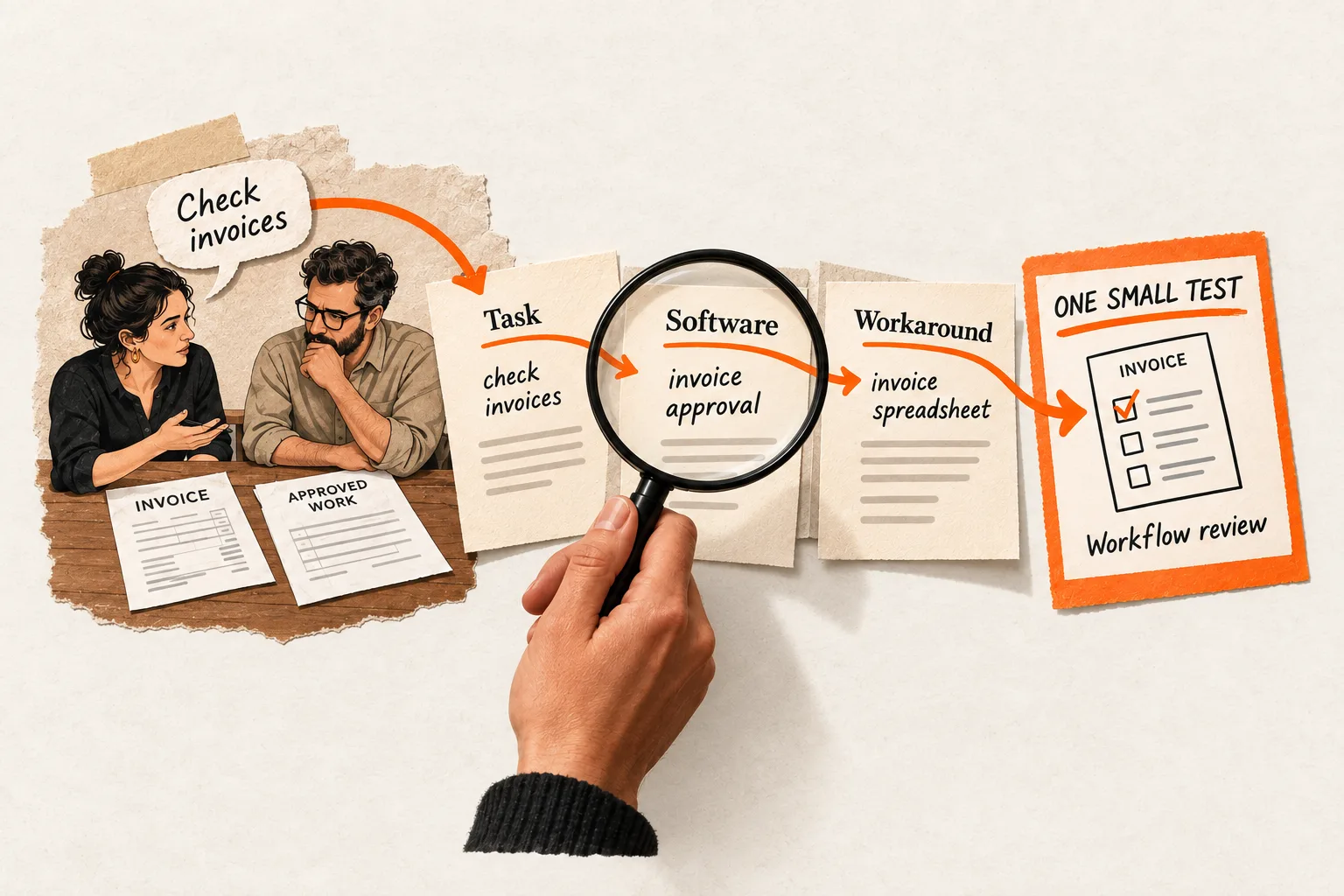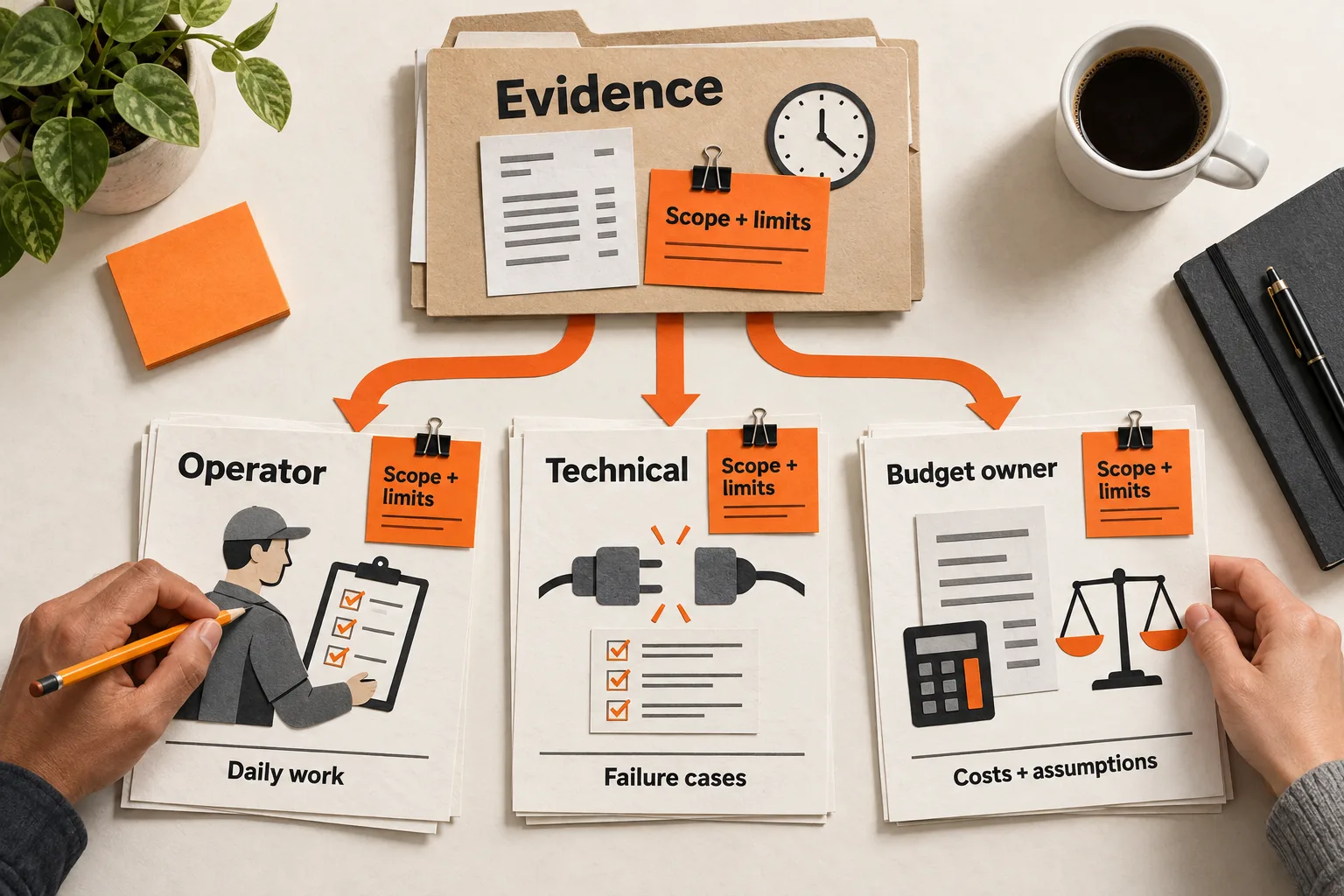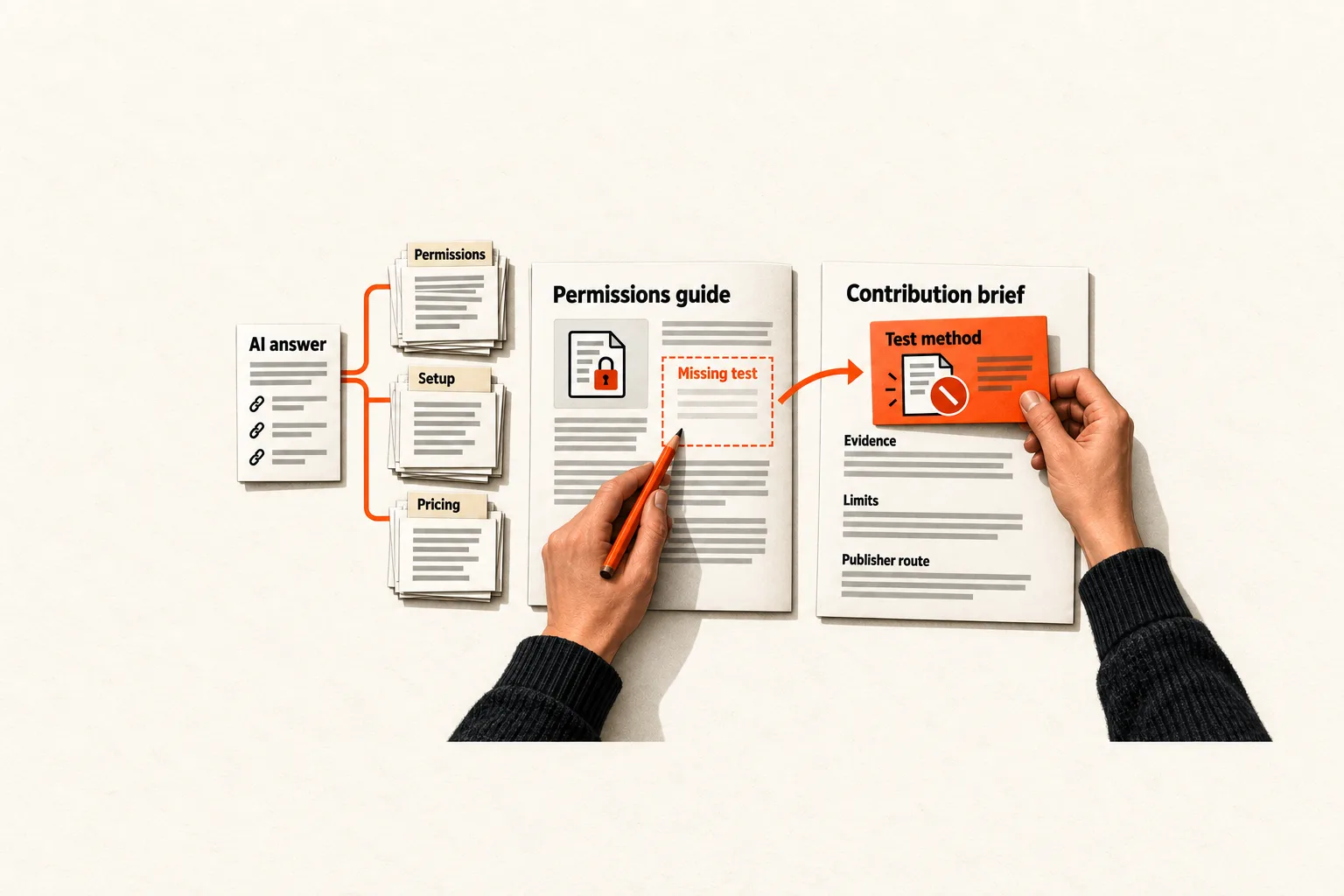
To find useful third-party contribution opportunities, group the pages cited in AI answers by the buyer questions they help resolve. Open each page, check its evidence, and identify something specific you can add or correct.
A specialist comparison and an integration guide may both mention a competitor, but they serve different decisions. One helps build a shortlist; the other may explain a requirement that determines whether someone can buy. A domain count hides that difference.
This AI citation source gap analysis ends with one contribution brief: a relevant page, a missing or inaccurate piece of evidence, and an appropriate way to supply it. Your brand’s absence alone is insufficient reason to pursue a placement.
Start with a specific buyer decision
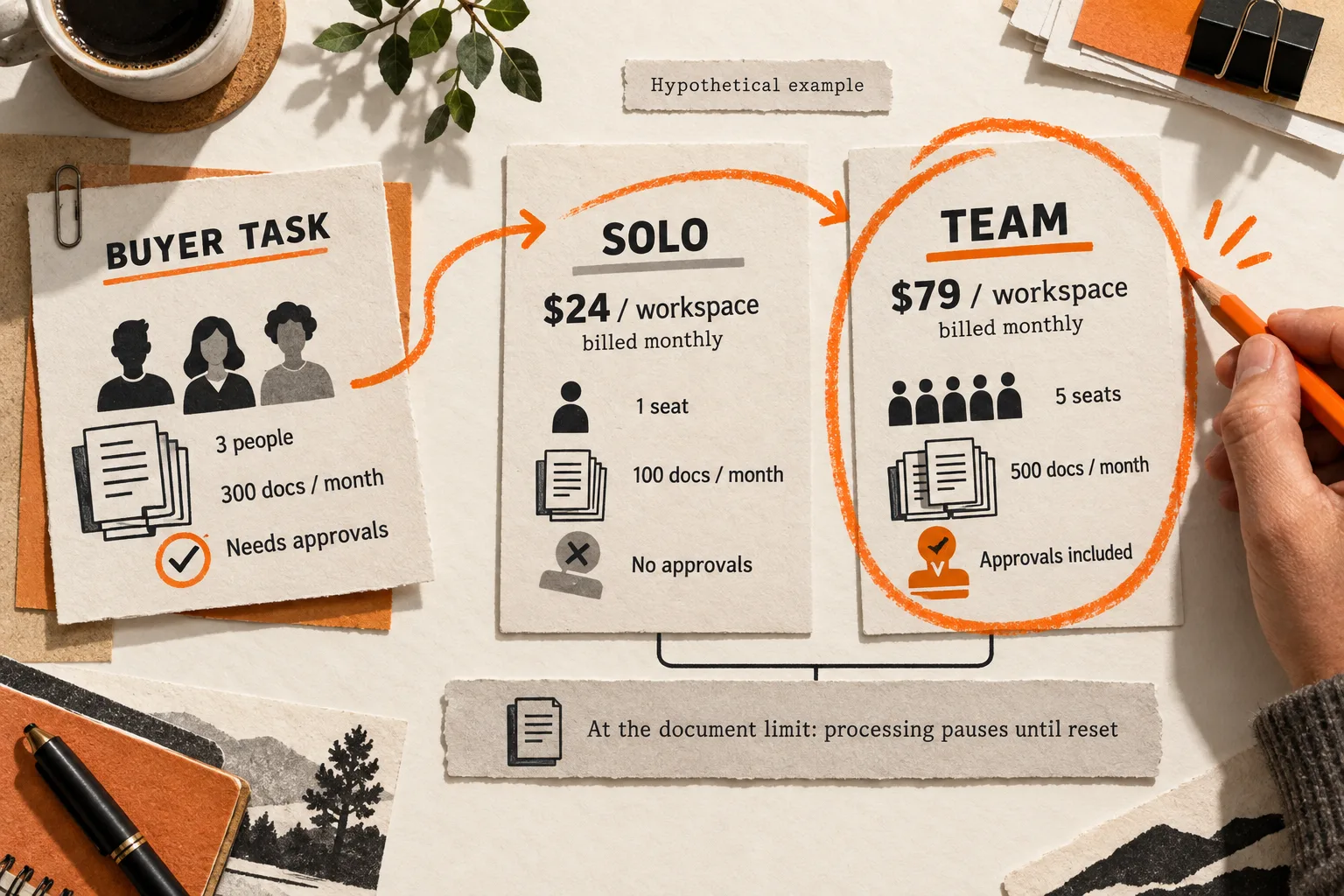
Choose one audience and one decision. “AI software for small businesses” gives you little to investigate. “A five-person support team choosing an assistant that respects help-center permissions” gives you concrete requirements.
Collect questions from customer conversations, support requests, or relevant public discussions. Keep the original wording separate from your interpretation, and label invented questions as hypotheses. A vivid comment can reveal a concern without proving that most buyers share it.
For a manageable first pass, choose six questions: two about whether the category solves the problem, two about requirements or implementation, and two about comparing options and accepting tradeoffs. This is a suggested workload, not a representative sample of buyer demand.
Avoid inserting your brand into every question; that changes the task from discovering category sources to investigating a named product.
For example, “Which support assistants respect existing document permissions?” and “How do I test whether a support assistant exposes restricted content?” belong in a permissions group. They still need different evidence: documented capabilities and a testing procedure.
Capture the exact pages and their role in each answer
Run the questions in one selected AI search experience. Give each run an observation ID and record the product and mode, date, exact prompt, visible model label if available, language, location settings, and relevant personalization settings. Use a fresh conversation for each question to reduce carryover.
Repeat the same questions on another day before committing substantial effort. If you add a second platform, inspect and report its results separately.
Google says AI Overviews and AI Mode may issue related searches across subtopics. Their responses and links can differ because they may use different models and techniques. Keep observations specific to the experience you tested. Google Search Central’s AI features guidance
Save each answer and its displayed destination URLs. For every link, record the nearby statement or section it appears to support. Distinguish inline citations from related-link lists when the interface makes that distinction.
Gemini’s documentation describes both sources and related content, and says some responses include neither. Preserve the interface label rather than treating every displayed link as the same kind of evidence. Gemini Apps source documentation
Record “no visible citation” and “AI answer not shown” separately. Neither observation establishes that a particular page was never retrieved or considered. Mark a failed collection attempt separately as well; it tells you nothing about the answer’s sources.
Keep your own pages in the record, but distinguish them from third-party pages. Separate competitor documentation from independent editorial coverage, too. Their owners and possible contribution routes differ.
Group URLs by the question they help resolve
Open each cited page. Assign it a primary buyer-question group, such as permissions, implementation effort, pricing limits, or migration. Add a secondary group only when the page contains relevant material for it. Preserve the exact URL even if you later summarize by domain.
Describe the page’s role in a few words: “explains permission inheritance,” “compares setup requirements,” or “documents a migration failure.” These descriptions tell you more than “high-authority site.”
Check whether the page supports the nearby claim in the AI answer. Mark support as direct, partial, unrelated, or unverified. If access is blocked, retain the link observation and mark the contents unverified. A visible citation gives you a page to inspect; its claims still need checking.
Use one record per page per observed answer:
| Field | What to record |
|---|---|
| Buyer question | Exact question, primary group, and any secondary group |
| Observation | Run ID, platform and mode, date, settings, link type, and saved answer |
| Page | Exact URL, publisher, source type, date checked, and update date if shown |
| Evidence | Nearby answer claim, relevant page passage or paraphrase, and support assessment |
| Brand coverage | Your brand, competitors, or no products mentioned |
| Possible action | Specific correction or contribution, monitor, or skip |
When measuring recurrence, count a page at most once per answer, even if it is linked several times. Count a domain at most once per answer in a separate total. Several pages from one publisher should not appear to be several independent publishers; note a shared origin for syndicated copies as well.
Report counts alongside the questions, dates, and number of answers observed. Keep related links distinguishable from citations in any totals. Recurrence in this small sample helps you choose pages to inspect; it does not establish how often buyers encounter them.
Decide whether the gap deserves a contribution
A useful gap combines a buyer need with evidence you can supply. Your absence from a page might reflect its scope, an editorial choice, or a requirement your product does not meet.
First, check whether the page addresses a buying constraint for your audience. A narrow implementation guide may deserve attention before a frequently cited introduction to AI.
Then assess its credibility for the particular claim. Look for a stated method, attributable expertise, inspectable examples, and current product details. Record commercial relationships or unclear sourcing. Citation frequency alone does not establish quality.
Write down what you can add. A reproducible test, documented limitation, integration example, or correction gives a publisher something to evaluate. “Please add us” leaves that work to them.
Finally, check the publisher’s correction process, submission policy, listing criteria, or community rules. Disclose your affiliation. Avoid manufacturing independent-looking endorsements or repeating promotional answers across discussions.
Choose one action per page: correct, contribute, monitor, or skip. Skip sources outside your audience, pages with no suitable contribution route, and comparisons where your product fails a required criterion.
For an inaccurate description of your company, use the focused guide to auditing third-party descriptions of your SaaS brand. The task here is to identify sources that answer buyer questions and decide where you can improve their evidence.
Worked example: choosing a permissions guide
Suppose a fictional startup sells a support assistant for small software teams. Its founder tests six buyer questions twice in one AI search experience, saving 12 answers. All counts and publisher situations below are hypothetical.
| Source | Appearances across 12 answers | Inspection finding | Decision |
|---|---|---|---|
| Specialist implementation article | 4, for permissions and setup questions | Explains permission inheritance but lacks a reproducible restricted-document test | Prepare a contribution |
| General software roundup | 5, mostly for broad discovery questions | Covers enterprise procurement and requires a capability the startup lacks | Skip |
| Community troubleshooting thread | 2 | Contains a relevant concern, but the thread is old and closed | Use the concern to improve the startup’s documentation |
These counts can overlap because an answer may link to more than one source.
The implementation article becomes the first contribution candidate. The startup can supply a small test dataset, expected behavior, observed behavior, and a limitation: its connector does not support one permission configuration.
After checking the article’s contribution policy, the founder prepares the test method, supporting documentation links, and an affiliation disclosure. The publisher may accept the contribution, decline it, or use the evidence without mentioning the startup.
The roundup’s higher count does not overcome its poor fit. The closed thread remains useful evidence of a concern, but provides no route to contribute there. Each inspection leads to a different action.
Evaluate the contribution separately from citation changes
Before starting, define an outcome that would justify the effort even if AI citations stayed unchanged: an accurate integration reference, a useful public test, or a corrected product limitation.
Track that outcome separately from later AI answers. Repeat the original prompts under comparable conditions, preserving dates and settings. Describe changes as observations; a before-and-after difference alone cannot establish that your contribution caused them.
Your site’s reporting has a different scope. Bing’s AI Performance announcement describes citation counts for your pages across supported experiences and distinguishes those counts from ranking, importance, or placement. Those reports cannot replace inspecting third-party pages. Bing’s AI Performance announcement
For a fuller observation protocol, see how to measure AI citations without fooling yourself.
Complete one contribution brief
Copy this worksheet into a document and fill it in for your strongest candidate:
Buyer decision: Who needs to decide what?
Observed source: Exact URL, platform, date, and observation ID
Missing or inaccurate evidence: What specifically needs work?
Proposed contribution: What can we demonstrate?
Supporting material: Test method, documentation, and known limitations
Affiliation disclosure: What is our relationship to the product?
Publisher route: Which stated process permits the contribution?
Effort limit and owner: Who will do the work, within what budget?
Useful outcome: What improvement would justify the effort?
Review date: When will we check the page and repeat observations?
Complete one brief and attach the evidence a publisher would need to assess it. If you cannot identify a specific contribution or an appropriate route, mark the page “monitor” or “skip” and inspect the next candidate.