If a buyer must run software on infrastructure their team manages and your product is available only as a hosted service, say so near the top of your comparison page. Explain which competitor offers that deployment option and what the buyer would need to operate it.
A useful “choose the competitor if” section connects one decisive requirement to evidence the reader can inspect. Keep the recommendation within what that evidence establishes: a documented deployment option can satisfy a deployment requirement without proving that the product suits the buyer’s entire workflow.
Start with a requirement that can change the choice
Pick a competitor that prospective customers actually consider. Identify a condition under which your product would block their work, require an unacceptable workaround, or exceed their budget.
April Dunford’s positioning guide starts with the alternatives customers would use without your product, then connects differentiated capabilities to value and the customers who care about it. Apply that sequence when choosing which alternative belongs on the page. Read Dunford’s positioning guide.
Look for deciding requirements in prospect questions, support conversations, interviews, and relevant public discussions. Keep people’s original wording separate from your interpretation. A request for “more control” could mean deployment control, permissions, export access, or predictable spending. Each calls for a different comparison.
Use the FindVex pain-point evidence sheet to organize those observations. Treat public complaints as questions to investigate; they do not establish a product’s current capabilities.
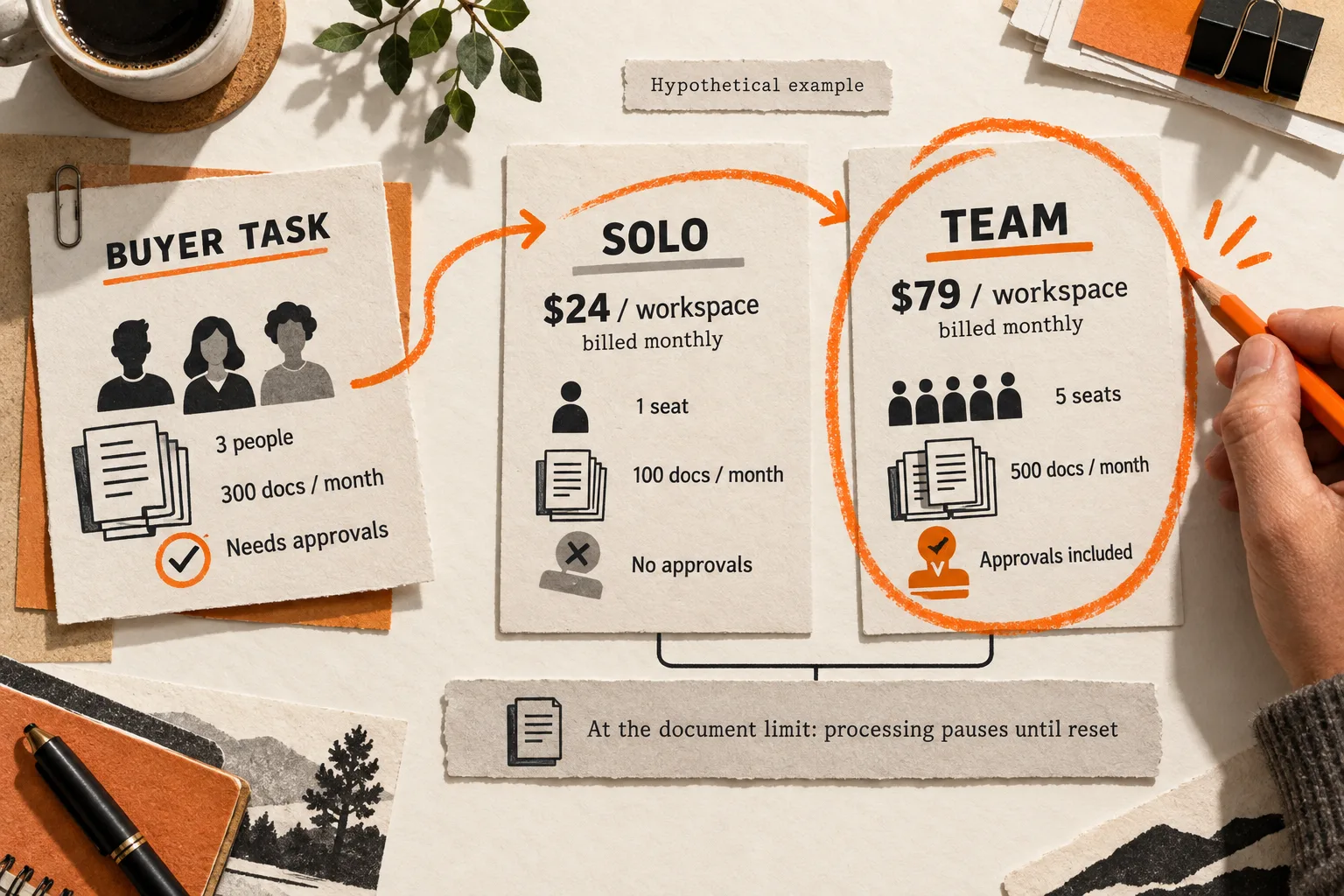
Write the requirement precisely enough to check. For an integration, name the trigger and action the buyer needs. For an approval process, specify who must approve what and which plan fits the budget. For an export, name the format the next system must accept.
“Better for enterprises” leaves too much unresolved. A small team can have a strict deployment requirement, and a large company can have a simple workflow.
Check both products against the same requirement
Read current documentation for both products, including the relevant plans, deployment options, and prerequisites. A feature sold as an add-on is a different buying proposition from one included in the plan being compared.
For each deciding claim, record the source URL, relevant passage, date checked, and what remains unknown. Separate the evidence from your conclusion:
| Statement | What it establishes |
|---|---|
| The vendor documents a capability | The vendor says the product supports it under the stated conditions. |
| Your team completed a test | The workflow behaved as observed in that test, with those settings and inputs. |
| You recommend the product | You judge that the evidence supports a choice for this buyer’s requirement. |
An integration listing alone does not establish that the buyer’s exact workflow will work. Check the actions, permissions, and limits that matter. If an unresolved detail could reverse the recommendation, name the check the buyer must complete before choosing.
Apply the same care to negative claims. Failing to find a feature in documentation does not prove it is unavailable. Seek explicit documentation or confirmation before marking it absent. Otherwise, label availability as unconfirmed. A capability on your own roadmap also cannot satisfy a requirement the buyer has today.
Make the recommendation as narrow as the evidence
State the buyer’s condition, the relevant product difference, and the tradeoff they would accept. Give the competitor credit for a legitimate advantage, such as deployment control or a required administrative feature. Avoid concessions that insult its customers.
Google’s review guidance recommends evaluating from the user’s perspective, discussing benefits and drawbacks, and explaining which options suit particular circumstances. For recommendations that name something best overall or best for a purpose, it calls for firsthand supporting evidence. See Google’s review guidance.
Use that guidance as an editorial check: explain the basis of your advice. When you have read documentation but have not tested the products, describe the documented fit. Claims about performance, reliability, or migration results need their own evidence. Adding a concession is not evidence of a ranking benefit.
Worked example: a hosted automation tool versus n8n
Suppose you run a fictional automation product called TaskHarbor. In this example, TaskHarbor is available only as a hosted service. A prospect requires the automation platform to run on infrastructure their team manages.
n8n documents both a managed Cloud option and a self-hosted option. Its deployment guide assigns infrastructure provision and maintenance to the customer who self-hosts. These are documented capabilities and responsibilities, checked September 27, 2026. See n8n’s deployment choices.
The evidence supports this illustrative section:
When to consider n8n instead
If your automation platform must run on infrastructure your team manages, TaskHarbor does not meet that requirement: it is available only as a hosted service. n8n documents a self-hosted option that meets this deployment requirement. Your team would provide and maintain the infrastructure. Before choosing it, confirm that the edition supports your required workflows and that your team can operate it.
TaskHarbor and its limitation are invented for this example. No product testing is represented here. The paragraph rules out TaskHarbor for one requirement and gives the buyer a specific alternative to evaluate.
Keep that boundary intact. Assess security, compliance, and data flows separately, including any external services the workflow calls. The deployment distinction alone does not answer those questions.
If the prospect wants a managed service, deployment no longer decides the comparison. Because n8n also offers Cloud, TaskHarbor would need another documented difference to explain why it suits that buyer.
Put the deciding fact where readers can use it
Place a brief fit summary near the beginning of the page. Put the fuller explanation beside the evidence for that requirement, with a direct link to the competitor’s documentation.
Identify your company as the publisher and disclose its relationship to the products being compared. Readers should be able to distinguish your commercial perspective from the facts supporting the recommendation.
Check the summary chart against the prose. If the section says a competitor supports a requirement on a particular plan, the chart must preserve that plan qualification.
For the surrounding structure, use the FindVex SaaS comparison page outline. The section developed here answers one part of that comparison: when the reader should consider the alternative.
Complete the worksheet before drafting the section
Copy this record for one deciding requirement:
Buyer requirement:
Why it is mandatory for this workflow:
Our current limitation:
Our supporting source and relevant passage:
Competitor capability, plan, and deployment option:
Competitor source and relevant passage:
Evidence basis: documentation / observed test
Prerequisite or tradeoff the buyer must accept:
Unresolved question that could change the recommendation:
Sources checked on:
Review owner and next review date or trigger:
If a capability remains unconfirmed, record that status explicitly. For an observed test, add the settings, inputs, date, and result.
Use the completed record to draft the public section:
Choose [competitor and option] if [specific requirement] is mandatory and [necessary conditions] are met. Our product currently [documented limitation]. [Link to competitor documentation] describes [capability that meets the requirement]. You will need [prerequisite or tradeoff]. This comparison is based on [documentation or the stated test].
If a material question remains open, use “consider” instead of “choose” and add the exact step to confirm before committing. The wording should reflect how much of the decision you have verified.
Before approving the section, check that both products face the same requirement, every deciding distinction has support, and the tradeoff matters to the buyer. Recheck the paragraph when either vendor changes the relevant feature, plan, or deployment option.
Test whether readers understand the choice
An exclusion can be too broad and discourage buyers whose needs your product meets. Review it against actual requirements before treating a drop in inquiries as success.
Keep a record of the page version. Examine whether inquiries meet your stated fit criteria, which mismatches still reach sales or onboarding, and whether readers misunderstand the exclusion. A few conversations can reveal unclear wording; they cannot establish a conversion effect.
Your next task is to revise one section on one comparison page. Complete the evidence record, write the paragraph, and ask someone unfamiliar with the products to explain who should consider the competitor, why, and what still needs checking. Revise any answer they cannot trace to a clear condition and supporting source.