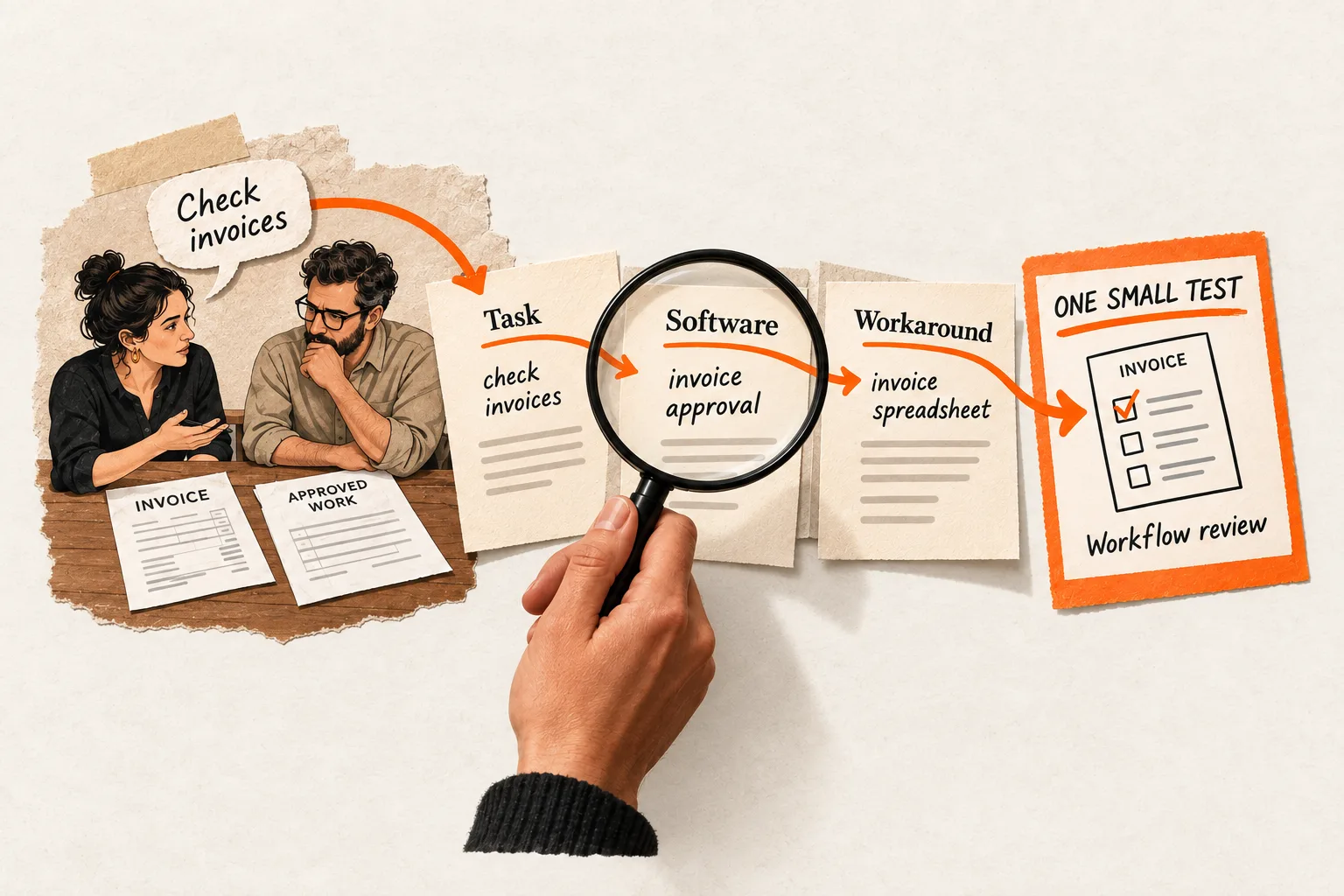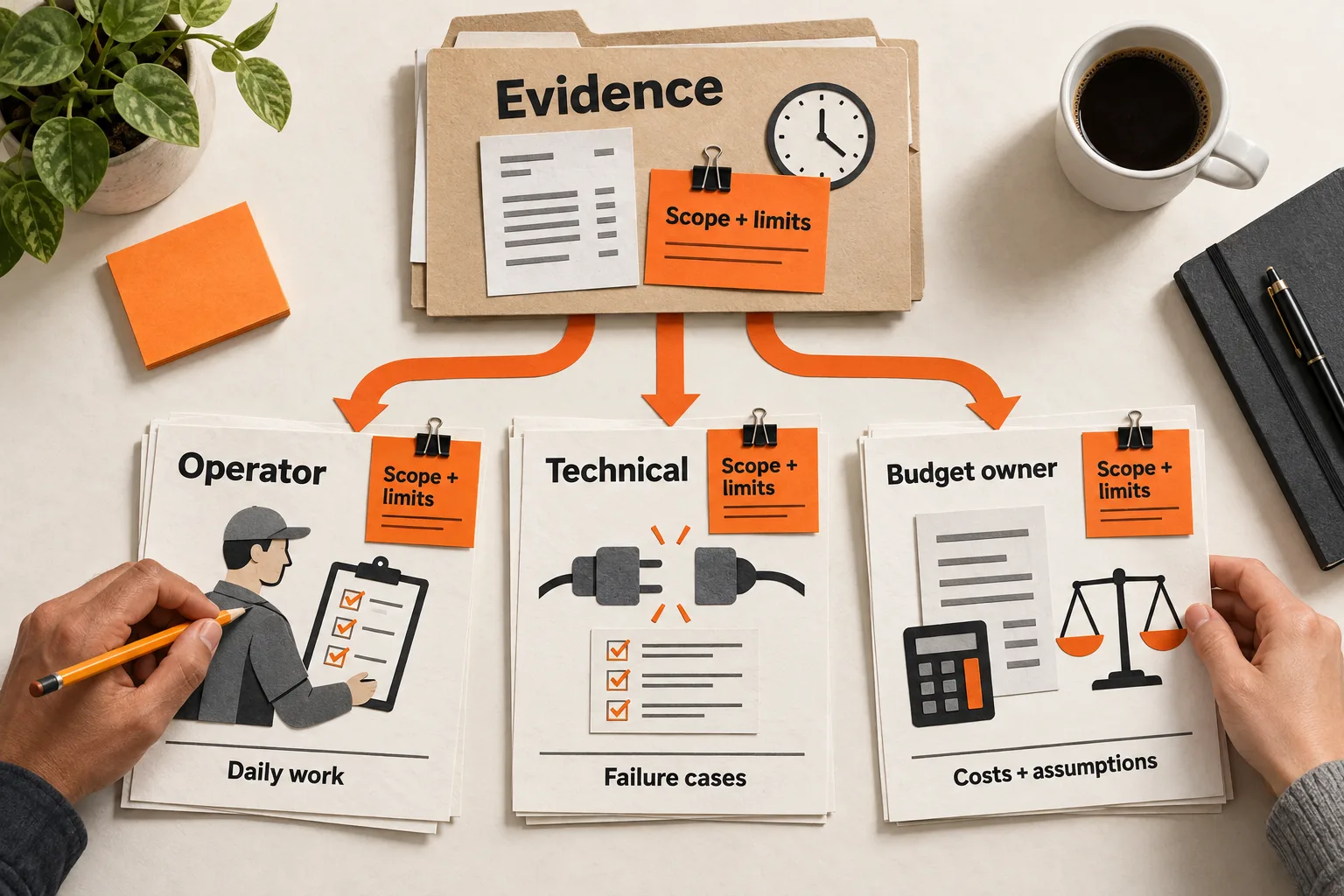
Before changing your SaaS content plan because a guide says an assistant “cannot browse” or “always cites the top search results,” check the product, mode, and evidence behind the claim.
Create a dated record of what the official documentation supports, what remains unknown, and which decision depends on the answer. The examples below use documentation checked September 27, 2026. They show how to verify a claim; they are not a comprehensive comparison of assistants.
Turn the claim into a testable sentence
Copy the claim into your notes with its original URL and date. Keep the author’s wording separate from your interpretation, then split any sentence that combines assertions.
For example, the hypothetical claim “This assistant searches Google and cites the highest-ranking pages” contains three assertions: it searches the web, uses a particular provider, and selects citations according to a ranking rule. Evidence for web search alone cannot establish the other two.
Rewrite each assertion using this pattern:
In [product and interface], under [mode and access conditions], the assistant can or does [specific behavior], according to [evidence checked on date].
Choose the verb carefully. “Can search” describes a capability. “Searched” describes an observed event. “Cited this page” describes part of an answer. Each requires different evidence.
Record the decision at stake. A claim that could lead you to spend a week rewriting documentation deserves a closer check than one you are saving for later reading.
Separate search access, retrieval, and citation support
Use these questions to avoid treating an available capability as proof of what happened in one response:
| Question | Evidence to seek |
|---|---|
| Is web search available? | Documentation for the exact product and mode |
| Did this answer use search? | A visible search indicator or available tool record |
| Was a particular page accessed? | A retrieval record, when available |
| Was the page linked? | The answer’s actual citation or source list |
| Does the page support the statement? | The relevant passage on the linked page |
If a retrieval record is unavailable, mark page access as unknown. A link alone does not tell you which passage, if any, the assistant retrieved.
Google’s Gemini Apps documentation says responses sometimes include sources or related links. These can point to public websites, uploaded files, or connected Workspace material. It says an absent Sources button means that response did not provide links. This establishes a limit on what the interface shows; it does not establish that no retrieval occurred. See Google’s explanation of Gemini sources.
Open each cited link and locate the supporting passage. Does it support the whole sentence, one clause, or just the general topic? Record that distinction before using the answer as evidence.
Match the documentation to the interface and mode
Give a consumer chat app, research feature, API integration, and enterprise workspace separate worksheet entries. Documentation for one does not settle a claim about another.
Claude’s help page illustrates why interface details matter. It describes workspace enablement for Team and Enterprise accounts and distinguishes interfaces with a Web search toggle from a newer experience without one. In the latter, the page says Claude searches when helpful. The direct URL-fetching instructions describe fetching with Web search enabled. Record these conditions rather than turning them into a universal instruction to enable a toggle. See Claude’s web search documentation.
Record the app, visible model label, selected mode, and search controls. Add the plan, workspace restrictions, region, and language where relevant. Note whether the prompt included a URL, uploaded file, or connected source.
Leave hidden or unavailable details marked “unknown.” If the documentation and your interface differ, save both observations and narrow your conclusion to the experience you can identify. The mismatch needs investigation before you generalize it to other users.
Check source access separately from training access
A claim about “AI crawlers” needs a bot name and purpose. A training policy alone does not describe search access.
Anthropic documents separate roles for ClaudeBot, Claude-User, and Claude-SearchBot. ClaudeBot collects content that may contribute to training; Claude-User supports user-directed website access; Claude-SearchBot supports search quality. The documentation explains blocking consequences for each. See Anthropic’s crawler guidance.
Before recommending an access change, record the bot, the provider’s description of its role, and whether the rule matches your team’s intent. Allowing access does not establish that an answer will cite your page.
Google Search has its own conditions. Google says AI Overviews and AI Mode may issue multiple related searches, and their responses and links can differ. To qualify as a supporting link, a page must be indexed and eligible to appear in Search with a snippet. Meeting the requirements does not guarantee inclusion. These conditions apply to Google’s Search features, not every assistant. See Google Search Central’s AI feature guidance.
Give each claim a verdict and a boundary
Use a consistent set of verdicts:
| Verdict | When to use it |
|---|---|
| Supported | The evidence directly supports the scoped claim. |
| Conditional | The claim holds only under a named mode, setting, or access condition that needs to be added. |
| Contradicted | The evidence conflicts with the claim as written. |
| Unresolved | The evidence does not settle the claim. |
Add a sentence stating the limit. For example: “The documentation establishes that search is available, but it does not establish an exclusive search provider or a universal citation-selection rule.”
Keep documentation findings separate from product observations. Documentation describes the provider’s stated behavior. An observed answer records what happened for a particular prompt and configuration.
If you run a test, save the exact prompt, date, visible settings, search indicators, answer, and linked pages. Start a fresh conversation to reduce the influence of earlier messages. Repeat the test when doing so answers a defined question, such as whether the behavior persists under the same settings.
A few runs may expose a counterexample or a configuration problem. They cannot establish a platform-wide citation rate. For that separate measurement task, use FindVex’s guide to measuring AI citations without fooling yourself.
Worked example: should a founder ignore Claude visibility?
Suppose a founder reads advice claiming that Claude cannot retrieve current web pages, so maintaining accurate public product documentation cannot affect its answers. This is a hypothetical exercise, not a reported product test or customer result.
The advice needs two worksheet entries:
| Field | Retrieval claim | Website-impact claim |
|---|---|---|
| Claim | Claude cannot retrieve current web pages. | Updating this company’s public documentation cannot affect Claude’s answers. |
| Scope | Claude chat experiences covered by the web search help page | This company’s pages and relevant buyer questions |
| Evidence | Official documentation describes web search and URL fetching under stated conditions. | That documentation does not establish the effect of changes to this particular site. |
| Verdict | Contradicted as a blanket statement | Unresolved |
| Boundary | Capability does not prove that a particular page was retrieved. | Neither citations nor traffic can be predicted from this capability check. |
The documentation check is dated September 27, 2026 and uses Claude’s web search help page. The supported replacement for the first claim is: “Claude supports web search and URL fetching under the documented conditions.”
The founder can remove the blanket retrieval claim from the team’s strategy notes. The next task is to inspect page access and choose a relevant buyer question for a bounded observation. A large content investment still needs evidence beyond the existence of web search.
Copy this verification worksheet
Create one entry per assertion in a shared document:
Claim as written:
Original claim URL and date:
Decision this claim would affect:

Product and interface:
Mode / visible model label:
Plan / region / language:
Search controls and workspace restrictions:
Input sources: web / supplied URL / file / connector

Official documentation URL:
Documentation update date, if shown:
Date checked:
Supporting passage or precise paraphrase:
Conditions attached to that passage:

Verdict: supported / conditional / contradicted / unresolved
Narrow statement the evidence supports:
What the evidence does not establish:

Optional observation:
Prompt and date:
Visible settings and search indicator:
Saved answer and citations:
Retrieval record, if available:
Whether each linked passage supports the claim:

Owner:
Next action:
Recheck date or trigger:
Before relying on an entry, confirm that the source matches the product and interface, the supporting passage addresses the claim, and the conclusion preserves the source’s conditions. Keep the documentation’s update date separate from the day you checked it. A recent visit does not make an old statement newly published.
Check one claim influencing your content plan
Choose one claim your team is using to justify a content decision and complete the worksheet. Assign an owner and finish with a specific action: correct the claim, inspect an access setting, run a bounded observation, or leave the decision open until better evidence is available. Set a recheck trigger, such as a change to the relevant documentation or interface.