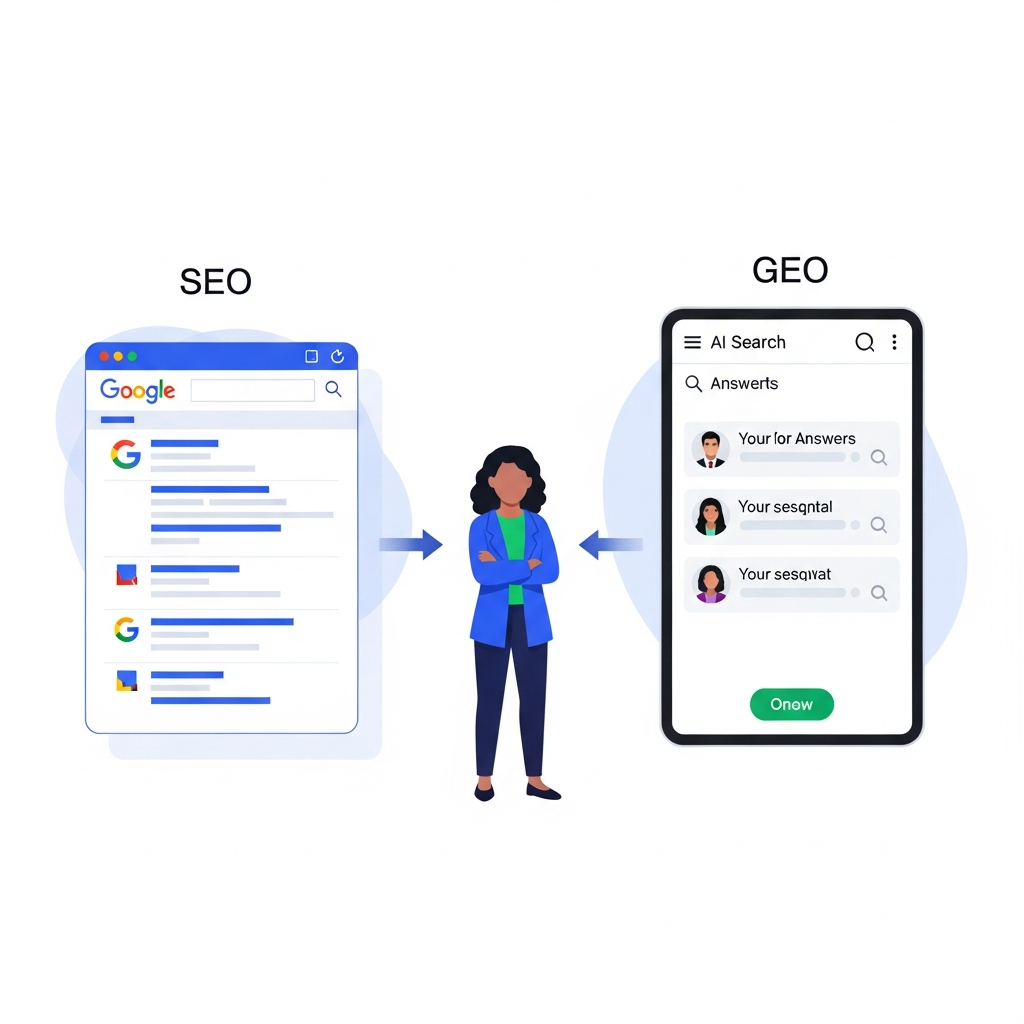
SEO vs GEO: The Ultimate Guide for Small Business Owners Navigating Search's New Era
SEO gets you ranked on Google. GEO gets you cited by AI. Learn the difference, why small businesses need both, and how to implement them without breaking your budget.
The Search Landscape Is Changing
If you've been running a small business for more than a year, you've probably noticed something different when you search for products or services online. Instead of just getting a list of ten blue links, you're now seeing AI-generated answers at the top of your search results. Sometimes these answers directly solve your problem without you ever clicking on a website.
This shift isn't just changing how customers find information—it's fundamentally altering how they discover and choose businesses like yours.
While you've likely invested time and money into SEO (Search Engine Optimization) to help your website rank higher in traditional search results, there's now a new player in town: GEO, or Generative Engine Optimization. Think of it as optimizing for AI-powered search engines that can understand and generate human-like responses.
The reality is that both traditional search engines like Google and AI-powered tools like ChatGPT, Perplexity, and even Google's own AI Overviews are becoming the primary ways customers research businesses. If your competitors are appearing in these AI-generated responses while you're stuck in traditional search results, you're missing out on a significant portion of potential customers.
The good news? You don't have to choose between SEO and GEO. Smart small business owners are learning to leverage both strategies to capture customers across all search channels. This guide will show you exactly how to do that, with practical examples and clear action steps you can implement starting today.
What Is SEO? (Traditional Search Optimization)
SEO is the practice of improving your website and online presence to rank higher in traditional search engine results pages (SERPs). When someone types a query into Google, Bing, or Yahoo, SEO helps determine whether your business appears on the first page or gets buried on page ten where no one will find you.
Let's use Mike's Plumbing in Austin as an example. When someone in Austin searches for "emergency plumber near me" or "burst pipe repair Austin," Mike wants his business to show up at the top of the search results. To achieve this, his SEO strategy focuses on several key areas.
First, Mike optimizes his website content with relevant keywords. His service pages include terms like "Austin emergency plumber," "24-hour plumbing repair," and "licensed plumber Travis County." He creates helpful blog posts about common plumbing issues Austin homeowners face, like "How to Prevent Frozen Pipes in Texas Winter" or "Signs You Need Slab Leak Repair."
Second, Mike builds local SEO signals by maintaining accurate business listings on Google My Business, Yelp, and other directories. He collects customer reviews and ensures his name, address, and phone number are consistent across all platforms.
Third, Mike earns backlinks from reputable local websites. He might partner with Austin home improvement stores, sponsor local events, or contribute expert advice to local news outlets covering home maintenance topics.
Technical SEO ensures Mike's website loads quickly, works well on mobile devices, and is structured in a way search engines can easily understand. This includes optimizing page titles, meta descriptions, and using schema markup to help search engines understand his services and location.
The goal of all these SEO efforts is simple: when someone searches for plumbing services in Austin, Mike's business appears prominently in the search results, driving more qualified leads to his website and phone number.
“AI agents do in hours what teams used to do in weeks. The advantage compounds.”
What Is GEO? (Generative Engine Optimization)
GEO focuses on optimizing your business information so AI-powered search engines and chatbots can find, understand, and recommend your services when users ask conversational questions. Unlike traditional SEO, which aims to rank in a list of search results, GEO aims to get your business mentioned or recommended in AI-generated responses.
Consider Dr. Sarah Chen, a cosmetic dentist in Chicago. When someone asks ChatGPT, Perplexity, or Google's AI Overview, "What's the best cosmetic dentist in Chicago for veneers?" Dr. Chen wants her practice to be mentioned in the AI's response.
GEO for Dr. Chen's practice involves structuring her online information in ways AI systems can easily process and cite. This starts with creating comprehensive, authoritative content that directly answers common questions her potential patients ask. Instead of just listing her services, she publishes detailed guides like "Complete Guide to Porcelain Veneers: Process, Cost, and Results" with specific information about her techniques, technology, and patient outcomes.
Dr. Chen also ensures her practice information appears in structured formats across authoritative medical directories, professional associations, and review platforms. When AI systems research dentists in Chicago, they can easily verify her credentials, specializations, and patient satisfaction scores from multiple credible sources.
Her GEO strategy includes creating content in formats AI systems prefer: clear, factual information with specific details, patient testimonials with measurable outcomes, and case studies that demonstrate expertise. She might publish articles about "Before and After Veneer Results" or "Why Digital Smile Design Matters for Veneer Success."
Most importantly, Dr. Chen optimizes for natural language queries. While SEO targets keywords like "Chicago cosmetic dentist," GEO targets conversational questions like "Who is the best dentist for smile makeovers in downtown Chicago?" or "What should I look for in a cosmetic dentist?"
The result is that when potential patients ask AI assistants about cosmetic dentistry options in Chicago, Dr. Chen's practice gets mentioned as a recommended option, complete with specific reasons why she's qualified to handle their needs.
SEO vs GEO — Key Differences
Understanding the fundamental differences between SEO and GEO will help you allocate resources effectively and set realistic expectations for each strategy.
The most significant difference lies in where results appear. SEO targets traditional search results pages where users see a list of websites ranked by relevance and authority. GEO targets AI-generated responses that appear as conversational answers, often before traditional search results. When someone searches for business recommendations, they might receive an immediate AI response with specific suggestions, bypassing traditional search results entirely.
Content strategy differs dramatically between the two approaches. SEO content typically focuses on keyword optimization, meta tags, and structured content that search engines can crawl and index. GEO content emphasizes natural language patterns, comprehensive answers to specific questions, and information formatted for AI interpretation. While SEO might target "divorce lawyer Boston," GEO targets "What questions should I ask when hiring a divorce attorney in Boston?"
The optimization timeframes also vary. SEO improvements can take three to six months to show significant results as search engines crawl, index, and evaluate your content changes. GEO results can appear more quickly since AI systems often pull from recently updated, authoritative sources, though building the authority to be cited consistently still takes time.
Here's a detailed comparison:
| Aspect | SEO | GEO |
|--------|-----|-----|
| Target Platform | Google, Bing search results | AI assistants, chatbots |
| Content Focus | Keyword optimization | Natural language answers |
| Result Format | Website listings | Direct recommendations |
| Measurement | Rankings, traffic, clicks | Citations, mentions, referrals |
| Timeline | 3-6 months | 2-4 months |
| Investment Level | Higher initial cost | Moderate ongoing cost |
User behavior patterns reveal another crucial difference. SEO users typically browse multiple search results before making decisions. They might visit three to five websites, compare options, and research extensively. GEO users often receive immediate answers and recommendations, leading to faster decision-making but requiring higher trust levels in the sources being cited.
Finally, competitive dynamics work differently in each channel. SEO competition is transparent—you can see who ranks for specific keywords and analyze their strategies. GEO competition is less visible since AI systems don't always reveal why they choose specific sources, making it harder to reverse-engineer successful strategies.
Why Small Businesses Need Both
The search landscape has become fragmented, with customers using multiple channels to research and discover businesses. Relying on just SEO or just GEO means missing significant portions of your potential customer base.
Consider James, who founded a small SaaS company that helps restaurants manage inventory. His target customers—restaurant owners and managers—use different search methods depending on their situation and preferred technology.
When restaurant owners actively research inventory management solutions, they often start with traditional Google searches like "restaurant inventory software" or "food cost management app." Strong SEO ensures James's SaaS appears in these search results, allowing potential customers to visit his website, explore features, and sign up for free trials.
However, many of James's best customers discover his software through AI-assisted research. A busy restaurant manager might ask ChatGPT or Perplexity, "What's the best way to reduce food waste in my restaurant?" or "How do successful restaurants track inventory costs?" With proper GEO, James's software gets recommended as a solution within these AI-generated responses, often with specific explanations of how it addresses the manager's concerns.
The timing and context also matter. SEO captures customers in active research mode who are ready to compare solutions and make decisions. GEO captures customers in problem-solving mode who might not have realized they need inventory management software but are looking for solutions to related challenges like food waste or cost control.
James discovered that customers acquired through SEO tend to have shorter sales cycles since they're already researching solutions. Customers acquired through GEO often have longer sales cycles but higher lifetime value since they're solving fundamental business problems rather than just replacing existing tools.
The most successful approach combines both strategies. James uses SEO to capture high-intent searches from restaurant owners ready to buy inventory software. Simultaneously, he uses GEO to get recommended when restaurant owners ask AI assistants about operational challenges that his software solves, expanding his market reach beyond people who already know they need his specific solution.
Which One Should You Do First?
The right starting strategy depends on your current digital presence, market position, and immediate business goals. Most small businesses fall into one of three scenarios, each requiring a different approach.
Scenario One: Zero or Minimal Online Presence
If your business has little to no online visibility, start with foundational SEO before investing in GEO. You need established digital credibility before AI systems will trust and cite your business as an authoritative source.
Begin with local SEO fundamentals: claim and optimize your Google My Business listing, ensure consistent business information across directories, and create a basic website with essential service pages. Focus on building initial customer reviews and establishing your online reputation.
Once you have basic online presence—a functional website, positive reviews, and accurate business listings—then add GEO strategies. AI systems need existing credible sources to reference, so building that foundation first creates better GEO results.
Scenario Two: Already Ranking Well for Primary Keywords
If you're already visible in traditional search results for your main services, GEO becomes the logical next step to expand your reach. You have established credibility that AI systems can verify, making you a stronger candidate for citations and recommendations.
Your existing SEO content can often be repurposed for GEO with strategic modifications. Transform your keyword-focused blog posts into conversational guides that answer specific customer questions. Expand your service descriptions to include detailed explanations that AI systems can cite when recommending solutions.
Scenario Three: Highly Competitive Market
In saturated markets where SEO competition is intense and expensive, GEO might offer faster results and better return on investment. Since fewer businesses are optimizing for AI citations, you might achieve visibility in GEO faster than breaking into competitive SEO rankings.
However, don't abandon SEO entirely. Instead, consider focusing SEO efforts on long-tail keywords and niche topics while simultaneously building strong GEO presence. This diversified approach reduces dependence on any single channel while building authority across multiple platforms.
The key is starting with strategies that match your resources and timeline. A comprehensive SEO agency approach might be right for established businesses ready to invest significantly, while businesses with limited budgets might prefer beginning with targeted GEO services to test AI channel effectiveness before expanding their digital marketing investment.
Cost and Timeline Comparison
Understanding the investment required for SEO versus GEO helps you budget appropriately and set realistic expectations for results.
Traditional SEO typically requires investment between $1,500 and $5,000 per month for small businesses, depending on market competition and service scope. This includes keyword research, content creation, technical optimization, link building, and ongoing monitoring. Most businesses see initial improvements within three months, with significant results typically appearing within six months.
The higher SEO investment reflects the comprehensive nature of traditional search optimization. You're competing against established websites with years of content and backlinks, requiring sustained effort to build comparable authority and relevance signals.
GEO services generally require an additional $500 to $2,000 per month, focusing specifically on AI optimization strategies. This includes content restructuring for natural language queries, authority building across AI-cited sources, and ongoing optimization based on AI platform changes.
Many agencies now offer integrated packages that address both SEO and GEO simultaneously. At Findvex, we've found that bundling both services creates synergies that reduce overall costs while improving results across both channels. Our comprehensive packages start at $499 per month, making professional optimization accessible for small businesses that previously couldn't afford separate SEO and GEO campaigns.
The timeline for GEO results can be faster than traditional SEO in some cases. AI systems often prioritize recent, authoritative content over established rankings, meaning well-crafted GEO content can start generating citations within two to four months. However, building consistent visibility across multiple AI platforms still requires sustained effort.
Budget allocation recommendations vary by business stage. New businesses should typically allocate 70% of their search optimization budget to foundational SEO and 30% to GEO. Established businesses with existing search visibility might reverse that ratio, focusing more resources on emerging GEO opportunities while maintaining existing SEO performance.
Consider the lifetime value of customers acquired through each channel when evaluating costs. Many businesses find that customers acquired through AI recommendations have higher trust levels and conversion rates, justifying higher per-acquisition costs. Similarly, customers who find you through traditional search often have shorter sales cycles, providing faster return on investment.
How to Measure Results
Measuring SEO and GEO performance requires different metrics and tools, though both strategies ultimately aim to increase qualified leads and revenue for your business.
Traditional SEO measurement focuses on rankings, organic traffic, and conversion metrics. Track your rankings for target keywords using tools like SEMrush, Ahrefs, or Google Search Console. Monitor organic traffic growth, paying attention to both total visitors and the quality of traffic based on time on site and pages per visit.
Most importantly, measure how SEO traffic converts to actual business results. Track phone calls, contact form submissions, and sales that originate from organic search traffic. Many businesses find that organic search visitors have higher conversion rates than paid traffic, making these metrics crucial for calculating SEO return on investment.
GEO measurement is more challenging since AI platforms don't provide the same detailed analytics as Google. Focus on tracking mentions and citations of your business in AI-generated responses. Regularly test queries related to your services across different AI platforms to monitor your visibility and recommendation frequency.
Monitor branded search volume increases, which often indicate that AI recommendations are driving awareness of your business. Track referral traffic from AI platforms when possible, though many AI systems don't pass detailed referral information.
Customer acquisition source tracking becomes critical for measuring GEO effectiveness. Ask new customers how they found you, specifically probing for AI assistant usage. Many customers don't volunteer that they used ChatGPT or similar tools for research, so direct questioning provides valuable insights.
Set up Google Alerts for your business name and key services to monitor when you're mentioned in AI-generated content or citations. This helps you understand which types of queries are generating recommendations and which platforms are driving the most valuable mentions.
The most important measurement remains business impact. Track overall lead quality and quantity from all digital channels, looking for improvements that correlate with your GEO optimization efforts. Many businesses find that AI-recommended leads have higher close rates since they arrive with specific understanding of your services and qualifications.
Consider implementing AEO services and working with an AI SEO agency that can provide specialized measurement tools and insights for tracking performance across both traditional and AI-powered search channels.
Common Mistakes to Avoid
Small business owners often make predictable mistakes when implementing SEO and GEO strategies, which can waste time and money while delaying positive results.
The most common SEO mistake is focusing too heavily on keyword density rather than user value. Many businesses create content that reads awkwardly because they're trying to include specific keywords a certain number of times. Search engines now prioritize content that genuinely helps users, so focus on answering customer questions thoroughly rather than hitting keyword quotas.
For GEO, the biggest mistake is simply repurposing existing SEO content without adapting it for conversational queries. AI systems respond better to natural language patterns and comprehensive answers. Instead of optimizing for "plumber Austin emergency," optimize for questions like "What should I do if my pipe bursts at 2 AM in Austin?"
Many businesses also make the mistake of neglecting mobile optimization. Both traditional search engines and AI systems prioritize mobile-friendly content since the majority of searches now happen on smartphones. Ensure your website loads quickly and displays properly on mobile devices.
Another frequent error is inconsistent business information across different platforms. If your business name, address, or phone number varies between your website, Google My Business, and other directories, both search engines and AI systems lose confidence in your credibility.
Patience is crucial for both SEO and GEO success. Many business owners expect immediate results and abandon strategies after just a few months. Both approaches require sustained effort and consistent implementation to achieve meaningful results.
Finally, avoid trying to manipulate rankings through outdated tactics like buying cheap backlinks or keyword stuffing. These approaches can actually harm your visibility and credibility with both traditional search engines and AI systems.
Frequently Asked Questions
Q1: What is the difference between SEO and GEO?
SEO optimizes your website to rank higher in traditional search engines like Google. GEO optimizes your business information so AI tools like ChatGPT and Perplexity recommend you in their answers.
Q2: Do small businesses need GEO if they already do SEO?
Yes. AI search is growing fast. Businesses that only do traditional SEO risk becoming invisible to customers who use AI assistants for research.
Q3: How much does GEO cost compared to SEO?
SEO typically costs $1,500-$5,000 per month. GEO adds $500-$2,000 per month. Findvex bundles both starting at $499 per month.
Q4: Can I do GEO without SEO?
No. GEO builds on SEO foundations. You need crawlable pages, clear business information, and quality content before AI systems can recommend you.
Q5: How long before I see GEO results?
Most businesses see initial AI citations in 3-6 months. Consistent visibility builds over 6-12 months.
Q6: What is AEO and how does it fit in?
AEO (Answer Engine Optimization) targets featured snippets and direct answers on Google. It bridges traditional SEO and GEO by optimizing for both search engines and AI systems.
Q7: Which should I do first: SEO or GEO?
Start with SEO if you have no online presence. Add GEO once your SEO foundation is solid. If you already rank well, add GEO immediately.
Q8: How do I get started with Findvex?
Book a free 20-point SEO/GEO audit. We analyze your current visibility and give you a prioritized action plan. No obligation, no sales pressure.
Conclusion: Don't Choose — Combine
The search landscape isn't shifting from SEO to GEO. It's expanding to include both. Small business owners who understand this shift and invest in both strategies will capture customers across all search channels.
SEO remains essential because traditional search engines still drive the majority of organic traffic. GEO is becoming critical because AI-powered search is growing rapidly and attracting high-intent customers who trust AI recommendations.
The businesses that win in 2025 and beyond won't be the ones that chose SEO or GEO. They'll be the ones that mastered both.
Ready to optimize for both traditional and AI search? Get your free SEO/GEO audit and discover exactly where your business stands and what to do next.
---
Findvex is a USA-based SEO agency that helps small businesses rank on Google and get cited by AI. We combine traditional SEO, GEO, and AEO into one affordable service. Learn more about our SEO agency USA services.
Findvex Team
Writes about SEO, AEO, and GEO for US small businesses at Findvex.
Related reads
Answer Engine Optimization (AEO): The 2026 Guide for Small Businesses
Learn answer engine optimization (AEO) in 2026. This practical guide helps small businesses get found in AI search, voice assistants, and answer engines.
SEOGenerative Engine Optimization (GEO): The 2026 Guide for Small Businesses
Learn how generative engine optimization helps small businesses get found in AI search. Our 2026 GEO guide covers strategies, tactics, and tips to boost visibility.
SEOSEO Agency in USA: AI-Powered SEO for Small Businesses | Findvex
Findvex is a leading SEO agency in USA delivering AI-powered SEO strategies that help small businesses rank higher, drive traffic, and grow revenue. Get started today.