Before turning a list of related SaaS keywords into article briefs, decide how many distinct answers readers need. Group queries when one focused page can satisfy the same task. Separate them when readers need different deliverables. Check whether an existing page already answers the question before commissioning another.
Keyword clustering turns those judgments into a page plan. For a small team, the useful output is a destination and a reason for each query. Treat that assignment as a working hypothesis you can revisit as evidence accumulates.
Start with the task behind each query
Take ten to twenty closely related queries. Beside each, finish this sentence: “The reader wants to ___ so they can ___.”
For an AI meeting assistant, “meeting summary template” might mean the reader wants a reusable structure for sharing decisions. “Meeting summary software” might mean they want to compare products that generate those summaries. The phrases share a topic, but the expected answers differ.
Keep the original query separate from your interpretation. If it came from a support request or customer conversation, preserve that context. A modifier such as “for clients” can change the examples, approval process, and level of detail the answer needs.
If you cannot describe the task, mark the query unresolved. The guide to mapping SaaS keywords to the buyer’s next decision can help with that first pass. Then decide which tasks can share a URL.
You do not need a separate page for every wording variation. Google says its language matching systems can connect a page with queries even when their exact terms do not appear in the text. Write a complete answer and use variants where they fit naturally. Google’s SEO Starter Guide
Compare the pages Google returns
For each plausible pair, inspect Google results using consistent US location, language, and device settings. Record those settings and the date. Collect up to ten ordinary organic result URLs per query, excluding ads, AI answers, and other result features from the overlap count.
Compare destination pages. Two different articles from the same publication count as different URLs. Remove tracking parameters and fragments only when you have confirmed that they lead to the same content; preserve URL differences that change the answer.
Count the distinct URLs present in both sets, then open several shared and unshared pages. Record the dominant format, the reader’s expected outcome, any constraints, and the URLs themselves. Note mixed intent and how many organic results were available for each query.
Three or more shared URLs across two sets of ten can be a useful prompt to consider combining the queries. This is an editorial review aid, not a Google rule or a validated cutoff. If either set has fewer than ten results, record the smaller set size and inspect the pages without treating the count as an equivalent comparison. Low overlap also leaves room for judgment; it does not prove that separate pages are necessary.
Search results vary with time, place, device, and recent search history. Recheck ambiguous pairs before committing substantial writing time. Google’s Search Console documentation
Check every pair within a proposed cluster. If query A overlaps with B, and B overlaps with C, compare A with C too. A broad software query can connect two specialized tasks that need different answers.
Choose one page, separate pages, or no new page
Inspect existing pages before making the choice. Read their content and purpose: a broad title may hide the precise answer you were about to commission.
| Decision | When it fits | What to record |
|---|---|---|
| One page | The queries describe the same task, the result formats are compatible, and one focused outline can answer them. | The destination URL and the answer it must provide. |
| Separate pages | Each task needs a different deliverable, evidence, or next step. | A distinct purpose for each page and where their coverage ends. |
| No new page | An existing URL answers the task, the use case does not fit your product or audience, or the evidence is too weak. | The existing page to improve, or the reason to defer the query. |
Shared results strengthen a one-page decision, but the outline still needs to work. If combining two queries makes the answer hard to find in a sprawling guide, reconsider the grouping.
For a proposed split, write one sentence describing what each page helps the reader do. If the sentences are interchangeable, revisit the split. Near-identical pages create more material to maintain without giving readers a clearer route.
Worked example: an AI meeting assistant
Imagine a two-person team reviewing five queries. All overlap counts and search observations below are hypothetical. They demonstrate the method and are not measured results or demand estimates.
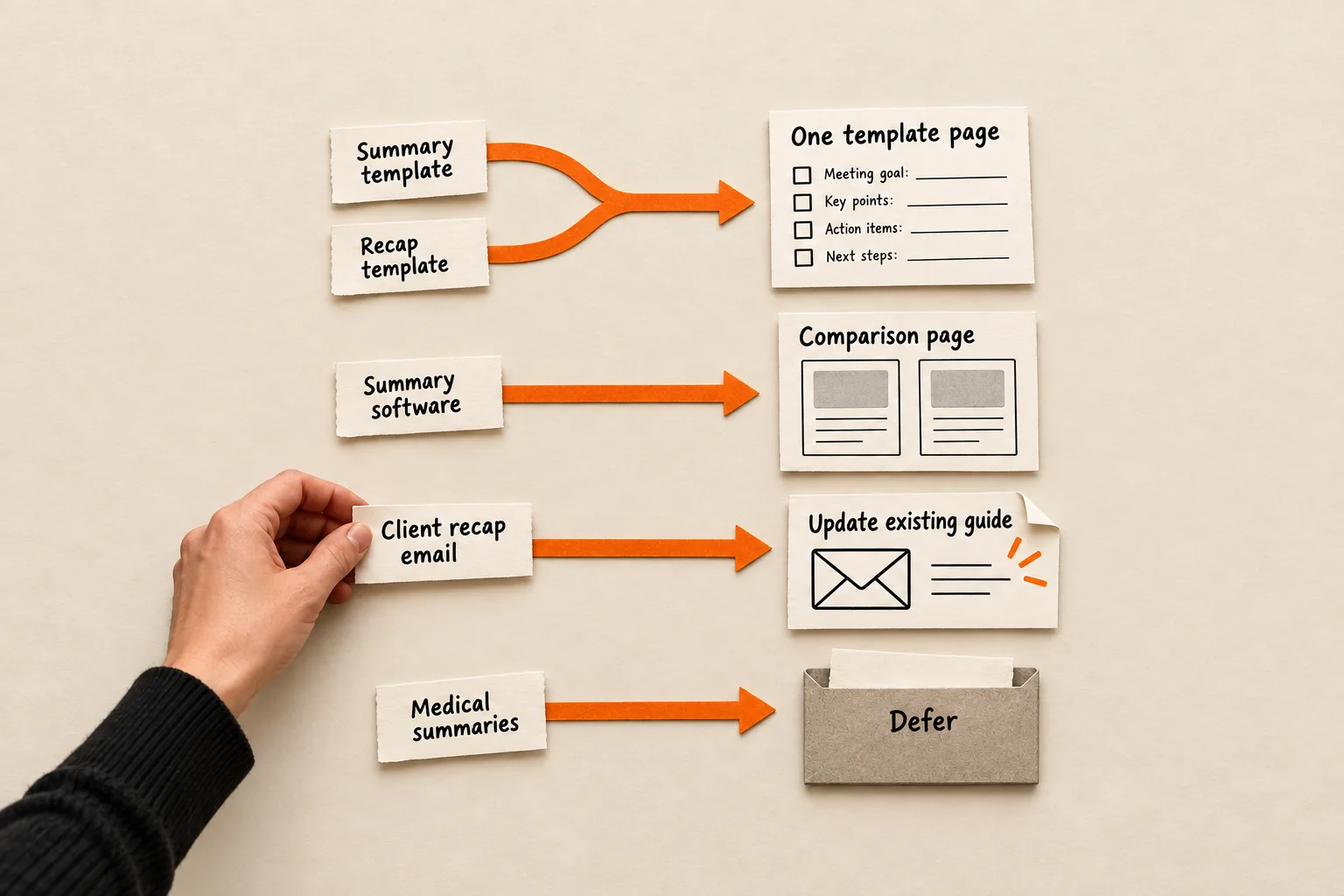
The team compares “meeting summary template” with “meeting recap template.” In this example, six of ten organic URLs are shared, and both result sets mostly offer editable structures and completed examples.
One template page can answer both queries. Its outline covers decisions, action owners, deadlines, and a filled-in example. The word “recap” can appear where it fits; a second page would repeat the same work.
Next, the team compares “meeting summary template” with “AI meeting summary software.” Only one URL is shared, and the software results mainly help readers evaluate products. That calls for a separate comparison candidate with verified capabilities, selection criteria, and tradeoffs.
“Client meeting recap email” has three shared URLs with the general template query. Yet the pages emphasize an email subject, wording for clients, and requests for confirmation. Those details change the deliverable. The team’s existing “Send a client meeting follow-up” guide already serves that task, so the team plans to add a recap example there and link to it from the general template page.
Finally, “medical visit summary software” introduces an audience and requirements the team has not researched or built for. It defers the topic, regardless of an attractive difficulty score.
The five queries produce one new template brief, one separate comparison candidate, one existing-page update, and one deferred topic. The client email decision shows why reaching an overlap threshold does not settle the page assignment.
Investigate existing overlap before merging pages
Two URLs appearing for a query should prompt investigation. That observation alone does not establish that one page is harming the other. Here, suspected cannibalization means overlapping pages may be interfering with the intended search outcome.
In Search Console, filter for a relevant query and inspect the Pages dimension. Compare periods using consistent country, device, and search type settings. The Performance report provides clicks, impressions, CTR, and average position, with dimensions including queries and pages. Search Console Performance report
The report has limits: some queries are omitted, and most performance data is assigned to the canonical URL. A missing query or a duplicate URL with little reported activity is therefore insufficient evidence for removing a page. Google’s documentation on dimensions and data groupings
Read both pages alongside the report. Does each serve a distinct task? Would a merger remove useful material or leave a separate audience without an answer? A change in which URL appears is a clue to inspect, not a diagnosis by itself.
If two articles provide essentially the same answer, choose the most suitable destination and preserve useful material before retiring the redundant URL. For a permanent move, Google recommends a permanent server-side redirect when possible; HTTP 301 and 308 indicate permanent moves. Update internal links to the retained destination as part of the cleanup. Google’s redirect guidance
Canonical annotations apply to duplicate or very similar pages. They signal a preferred representative URL, but Google may choose another. Use them for that purpose rather than assigning distinct articles to a keyword cluster. Google also advises against using noindex to select a canonical page within a site. Google’s canonicalization guidance
Copy this page-decision worksheet
Create one record for each proposed cluster. If you choose separate pages, give each destination its own purpose and boundary.
Queries, in their original wording:
Reader and task:
Required answer or deliverable:
Existing URLs inspected:
Search location, language, device, and date:
For each pair: shared URLs, result count per query, and formats:
Decision: one page / separate pages / no new page
Destination URL, or reason to defer:
Page purpose in one sentence:
Coverage to leave to another page:
Evidence still missing:
Review date and reason to reconsider:
For the hypothetical template cluster, a completed decision could read:
Queries: meeting summary template; meeting recap template
Task: Share meeting decisions and assigned actions.
Deliverable: Editable structure with a completed example.
Decision: One new page.
Purpose: Help a meeting organizer write a usable summary.
Boundary: Product selection belongs in the software comparison;
client email wording belongs in the existing follow-up guide.
Evidence still missing: Actual search results and an inventory
check before approving the brief.
The missing-evidence field matters. The example’s invented counts explain a decision; your own record needs the URLs and observations that support it.
Assign your next ten queries before writing a headline
Take the next ten keywords in your queue and assign each to an existing URL, a justified new page, or a deferred task. For every proposed page, confirm that its purpose is distinct, its examples fit the reader, and no existing page already completes the task.
Keep unresolved queries visible. After making a change, preserve the original query set and record what changed. Review search performance alongside the reader action the page should support. A single query’s movement is too narrow a basis for declaring success, and a before-and-after difference does not establish causation.